author.travelffeine.com

Category: Travel Stories

Travel misadventures, stories, and journals of our adventures. Be inspired, have a laugh, and join in on the fun!

  • Lake Quinault Lodge: Your Rainforest Retreat

    Lake Quinault Lodge is a beautiful historic lodge set on a wooded lake.  It’s a short 5-minute drive off US-101 North, and I had been missing it all these years. For almost two decades, I’ve made regular visits to Kalaloch Beach, only a 30-minute drive past Lake Quinault Lodge. I had no idea the beauty I was passing up each time I drove past the Lake Quinault sign on the side of US-101. 

    Imagine a pristine lake surrounded by rainforests filled with ancient trees dripping with emerald moss—a place where you and your family can get away and unplug.  You can hike in the rainforest, paddle kayaks on the lake, and gaze up at some of the world’s largest trees.  It is a breathtaking escape, and it’s less than a 3-hour drive from Seattle. If you’ve never been, I hope this post will inspire you to make a trip there this year.

    History of Lake Quinault Lodge

    Lake Quinault Lodge feels like stepping back in time. This rustic lodge was designed in 1926 by the Seattle architect Robert Reamer, who also designed Old Faithful Inn in Yellowstone National Park.  What amazes me is that it only took 53 days to complete this stunning lodge! According to the USDA Forest Service, bonfires were lit around the construction site so that crews could work around the clock to complete the lodge before the rainy season started.

    Cedar shingles cover Lake Quinault Lodge as it curves to form a v-shape or half-circle. Its two-story peaked roof rises tall, surrounded by towering cedar trees, Douglas firs, and even a few California coastal redwoods. President Franklin D. Roosevelt ate lunch at the lodge’s restaurant in 1937 during his trip around the Olympic Peninsula. The restaurant is now named the Roosevelt Dining Room in his honor.

    His visit to the Olympic Peninsula inspired him to make it a part of the U.S. National Park system. He also named the Olympic elk the Roosevelt elk in honor of former President Theodore Roosevelt. President Theodore Roosevelt created the Olympic National monument in 1909 to help stop the decline of the elk population. 

    It is no surprise that once President Franklin Roosevelt saw the natural beauty of this area that he wanted to preserve it for future generations.  I am thankful he did.
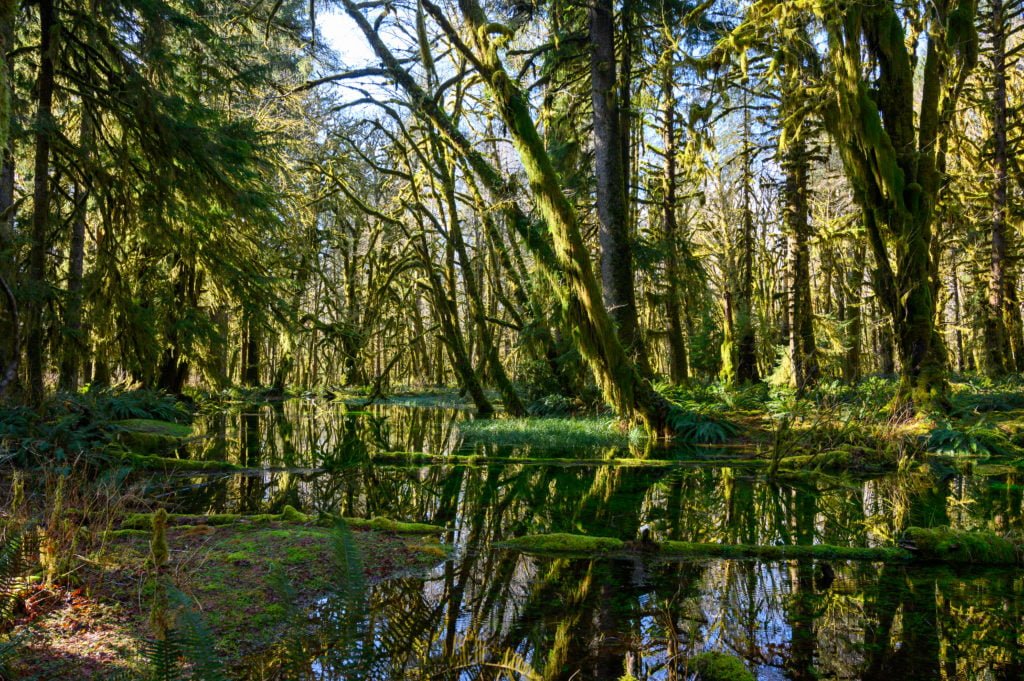
    Quinault rainforest

    Accomodations at Lake Quinault Lodge

    Main Lodge

    The rooms in the main lodge are on both the first and second floors. They have queen or king bed accommodations and some lake view rooms to choose from as well. The lodge rooms provide you with the feeling of staying at the lodge during the early 20th century.  Staying in the main lodge offers easy access to the lodge amenities such as the Roosevelt Dining Room, fireplace sitting room, and pool.

    Fireplace Rooms

    The fireplace rooms are in a separate building that is accessible through the second story of the main lodge.  It is also accessed directly from the parking lot next to the main lodge. These rooms come equipped with gas fireplaces and offer lake views. Trees partially obstruct some of the lake views. 

    Each of the fireplace rooms includes a private balcony with a seating area.  The fireplace rooms also include a mini-fridge, television (with about ten cable channels), and heated bathroom floors.
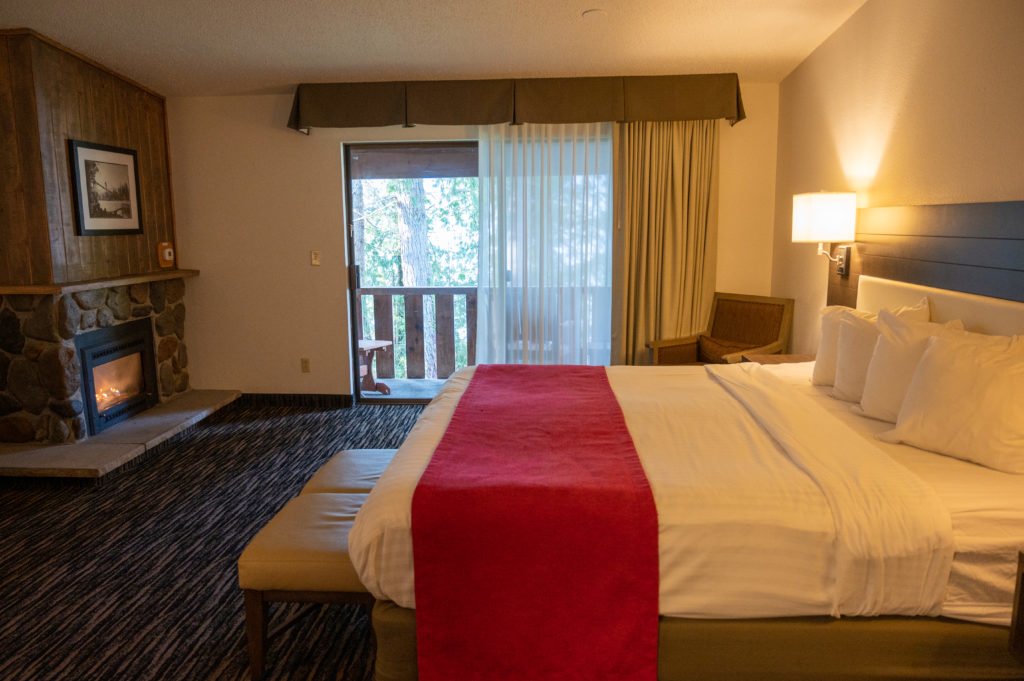
    Lake Quinault fireplace room

    Boathouse Rooms

    The boathouse is a separate two-story building located on the opposite side of the property from the fireplace rooms. It is not attached to the main lodge at all and sits a little below the main lodge and is closer to the lake. 

    Constructed with a wrap-around deck, guests enjoy easy access to the lawn and lake. Only some of the rooms at the boathouse offer lake views. The first-floor accommodations of the boathouse are the only rooms where pets are allowed to stay on the Lake Quinault Lodge property.

    The Beverly Suite occupies the top floor of the boathouse and provides the experience of staying at your own private residence on Lake Quinault. It has two bedrooms, a sleeper sofa, a kitchen, and a living room area with a television.

    Lakeside Rooms
    The lakeside rooms have a more contemporary look of what you might expect from a modern hotel rather than a lodge retreat.  All rooms offer partial lake views, televisions, and private balconies. There are also a few ADA accessible rooms available.

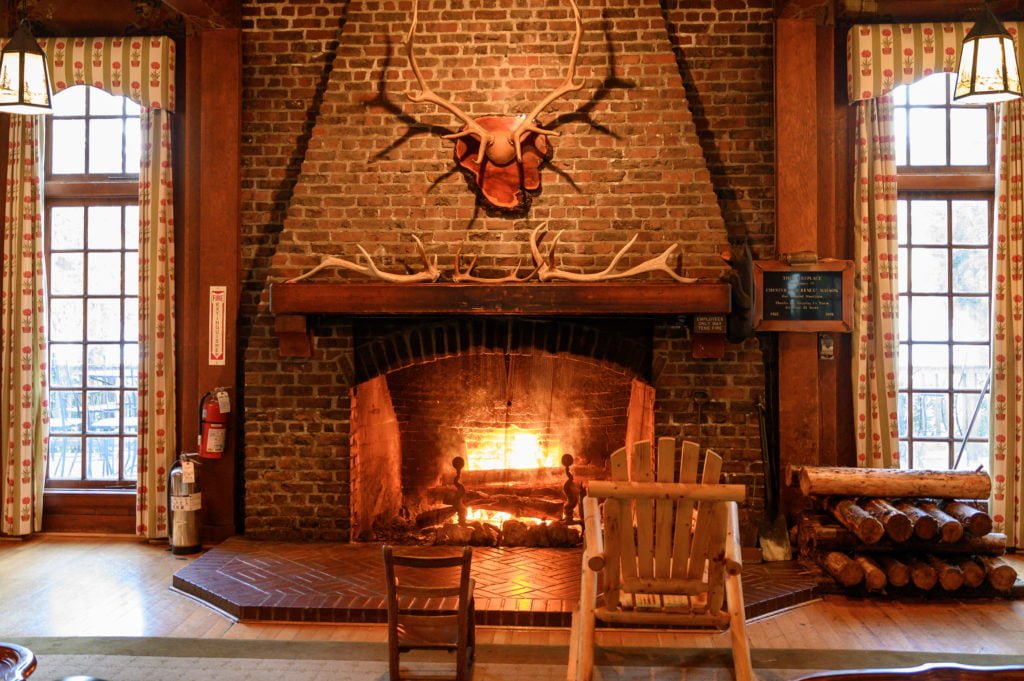
    Fireplace in Lake Quinault Lodge

    Lake Quinault Lodge Amenities

    Room Amenities:

    All rooms on the Lake Quinault Lodge property offer coffee makers and bottled water. I appreciated the two bottles of water I received each day during my stay.  They were perfect for taking with me in the car for my day hikes around the lake. Some of the rooms include TVs and about ten or so cable channels, but most do not have any television. The main lodge and fireside rooms also include Wi-Fi.

    There is no room service, and there are no phones in the rooms. Lake Quinault Lodge is about unplugging and unwinding.

    Pool & Sauna:

    The main lodge has a pool and sauna that is available to all guests, and it’s open from 9 a.m. until 10 p.m. each day. There are changing rooms outside the pool in case you happen to come during the winter and don’t want to make the chilly walk to the pool. 
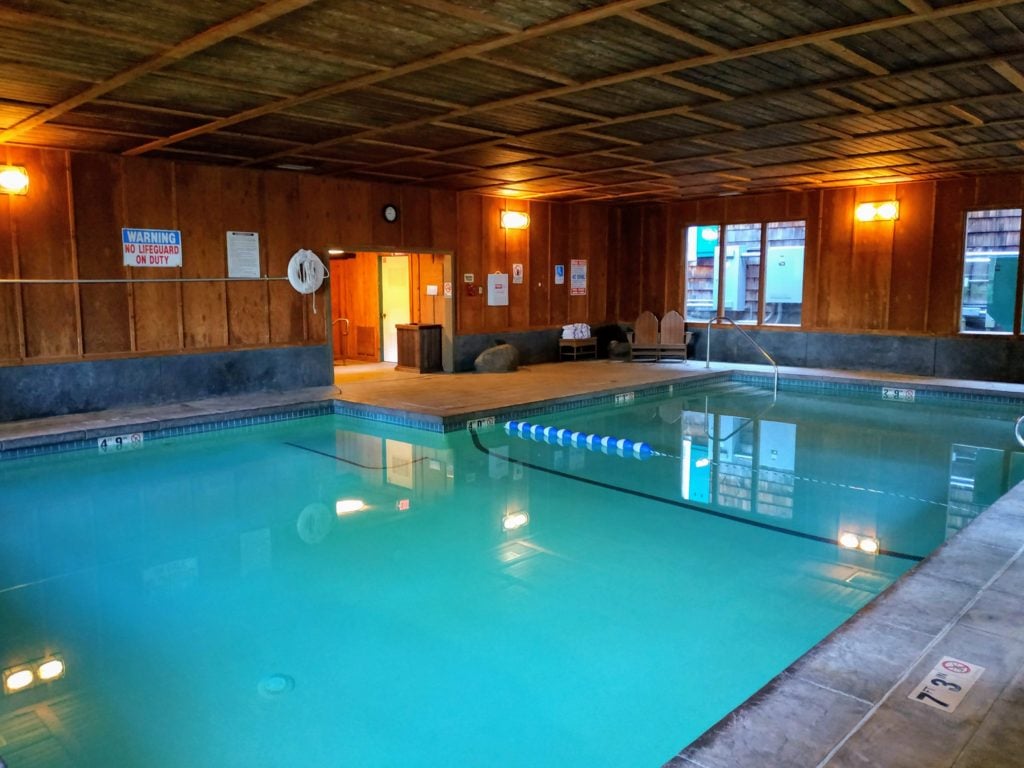
    Pool at the Lake Quinault Lodge

    Game Room:

    Next to the pool and sauna is the game room.  There are a couch and television in one area where parents or kids can lounge around watching a little cable television. A shuffleboard is in one corner and a ping pong table (aka tabletop tennis) and a Foosball table in another area of the game room. The game room, combined with the pool option, makes for great spaces when the weather is less than desirable outside.

    Roosevelt Dining Room

    The Roosevelt Dining Room offers relaxing views of the lawn and lake. I dined here for breakfast on a rainy day, and it was so peaceful to watch the rain out the wall of windows. 

    There are also hummingbird feeders set up along the windows so we could watch the hummingbirds feed while eating our breakfast.  The sausage biscuits and gravy, as well as the spinach, mushroom, and goat cheese omelet, were delicious!

    Dinner here is also amazing. You can watch the sunset over the lake and catch glimpses of its colors through the trees. During the busy months, make sure to make a reservation and snag a window seat when possible.
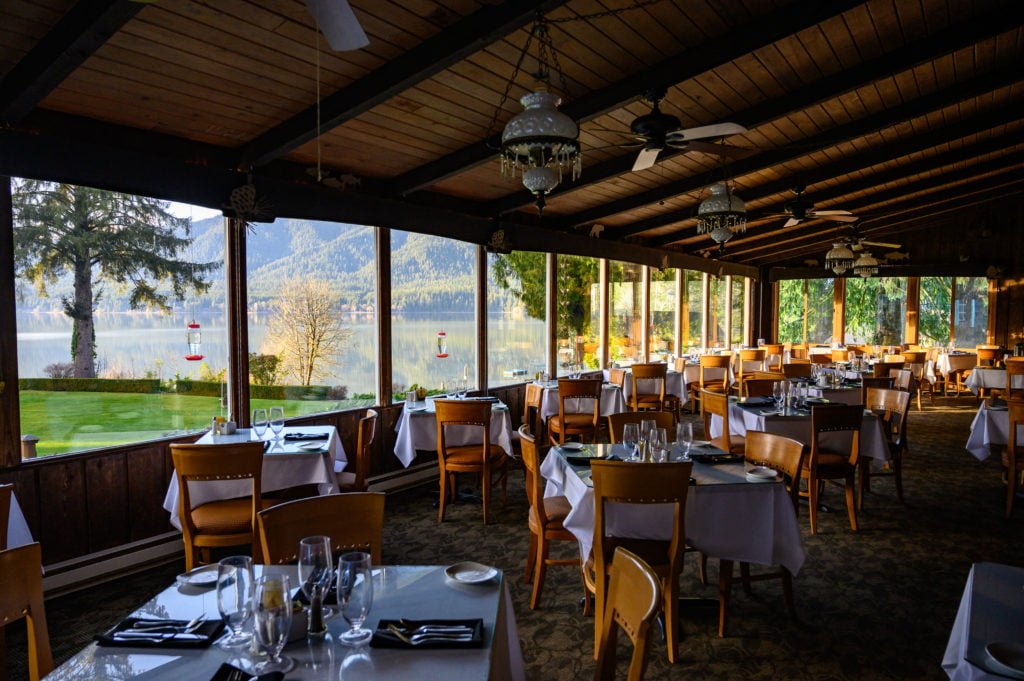
    Roosevelt Dining Room

    Sitting Room:

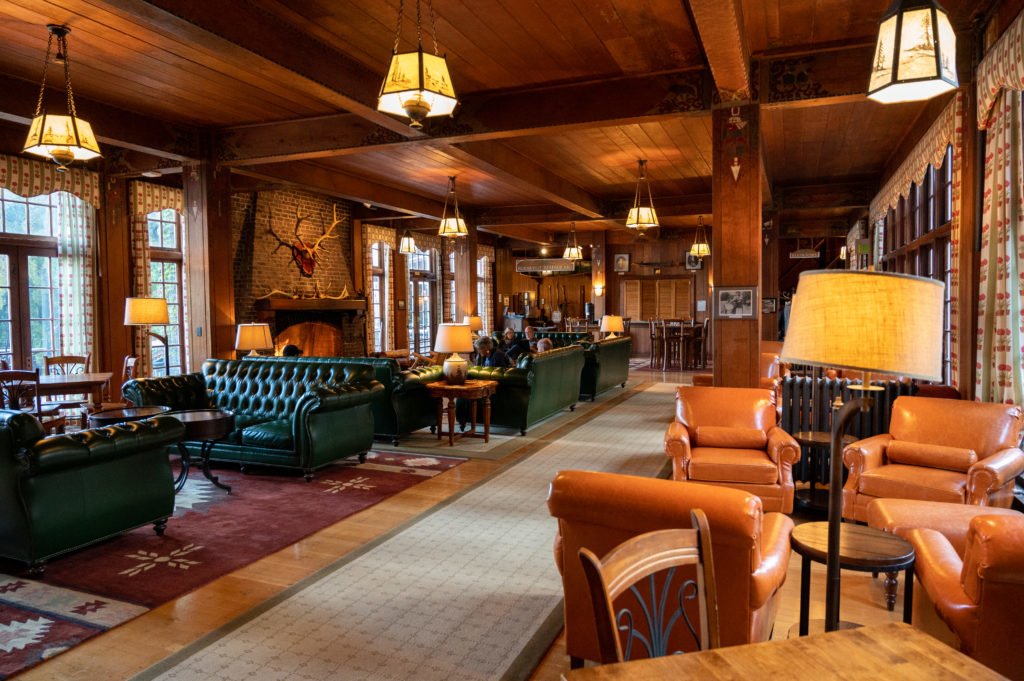
    On the main floor of the lodge is a large sitting area. Gorgeous timber beams painted with Northwest designs act as supports throughout the space, and in the center of the room is a giant fireplace. It’s the perfect place to settle into one of the comfy chairs for a cozy read with your favorite book. 

    Glance out the large windows on either side of the fireplace and enjoy views of the sprawling lawn and lake.  This will be your favorite space on a rainy day.  It feels so cozy, and the lodge makes you feel as though you’ve stepped into some time portal into the early 20th century. 

    The sitting room also has a jumbo-sized chess set, historical photographs scatter the walls, and there are puzzle tables replete with puzzle pieces (I assume all of the pieces are there).  In the mornings, you can find complimentary coffee supplied here. What a great place for your first (or perhaps second) cup of morning coffee.Lake Quinault Lodge Sitting Room
    Deck and Lawn Area

    When the weather is sunny, the deck off the backside of the main lodge is a beautiful place to enjoy a cup of coffee.  Tables and chairs are scattered along it to create spaces to soak in the occasional bouts of sunshine.  Adirondack chairs dot the lush green lawn in front of the deck area.

    These chairs are my favorite type for lounging in, chatting with a friend, or reading a good book. There is also a gazebo on one side of the lawn, which lights up at night.  Next to the gazebo is a horseshoe pit where you can test out your throwing skills.  I admit, I’m lousy at horseshoes, but I still enjoy playing.

    Lake Quinault

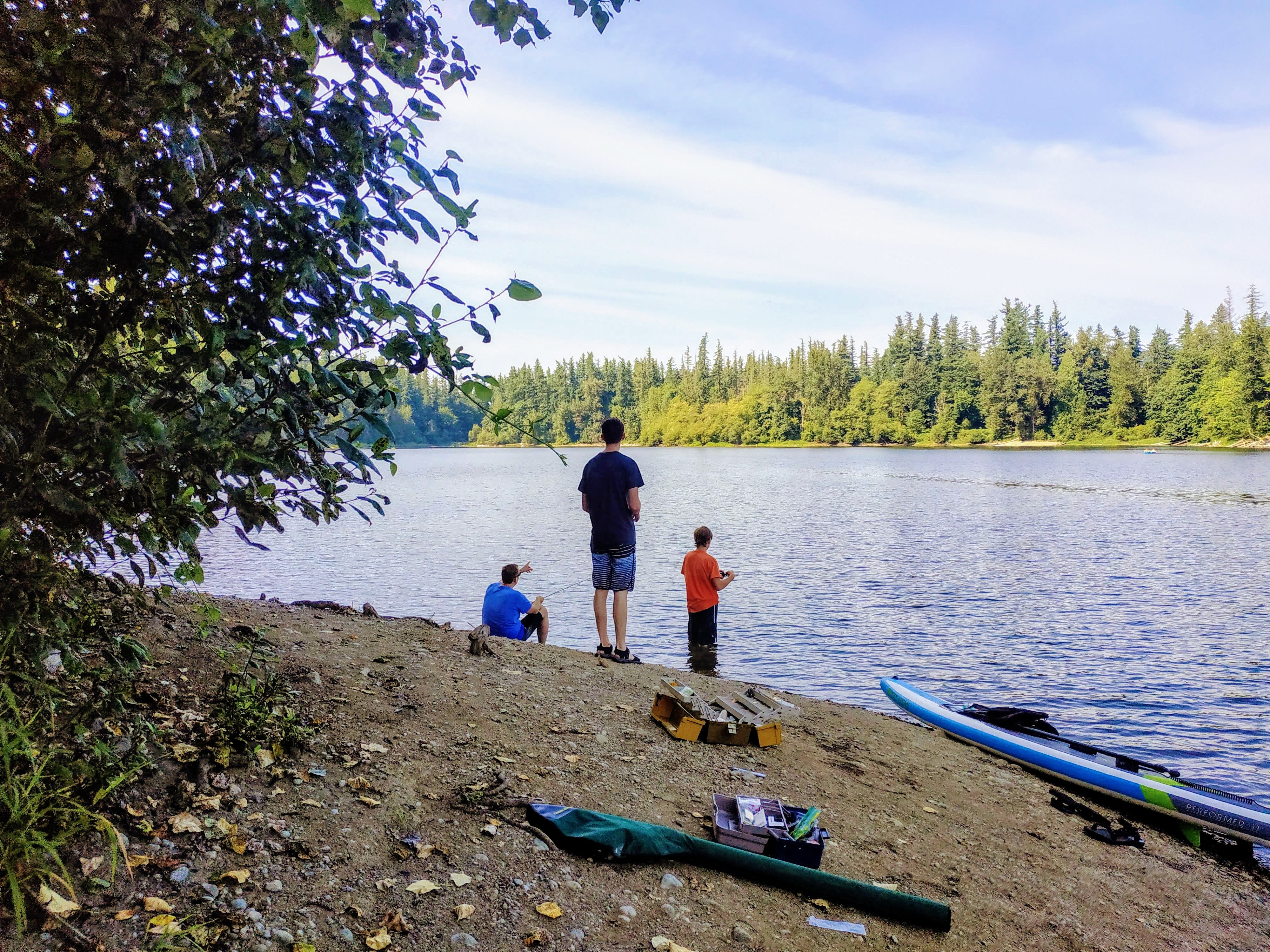
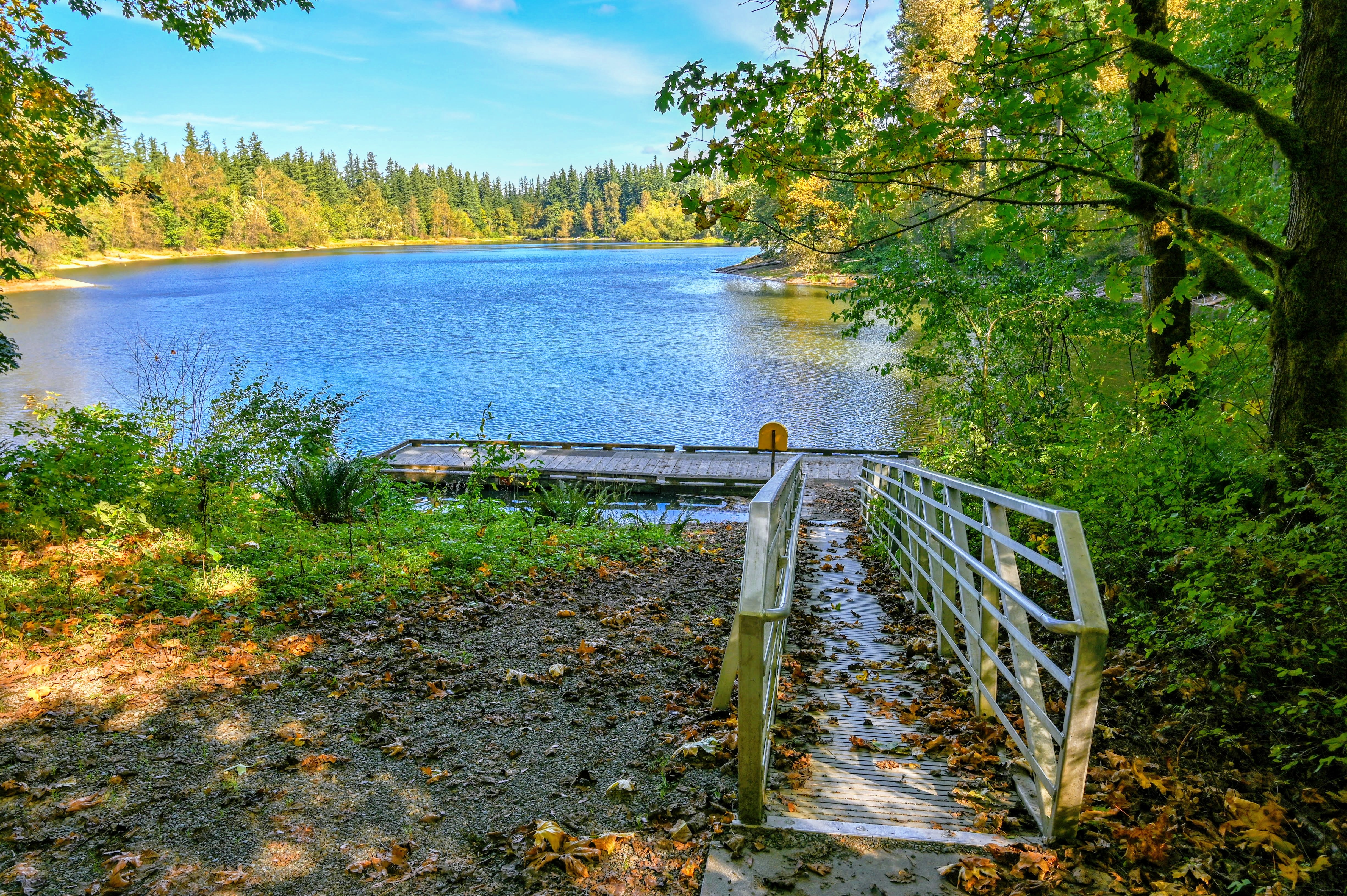
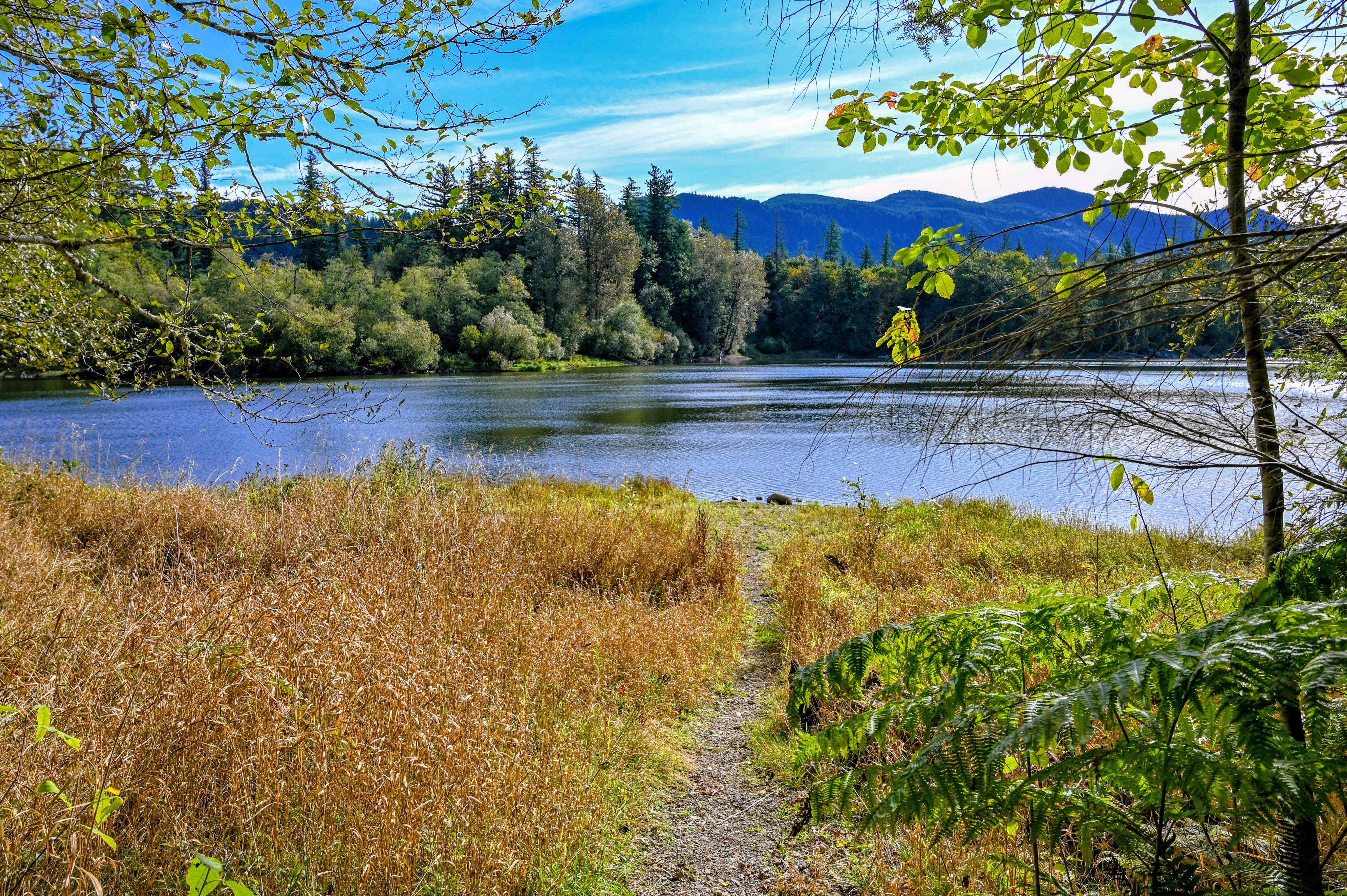
    Follow the path from the lodge that leads down to Lake Quinault.  This lake is 2 miles wide and around 300 feet deep.  There are seating areas carved into some of the driftwood on the beach. These make perfect resting areas to watch the sunset.  

    In the summertime, you can rent kayaks, canoes, and paddleboards from the beach. They also offer boat tours of the lake during the summertime, with rates starting at $35.  Check with the front desk at Lake Quinault Lodge to learn about all of their tour options.
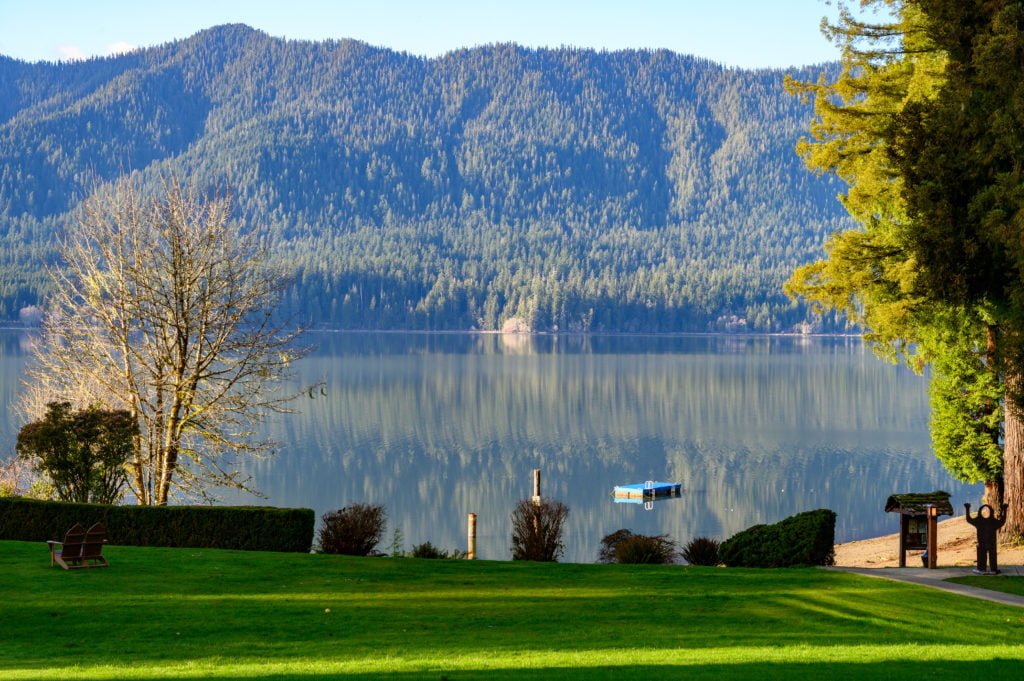
    Lake Quinault

    Things to Do

    • Game Room
    • Pool & Sauna
    • Hiking
    • Boat Rentals (seasonal)
    • Swimming (seasonal)
    • Tours (boat tours, driving tours, and hiking tours offered seasonally)
    • Reading
    • Relaxing
    • Puzzles
    • Fishing
    • Horseshoe Pit
    • Stargazing (it’s so beautiful on a clear night)
    • Drive Around the Lake (Takes about 1.5 hours, un-paved road for half of the drive)
    • Drive to the Ocean at Kalaloch (only a 30-minute drive)

    What to Pack

    Here are some items I recommend bringing: Bug spray, swim clothes, cameras, books, notebooks, rain gear, layers, hiking shoes, board games, and activities in case of rain. If your kids need a movie or online entertainment, you can always download movies and shows ahead of time to your mobile device or tablet. Also, see my tip for light sleepers below, you’ll want to bring headphones or earplugs if that applies to you.

    What Time of Year to Visit

    Any time of the year is a wonderful time to visit. However, during the summer months, you will have the opportunity to rent boats and kayaks and spend more time playing on the lake. The downside is that it is busier and more expensive.  

    In the winter, it is rainier, colder, and you have frequent wind storms; however, you will also find better rates and fewer people. So it depends on your needs and what experiences you want to get out of it. 
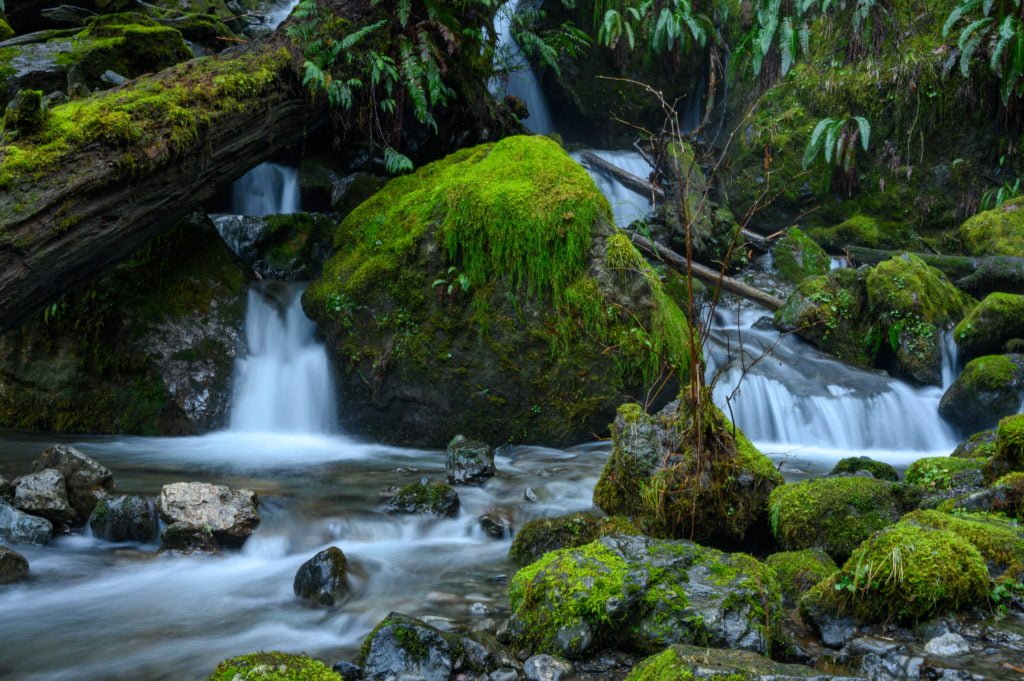
    Quinault waterfall

    Useful Tips & Things to Know

    Weather Tips

    Make sure to pack layers. Whether you visit during the winter or the summer, due to the coastal location and forest shading, it can be chilly here no matter what time of year you visit.  Also, you are visiting an area bordered by rainforests, and they are called “rainforests” due to the abundance of rain they receive.  Therefore be prepared for rain. Pack your raincoats and waterproof hiking gear.  Prepare to get a little muddy on the trails.

    Another weather component to be mindful of, are the wind storms.  This area often gets wind storms, especially during the winter.  This can cause power outages and downed trees.  Check with Quinault Lodge ahead of time if you are concerned about this, and of course, don’t ever go out hiking during a wind storm.  A tour guide at Lake Quinault Lodge once told me that even the elk come out of the forest during a wind storm and find a safe meadow to wait out the storm.

    Seasonal Hours
    Certain activities like boat rentals and camping are unavailable during winter. The Mercantile store and restaurant is also closed. So you have fewer options for activities and places to eat during the winter months.  This won’t keep you from having a pleasant visit, but it is something to be aware of.
     
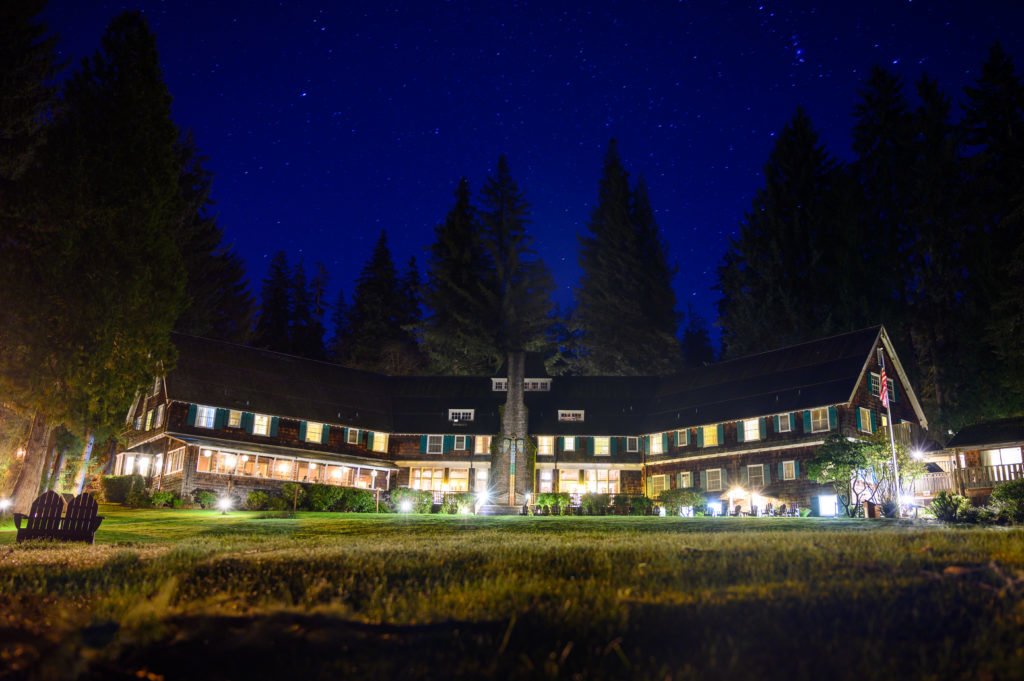
    Lake Quinault Lodge with stars

    Money-Saving Tips

    To save money on food, I like to pack stuff for peanut butter and jam sandwiches.  Then when I’m out all day hiking and taking photos, I don’t have to return to the lodge for food.  I make a sandwich in the car, and I also pack a bottle of water and some snack bars. 

    Other ways to save money on food are to bring some ramen cups and then use your coffee maker to boil water. Maybe bring a box of your favorite donuts to have with your morning coffee.  You’ll burn off the calories later.

    Email Offers

    You can also sign up for the Olympic National Park email list and learn about deals on accommodations throughout the year. I visited Lake Quinault Lodge during the winter on a buy one night, get 1-night free deal–major bonus!

    No Cell Service

    It’s important to know that there is no cell service at Lake Quinault Lodge. I overheard one person say that if you stood on the lawn, in a particular spot, you could get a spotty signal. I  had no cell signal during my visit, so I would not count on that.  

    You do, however, have Wi-Fi at the lodge, and I also had coverage on the property around it. This means if you want to text or call someone, plan to use Google Duo or Hangouts (or similar app) for Wi-Fi calls and texts.

    Smoking Policy

    All rooms and facilities at Lake Quinault Lodge are non-smoking.

    Alert for Light Sleepers

    This is your public service announcement for all of you light sleepers (myself included). The walls separating the rooms at Lake Quinault Lodge are thin. You can hear the conversations of your neighbor at normal speaking volumes. You can also listen to them, brushing their teeth and snoring at night.  Make sure to pack headphones or earplugs if this will be a problem for you.  It will depend on your “neighbor.”
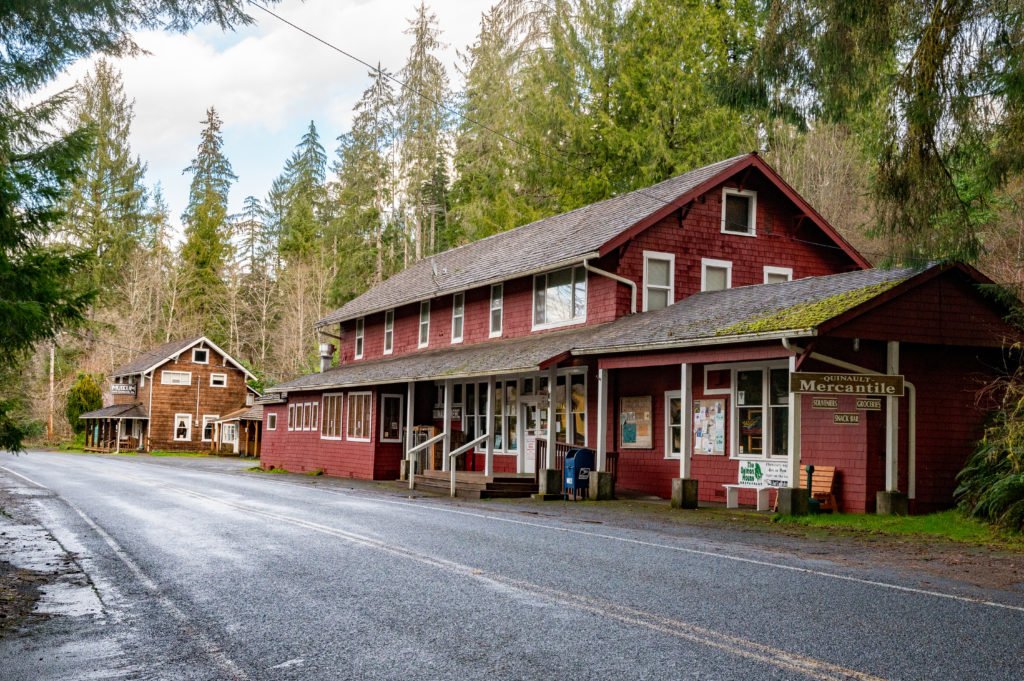
    Quinault Mercantile

    Dining Options

    In addition to dining at the Roosevelt room at Lake Quinault Lodge you can also eat at the following places:

    The Mercantile (opened seasonally)

    The Mercantile sells a variety of gear from food to camping and fishing supplies and souvenirs. It also has a small restaurant where you can get burgers or pizza during the summer months.

    Amanda Park 

    This is the small town only a 5-minute drive from Quinault. There is Dino’s Pizza & Grill (opened afternoon and evenings) as well as the Quinault Internet Cafe (closes at 3:30 p.m.), both are good choices when you’re looking for an alternative to dining at the Lake Quinault Lodge.

    Kalaloch Lodge’s Creekside Restaurant

    The Kalaloch Lodge is a short 30-minute drive from the Lake Quinault Lodge.  Their Creekside Restaurant offers ocean views as well as a delicious, locally sourced menu and a full bar for drinks. Enjoy a meal and a walk on the beach afterward before heading back to Lake Quinault Lodge.
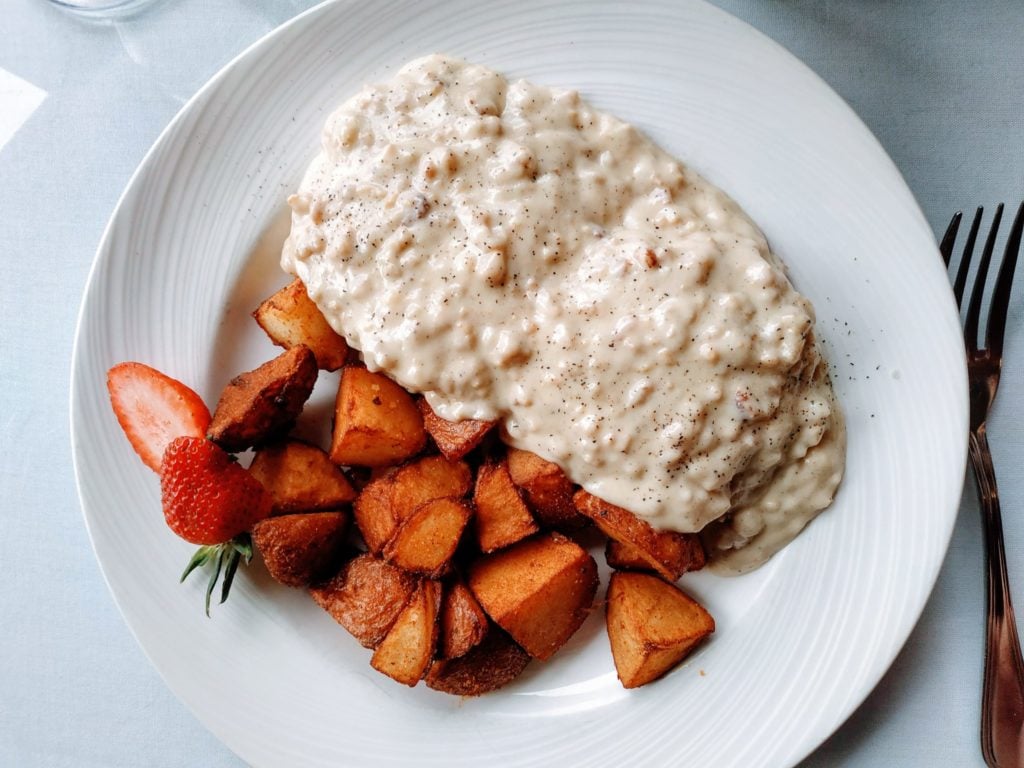
    biscuits and gravy Roosevelt Dining Room

    Getting to Lake Quinault Lodge

    It’s less than a 3-hour drive from Seattle to Lake Quinault Lodge. Take I-5 South and cut over to Hwy 101 N. Watch for signs for the turnoff for Lake Quinault alongside the road.  The turn off is about a 7-minute drive after passing the town of Nielton.
    Don’t miss the incredible memories waiting to be made at Lake Quinault Lodge.  I cannot believe I didn’t stop in Quinault sooner.  It is quickly becoming my second favorite spot along the Olympic Coast.  I now have another destination that competes for a spot that once only belonged to Kalaloch. The mossy trees and the otherworldly beauty of this area have sucked me in and now holds a piece of my heart.
    Related Articles for the Area Around Lake Quinault Lodge

  • A Self-Guided Tour of Historic D-Day sites in Normandy

    Visiting the historic D-Day sites is an unforgettable way to spend the day.  It is one of those bucket list trips that leave you better for having made them. June 6, 1944, is one of the most historic dates in world history. The victory achieved on D-Day changed the course of the world.  

    The freedoms I have today are in large part due to the battles fought on the shores of Normandy. If you have an opportunity to travel to France, take some time to visit the D-Day sites in Normandy. You’ll never forget it.

    In this post, I share my one-day self-guided itinerary to some of the D-Day sites in Normandy, France.  You’ll get a chance to learn about my experience and also see how easy it is to plan your own trip to this historic region. Although I would have preferred a minimum of 2 days for my visit, even with only one day to see the D-Day sites, you can cover a lot of ground and still have an unforgettable trip.

    Overview of Our One-Day Itinerary to D-Day Sites in Normandy

    Where We Started Our Road Trip

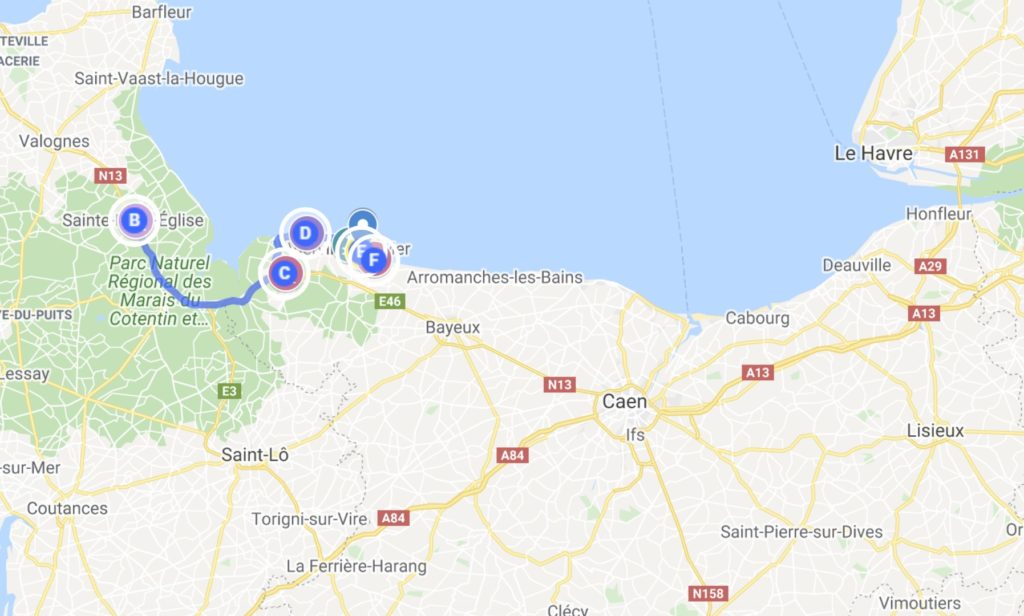
    We took a direct train from Paris to Caen, where we’d booked our hotel and rental car.  In addition to spending one day seeing the D-Day sites, we also spent one day driving to Mont-Saint-Michel. For our one-day D-Day itinerary, we drove from our hotel in Caen to our first stop, the Airborne Museum in Sainte-Mere-Eglise. Then we worked our way back in the direction of Caen for the remainder of the itinerary.

    Tip: You could easily make this trip in reverse, and depending on what time of year you go, you may want to.  We discovered during our visit here in October, that places open later and close earlier in the fall and winter.  

    So in the case of our route, we arrived at the Airborne Museum, thinking it opened at 9:00 a.m. (according to Google) only to discover it did not open until 10:00. Thus, we could have started at the Normandy American Cemetery, which opened at 9:00 and closed at 5:00 and then saved the Airborne Museum for last, which closed at 6:00 p.m.  Live and learn!

    Benefits of a Self-Guided Road Trip to See D-Day Sites

    By driving yourself to the D-Day sites, you have more flexibility and choices in which places you see and how long you spend there. Driving in France was easy for me since they drive on the same side of the road as we do in the U.S. As long as you can drive a car with a manual transmission, it is pretty much the same as driving in the States. The road signs may look a little different, but all in all, it’s a very similar experience.

    However, if you’re not comfortable with driving on your own in France, there are a lot of tour companies that will drive you around to the historic D-Day sites. You can take 12-hour day trips from Paris, or local tours starting at Caen and Bayeux. So decide on whichever option works best for you and your itinerary.

    A Little Background About This Trip

    My visit to Normandy, France, was a part of a 2 1/2 month backpacking trip I took with my friend through Europe.  As I planned our route and the “must-see” stops along the way, I knew that visiting Normandy, France, and the historic D-Day sites was a must for me.  Our visit to Normandy was during the final three weeks of our trip through Europe.  

    Before arriving in Normandy, we toured the house where Anne Frank hid in the attic before being captured by the Nazis. We visited Berlin and walked over what was once Hitler’s underground bunker and wandered through the Memorial to the Murdered Jews.  Then we traveled to Krakow, Poland, where we took a day trip to the Auschwitz-Birkenau concentration camps. Finally, we went to Normandy, France, and visited some of the historic D-Day sites.  

    It was a journey through World War II history, starting with the atrocities that forced people into hiding and ultimately led to the death of millions of people. Our travels brought us full circle to Normandy, and the history surrounding D-Day, the battles leading up to it, and the battles fought afterward. 

    Although the history surrounding D-Day was one of tragedy, it was also one of triumph and hope. I saw the bleakness of death at Auschwitz, which only made my visit to the D-Day sites all the more impactful. The price was high, the sacrifice great, but freedom demands we risk everything or end up with nothing. I am so grateful for those who gave their lives so I could live in freedom.

    Site 1: Church of Sainte-Mere-Eglise

    We started our day of sightseeing in the town of Sainte-Mère-Église. We arrived a little after 9 a.m. and found that the Airborne Museum didn’t open until 10 a.m. So we wandered over to the Church of Sainte-Mère-Église, where a mannequin of a paratrooper’s body hangs from the church steeple.

    John M. Steele

    We learned more about the paratrooper represented on the church steeple during our visit to the Airborne Museum. His name was John Steele, and he was a paratrooper with the 82nd Airborne Division. During the drop into Sainte-Mère-Église, one of the houses caught fire, which unfortunately illuminated the night sky, and thus the paratroopers dropping in. 

    John Steele was hit in the foot on his way down and lost control of his parachute. His parachute caught on the church steeple. He hung there for around 2 hours, pretending to be dead before German soldiers came up and brought his body down. They took him as a prisoner, but three days later, he escaped and returned to his division. He survived WWII and returned home after the war was over. 

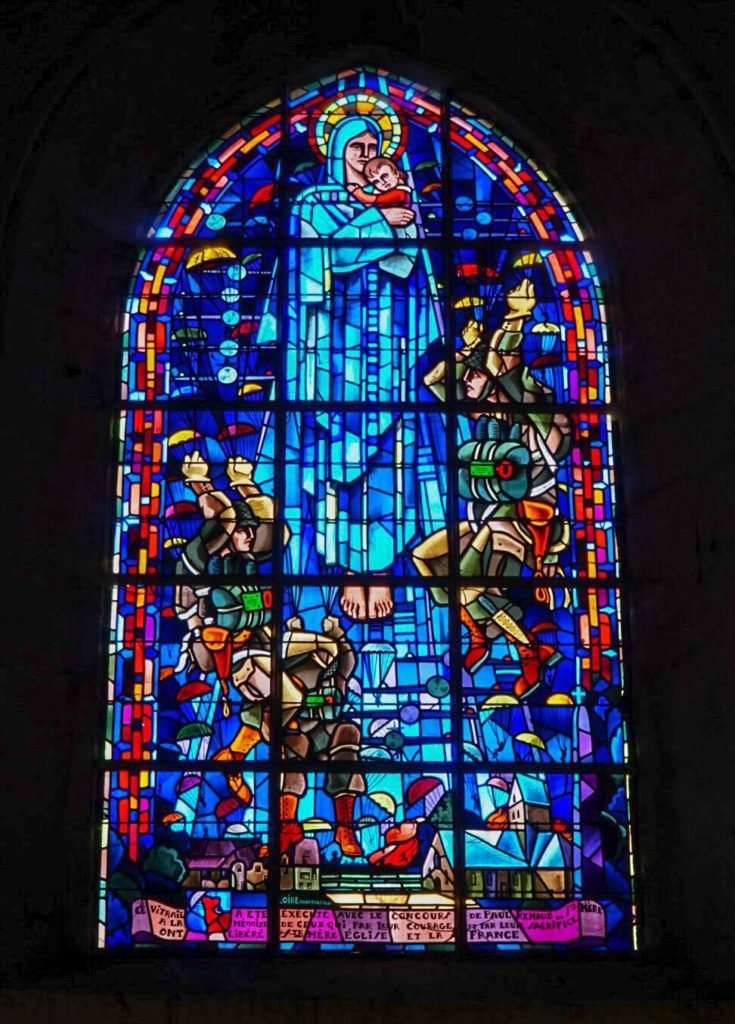
    stained glass window of angel and paratroopers
    A beautiful stained glass window in the Church at Sainte-Mere-Eglise.

    There is so much more to John Steele’s story and to the paratroopers that dropped that night. For any of you who have watched “The Longest Day,” you might remember seeing the scene of the paratroopers dropping in.

    The real story is full of heroism, as one of his fellow troopers on the ground gave his life to save John’s.  The chaos was compounded by the house fire, which lit up the sky and made them glowing targets.

    Go inside the church and take a look around. There is a beautiful stained glass window created in memory of the paratroopers that lost their lives here. There is also another one portraying the angel Michael surrounded by the symbols of the various Allied forces who fought to free Sainte-Mère-Église.

    Time Spent Here: (~ 30 minutes)
    Location: Church of Sainte-Mère-Église, Rue Koenig, 50480 Sainte-Mère-Église, France
    Commute Time to Next Site: ~ 1-minute walk across the parking lot.

    Site 2: The Airborne Museum at Sainte-Mere-Eglise

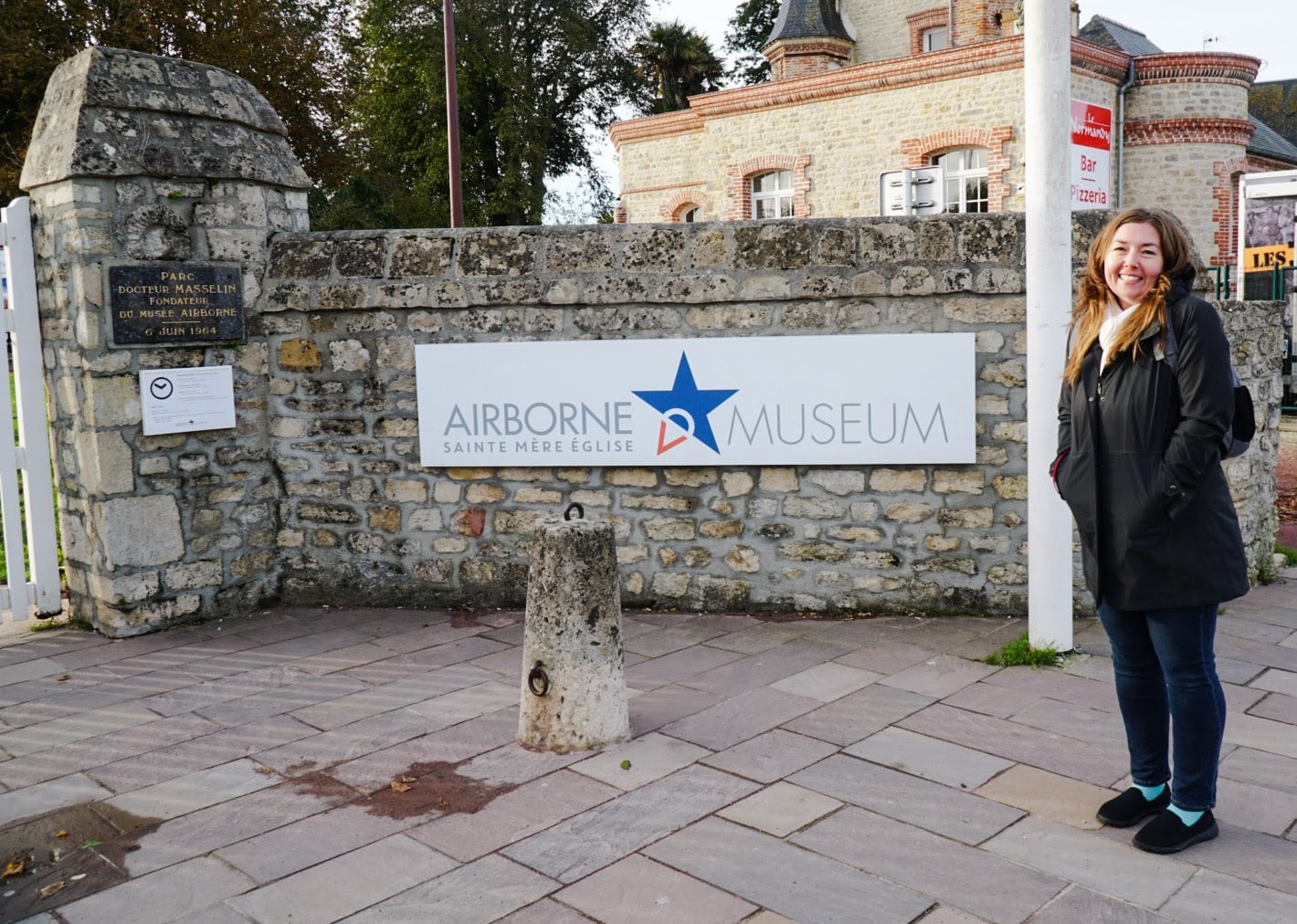
    The Airborne Museum is a thoughtfully designed museum made up of multiple buildings as well as an outdoor area. At the ticket desk, you receive a tablet to carry with you as you make your way through the different areas.  The tablet provides additional information about the exhibits and includes interactive features, which if you have kids, they will especially enjoy this feature. For the most part, you won’t need the tablet. However, it guides you in a particular order throughout the museum complex.

    The first building we entered after purchasing our tickets was the building designed like the inside of a big parachute.  Inside there are numerous displays of paratrooper’s gear, mementos, and stories of some of those involved in the liberation of Sainte-Mère-Église. The museum does a beautiful job portraying the details of what these paratroopers must have gone through to prepare for their mission.

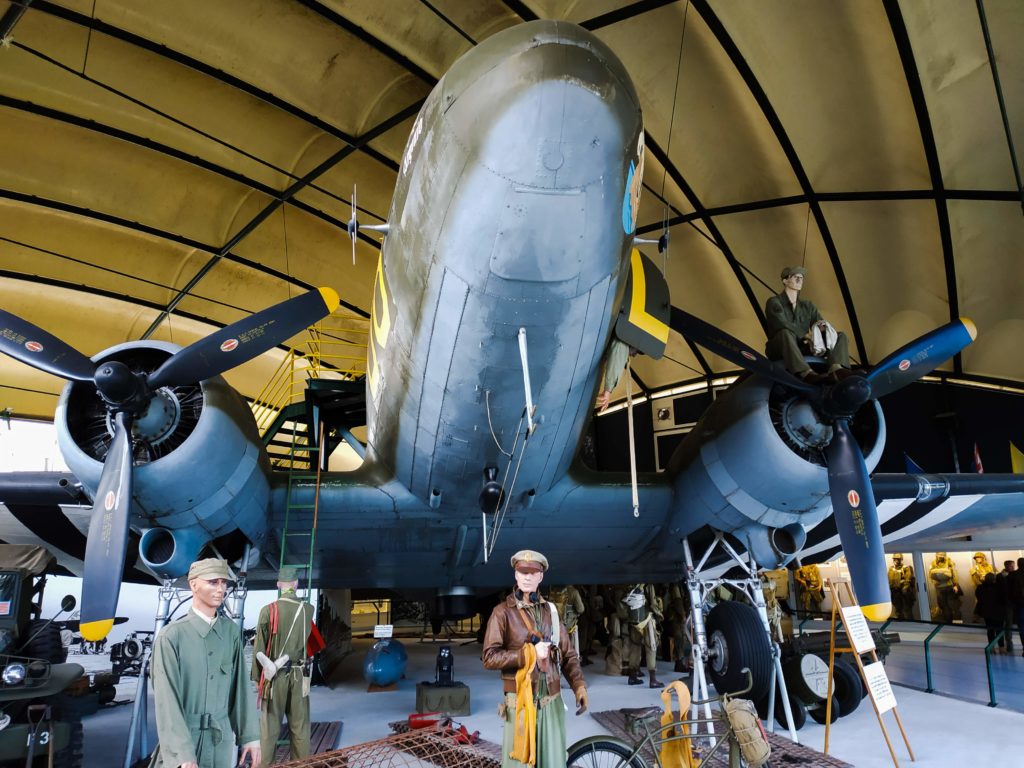
    In the next building is a large display of an airplane, and on one side is a mannequin of President Eisenhower and a printed copy of his D-Day order.  Many of these guys were barely out of high school. They didn’t have much training, and yet they were going into one of the biggest and most important battles in US history. They would be some of the first boots on the ground for the US military in Normandy, France.

    “You are about to embark upon the Great Crusade, toward which we have striven these many months. The eyes of the world are upon you. The hope and prayers of liberty-loving people everywhere march with you.” ~ General Dwight D. Eisenhower

    Airplane replica at Airborne Museum D-Day Normandy
    One of the Airborne Museum’s life-sized displays.

    In another room, audio speakers play the sounds of battle along with a display of an aerial view of Sainte-Mère-Église. I also learned during my visit here, that the paratroopers had to carry packs that weighed anywhere from 90 lbs to 180 lbs!  Can you imagine jumping from a plane with a pack the size of a human strapped to your back?

    The Soldier’s Stories Helped to Connect on a Personal Level

    It was incredible to hear their stories and to take a glimpse into what those men went through. It was heroic yes, but also scary. Real courage isn’t without fear. It’s acknowledging the fear and moving forward in spite of it. Courage understands what’s at stake.

    We watched a touching film that showed the images of Holocaust survivors and also the piles of dead bodies. Tears sprang to my eyes as it put in perspective what was being fought for.  All of our future freedoms were at stake if Hitler, and the other countries fighting against democracy, had not been stopped.

    I highly recommend making the Airborne Museum a part of your itinerary when visiting D-Day sites in Normandy. They took excellent care to make it a moving and thoughtful museum and memorial to 82nd and 101st Airborne Divisions.

    Time Spent Here: (~ 1.5 hours)
    Location: Airborne Museum, 14 Rue Eisenhower, 50480 Sainte-Mère-Église, France
    Commute Time to Next Site: ~ 30-minute drive

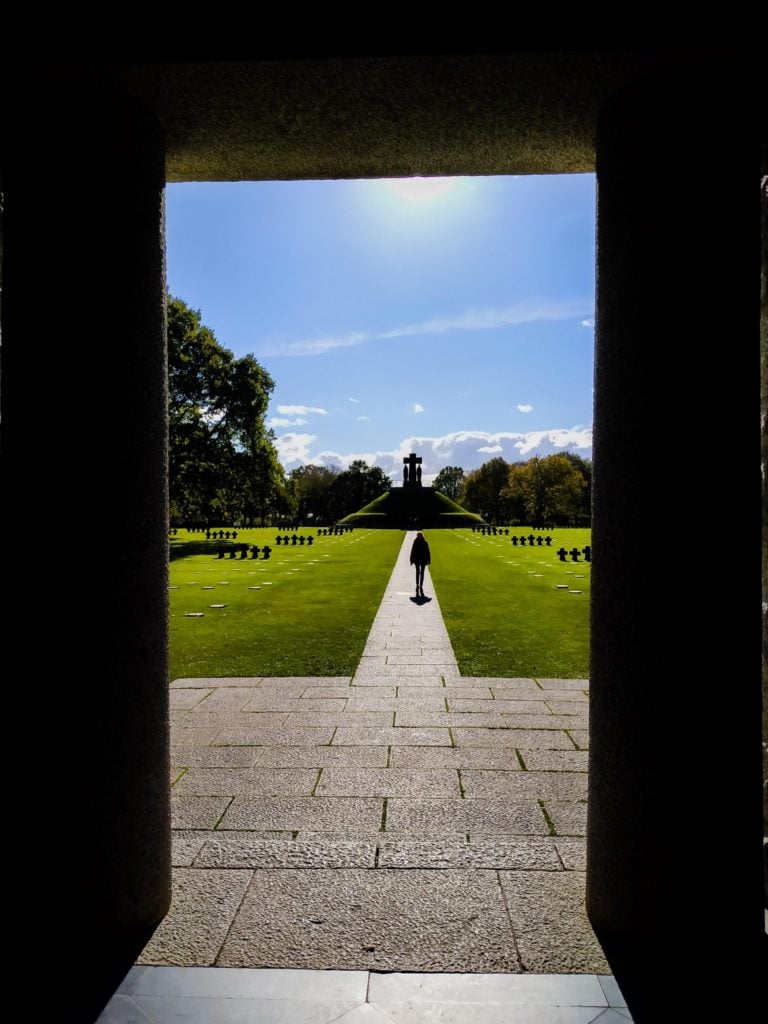
    entryway to La Cambe D-Day German War Cemetery
    The entryway in the German war cemetery at La Cambe.

    Site 3: La Cambe German War Cemetery

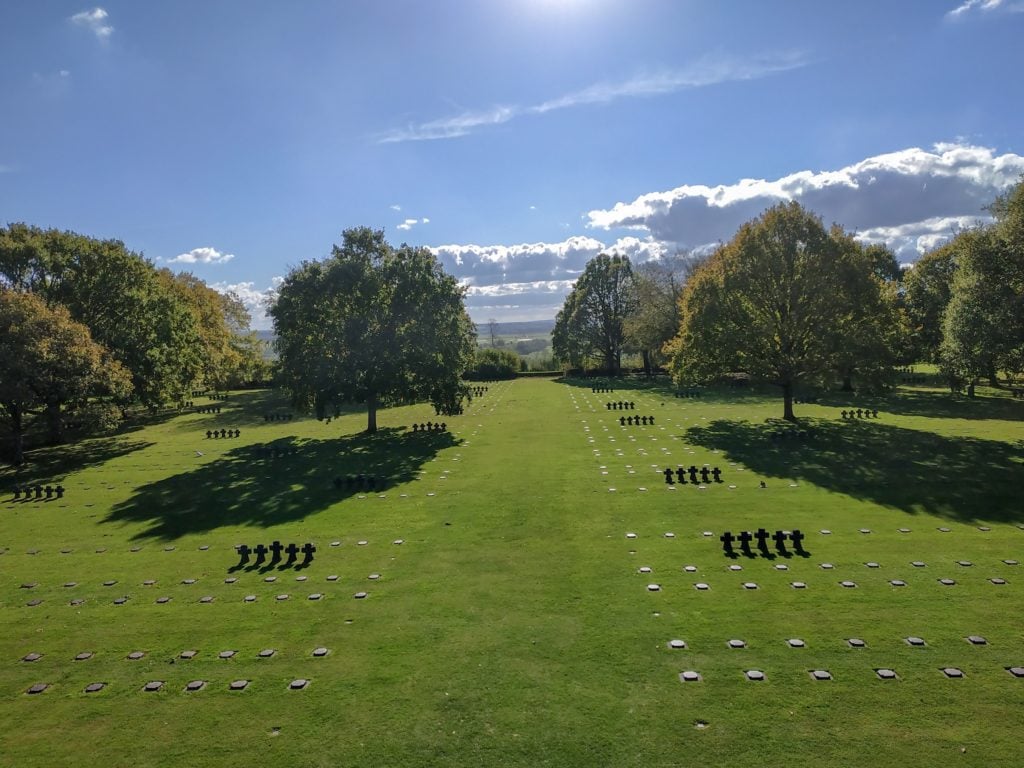
    Our next stop is the La Cambe German war cemetery. It is a simple and somber graveyard, and it is also the largest war cemetery in Normandy. There are over 21,000 bodies buried here as compared with the less than 10,000 buried at the American cemetery in Colleville-Sur-Mer.

    As you walk through the entrance to the cemetery, you notice straight in front of you, a mound of raised earth (also known as a tumulus). Sitting on top is a giant dark stone cross with a man and a woman on either side. I assume this represents the mother and father of the dead. I recommend you walk to the top and get a bird’s eye view of the enormous size of this cemetery.  

    Most of the graves are marked with simple bronze-colored stones set in the ground. There are also rows of dark stone crosses spaced here and there across the cemetery. As I pass by the markers, I notice that most of the soldiers buried here were only 18 or 19 years old.  According to the cemetery, most of the soldiers buried here died between June 6, 1944, and August 20, 1944.

    The German soldiers buried here were teenagers sent off to war by the command of their country. A surviving German soldier said that some of the soldiers enlisted in WWII were only 16 years old, forced to go to war, scared to death, wanting to run, but told they’d be shot if they did.  They had families who loved them and mourned their loss. War is ugly no matter which side you’re on.

    La Cambe German War Cemetery at D-Day Normandy
    A view of the German cemetery at La Cambe from atop the tumulus.

    A Comparison of Two Cemeteries

    My visit to the German war cemetery at La Cambe provided a thoughtful comparison with my visit to the Normandy American Cemetery at Colleville-Sur-Mer. I left the La Cambe cemetery feeling sorrow at the tragic loss as a result of this war.  Although there is still certainly a sense of loss at the American cemetery, I left it feeling a sense of pride and gratefulness. It was a cemetery that celebrated and thanked those buried within, rather than only mourning their loss.

    Time Spent Here: (~ 30 minutes)
    Location: La Cambe German war cemetery, Les Noires Terres, 14230 La Cambe, France
    Commute Time to Next Site: ~ 20-minute drive

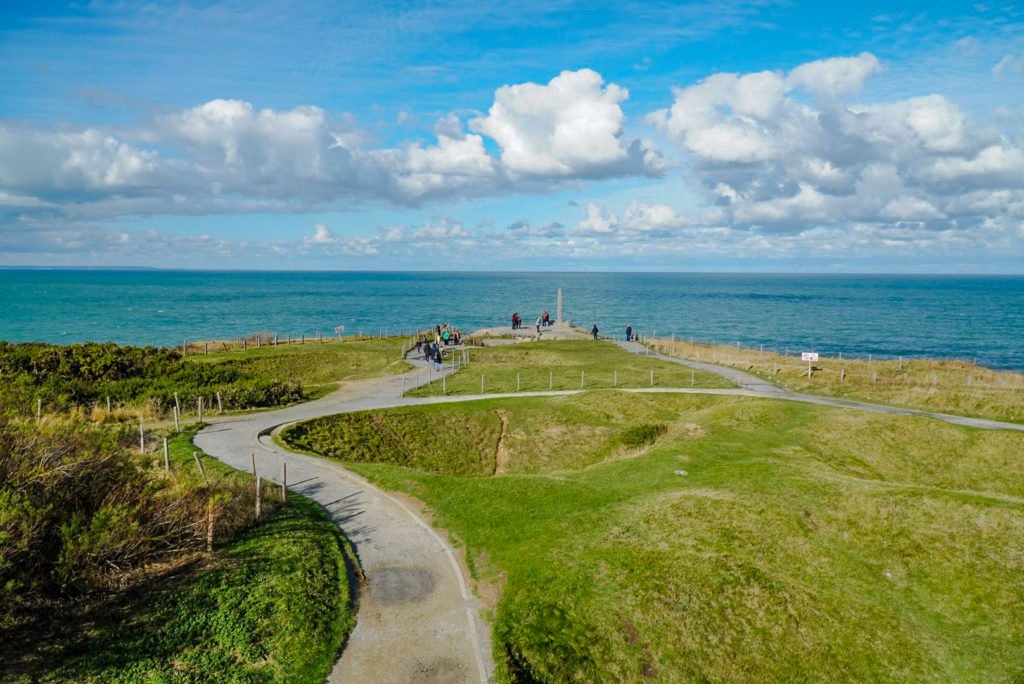
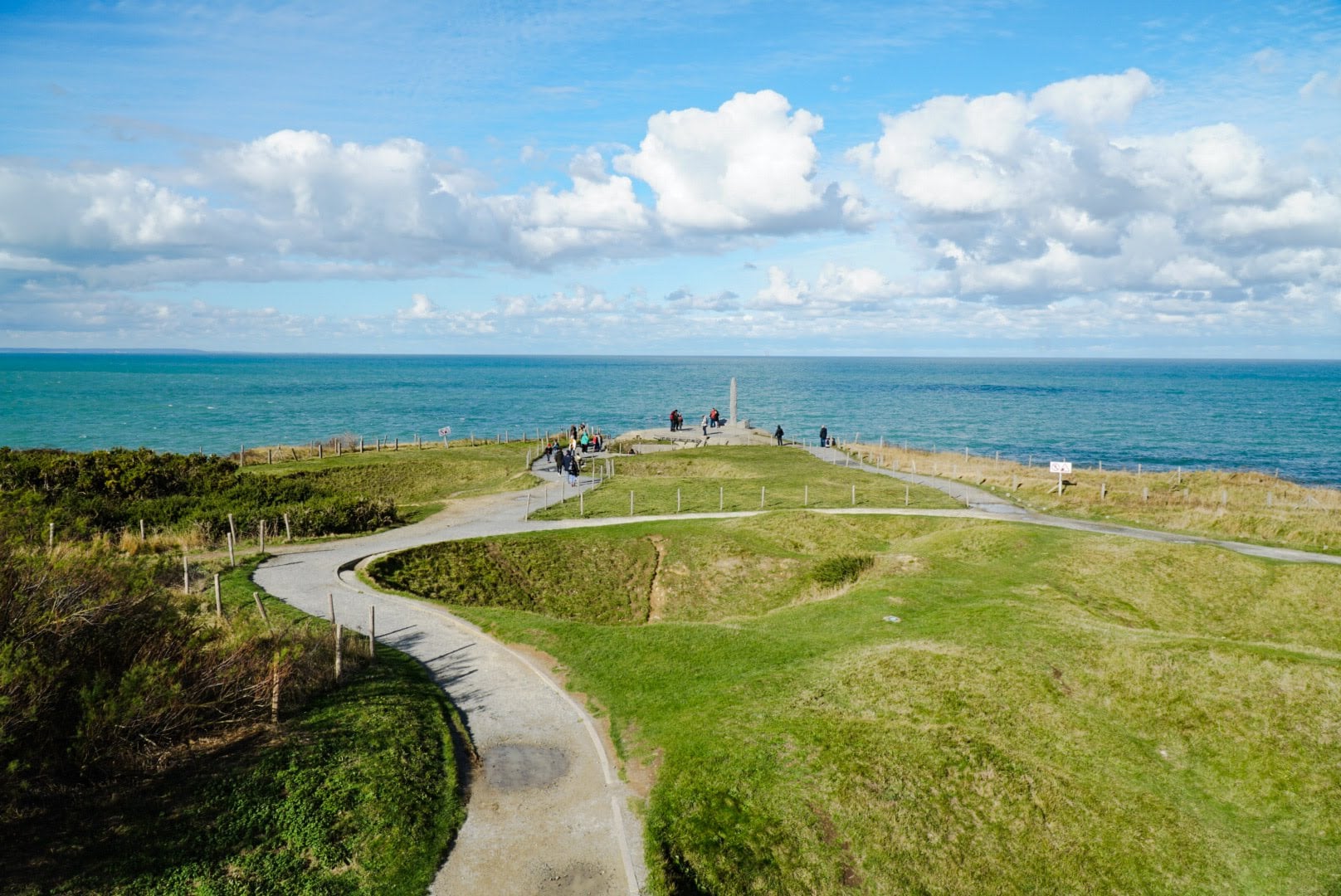
    Path to the memorial for fallen Rangers at Pointe du Hoc
    Looking down the path to the memorial for the fallen Rangers at Pointe du Hoc.

    Site 4: Pointe du Hoc

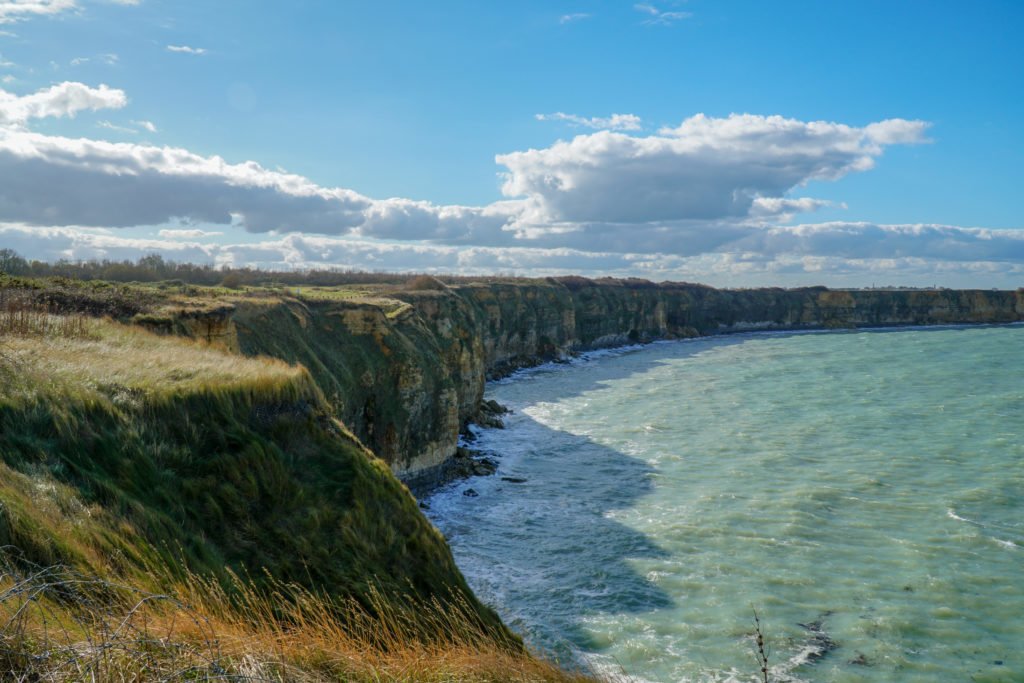
    Next, we drive to the parking area for Pointe Du Hoc. Near the parking area is a memorial to the Army Rangers who gave their lives during the bloody battle fought here.  It is a moving tribute to their courage and sacrifice. It tells the story of the Ranger’s persistence to scale the cliffs soaking wet in the middle of a storm while being gunned down by Germans from above.

    What courage and commitment it took for them to continue scaling the almost 100-foot cliffs! Their fellow soldiers were dying one after another, and yet they continued to climb until at last some of them reached the top and claimed Pointe du Hoc as an Allied stronghold.

    The cliffs at Pointe du Hoc
    The same cliffs at Pointe du Hoc the Rangers once scaled.

    This, of course, is the short version.  The entire story of what occurred at Pointe Du Hoc on June 6, 1944, is an incredible tale of heroism. It is almost unbelievable, like something out of a Hollywood movie, and yet it’s true. These men defied unbelievable odds. 

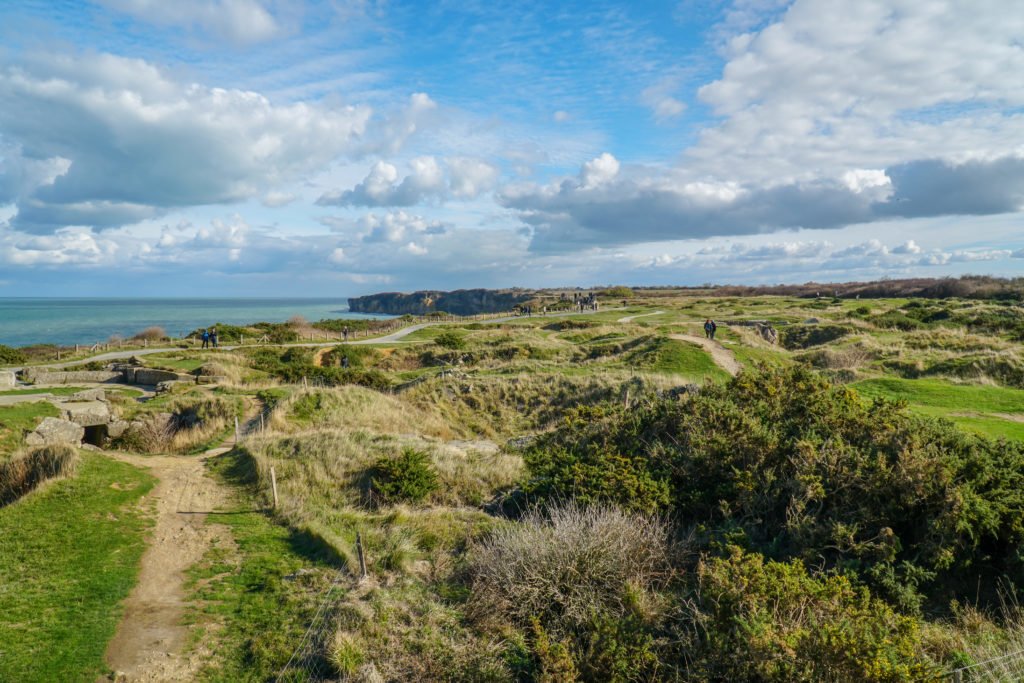
    craters formed from aerial bombings at Pointe du Hoc
    The craters from the aerial bombings dot the landscape.

    Lunar Landscape

    From the memorial near the parking lot, you continue down a trail leading to the very cliffs these Rangers climbed on that dark and stormy night. You walk past large craters from aerial bombings and get a chance to step inside the bunkers the Germans built to house their 155mm arterial guns. These guns could target ships up to 12 miles offshore! You can understand why it was so crucial for Allied forces to overtake these strongholds to win the fight on D-Day.

    The walk to the stone memorial overlooking the water is memorable in itself. It gives you a scope of the type of battle fought here.  Kids will enjoy exploring the craters and empty bunkers. The walk from the parking lot takes about 10 minutes.  Make sure to wear sturdy walking shoes and give yourself enough time to explore the grounds before heading on to your next stop.

    Time Spent Here: (~ 1 hour)
    Location: Pointe du Hoc, 14450 Cricqueville-en-Bessin, France
    Commute Time to Next Site: ~ 15-minute drive

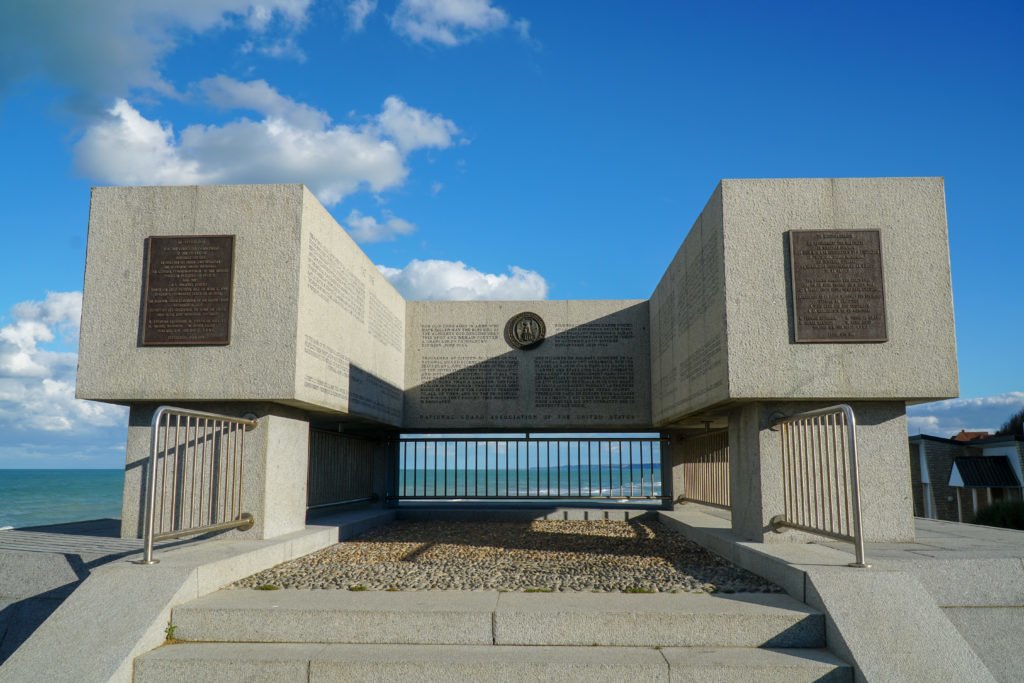
    National Guard Association Monument
    The National Guard Association Monument built atop a former German pillbox.

    Site 5: National Guard Association Monument at Omaha Beach

    The National Guard monument located along Omaha Beach is an inspiring monument dedicated to the soldiers of the National Guard who fought not only in World War I but also in World War II.  That was one of the things written on the monument that stuck out to me. It mentioned how the sons of the National Guardsmen would fight for freedom in WWII just as their fathers had fought for freedom during WWI. What a powerful legacy.

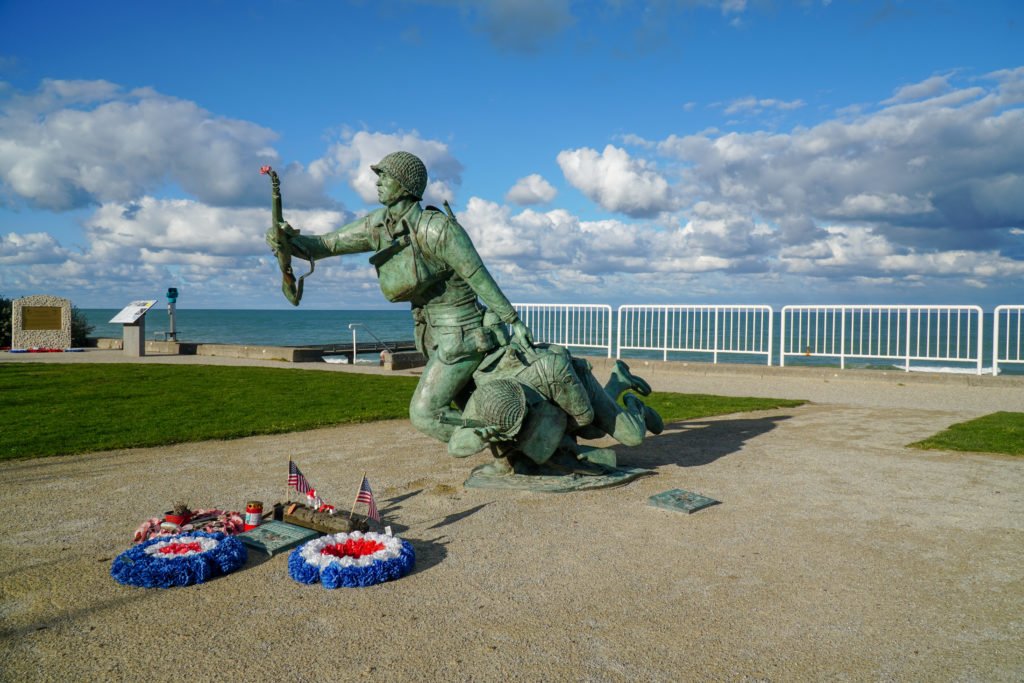
    Take time to read the words and quotes engraved on each side of the monument. Close to the monument is another memorial of a National Guardsmen carrying his fellow soldier out of battle. This memorial is in tribute to the National Guardsmen of the 29th Division’s 116th Infantry Regimental Combat Team. 

    They were some of the first to land on the area that is now referred to as “bloody Omaha.” They came with brothers, and boyhood friends, never to return home to their families or to live out their lives.  They were so young and so courageous. The soldiers who fought in WWII are true superheroes. 

    Memorial to National Guard
    The tribute to the National Guard titled “Ever Forward.”

    Walk along the beach while you’re here and look up at the cliffs. Imagine what it was like for the soldiers who landed on these shores, wet, cold and disoriented, being gunned down in the water before they even had a chance to fight. No matter what, they wouldn’t be stopped.  They knew what they had to do, no matter the cost!

    Time Spent Here: (~ 15 minutes)
    Location: National Guard Monument (Secteur Charlie), 12 Boulevard de Cauvigny, 14710 Vierville-sur-Mer, France
    Commute Time to Next Site: ~ 5-minute drive

    Site 6: Omaha Beach Memorial

    We drove along the waterfront for another 5 minutes before reaching the parking area for the Omaha Beach Memorial.  The wind was blowing and the cold air bit into our skin. The skies were blue and clouds dotted the horizon. It made me think of the weather conditions the soldiers dealt with during the early morning hours on June 6, 1944. 

    I tried to imagine a much darker and stormier scene.  The first wave of soldiers arriving soaking wet, many drowned before they ever made it to shore. Gunfire raining down from German soldiers perched on the cliffs and the beach. This was war, ugly and chaotic with freedom on the line.  

    I live in the light of victory, but on D-Day, victory was still being fought for. It was a scene of tragedy, and decades later, many survivors would continue to have a hard time talking about it. I’ll never truly understand the full cost, but I’ll do my best to live gratefully.

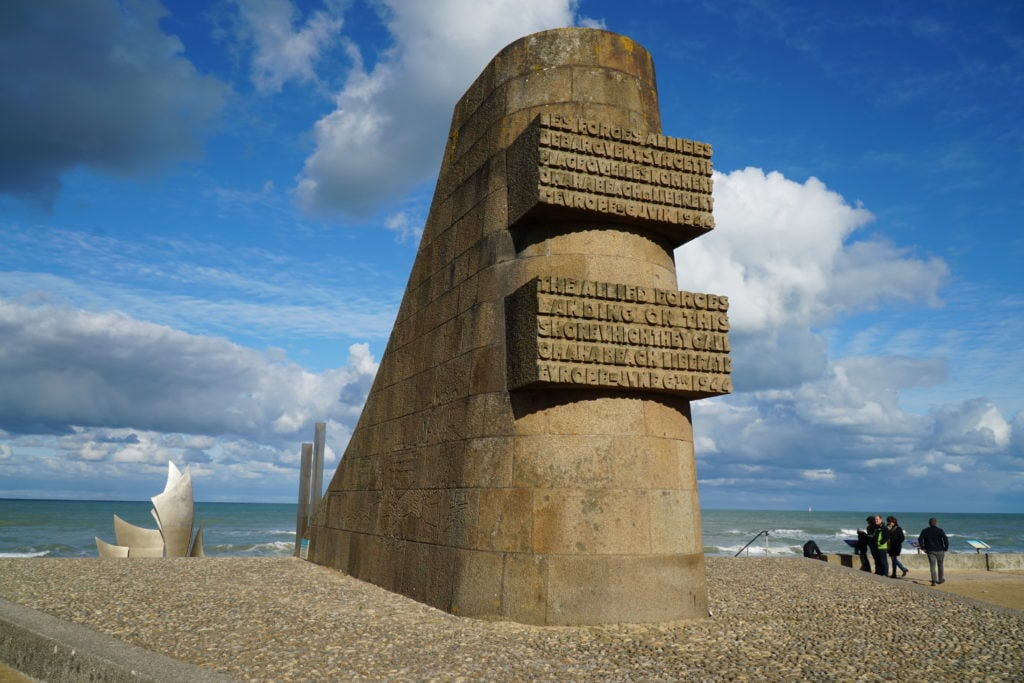
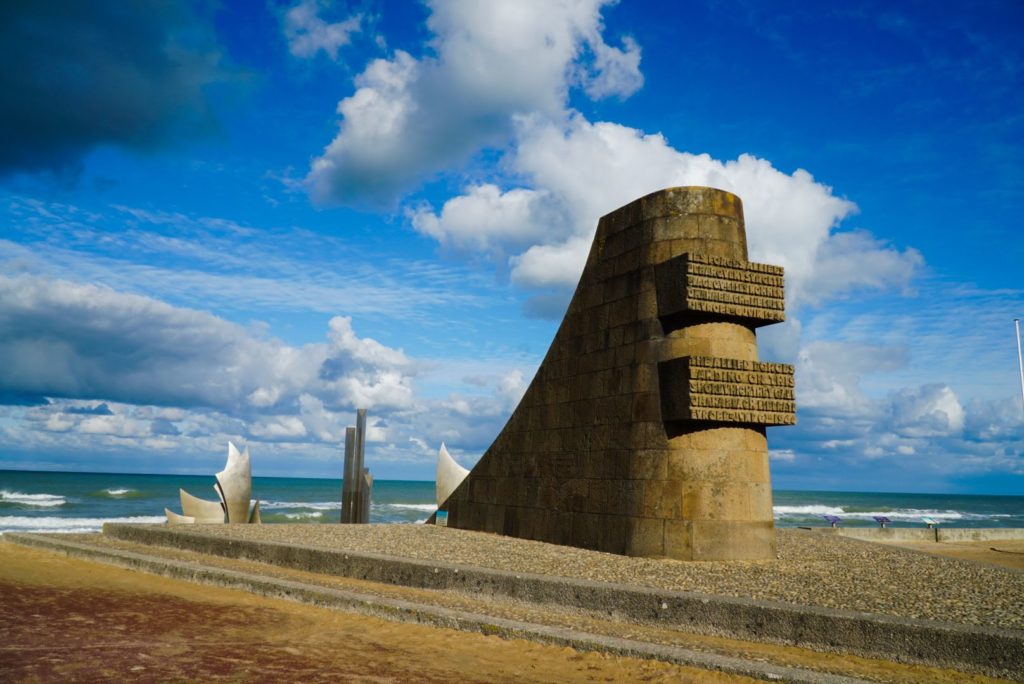
    A stone memorial at Omaha beach commemorating D-Day.
    A stone memorial at Omaha beach commemorating D-Day.

    Next to the parking lot, there is a large stone marker, which is a memorial to the Allied forces landing here on Omaha Beach on June 6, 1944.  On one side of the stone memorial is the inscription: —No mission too difficult —No sacrifice too great. Duty First. Forced Omaha Beach at dawn 6 June. The other is etched with the images of soldiers and reads: Erected in memory of those —The 116th RCT 29th Infantry Division AUS landed here June 6, 1944.

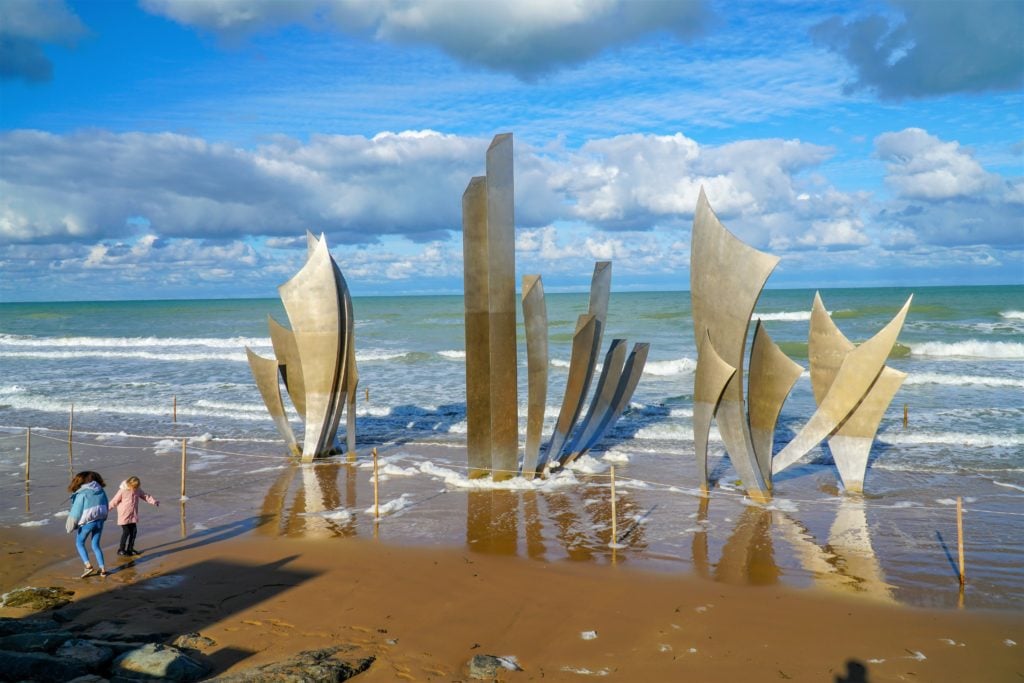
    Les Braves

    Just behind it is a beautiful metal sculpture rising out of the sand just off the shore. The sculpture created by French sculptor Anilore Banon is titled “Les Braves.” According to Banon, the sculpture consists of the following three elements:

    The Wings of Hope – So that the spirit which carried these men on June 6, 1944, continues to inspire us, reminding us that together it is always possible to change the future. 

    Rise Freedom! – So that the example of those who rose against barbarity, helps us remain standing strong against all forms of inhumanity. 

    Wings of Fraternity – So that this surge of brotherhood always reminds us of our responsibility towards others as well as ourselves. On June 6th, 1944, these men were more than soldiers, they were our brothers.

    Les Braves D-Day Sculpture
    “Les Braves” sculpture on Omaha Beach.

    The people of Normandy are still very grateful to the American and Allied forces for freeing them from the Germans.

    If you have extra time and want to stop, there is the Omaha Beach Museum about a 5-minute walk from the Omaha Beach Memorial.

    Time Spent Here: (~ 1 hour)
    Location: Omaha Beach Memorial, Avenue de la Libération, 14710 Saint-Laurent-sur-Mer, France
    Commute Time to Next Site: ~ 15 minute drive

    Lunch Break

    We ate lunch at the D-Day restaurant across from the Omaha Beach Memorial parking lot. It was a choice of convenience. However, it was warm and cozy inside the restaurant. My lunch consisted of some toast topped with ham and cheese. It was a warm break from the chilly weather outside.

    I recommend packing snacks and water in your car, and possibly a picnic lunch if you’re able to. I didn’t see too many dining choices along this route.  However, that may be due in part to the time of year when we visited. In the summer, you might find more options available.

    Location: D-Day House, 1 Rue Désiré Lemière, 14710 Saint-Laurent-sur-Mer, France

    Normandy American Cemetery for WWII
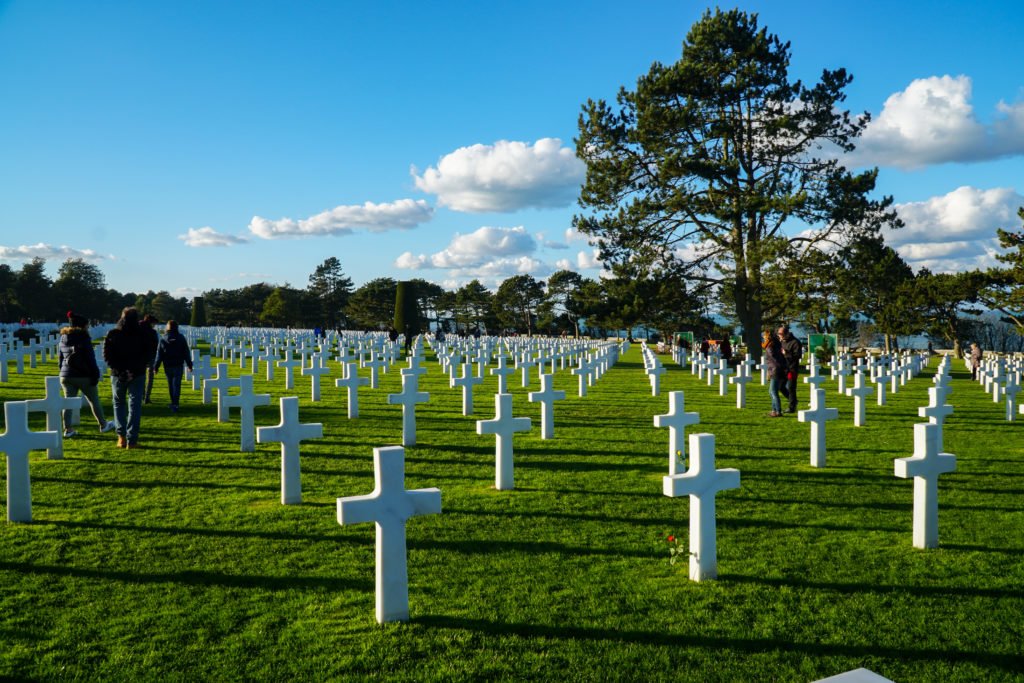
    This beautiful cemetery dotted with white crosses is a serene resting place for the heroes buried here.

    Site 7: Normandy American Cemetery & Memorial

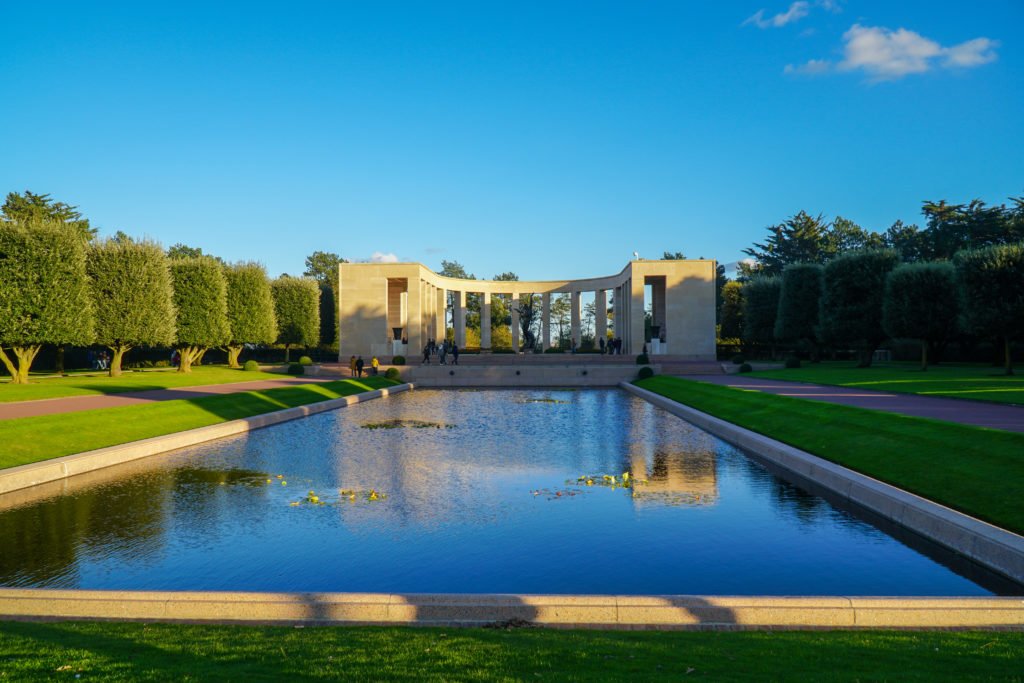
    Next, we drove to the Normandy American Cemetery and Memorial in Colleville-sur-Mer. Due to the delay at the Airborne Museum, we only had about an hour to spend at the cemetery before it closed at 5:00. So we quickly parked and headed down the long path.  We bypassed the visitor’s center, knowing what little time we had and instead continued to follow the path towards the ocean, along the infinity pool, and then curving around to the cemetery.

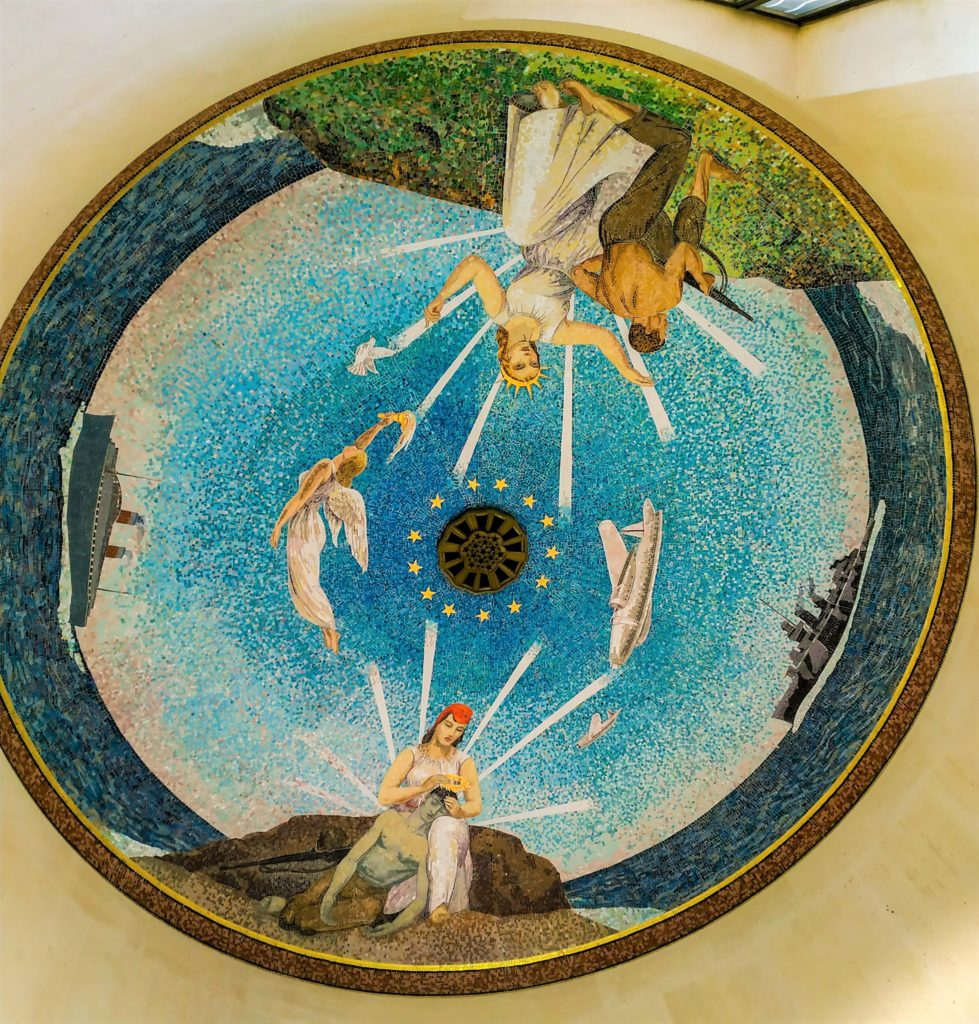
    mosaic at Normandy American Cemetery
    The beautiful mosaic on the chapel ceiling.

    The rows and rows of white crosses stretched out almost endlessly in front of us.  People were milling about through the rows of crosses, searching perhaps for the grave of a loved one.  As you walk throughout the Normandy American cemetery, you feel almost as though you are in a park and not a cemetery. The setting is so lush and green. It is very peaceful.

    Sculptures & Artistic Tributes to the Fallen

    Make sure to stop in the cemetery’s chapel.  It is the rotund building at the center of the cemetery. Step inside the small chapel and admire the beauty and thoughtfulness put into the gorgeous mosaic on the chapel’s ceiling. American painter Leon Kroll created this beautiful portrait symbolizing American on one side, sending out her son to battle and France on the other side, taking our fallen soldier in her arms.  It is such a beautiful image. 

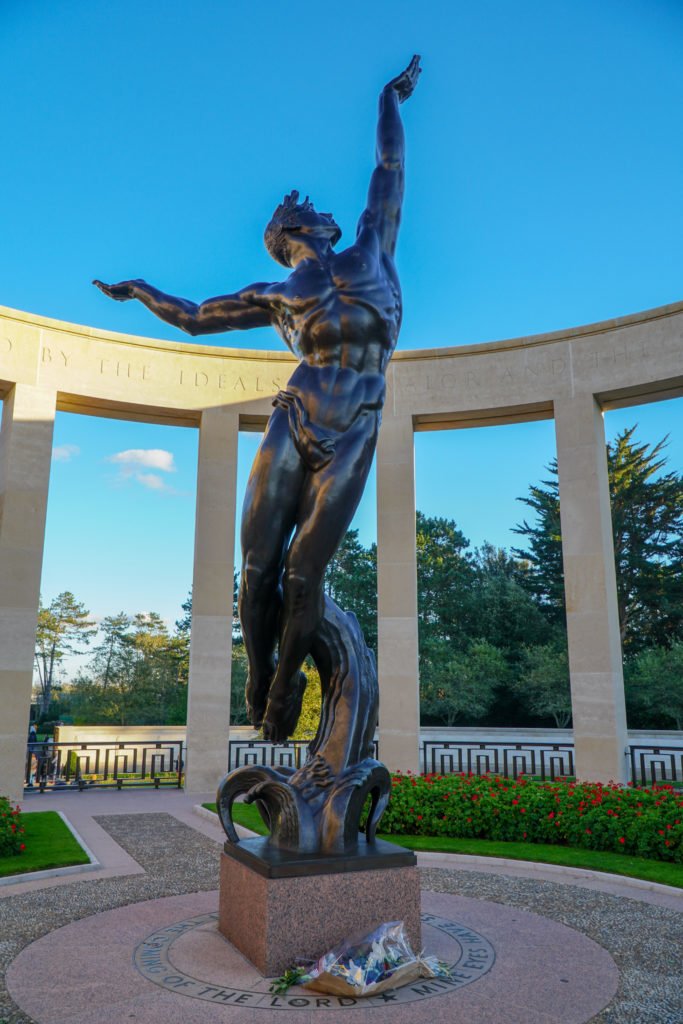
    After you finish your walk around the cemetery, make your way to the large reflection pool where you’ll see a tall bronze statue rising above from the far end.  This beautiful sculpture created by Donald Harcourt De Lueis titled “Spirit of American Youth Rising from the Waves.” It bears an inscription at the bottom that reads “Mine eyes have seen the glory of the coming of the Lord.” On the walls close to it, you’ll find huge maps displaying all of the various forces along the shore and their routes.  It is awe-inspiring!

    Bronze sculpture at D-Day cemetery in Normandy France
    “The Spirit of American Youth Rising.”

    If you have time, walk along the shores of Omaha Beach below the cemetery. Make sure to stop in at the visitor’s center for more helpful information regarding those buried here and to view the beautiful infinity pool.  They have volunteers on staff who can also help you locate any loved ones who are buried here.  

    Normandy American Cemetery in Colleville-sur-Mer is a beautiful park-like setting, very peaceful.  A wonderful resting place and memorial to these soldiers.

    Time Spent Here: (~ 1 hour)
    Location: Normandy American Cemetery, 14710 Colleville-sur-Mer, France
    Commute Time to Next Site: This was the final stop, and it was about a 45-minute drive back to Caen.

    The reflection pool at Normandy American Cemetery.
    The reflection pool at Normandy American Cemetery.

    Tips & Recommendations for a Self-Guided Tour of D-Day Sites

    Planning Tips

    • Always check the hours for each museum directly on the museum’s website. Google is not always up to date on its listing for hours and operations.
    • Pack snacks and drinks in the car to keep your energy up in between stops.
    • Make sure you can drive a manual transmission before renting a car in Europe.
    • Organize your day, so you have the most time at the sites you want to see. Then if you can’t make it to all the stops on the list, you will at least have seen the ones most important to you first.
    • Wear layers and sturdy walking shoes.

    How Much Time To Spend Here

    There is so much to see that you could spend days or possibly weeks here, depending on your interests.  However, with only one day, you’ll need to pick the top sights you want to see and save the rest for your next trip. One site I would have liked to have fit into our day was Utah Beach. I guess I’ll save that for my next trip!

    Getting Here:

    You can take a direct train from Paris’ Saint-Lazare station to Caen. This takes approximately 2 hours, 15 minutes. You can also take a train from Caen to Bayeux if you prefer to stay there.  In Bayeux, bus #70 takes you to many of the D-Day sites if you prefer not to drive.  You can also, of course, book a tour of the sites. Caen also has an airport so if you’re coming from somewhere other than Paris, you might check to see if they have flights that go through it.

    Recommended Apps to Download Before Your Trip

    Google Maps: This invaluable tool will help you get to each destination along your journey. If you plan to do a self-guided driving itinerary, then you will want to install Google Maps on your phone ahead of time and also download it for offline use.

    Normandy D-Day 1944 (by Spot on Locations Ltd): This Normandy D-Day app provides the names and locations for all the various D-Day sites in Normandy. It gives historical details associated with each area and includes over 500 photos and 100 locations. If you like learning more about the history, then consider downloading this app before your trip and looking through the areas you’ll visit and read up on the history associated with each.

    Rick Steves Audio Europe: Consider downloading this app before any trip you take to Europe.  If you enjoy self-guided tours, then you will appreciate this app. Just put your earbuds in, and Rick Steves will guide you on your walking tour to whichever destination you’ve chosen on the app. 

     So say you choose France, you will then see a list of all the audio guides the app has for France.  Look for the one titled “Normandy: D-Day Sites” and listen to this before your trip to D-Day to get an idea about what there is to see and learn more about the history of the region. The app has not only audio walking guides, but also interviews with local experts on a variety of subjects relating to each location.

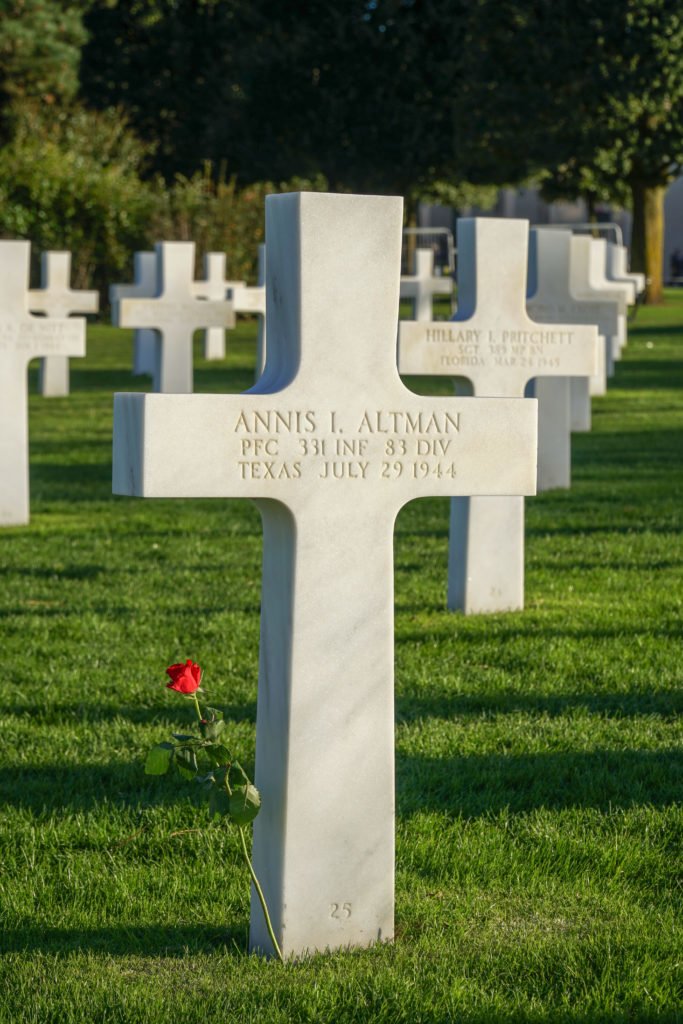
    crosses at American Cemetery in Normandy.
    Roses and flowers left by crosses. Reminders that they are not forgotten.

    Closing Thoughts on D-Day

    Visiting the D-Day sites in Normandy was like walking through the history books. It is one thing to read about this incredible date in history, but it is something else to see the area firsthand. To see the graves of the thousands of soldiers who lost their lives here, and to read about their individual stories is an incredible and moving way to spend the day.  

    Visiting sites like D-Day or even Auschwitz remind me of the beauty of the human spirit. Yes, there is an ugly side to humanity. However, there is also resilience and a determination to overcome even the worst odds for the good of mankind.

    I hope you plan a trip to visit Normandy, France, and the historic D-Day sites. However, if you can’t do that right now, why not visit a local Veteran’s Cemetery or museum near you, dedicated to those who gave so we could have freedom.  Say thank you the next time you see a veteran, and let’s use our freedom to show compassion and grace to everyone we meet.

    Thank You to All Who Served and Continue to Serve

  • Misadventures in Normandy France: There’s no going back.

    My friend Angela and I took a two and a half month backpacking trip through Europe, and although the majority of our travel was via trains and planes, we did rent a car during our visit to the Normandy region of France.  It wouldn’t have been a complete trip if I couldn’t say we used “trains, planes, and automobiles.”  

    Little did I know at the time, but this decision would go down in my travel journals as yet another travel misadventure. For those of you, who have read some of my previous misadventure stories, you know that I recommend you try to keep a positive attitude and have fun even when things don’t go the way you planned.  Our misadventure in Normandy was no different!

    The Misadventure Begins!

    The Normandy region of France is known for its rich history and beautiful coastal towns. In addition to the historic D-Day sites, there is also the unique island fortress of Mont Saint-Michel, seaside towns like Honfleur, the historic city of Rouen, the home of Claude Monet in Giverny and much more in Normandy. This region deserves so much more time than we had to give it.

    We took a train from Paris to Caen, where we had a hotel just outside the city. This is an excellent base for a quick trip to see the D-Day sites. It also has an airport, which made it convenient for us to get to our next destination.  Upon arriving at Caen, we took an Uber to our hotel, where we spent the night.

    The next morning we took a taxi to the car rental agency. However, we arrived before our rental time of 9:00 a.m., and the woman at the desk said that she couldn’t give us the car before 9:00. Since we still had around 20 minutes to wait, we decided to find an ATM and get some cash for our trip to Mont Saint-Michel.

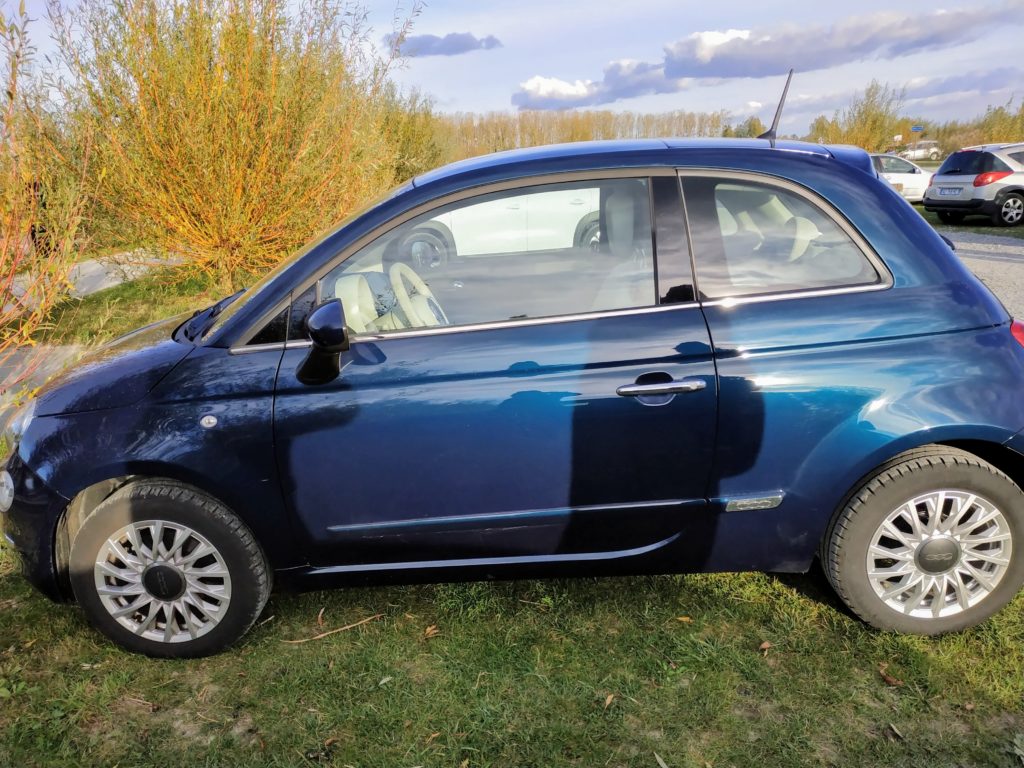
    We get our money and return to the car rental agency.  When we arrive back at the agency, there is now a line.  We wait and wait and wait. By the time they finally get around to helping us and giving us the keys to our car, it is almost 10:00 a.m.!  Our car, a Fiat 500, is positioned at the exit to the garage, so we quickly look over it and then get in and drive away.

    Blue Fiat 500 rented in Normandy.
    Our rental car while in Normandy, France.

    Driving to Mont Saint-Michel

    We are meeting a friend of Angela’s in Mont Saint-Michel, and we still have a 2-hour drive to get there.  Since the car rental process took longer than expected, we are running a little behind schedule.  This is a common occurrence when traveling.  Often timetables, trains, planes, and so on run behind schedule, and you must be flexible enough to adapt your itinerary accordingly.

    So Angela, with the help of Google, navigates us out of the city and onto the freeway.  We talk about the road signs that are different than our own back home, but mostly this could have been any freeway in rural America.  Fields and farmhouses dot the landscape. It is not so different from many highways in the U.S.

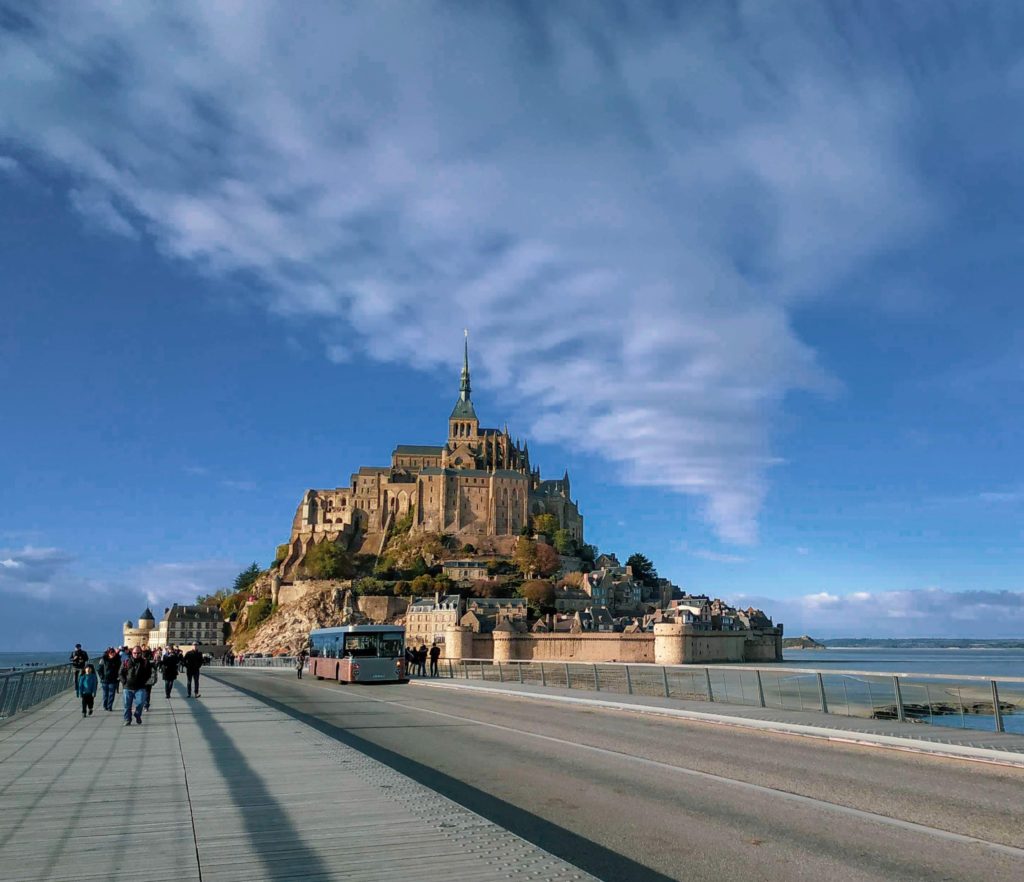
    We arrive at the parking lot for Mont Saint-Michel and quickly locate a parking spot.  Angela gets a text from her friend, who has also just arrived. We follow the signs from the parking lot to the shuttle area. However, since there is a long line for the shuttle, we decide we’ll walk to the island. 

    It is cold today. The low is around 32 degrees Fahrenheit, and the high is in the low 40’s, but with the wind chill, it feels much colder. However, we’re committed and figure it will give us excellent opportunities for photos along the way. It turns out that it’s about a 40-minute walk, thus, the reason for the shuttle line.

    Mont St-Michel in Normandy region of France.
    The view of Mont Saint-Michel as we walk up the causeway.


    We meet with Angela’s friend and have a wonderful time exploring the city of Mont Saint-Michel. I plan to write a post all about our visit.  It is such a unique destination, and I recommend you take a day to visit it if you’re ever in the area.

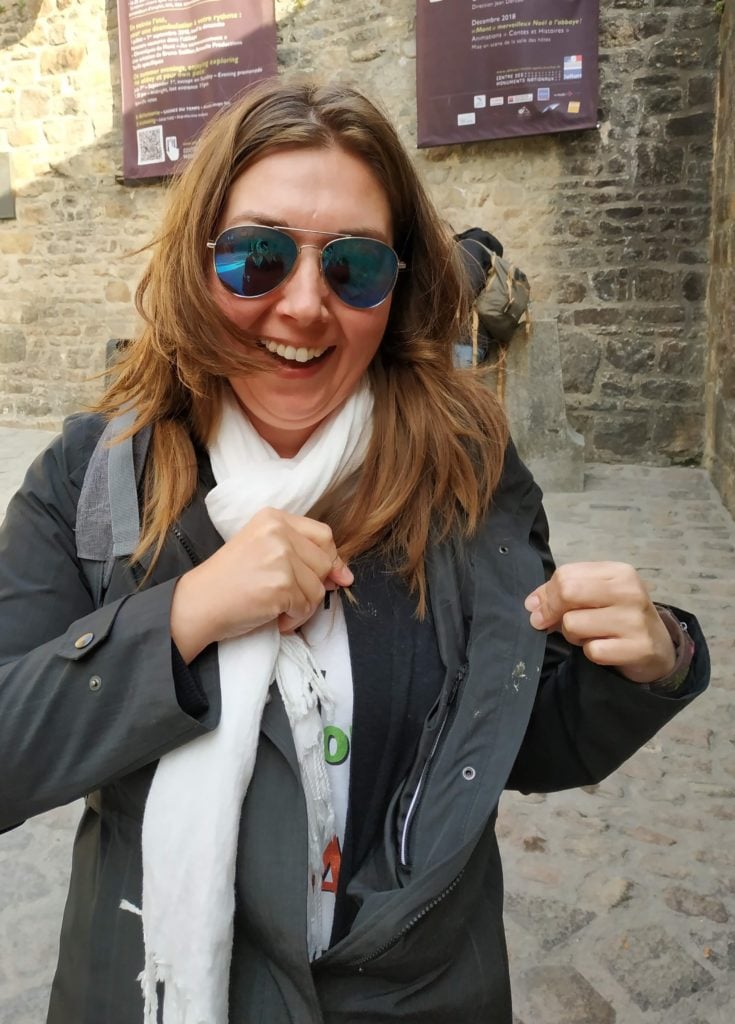
    As we leave the walled city area, we walk through an archway, and as we exit the arch, there is a man with his two kids who are throwing something – food, I assume.  Shortly after passing them, Angela says, “I think a bird just pooped on me,” but I say, “well, the kids were throwing stuff, so that was probably it.”

    She leaves to use the restroom before our two-hour drive back to the hotel. She returns and shows me that she did indeed get pooped on by a bird.  It is on the front of her jacket. Talk about misadventures! Yuck!

    woman with scarf and coat
    Angela shows me the evidence.

    The Parking Lot Discovery

    We return to our car and prepare to leave. I put the car in reverse, nothing happens. It doesn’t move. So I figure that I must not have the stick shift over in the correct position. Some cars can be a little finicky, no big deal. So I try to back up again. Nope. Nothing. I try everything I can think of and still NO REVERSE.  So then Angela and I start Googling what to do. We discover that this is a common issue with the Fiat 500.  

    Now to all of you out there who think I must not know how to drive a stick shift, I assure you, that is not the case.  I have driven and owned manual transmission cars off and on since receiving my driver’s license (and even before that). No, this car’s reverse was just not working.

    There were a few suggestions from people online for ways to possibly get reverse to work, like turn the car ignition off, put it in first, then turn on and try putting it in reverse.  I tried all of these suggestions and still nothing!

    So we realize, there’s only one thing to do–push the car backward ourselves!  So Angela, being the good sport she is, pushes the car back.  Thankfully it’s a small car. We both feel entirely ridiculous and are laughing so hard as she pushes the car backward.

    Angela is our personal reverse valet! Her superhero name is The Human Reverse Machine (coming to a parking lot near you)!

    Accepting the Situation and Moving Forward

    We laugh and discuss the absurdity of our situation as we begin our drive back.  We both agree that it seems hard to believe the car rental company would not have known about this issue. It was rather convenient that the car was already facing forward when we got into it. Otherwise, we would have discovered the problem at the rental agency, rather than almost 100 miles away!

    We talk about driving back to the rental company that night, but due to our late departure from Mont Saint-Michel, it would be a challenge to arrive before the rental agency closed. Plus, it was a hassle getting the car this morning, and we had a full day of driving to D-Day sites the following morning. So we agree to accept it as is, rather than miss out on our intended itinerary.

    There’s No Going Back

    Thus our misadventure in Normandy began.  The next morning, we get in the car to leave, and Angela has to push the car out so we can be on our way. Nothing quite like something not working to make you appreciate those simple things you take for granted! Just imagine for a moment if your car didn’t have a working reverse.  

    You’re at the grocery store, you go to the front of your car to push it backward, and someone walks by and asks: “Watchya doin’?”  You reply: “Oh, you know, just backing the car out.”

    Perhaps you’re leaving for work in the morning, and you holler “Hey honey, I’m leaving for work, can you help me back the car up?”

    You decide to stop in at the local Sonic drive-in, and the server brings your food out to your car, you thank them and then ask, “Could you help me back out now?”

    Okay, you get the point, reverse is a requirement in a car!  It’s also something I never thought I’d be missing, but then, travel is unpredictable!

    Omaha Beach Memorial Site
    Omaha Beach Memorial Site

    Angela: The Human Reverse Machine in Action

    We arrive at our first D-Day site, The Airborne Museum at Sainte-Mère-Église, and discover there are no pull-through parking spots.  Just our luck! Unfortunately, this is a recurring theme throughout our entire day! Park to see D-Day sites, Angela pushes us out, and we continue to the next location. 

    When we arrive at Pointe du Hoc, I turn into a disabled parking lot by mistake. It is a dead-end lot too. So now I need to–yep, you guessed it–back out! I do my best to swing as wide as possible, but it is too tight with parked cars on either side for me to complete a full U-turn.  So I am directly behind another vehicle that also happens to want to leave at this exact moment!

    The passenger is outside the vehicle attempting to help her driver back up. She looks at Angela, who is getting out of our car and motions as if to say, “no-no, move, we’re trying to leave.”  Angela, of course, nods her head, saying, “yes, I understand, so are we.” 

    I am inside the car, observing this hilarious game of charades.  Angela then pushes our car backward and gets in.  We drive off laughing hysterically at the absurdity of the situation and the look on that poor woman’s face! What she must have thought of us.

    At Omaha Beach, when we begin to leave, people are standing around watching as these two crazy girls push their car out of the parking spot. One of them even stopped to ask Angela if she needed help, “no, been doing this all day long!”  It is tough not to laugh as the situation is so odd and funny. 

    And so this is how our misadventures in Normandy went.  We were so happy to return the car that night. Note to self: never rent (or buy) a Fiat 500 again. Enjoy this video clip of the human reverse machine in action.

    Embrace Your Misadventure. Choose Laughter.

    Summary of our misadventures in Normandy: We get our car late, Angela gets pooped on by a bird, and we discover (after driving almost 100 miles away) that we have no reverse – not to mention it’s freezing outside!  Did this keep us from having an incredible visit to Normandy?  Not one bit.  I think it is even more memorable because of our misadventures!

    Had I let the car situation ruin our trip, I would have missed out on so much.  The D-Day sites in Normandy are full of world-changing history. They hold stories of honor and sacrifice, peace, and unity. I was humbled as an American to come and see first-hand these areas I had only read about in history books. I left inspired and grateful to all who sacrificed so I could have freedom, and just think, I could have let a little thing like working reverse stop me.  

    Things happen when you’re traveling, and you need to roll with the punches and have a good attitude.  We took what could have been a very frustrating situation and chose to see the endless humor in it, and we didn’t waste our only day to see D-Day sites because of it. We played the hand we were dealt with and created some unforgettable memories in the process.

    Thankfully, Angela was a good sport and isn’t a wimp. She backed our car up over and over again like a boss!

    So misadventures or not, have fun making memories!

    Choose Laughter!

  • An Unforgettable Road Trip to Key West

    This post is a journal of the day’s sightseeing and experiences.  I also wrote some travel guides to help you on your next trip to the Florida Keys. You’ll find these linked at the bottom of this post.

    I visited Key West once before in the late ’90s; however, my husband had never been there before.  He told me he wanted to see the Seven-Mile Bridge as he had seen it in the True Lies movie with Arnold Schwarzenegger. 

    I’m sure vacations have been planned on less. So we drove from Orlando, where he had just finished with a business conference, to Islamorada. We spent the night there before continuing our road trip to Key West.

    Now before I continue, I thought I should put in a small disclaimer, just in case you’re reading this as a bedtime story to your kid or something.  

    Disclaimer: There are references to nudity and naked bodies in this post; if that bothers you, read one of my other posts instead.

    Morning of our Florida Keys Road Trip

    We packed up our camera gear, drone, swimming clothes, bottled water, and sunscreen and headed out the door!  First stop was coffee and breakfast at the Midway Cafe and Coffee Bar in Islamorada. 

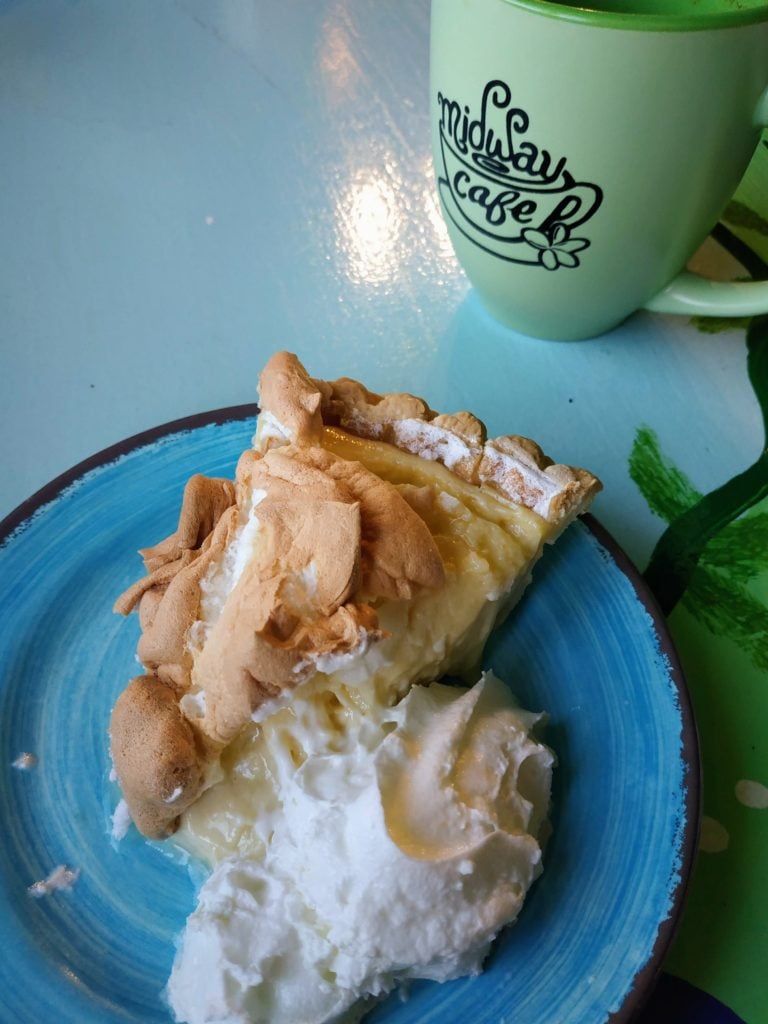
    I order some avocado toast and key lime pie for breakfast and a bottomless cup of coffee. I love a bottomless cup of coffee.

    When I received my key lime pie, I was surprised to see it made with an actual pastry crust, not the graham cracker crust I was used to. You can read more about why that is in my post on finding the best key lime pie in the Florida Keys

    I enjoyed breakfast at the Midway Cafe and recommend you stop when you’re in the area. They have a little space where they sell handmade jewelry and other locally crafted items.  It’s a brightly-colored, sunny spot, perfect for enjoying some coffee before heading to Key West.

    midway cafe mug and key lime pie
    Some say this is the traditional way to make a key lime pie.

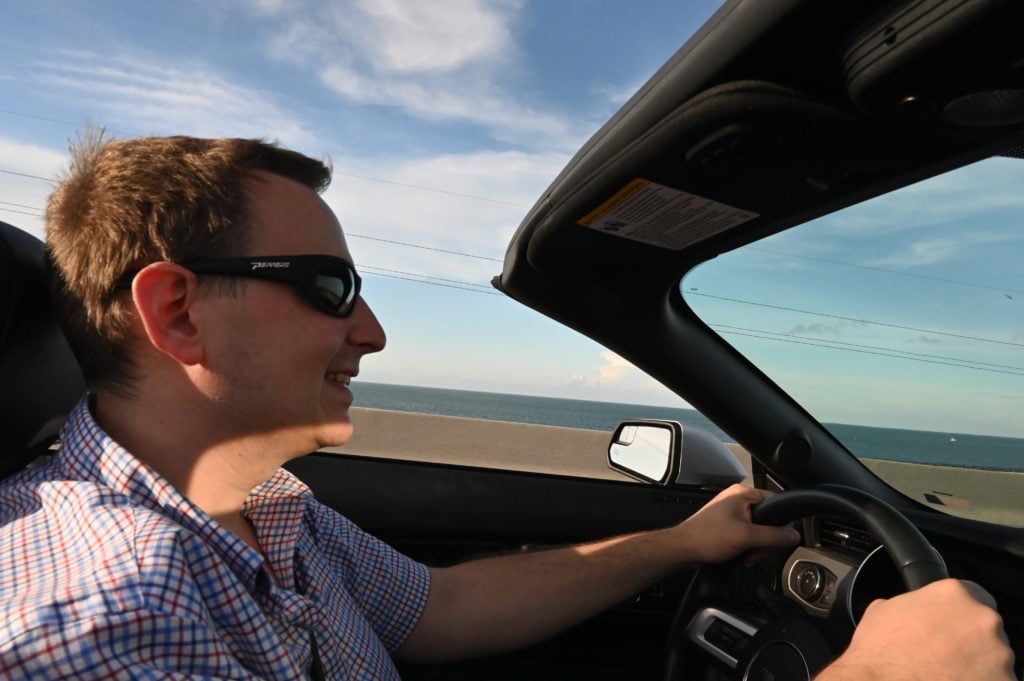
    After we finished, we went out to the car, where hubby was so excited to be driving a convertible Ford Mustang for our road trip.  He made sure I took a few photos of him driving, and of course, we had a Florida road trip playlist that included “Ice Ice Baby.”

    Back on the Road

     It was great fun driving with the top-down and the wind blowing in our hair.  However, I will say we didn’t leave the top down for our entire day of driving.  For one thing, it is just too hot! And second, my hair-whipping about into a frantic rat’s nest did get old after awhile.  It is still a lot of fun, and I recommend it if you get the chance for a free upgrade, like we did, to go for it!

    man driving in convertible
    Hubby loved driving with the convertible top down, wind in his hair.

    Photo Stop at Duck Key

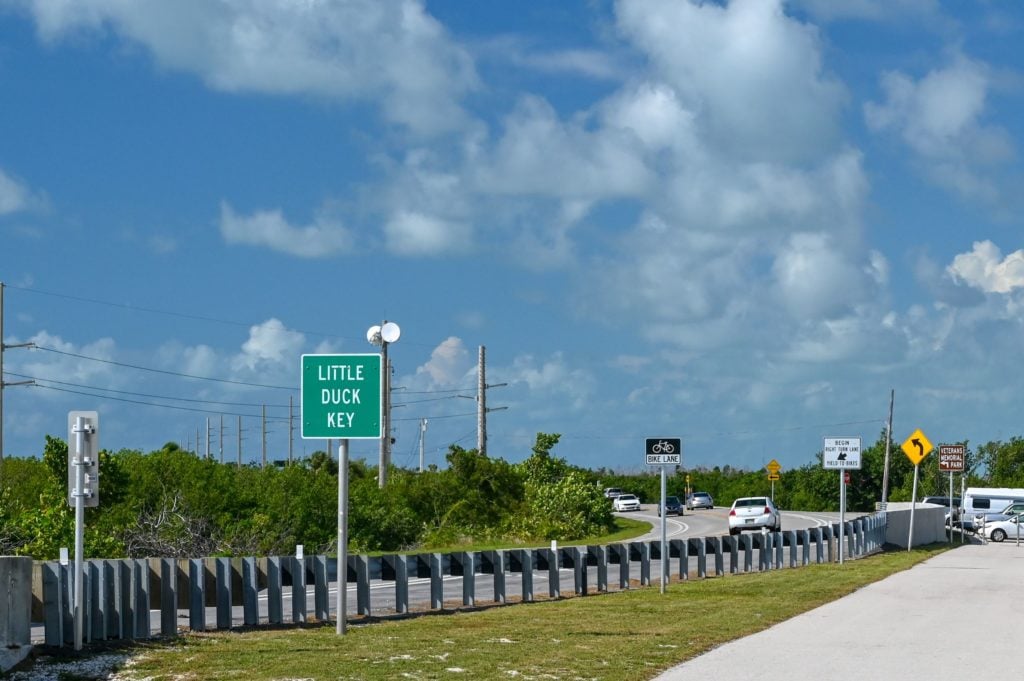
     This one made me laugh, so I took a picture of the sign.  Little Duck Key, get it? Hmm, perhaps you had to be there.

    Little Duck Key road sign in Florida Keys
    I love the play on words. The Florida Keys have lots of interestingly named Keys, which is part of the fun!

    Hubby brought his drone, and we did a lot of research, including using apps that tell us whether it is okay to fly, what times of the day is better, and then we also read the local forums to find out where local Floridians went to fly their drones.  

    Unfortunately, there have been some not-so-bright drone owners who have flown their drones into restricted areas such as airports and other places most people would never dream of doing! This creates a very complicated and restrictive process for the rest of us drone owners.

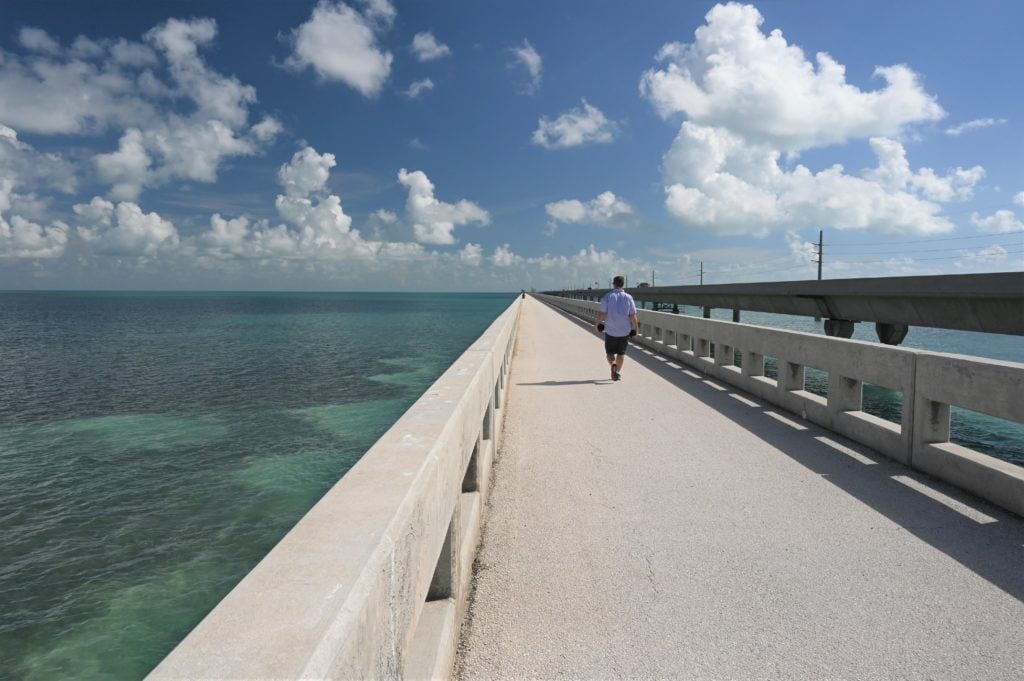
    So, after doing our do-diligence, we found a spot along the old seven-mile bridge that, according to locals, was approved for drone flying.  We walked a little way up the bridge, away from other people (although there were some other tourists who at first gathered around hubby, as the drone always seems to bring spectators).  

    Once hubby felt we were a safe distance from people, and he had an open area to land when needed, he put the drone up in the air.

    man walking up old seven-mile bridge in Florida Keys
    Walking the old seven-mile bridge. Beautiful, but hot!
    The Heat Makes Me Crabby

    I’m not sure how long we were out flying, but we did walk as far as we could on this section of the old seven-mile bridge, and needless to say, when I left the car, I had not planned on spending so much time walking in the hot sun.  I didn’t put on sunscreen when I left this morning, as we headed to breakfast and then I thought I’d apply it afterward. I forgot.
     

    So, now my shoulders are turning a bright red, and my feet are tired from walking miles on concrete, and I’m getting a little crabby.  This always seems to happen when overheating. Hubby and I discussed this once when we were in Thailand. We were walking up the road in Koh Lanta, headed to a “secret” beach, and he mentioned how heat affects the way people act.  

    Sure enough, about 5 minutes into our walk, the conversation turned into a “whose idea was it to walk here anyway” argument.  However, soon, we reached the beach, and as soon as we cooled off in the beautiful turquoise water, our attitudes were miraculously back to cheery and chipper.  

    That was how my walk back on the seven-mile bridge went. Of course, after I got back to the car, drank some water, put on some sunscreen, and turned on the a.c., I adjusted my overheated attitude, and we were on our way again.

    This is, of course, the side social media doesn’t typically show.  You see us in the pictures smiling together and looking like we never have a care in the world.  Uh, no, we’re humans, only humans.

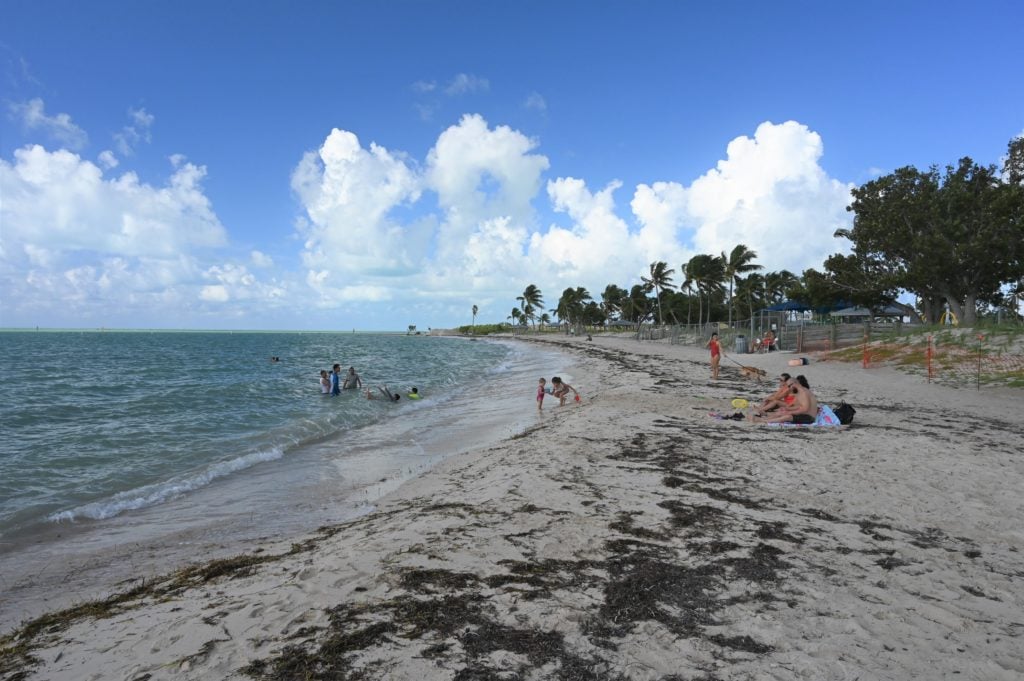
    Sombrero Beach in Marathon, Florida.
    Sombrero Beach in Marathon, Florida.

     Next stop Sombrero Beach

    Sombrero Beach is reportedly one of the best beaches for swimming in the Florida Keys.  For those of you who don’t know, the Florida Keys are formed from a protected reef system.  In short, there are very few swimmable beaches here. Often, sand is brought in to form man-made beaches.  So we headed for Sombrero Beach in Marathon, to check it out.

    When we arrived, we found it under construction.  The restoration project looked like it was in its final stages, and it appears to be a fantastic place to bring the family and spend the day.  The one area you could still access had people swimming and sunbathing, so I’m sure this beach is a popular one and even more so once the restoration project is complete.

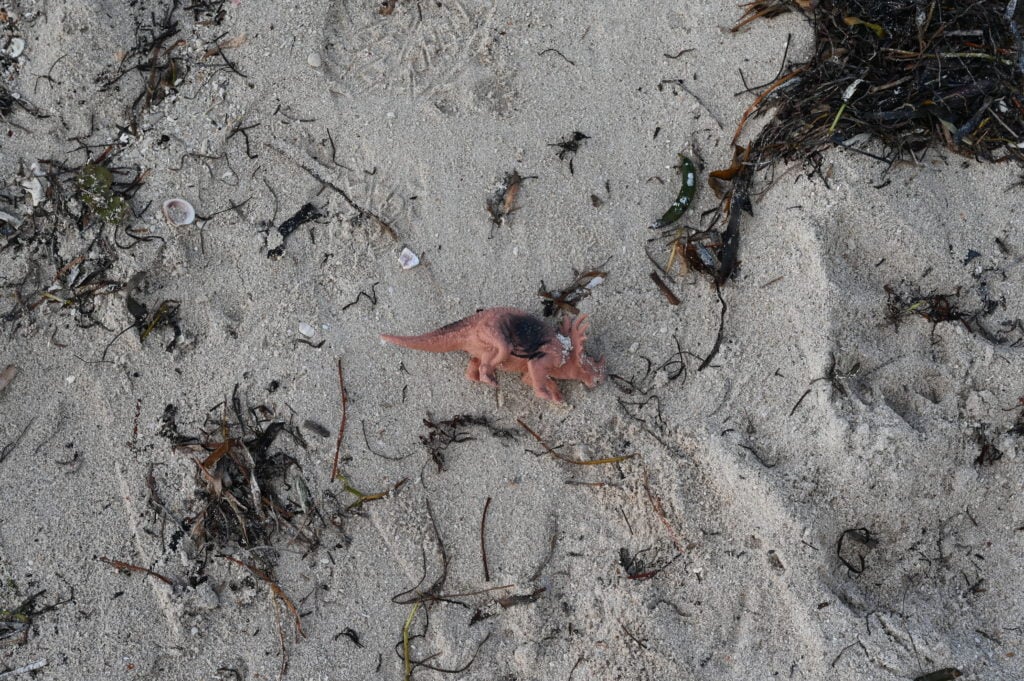
    I hand hubby my camera for a little bit, not sure why.  He took this “artistic” photo. I’ll let you see if it speaks to you.

    plastic dinosaur on Sombrero Beach in Marathon Florida
    “Beach Art”

    Key West Here We Come!

    With all the time we’ve had in the sun, we now prefer to sit in the air-conditioned car.  So we decide to keep on rolling until we arrive in Key West. We can see anything we miss on the way back.  A road trip through the Keys is about the journey, not the destination.

    We Have Arrived!

    We arrive in Key West and make our way for Old Town. Usually, I drive closest to my first sightseeing stop and then find a parking spot. Since today is Saturday, I navigate hubby to the nearest public parking garage, where we park and instead to walk to our destinations.

    This was the best decision we could have made!  We didn’t discover until later, but we arrived in Key West during their Fantasy Fest.  The streets were blocked off for vehicle traffic, and crowds of pedestrians were everywhere!  So, although the heat felt unbearable to a Pacific Northwestern like myself, I was happy we had parked and didn’t get tangled up in the mess of crowds and closed streets.

    Lunch Stop

    We head for lunch at Caroline’s Cafe on Duval Street. Breakfast was a long time ago, and we are hungry! As we walk there, we notice people carrying folding chairs and dragging coolers behind them.  I say, “there must be a parade today.” Well, I was right, but it wasn’t quite what I expected.

    As we cross the street to Caroline’s Cafe, I notice two people walking across the road towards us.  I also see they have no clothes on. Their bodies are painted with patriotic “clothing,” stars and stripes “shorts” and giant “stars” up top. I think, hmm, that’s interesting, have we stumbled onto some Mardi Gras festival?

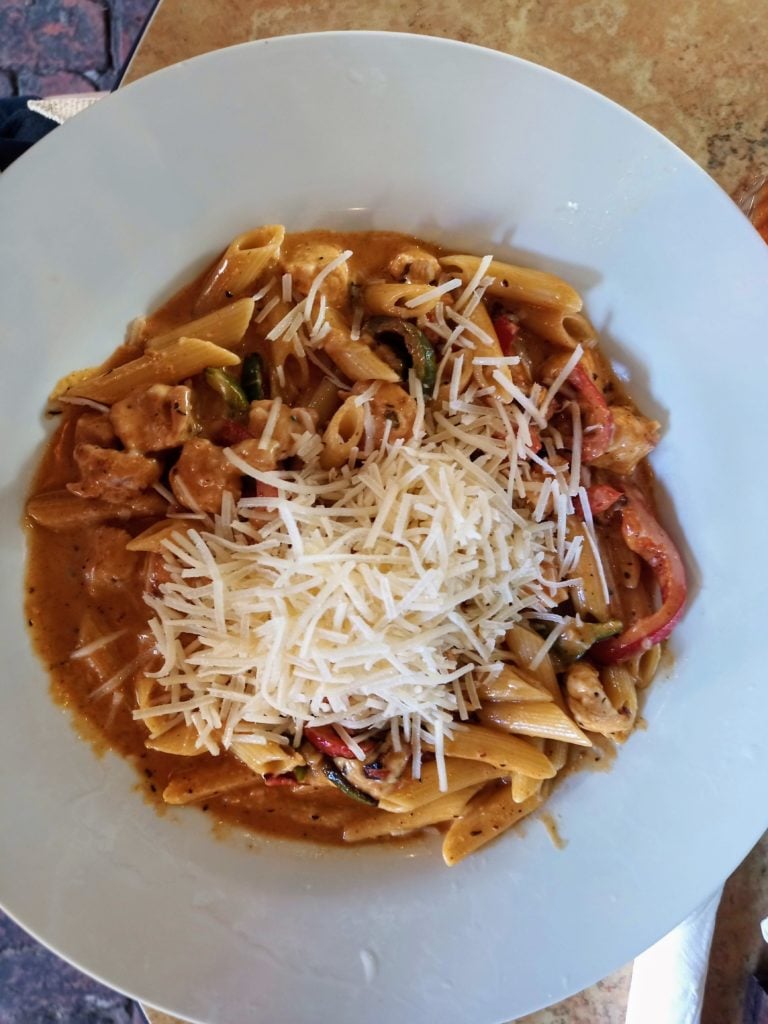
    Let me say before I continue, that lunch was fabulous!  I had the blackened chicken pasta, and it was SO good!! I highly recommend it if you are ever in Key West.

    blackened chicken pasta
    This blackened chicken pasta was so good! Hubby kept nibbling off of my plate as it was better than his Cuban sandwich.

    Lunch-time “Sightseeing”

    So, as we sit down to order, I notice the people at the table directly across from us, are also wearing painted “clothing.” Now, I’ve been to Europe, seen lots of statues, and even a few nude sunbathers, but this, this was not something I had seen before. We’re Americans. We don’t do public nudity.

    So as I notice more and more people with their painted on clothing.  Hubby leans across the table and tries to oh-so subtly tell me to look behind me. I think in my head, “Um, what could you possibly show me that I haven’t seen yet!” So I peer over my shoulder, in an “I’m not turning to look at you” sort of way and see another naked painted person.  

    It’s at this point that I realize my husband doesn’t know that he is surrounded by naked people.  This is quite funny to me. So I also oh-so-subtly give him the nod to look at the table right next to us.  A lot of glitter and paint–that is all my friend. Glitter and paint.

    I will note here though that the men all have a grass skirt or some other covering for their lower front regions.  Their backsides, not so much.  

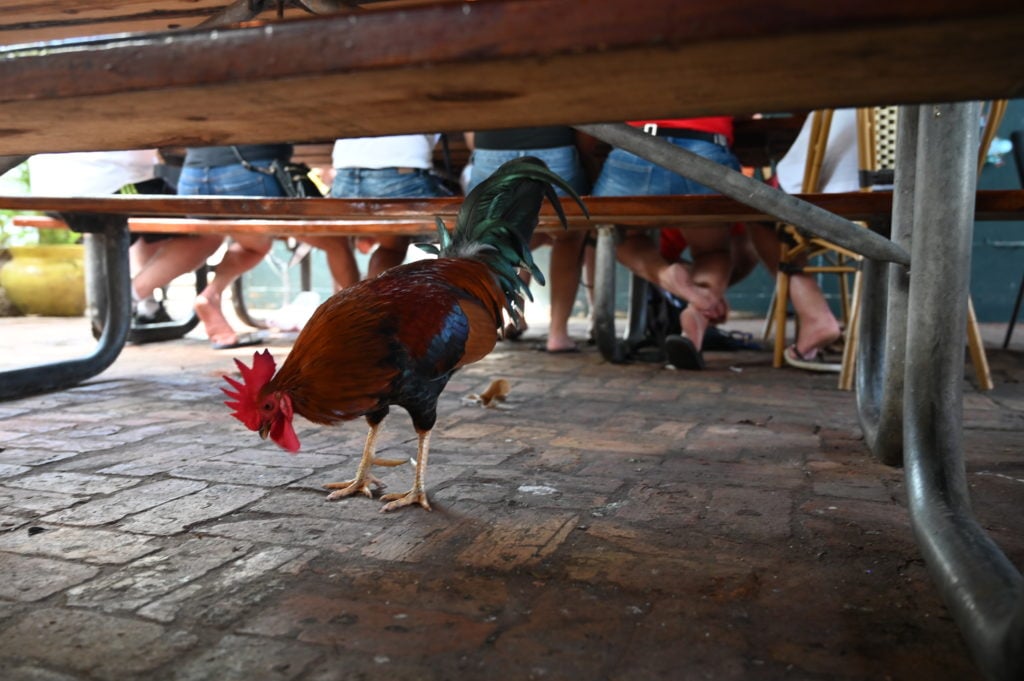
    rooster under the table at Caroline's Cafe in Key West
    The resident rooster and vacuum cleaner at Caroline’s Cafe.

    The Emperor’s New Clothes

     So, as the realization hits my husband, he says, “they’re naked!”  Yep. Bingo! He thought they were actually wearing something. Nope. Nothing but paint.  He made a trip to the restroom while we waited for our check and saw the line of people waiting to be painted.  As you can imagine, the people in line were wearing, um–the Emperor’s new clothes. Of course, the difference between them and the childhood story’s character was that they knew they were naked. They were naked as j-birds.  

    After lunch, we discussed his newfound realizations, and we laughed as he and I certainly had a new experience on this trip to Key West.  We saw things we’d never seen before. I guess that’s what traveling is all about! We also discussed the problems that might arise from the lack of clothing.  

    Like where do they put their credit cards and wallet?  Does every painted person bring a clothed person with them to carry stuff?  What happens if they sweat or get wet? This question’s answer was discovered by hubby’s trip to the restroom, where he saw a sign stating that the paint was waterproof.  Phew! That could have caused some problems.

    Fantasy Fest

    Fantasy Fest was created over 40 years ago as a way to increase tourism during Key West’s slow season.  So every October for ten days, the city turns into a festival that is a mixture of Mardi Gras meets Halloween.  The final weekend of the festival, which we just happened to arrive on, is when they block off a section of the city, for an adult-only area in which nudity laws are “relaxed.” 

    This is only in the sectioned off portion of the city and only during Fantasy Fest.  We did not see any children in this area, or much at all, which of course makes sense.  So, should you plan to visit Key West, during the off-season, you may want to keep this in mind when making your travel plans.

    And in case you’re wondering how much people pay for their paint jobs, prices range from $100 to $1000. This depends on how much of your body is painted and how detailed of a design you want.

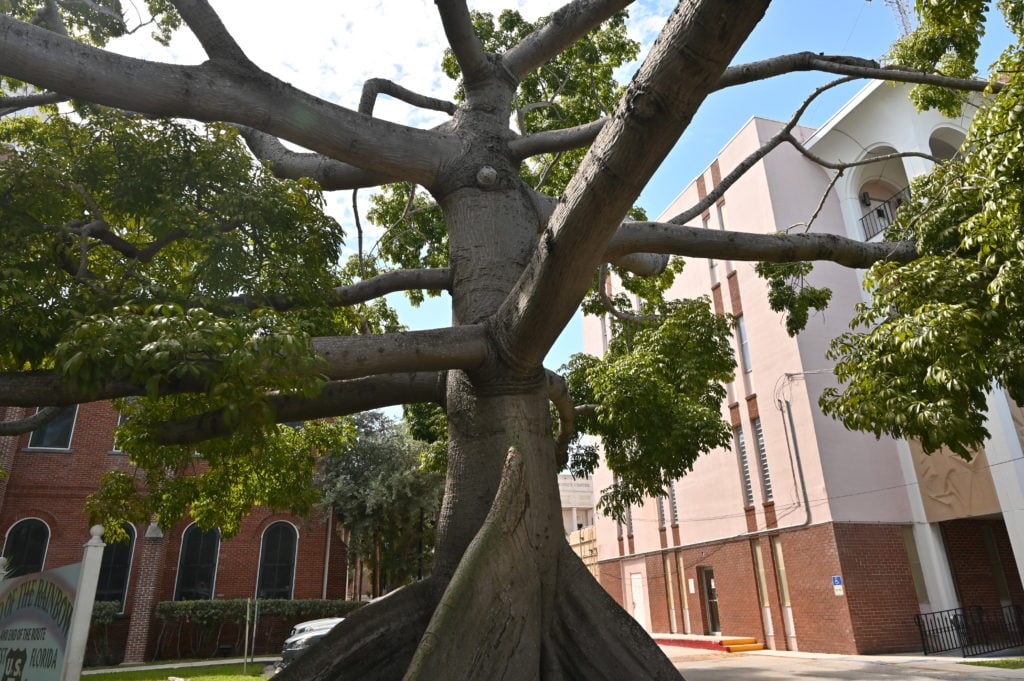
    Kapok Tree in Key West

    We left the restaurant and headed in the direction of our next stop, Ernest Hemingway’s former Key West residence.  As we walked there, the heat felt unbearable. Soon I began to think there might be something to wearing no clothes.

    Kapok tree Key West
    A Kapok tree in Key West.

    We passed this beautiful Kapok tree, which reminded me of the banyan trees in Maui.  It was a nice place to stop in the shade. We kept crisscrossing the street to follow the shady side of the road.  That is how hot it was in Key West. I later learned that they had a 234-day hot streak this year.  During that time, Key West had temperatures at 80 degrees Fahrenheit or warmer. 

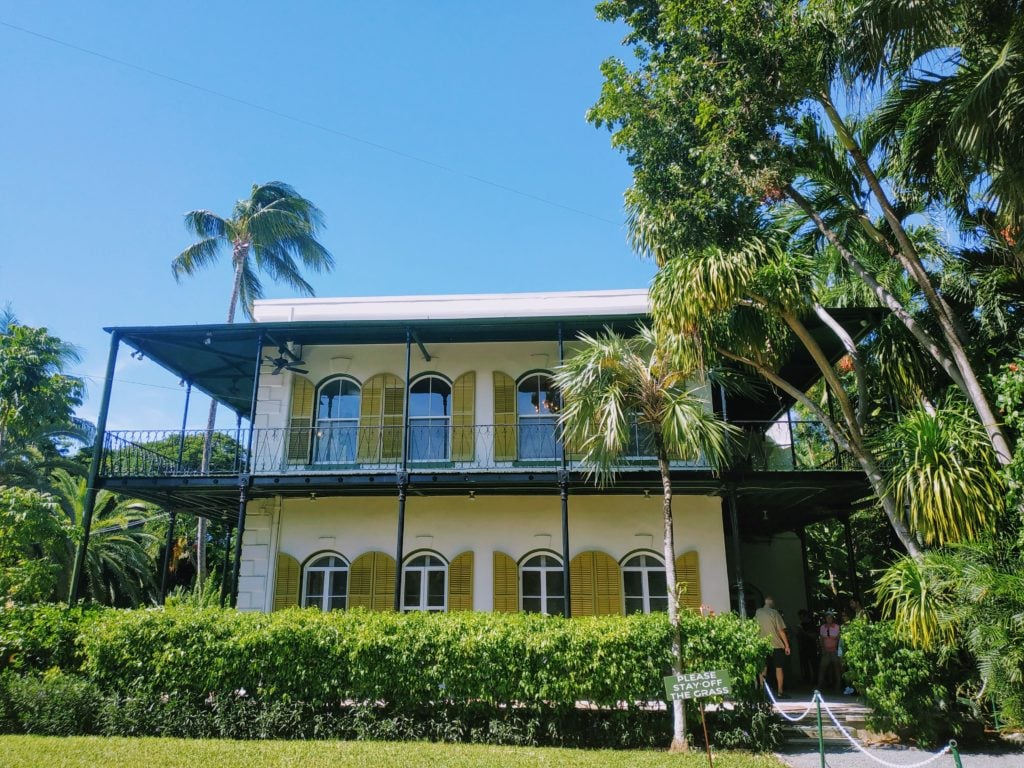
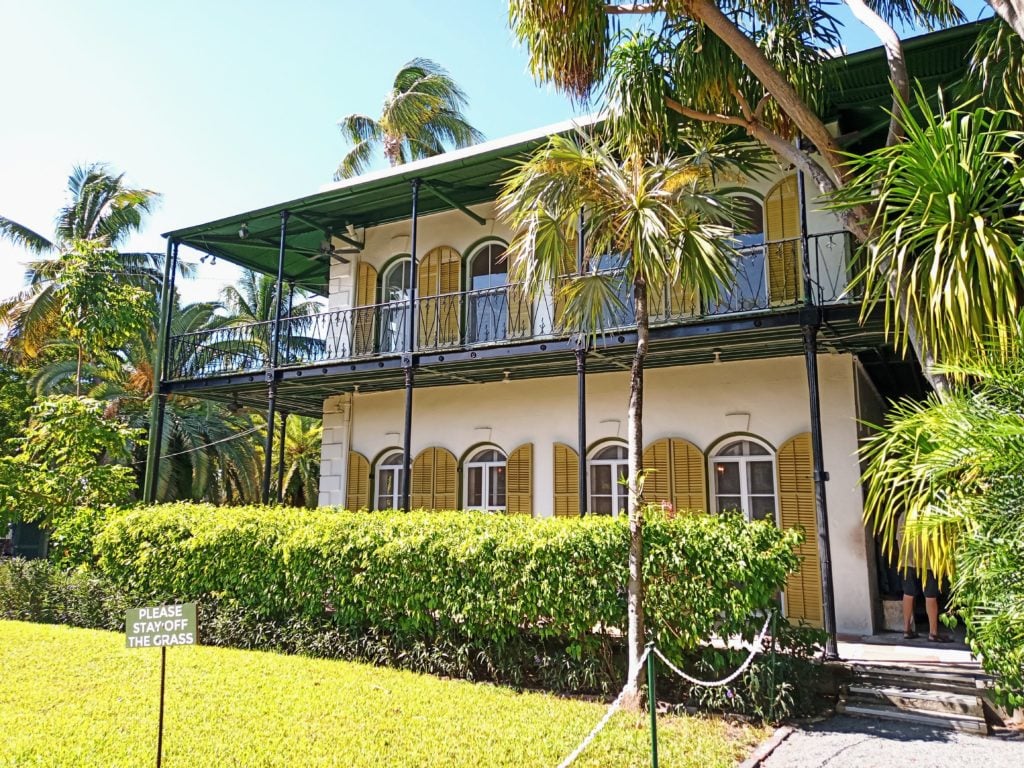
    Ernest Hemingway’s Home

    When we finally arrived at Ernest Hemingway’s home, we discovered you had to pay in cash.  We did not have any cash, and I was okay skipping it (when I’m hot and tired, I tend to lose interest). However, hubby asked the woman at the ticket window, “is it air-conditioned inside?” She replied “yes” that it was, and there was also an ATM around back to get cash.  Well, that was enough for him. He heard the magic words “air-conditioned” and might have paid any price to get some reprieve from the heat.

    Ernest Hemingway's Home in Key West
    The former residence of Ernest Hemingway.

    So I got the cash, and we went inside where it was nice and cool. The inside of the home is decorated with some of Hemingway’s original furnishings. And on display are also some of his books, his typewriter, and movie posters from the many movies adapted after his books.

    There is a swimming pool outside the house that calls to you to jump in; however, this is, of course, not allowed.  We peeked inside Hemingway’s writing studio. I told hubby how nice it must be to have an entire studio dedicated to writing.

    Soon, our tour was over, and after another stop in front of a fan, we went out into the heat to continue our sightseeing.

    Southernmost Point in the Continental U.S.

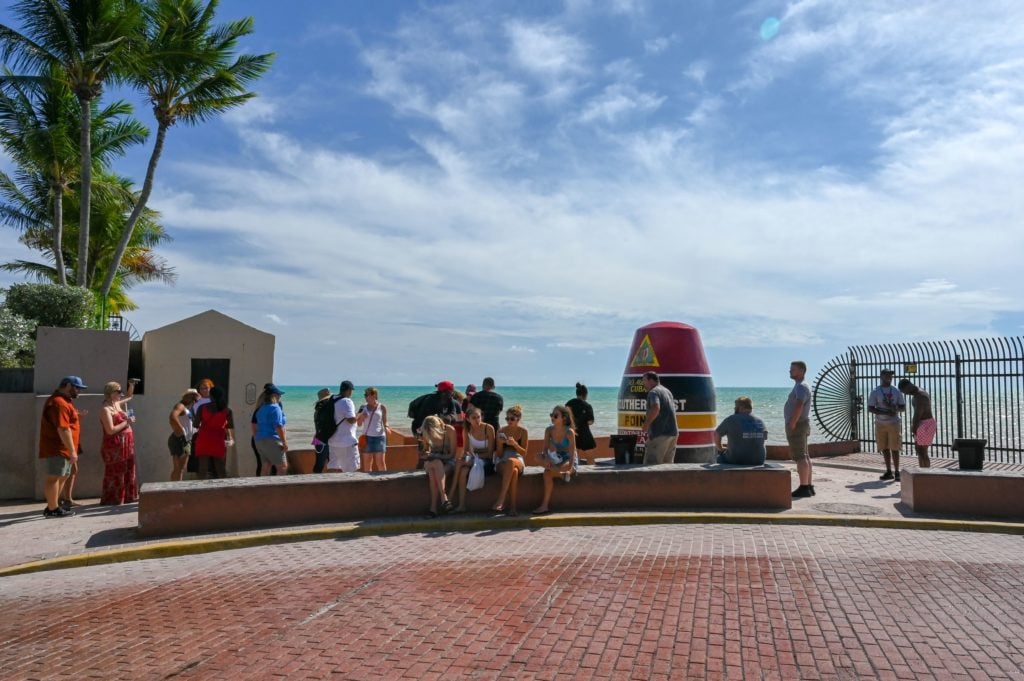
    Because it was hubby’s first trip to Key West, I thought he should go to the Southernmost Point in the Continental U.S.–just to say he had.  As we walk, the sweat drips down our faces, and my husband assures me he does not need to walk all the way to the Southernmost Point.  However, we were almost there, so we might as well finish.  

    We arrive only to discover there is a line, a line of people who all want a picture with the marker that shows they are at the Southernmost Point in the Continental U.S.  It is crazy hot out! Hubby and I stand across the street in the shade, neither of us have any interest in standing in the hot sun for this photo opp. 

    Southernmost Point Key West
    The line stretches outside the frame. The heat is underrepresented in this photo.

    We also conclude that we are way too hot, tired, and sunburned to walk back across town.  It is at that moment, a man pedaling a rickshaw comes down the street, we ask him if he can take us to our next stop, the Key West Key Lime Pie Company. Thankfully, he says yes, and we hop on board!

    Our driver pedals away almost effortlessly and chats with us about Key West and all the local sites.  He said that this is cool, fall weather compared to the summer, where it can get over 100 degrees Fahrenheit, plus humidity!  Yikes! Note to self, never visit Key West in the summer.

    He takes us as far as he can before the closed roads prevent him from going further, and we thank him for the ride.  This is the best $20 I have spent in a long time. 

    Key Lime Pie in Key West

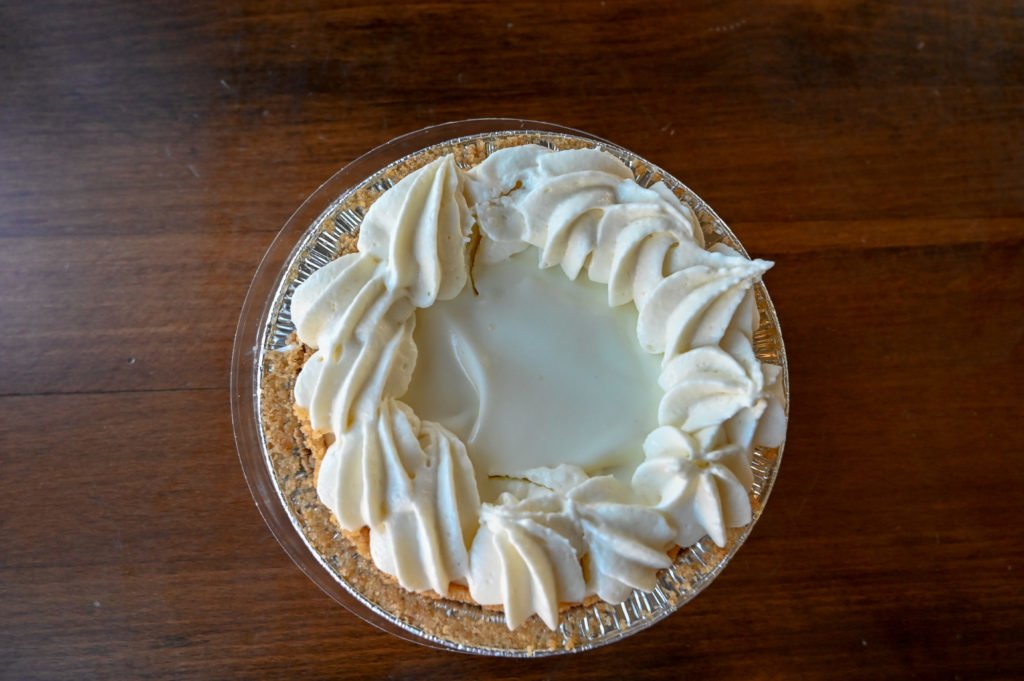
    We continue through the crowds, passing creatively painted people to make our way to the Key West Key Lime Pie Co.  The man behind the counter is so friendly and welcoming. We purchase one of their mini key lime pies to share. The man pipes freshly made whipped topping on it before serving it to us. Yum!

    Mini key lime pie from Key West Pie Co
    The freshly piped whipped topping was a nice touch to this mini key lime pie.

    We enjoy our pie and ice-cold water before walking down the street to our next stop, Kermit’s Key West Key Lime Shoppe.  Yes, I have more key lime pie, all in the space of 10 minutes. I’m pretty sure I’ll sweat the calories off anyway!  

    We sit down to share a slice of key lime pie at Kermit’s. The pie at Kermit’s is everything I looked for in a key lime pie.  Wonderful tart lime flavor with a buttery graham cracker crust–delicious!  

    Driving Back Through the Florida Keys

    It is late afternoon, and with the parade just around the corner, we both agree we’d rather not get stuck in traffic. Although we may not have hit all of the sights in Key West, we certainly have had a unique experience. So we make our way in the heat to the parking garage, excited to turn the air conditioning on and begin our drive back to Islamorada.

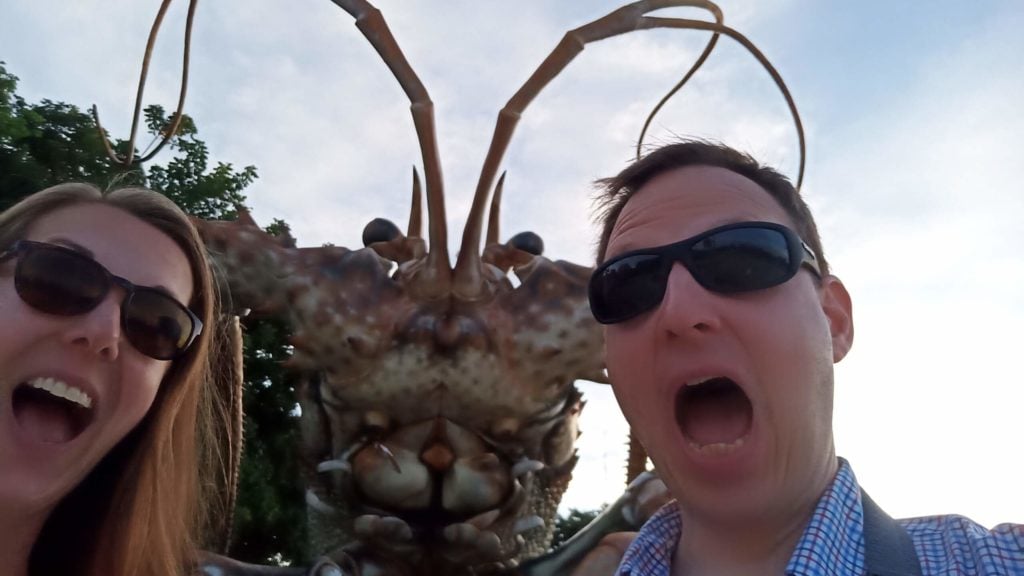
    We enjoy the drive back through the Keys, put the top down again, turn up some fun Latin music, and pretended to be carefree teenagers. Of course, we had to stop for selfies at this giant lobster, and we weren’t the only ones. Another man in a red convertible Chevy Camaro stopped and asked if we’d take his picture with the giant lobster too. Nothing like sunshine and warm breezes to make you feel like a kid again!

    selfie with giant lobster
    Who can pass up a selfie with a giant lobster?

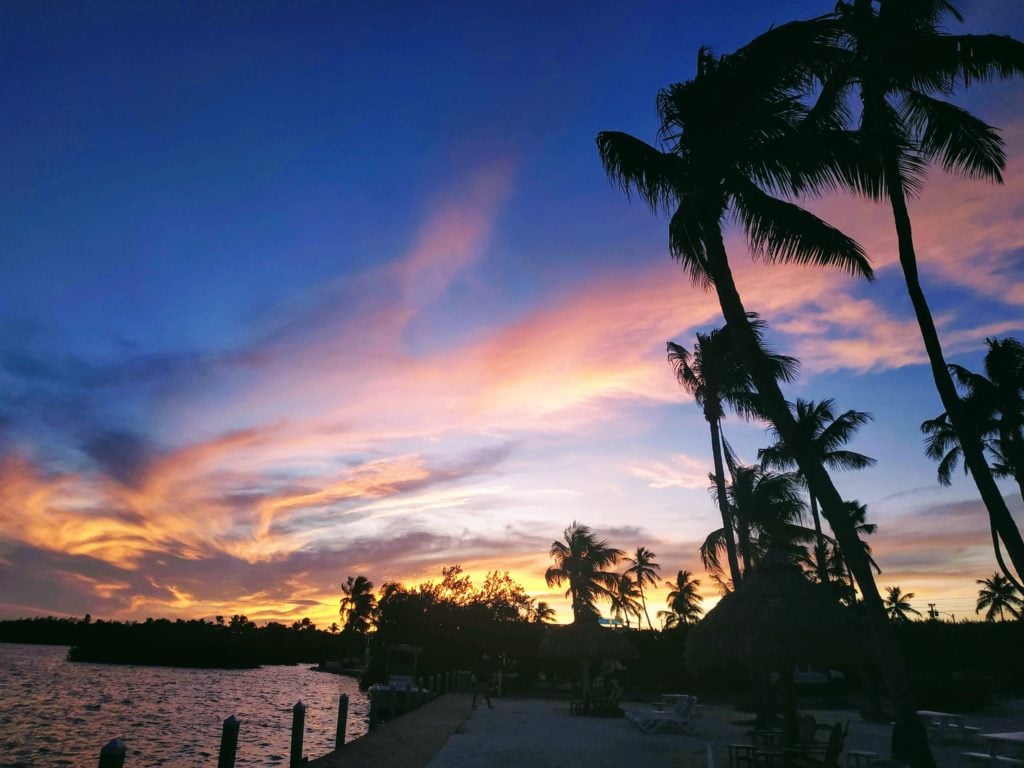
    We end the evening with a gorgeous sunset while watching a thunderstorm across the water in the distance. It was a fun day!  

    One thing is for sure if you travel with me, things are bound to be interesting! This was undoubtedly one unforgettable road trip to Key West. Here are some more ideas for what to do during your trip to the Florida Keys and make sure to discover where to get the best key lime pie in the Keys too.

    Collect Memories, Not Things!

  • Driving to Key West: A Road Trip in the Florida Keys

    Driving to Key West is a sun-filled, top-down, only-in-Florida kind of road trip. Just remember when you’re road tripping through the Florida Keys, that it is about the journey rather than the destination.  Yes, there is plenty to see in Key West, the end of the line for a Florida Keys road trip, but half the fun is getting there.  

    Driving to Key West should be a series of stops in whichever Key grabs your fancy, eating huge amounts of key lime pie, photo ops, and listening to your favorite road trip music.

    Where to Start Your Road Trip to Key West

    My hubby and I just finished a road trip from Orlando to Key West.  We stayed two nights in Islamorada and spent one full day driving to Key West.  We also stopped in Miami and spent a fun-filled day there before heading back to Orlando to catch our flight home.

    I recommend spending at least one night in the Florida Keys and giving yourself one full day to drive to Key West. Here are some examples of non-stop drive times to Key West:

    • Orlando to Key West ~  6 ½ hours
    • Miami to Key West ~ 3 ½ hours
    • Key Largo to Key West ~ 2 hours
    • Marathon to Key West ~ 1 hour

    It’s About the Journey, Not the Destination

    This should be a relaxed road trip, with lots of time for stopping whenever it strikes your fancy, and extra time to spend sightseeing in Key West. I mean, you’ve taken the time to drive all the way there, might as well spend a couple of hours before returning to the car and starting the adventure in reverse.

    Driving to Key West is not a trip of speed. US Hwy 1 is a mostly two-lane highway with lots of traffic.  So you shouldn’t take this trip thinking you’ll speed all the way to Key West. It’s not going to happen.  Enjoy the journey.

    I’ll cover things to do in the Florida Keys, places to eat, and where to find the best key lime pie.  Now put the top down or crank up the a.c. and let’s hit the road!

    Top Things to Do On Your Drive to Key West

    Americana Photo Opsgiant lobster in Islamorada Florida

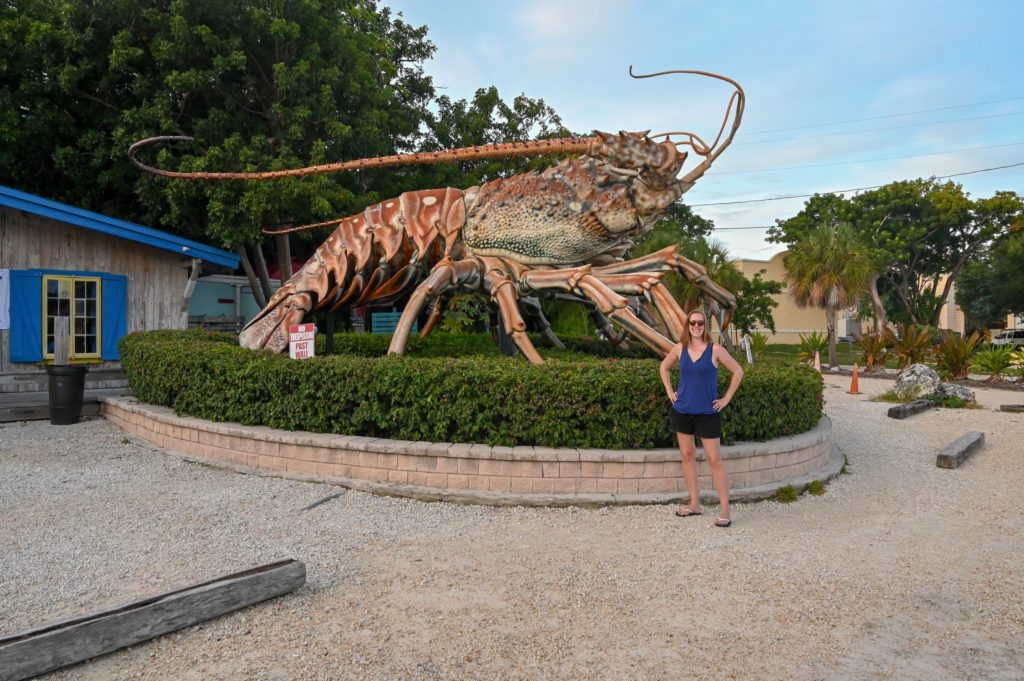
    This is one thing I love to do when taking a road trip in the U.S.! Stop and see the world’s largest ball of yarn, or a giant talking cow, these are a part of the quintessential American road trip.  The Florida Keys have lots of fun ones like this giant crab at the Rain Barrel Artisans Village in Islamorada. Keep a lookout, and you’ll see a billboard-sized mermaid, a large conch shell, and other fun stops to take photos of when driving to Key West.

    Stop at a Park and Enjoy Some Beach Time

    Although the Florida Keys aren’t known for their traditional beaches, you can still find a sandy shore or two to walk along the water, rent kayaks, snorkel the reefs or even go for a swim if you can find a spot deep enough.

    Due to the reef system that protects the Florida Keys, it prevents the large waves from coming in and creating the large sandy beaches most people are accustomed to finding.  Sand is often brought in to develop man-made beaches in the Keys. This barrier of protection also creates a shallow bottom, but there are some areas you can still go for a swim or wade out for deeper waters.

    Don’t forget your sunscreen and also bring water shoes if you have them as the shoreline can be rocky due to the reef system that makes up the Florida Keys.

    John Pennekamp Coral Reef State Park and Bahia State Park are two great choices when looking for a park to spend some time by the water in the Florida Keys.  

    Another beach that makes a great place to go for a swim is Sombrero Beach in Marathon. The park has been completely renovated and is a beautiful park to spend the day snorkeling and swimming. It has bathrooms, showers, playgrounds, picnic areas, and a lovely beach area for sunbathing and relaxing.

    If you prefer, you can always save the beach time for your ride back through the Keys after visiting Key West.

    Feed the Tarpon at Robbie’s in Islamorada

    Stop at Robbie’s on your drive to Key West and create some fun memories feeding the giant silver tarpon. It costs $2.25 to gain access to the feeding dock. You can buy a bucket of fish for $4.00 to feed the tarpon, or you can watch others feed the fish from the pier.  Visit Robbie’s to watch a video of what it’s like to feed a tarpon.

    Robbie’s address: 77522 Overseas Hwy, Islamorada, FL 33036

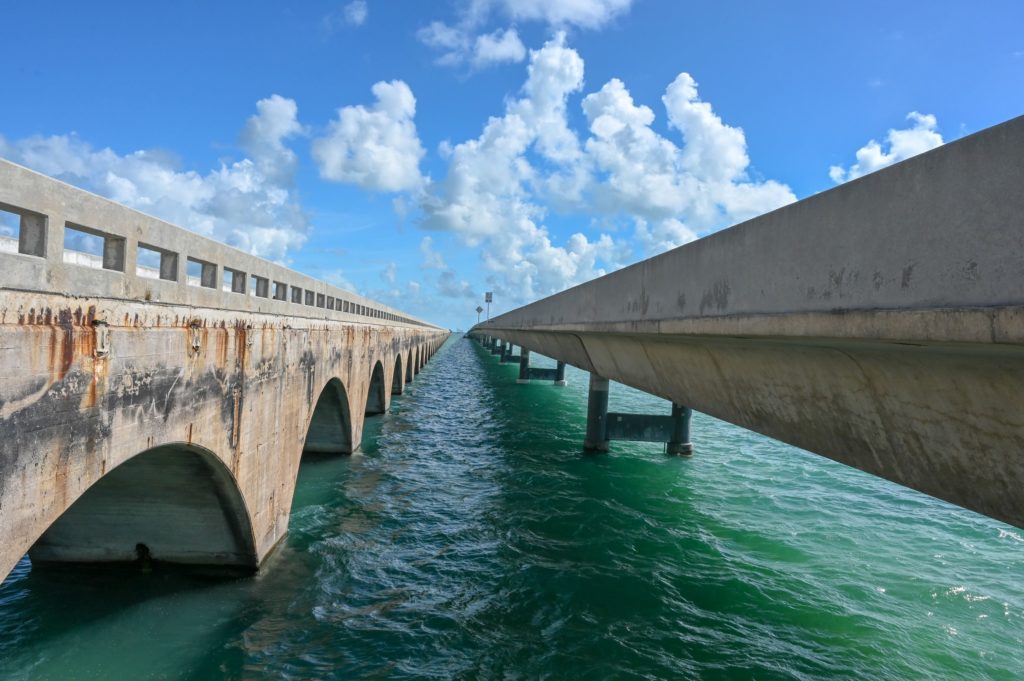
    Walk along the old 7  Mile Bridge. 
    old and new 7 mile bridges in Florida Keys

    Stop on Little Duck Key (yeah that made me smile too) at the parking lot for the boat launch and old 7 Mile Bridge near mile marker 40. The old 7 Mile Bridge is now a pedestrian walkway, and it runs parallel to the new 7 Mile Bridge. Walk along it and enjoy some beautiful views of Little Money Key.  Take time to watch people fishing, look for starfish, sea turtles, and to spot fish swimming below. Enjoy a stroll in the sun in a unique setting you probably won’t find anywhere else.  
    Visit the Dolphin Research Center on Grassy Key

    If you love dolphins, then consider stopping at the Dolphin Research Center and learn about the dolphins they have rescued and the rehabilitation efforts of the facility.  You can also book a dolphin encounter and get in the water with the dolphin.  Depending on your interest level or program you want to do, you’ll need to book in advance and plan for a few hours here.  So keep that in mind if you only have one day to drive through the Florida Keys.

    General Admission Fees: $28 for adults and $23 for kids. Program fees vary with each program you choose.  Visit the Dolphin Research Center to learn more about all the plans they have to offer and to book your experience.

    Dolphin Research Center address: 58901 Overseas Hwy, Grassy Key, FL 33050

    Eat Key Lime Pie at Kermit’s Key West Key Lime Shoppe

    You’ve finally made it to Key West! Your drive to Key West has been a full one so far,  why not congratulate yourself with some key lime pie for a trip well done, or whatever reason you can create to tell yourself its okay to eat another piece of key lime pie.

    I tried key lime pie from breakfast to dinner during my day in the Florida Keys, and Kermit’s was one of the best pieces of pie I ate!  You can read all abut the amazing key lime pie I ate, plus an unexpected, but delicious key lime creation that was a favorite of mine on Where to Find the Best Key Lime Pie in the Florida Keys.

    Visit Ernest Hemingway’s house in Key West

    Ernest Hemingway's Home in Key West

    Take a glance into the life of this famous American writer. Enjoy a break from the sun inside the air-conditioned house of what was Ernest Hemingway’s former residence. Hemingway lived here from 1931 to 1939. 

    The house is full of memorabilia from the many movies inspired by Hemingway’s books as well as his original possessions. One of his typewriters, books he owned and you can peer into his writer’s studio, his own space to create his masterpieces. 

    You can wander around the grounds as well. Look at the refreshing swimming pool, but don’t give in to its call to jump in. The grounds around the house offer lots of shaded spots for sitting and thinking. There is also a bookstore on the backside of the house where you can purchase souvenirs.

    General Admission is $14 for adults and $6 for children. It’s important to note that they don’t accept credit cards for tickets. They do, however, have an ATM by the bookstore in case you need to get some cash for payment. There is also an optional 30-minute guided tour included in the price of general admission.

    Address: 907 Whitehead St, Key West, FL 33040

    Hike to the top of the Key West Lighthouse

    Across the street from Ernest Hemingway’s house is the Key West Lighthouse. You can climb the 88 stairs to the top to get a bird’s eye view of Key West.  This historic lighthouse was built in 1848 and was one of the first to have a woman as its Keeper.  You will have a chance to tour the lighthouse as well as the Keeper’s Quarters and learn a little more about the history of the Key West Lighthouse.

    General Admission is $12 for adults and $5 for kids.
    Address: 938 Whitehead St, Key West, FL 33040

    Walk Around Old Town Key West

    White Church in Key West

    Enjoy walking around town, shopping at the small boutique shops, and admiring the beautiful buildings in Old Town Key West. You can start at Mallory Square and walk down Duval Street to the Southernmost Point. Stop by the historic cemetery or visit Mile Marker Zero.  Old Town is a fun area to park the car and spend your time on foot.

    Tour the Truman Little White House

    Get a chance to see where President Harry S. Truman spent his winters. It seems like a pretty excellent alternative to winter in Washington D.C.! Learn more about this historic house and its use since constructed by the U.S. Navy in 1890.

    General Admission is $21.45 for adults and $10.75 for kids. If you purchase your ticket online, you can save a couple of dollars.

    Address: 111 Front St, Key West, FL 33040

    Stop at the Southernmost Point in the Continental U.S.

    Southernmost Point Key WestEnjoy another photo op, however just know that you may have to get in line to take your photo with the marker stating it is the Southernmost Point in the Continental U.S. There isn’t any shade either.  So you can decide just how important this photo op is to you.

    The Drive Back Thru the Florida Keys

    If you didn’t get a chance to spend some time on the water, now would be an excellent time to visit one of those parks I mentioned earlier.  It’s also a good time to grab some more key lime pie and decide where to watch the sunset.

    Watch the Sunset

    Sunset on Islamorada in Florida Keys

    Wherever you happen to be in the Florida Keys, make sure to enjoy a beautiful Florida sunset. Here are a few options for places to watch the sunset either in Key West or on your drive back.

    • Sunset Tiki Bar and Grille (at the Galleon Resort): 617 Front St, Key West, FL 33040
    • Lorelei Restaurant and Cabana Bar: 96 Madeira Rd, Islamorada, FL 33036
    • Sundowners: 103900 Overseas Hwy, Key Largo, FL 33037

    Places to Eat When Driving to Key West

    Coffee & Breakfast:

    • Midway Cafe & Coffee Bar
      Address: 
      80499 Overseas Hwy, Islamorada, FL 33036
    • Harriette’s Restaurant
      Address: 95710 Overseas Hwy, Key Largo, FL 33037

    Lunch Spots:

    • Twisted Shrimp
      Address: 87745 Overseas Hwy, Islamorada, FL 33036
    • Caroline’s Cafe
      Address: 310 Duval St, Key West, FL 33040

    Dinner Options:

    • Lorelei Restaurant & Cabana Bar
      Address: 96 Madeira Rd, Islamorada, FL 33036
    • Hobo’s Cafe
      Address: 
      101691 Overseas Hwy, Key Largo, FL 33037
    • Santiago’s Bodega
      Address: 7305, 207 Petronia St #101, Key West, FL 33040

    Things to Do if You Have More Than One Day

    Where to Stay in the Florida Keys

    You have so many choices for where to stay.  I’d pick one based on where you’re traveling to next.  Marathon is an excellent choice for a Key close to Key West, but outside the busy Key West party scene.  Islamorada was a great stop for us as we were heading to Miami the next day, so it was a good midway point. If you want choices galore and don’t mind driving the full length of the Florida Keys in one day, then you might research options in Key Largo.

    For a unique option, you might consider one of these Air BnB options:

    Final Thoughts on Driving to Key West

    As I stated at the beginning of this post, driving through the Florida Keys, is not a race to the finish, but more like a leisurely Sunday drive.  It should be full of sunshine and fun stops and road trip memories to last a lifetime. 

    Pack sunscreen, beach towels, extra water, flip flops, maybe a change of clothes, depending on your dinner plans and your favorite road trip music.  I suggest some fun hits like “Ice Ice Baby” to get everyone laughing and then throw in some upbeat Cuban music that’ll have you dancing in your seats.  Smiles for everyone!

    Happy Road Tripping!

  • The Leu Gardens: An Oasis in Orlando

    When visiting Orlando, everyone immediately thinks of the fantastic amusement parks the area has to offer. However, as fun as these amusement parks are, they can be exhausting! So if you need a break from amusement parks during your visit to Orlando, look no further than the beautiful Henry P. Leu Gardens. The Leu Gardens are an oasis in Orlando. 

    Explore the history and culture of Orlando and enjoy a break from the hustle and bustle of the city. The Leu Gardens span 50 acres so although you could spend an entire day trying to cover it all, I will share some highlights from my visit to give you an idea of things you can see in 1-2 hours.

    About the Leu Gardens

    The Henry P. Leu Gardens were donated to the city of Orlando by the former owners Mr. Harry P. Leu and his wife, Mary Jane, in 1961.  However, the history of the garden goes back to the mid-1800s when the first owners settled the land. The final owners, Mr. and Mrs. Leu, purchased the property in 1936. They loved traveling, and they loved plants. They combined these two passions by buying plants during their travels and then bringing them back to plant in their garden. 

    The Leu House Museum is one of the historic buildings still on the property and is a historic landmark with the National Registry of Historic Places. However, the museum remains closed due to hurricane damage until further notice.  The home is still a beautiful place to view from the outside, and I’m sure you could ask the front desk for additional details regarding the families who lived here. The woman I spoke with when purchasing my ticket was so friendly and helpful.

    Leu Garden Favorites

    I happen to be in Orlando with my husband. He is here at a business conference, and I tagged along. After his conference ends, we will take a week’s vacation to explore the Florida coast on a road trip to the Keys.  However for now, I am on my own. I hoped to see a different side of Orlando than just the amusement parks. Someplace the locals go to when they want a quiet spot. The Henry P. Leu Gardens was highly recommended and was just what I was looking for! 

    The following are some of the areas I saw during my visit to the Leu Gardens. I spend almost 1.5 hours here, and I feel like I covered quite a lot during my short visit.

    Tropical Stream Garden

    You enter the gardens by leaving the Garden House (Welcome Center) through the side door. After a short stroll down the path, you come to the Tropical Stream Garden. You feel as though you’ve entered an exotic tropical destination. Vines creep down from trees, the faint trickle of water running over rocks greets your ears, and beautiful tropical flowers and palm trees surround you.

    The Tropical Stream Garden is the perfect way to begin your journey through the Leu Gardens. I immediately felt relaxed as I could stroll at my own pace, no crowds, just a winding shaded path, full of unique plants.

    The path through the Tropical Stream Garden eventually leads you to the Lake Rowena Overlook.  Enjoy a rest under the gazebo, or learn about the various creatures that call Central Florida home. I looked into the lake and watched some turtles swimming below. There are also some beautiful bald cypress trees growing in the water next to the overlook.  We do not have this type of tree in my home state of Washington, and I enjoy seeing new varieties of trees and plants.

    Rose Garden

    After exiting the overlook area, I continued through the Color Garden and into the Rose Garden. The sweet perfume of the roses wafted up to greet me, and I smiled.  I love the smell of roses. It was a subtle aroma, not overpowering, just a light sweetness, perfect for strolling through and spending some time by the fountain.

    Camellias

    I made my way to the Camellia Garden with hopes that perhaps they would be blooming. Their pamphlet states that the Leu Gardens is home to the most extensive documented camellia collection in Eastern North America. It also said that they bloom from mid-October through March.  Well, it is mid-October, however, unfortunately, they were not blooming. I would love to revisit this garden when they are in bloom as I can imagine what a beautiful spectacle they are. There are over 200 varieties!

    I exited the camellias area via the white garden, which, as you can imagine, is filled with plants whose blooms are only white.

    Vegetable Garden

    I stopped in briefly at the Vegetable Garden, in addition to growing a variety of fruit and vegetables here, they also have these delightful statues. Apparently they donate the food harvested from this garden to local food banks.  I think that is such a great idea! I’m a little jealous of Florida’s warm climate and its ability to grow fruit and vegetables year-round. 

    However, as I stand here admiring their plants, sweat is dripping down my face, and it reminds me why I live on the more mild West Coast and only visit warm destinations as an escape from the rain or in rare cases, the snow!

    Butterfly Garden

    The butterfly garden is just a few short steps away from the vegetable garden.  I was thrilled to watch the various butterflies flit about, sometimes in pairs, and often by themselves.  They dash about in random patterns, and at times, I have to duck to avoid them hitting me. I worked hard to try and capture this photo of one who landed long enough for me to photograph it. 

    monarch butterfly in leu gardens

    There are plaques placed in this area of the garden that teach you interesting facts about these beautiful creatures.  And they have butterfly cocoons inside a small glass enclosure so you can see the various colors of cocoons each butterfly has. This was so cocool! Sorry, I just had to go there.

    Floral Clock

    I left the Butterfly Garden and passed once more through the Rose Garden on my way to see the Floral Clock.  This working clock was donated to the Leu Gardens by the Kiwanis Club of Orlando in 1975. It was inspired by the first-ever floral clock in Edinburgh, Scotland, commissioned in 1903. The Leu Gardens floral clock varies in appearance, depending on the season.

    Palms, Cycads & Bamboo

    I was ready for another break from the sun, so I wandered into the Palms, Cycads & Bamboo Garden. The plants in this section date back to the prehistoric era. I’m sure everyone is familiar with palm trees. However, I often confused cycads for a type of palm tree plant.  They are, in fact, different. 

    Cycads are cone-bearing plants not related at all to palm trees. I would describe them as fern-looking palm trees. Meaning their leaves remind me more of ferns than palm tree leaves. Bamboo is so unique and regal looking, and this section makes a great way to enjoy time in the shade and marvel at these unusual plants.

    Leu House Museum

    As I mentioned above, the Leu House Museum is closed currently for renovations due to hurricane damage. However, you are welcome to walk around the house and admire the lush setting of the surrounding gardens.  I am not sure how different the gardens look now when compared to when Mr. and Mrs. Leu lived here. However, I like to imagine it must have been a marvelous place to live.

    Don’t miss the path lined with old oak trees, it is not far from the house, and you should pass by it on your way from the Palms Garden to the Leu House Museum. These beautiful oak trees are scattered throughout the Leu Gardens, and many of them are over 200 years old!

    Additional Areas in the Leu Gardens

    Although my path through the Leu Gardens might resemble that of a butterfly, I covered a lot of ground.  I passed by many beautiful gazebos and fun sculptures. There is an Idea Garden that demonstrates a variety of designs that will perhaps inspire your garden.  And there is also an Arid Garden which displays plants from deserts. No irrigation is used in this garden. So it offers a good demonstration for gardening in areas of drought — or perhaps for people like myself, who forget to water.

    Art Exhibits at Leu Gardens

    In addition to the gardens, the welcome center has a rotating art exhibit.  While I was there, they had a colorful display of watercolor paintings by local artists.  My morning spent admiring local art, and strolling through the gardens was just what I needed. I felt I had a morning of culture and beauty that left me ready to rejoin the city and my subsequent ride in traffic. 

    Other Activities at Leu Gardens

    As if the gorgeous gardens and art exhibits weren’t enough, the Leu Gardens also offer concerts in the park and movies in the park.  So make sure to check their calendar when you visit as you might find some new ways to create memories during your visit to Orlando.

    If you happen to visit with kids, there is a geocache hidden within the gardens.  Kids and adults alike will enjoy geocaching, which is essentially like a digital scavenger hunt, sometimes they have clues, but usually, you track the coordinates on your phone using a compass.  Geocaching.com provides the details on which app to download. It also shows the many geocaches hidden throughout the area. It is something fun your family can do together, whether at home or when traveling.

    Useful Information

    Admission Fees: It costs $10 for adults 18 and older. Children 4-17 are $5, and children three and under are free.  Additionally, you receive a wrist band so you can come and go throughout the day.

    Food: There is no food sold on-site. However, you can bring your lunch and eat it on the patio overlooking Lake Rowena.  Or, as I mentioned, you can always leave, grab something to eat or take a break from the heat and then return later in the day.

    Henry P. Leu Garden Hours: The Leu Gardens are open every day from 9 a.m. to 5 p.m.

    Other Amenities: There is a small gift shop located in the welcome center as well as a library filled with books on botany and gardening.  You are welcome to sit inside the air-conditioned space and read during your visit. It is also good to note that there are multiple water fountains and restrooms throughout the gardens.

    It was so lovely to take a break and see some of the culture and beauty of Florida.  Amusement parks can be fun, but it is always good to take a break from the tourist attractions and visit a place the locals enjoy going to. I hope you will take the time to visit the Henry P. Leu Gardens on your next trip to Orlando.  It is worth the visit!

  • Gold Creek Pond and Autumn Surprises

    If you’re looking for an easy trail with beautiful views, a picnic area, ADA accessible and close to Seattle–look no further! The Gold Creek Pond Trail is a 1.1 mile loop trail that circles the Gold Creek pond. It is a relatively flat, paved (with a few boardwalk bridges) trail that circles this very large alpine lake of a pond. Keep reading to discover why this trail is worth the trip!

    A Little History About Gold Creek Pond

    As you look at the photographs of Gold Creek Pond, try to imagine that back in the ’70s and ’80s, this pond didn’t even exist.  Instead, this area was a gravel pit supplying the construction of the I-90 freeway. Since that time, a restoration project began and is still underway, to develop the area around Gold Creek. It is such a beautiful location now, as you look out over the water, it is incredible to see the transformation from pit to pond.

    A Snowy Surprise

    The night before I visited Gold Creek Pond, I had plans to take my camera and go hunt down some fall foliage.  When I got up the next morning, my phone’s weather report showed it was 36 degrees out!  Let me tell you for Seattle fall weather–this is cold!

    Honestly, one of the things I love about the Seattle area is our mild weather.  Typically in early October, it is often sunny and in the 60s! I had initially planned on driving to Leavenworth; however, with my late morning start, I knew I’d need to adjust my plans. Gold Creek Pond Trail was on my radar for a while, and it was only an hour’s drive, so I decided to head there.

    Imagine my surprise when I discovered Snoqualmie Pass (Gold Creek Pond is near the summit) had snow! Snow. And it’s barely October! This was odd, but I figured if I didn’t get any photos of fall colors, at least I’d get some snowy fall photos?

    Gold Creek Pond Trail

    After you arrive at the parking lot, you will see a pit toilet on the right and an information board in the center. Follow the path to the left of the information board. Soon you will arrive at the above trail sign. 

    If you go right, this will also lead you to the trailhead for Gold Creek Trail, which takes you to the Alpine Lakes Wilderness Area. However, for this hike, you can go either right or left as you make your loop around the pond. If you come here for a picnic or BBQ, go left as this is the quickest way to the picnic area.

    There are a couple of small wooden bridges that you will cross as you make the 1.1-mile loop around Gold Creek Pond. The wooden planks were icy when I visited, so I took it slow when crossing. If you make the loop counterclockwise, as I did,  you will walk alongside Gold Creek through a wooded area before seeing Gold Creek Pond.

    As I walk, I hear the sounds of the water rushing over the rocks in the creek. The crunch, crunch of snow under my feet, and the faint laughter of someone on the other side of the pond greet my ears. I smile at the beauty this odd snow day had brought.

    One of the wooden bridges you will cross on the loop trail around Gold Creek Pond.

    Making Friends on the Trail

    About halfway around Gold Creek Pond, I came across the two hikers who I had heard earlier. They laughed and had fun as they splashed water and captured it in slow motion with their cell phones. I like meeting people on the trail and seeing their enjoyment of nature.

    informative sign about beavers in Gold Creek Pond
    There are a few informative signs scattered around the trail.

    Later I met a lovely woman who was out hiking with her dog. She said she comes out here during each season and takes a photo.  In wintertime, she uses crampons or snowshoes and said it is beautiful to see then too.

    Then I met a photographer who was seizing the opportunity to find snowy mushrooms, something you wouldn’t usually see.  And later towards the end of the loop trail, a nice man and his wife let me know when I crossed the creek that if I looked down, I could see salmon swimming below.

    So you see, besides enjoying the beauty of nature, you get to meet all sorts of friendly people. It’s a perfect way to relax and remember what a beautiful world we live in.

    fall colors and reflections in the water of gold creek pond
    Make sure to walk out to that tip by taking a short trail that splits off the main one just past the beaver sign.

    Taking Time to Soak in Nature’s Beauty

    Make sure to locate one of the many benches scattered along the trail. There are a few right next to the water that would make the perfect resting spot.

    And if you’re lucky, you might even spot a great blue heron. You are almost certain to see ducks and Canadian geese and of course, the frequent sightings of a mischievous squirrel or two.

    snowy bench by the water at Gold Creek Pond
    Perhaps another time when winter hasn’t beat me to the seat.

    Getting to Gold Creek Pond Trailhead

    It’s only about a 1-hour drive from Seattle to Gold Creek Pond. And what a beautiful drive it is!

    • Take I-90 E to Exit 54 for the Hyak ski area.
    • Turn left at the stop sign.
    • Make a right at the first road passed the I-90 on/off ramps (Forest Service Rd #4832).
    • Drive parallel to I-90 for about 1 mile before making a left at the sign for Gold Creek Rd and Trail.
    • Then continue another quarter mile before making a left onto the pavement and into the parking lot.

    Useful Information

    Road Conditions: The road leading to the trailhead parking lot is a dirt road that is full of potholes. So take it slow, and you should be fine. Once you make the final left, it returns to a paved road as you enter the parking area.

    Parking/Fees: You need a Northwest Forest Pass to park here.  Please note that in the winter, a Sno-Parks permit is required — which is different from the Northwest Forest Pass. If you don’t already have a Northwest Forest Pass, you can purchase a day pass at the parking lot trailhead. For winter use, buy the appropriate sno-parks permit ahead of time.

    Trail access: Gold Creek Pond Trail is ADA accessible, and I saw one woman in her motorized wheelchair here, even with the snow! Some parts of the trail, when I visited, were overgrown a little on each side, so the path got a bit narrow. I love that we have this beautiful trail accessible to those with mobility issues.

    Facilities: There is a pit toilet at the trailhead. Make sure to bring your hand sanitizer, as there was none provided when I visited. On the left side of the pond, you will find a large picnic area with lots of picnic tables and even a few grills scattered here and there.

    Don’t miss this beautiful and family-friendly trail. It is a short drive from Seattle, and if you have extra time and want to explore more of the Snoqualmie area’s beauty, make sure to stop and see the Snoqualmie Falls.

    Happy Trails!

  • Nolte State Park: A Pacific Northwest Secret

    Nolte State Park is a hidden gem in the Pacific Northwest.  This Washington State day-use park makes a perfect place to get away for a few hours or even the whole day! When you feel like you need to escape the hustle and bustle of the city it provides the perfect natural setting to get away and think. And when you want a park to take the whole family to for some fun in the sun, Nolte State Park makes the perfect choice!

    Below I list all the activities you can enjoy at Nolte State Park, and I hope you will take the time to visit it soon. You will feel like you have stumbled upon a retreat in the woods. It might even become your new favorite park, and perhaps you’ll want to keep it a secret too!

    Activities at Nolte State Park

    Feel free to click on links below and jump ahead to the various activities and information found in this article.

    I had heard of Deep Lake and Nolte State Park for years. However, I had never taken the time to visit it.  Then this year, my hubby and I purchased some inflatable stand up paddleboards (SUPs). So I started researching some places we could try them out around the Seattle region, and that’s when Nolte State Park popped up on my radar again. I am so glad we decided to check it out! It is such a beautiful lake for both stand up paddleboarding and kayaking. Please note that only non-motorized boating is allowed on Deep Lake.

    Besides boating around the lake, if you enjoy fishing, Deep Lake is a stocked lake that is open to fishing year-round. You can catch rainbow trout, cutthroat trout, kokanee, yellow perch and more.

    The first day we paddled out on our stand up paddleboards here, fish were jumping everywhere!  Honestly, I was a little concerned one might jump up and knock me off my SUP! Now that would have made for a good story!

    In addition to bank fishing, Nolte State Park also has a fishing dock, and of course, you can always bring your non-motorized boat for fishing too. The dock can sometimes get busy with other anglers and in the summer it is often commandeered by a large crowd of kids who test out their cannonball skills. So finding a spot along the bank is often the best choice. 

    If you prefer an activity that doesn’t require getting wet, take a peaceful stroll around Deep Lake. You will find the start of the 1.4-mile loop trail by following the path that goes alongside the playground area. I really this trail. It feels as though I’m miles away from the city as I listen to the wind gently blowing in the trees. I admire all the beautiful trees and meander down so many of the side paths that lead to the lake, that a man once lapped me 3 times!

    One thing I love, is that this trail makes for a beautiful walk no matter the time of year.  Even on a rainy day, you can just put on your raincoat and enjoy a quiet walk in the rain. Make sure to have fun exploring all the different side paths that take you down the lake.  Pick one and find your favorite thinking spot or perhaps your favorite fishing spot. Pull up a rock and enjoy the sound of wind rustling through the trees. 

    If you have kiddos who need to run off some energy, why not do a few laps around Deep Lake. Allow them to expend some energy while getting a little fresh air. There are multiple benches along the way for resting or for enjoying the serene surroundings. Also, the gravel path is stroller friendly!

    However, if you have mobility issues that make the path too rough for you, there is a short paved path alongside the large picnic area that has views of the lake and a grassy area with lots of picnic tables and grills that overlook Deep Lake.

    In addition to boating, fishing, and hiking, there is also a horseshoe pit and a kids’ play area. And there is a small field next to the kids’ play area where you can toss a frisbee or football. There is really everything you could want to create a day full of memories.  We created fun memories with our nephews and niece. They loved swimming, boating and fishing — all in one day!

    Reservable Group Shelters

    Nolte State Park also has large kitchen shelters that can be reserved for groups ahead of time, and there are BBQ grills at almost every picnic area. Most BBQ grills are located in the central area overlooking the lake, but there are also a few on both sides of the lake, so make sure to look around and find the perfect spot for you and your group.

    Fees: You need a Discover Pass to park at Nolte State Park as it is a part of the Washington State Park system. You can purchase a day pass at the park for $10 or buy an annual pass for only $30.  I think the ability to go to all of Washington’s State Parks as much as I want for a year is worth the price. Skip a few trips to the coffee store, or purchasing your favorite snack for a month, or whatever.  

    And if the budget is still too tight, make sure to check out the WA State Park website for their free park days. They have multiple days throughout the year, where no Discover Pass is needed.

    Swimming in Deep Lake: There is no lifeguard on duty. There is a rapid drop off after you enter the lake when it becomes deep. Make sure all kids (and anyone who isn’t a strong swimmer) have life vests on at all times.  It would be far too easy for a child to drown here as there isn’t much of a shallow entry before it becomes too deep to touch bottom. So please take the necessary safety precautions to ensure everyone has a fun and safe visit!

    Nolte State Park Hours: 8 a.m. to dusk

    Fishing at Deep Lake: A Washington State fishing license is required to fish here for anyone 15 years or older. Visit the Washington State Department of Fish and Wildlife for further information.

    Restrooms: There are multiple restrooms with sinks and soap. Additionally there are drinking water spouts in a few different spots around the park.

    Nolte State Park Address: 36921 Veazie Cumberland Road, Enumclaw, WA 98022

    From Seattle: 

    Take I-90 E to Exit 17 for Front Street/Issaquah-Hobart Road Southeast, turn right onto Front Street and follow this road for almost 9 miles, (Front Street becomes Issaquah Hobart Road), continue following the road for another 5.5 miles as it becomes  276th Ave SE, and then also Landsburg Rd SE. Then turn left at the 2-way onto SE Kent Kangley Rd and follow for about 1 mile before making a slight right onto Retreat-Kanaskat Rd/Retreat Kanasket Rd SE. 

    Stay on this for about 3 miles before turning right onto Cumberland Kanaskat Rd/Cumberland Kanasket Rd SE. After about 4 miles this becomes Veazie-Cumberland Road SE, continue anther 1.5 miles before making a right into the main entrance (pass the boat launch entrance) for Nolte State Park.

    From Tacoma:

    Take I-5 N to WA-18 E towards Auburn. Then take the WA-164 E exit toward Enumclaw and turn left onto WA-164 E/Auburn Way S. Stay on this for about 7 miles. Then turn left onto SE 400th St/Krain-Wabash Rd and follow for another 7 miles before making a slight right to merge onto SE 392nd Street. Continue for about a mile before making a left onto Veazie Cumberland Rd Se. After about 1.5 miles make a left into the Nolte State Park entrance.

    During the summer, Nolte State Park can be very busy. So plan to come early in the day to get a parking spot as well as pick out your area on the beach and picnic area if you want to barbecue. And if you have a large group, make sure to reserve a group shelter ahead of time. There are a few parking spaces on the shoulder of Veazie Cumberland Rd SE if the parking lot is full.

    Take a little walk down the paths along the sides of the lake to see if you can find a picnic table nestled in the trees or closer to the lake. I think as you come here and explore the path around Deep Lake, you will soon discover “your” spot.

    Don’t forget to pack sunscreen and possibly bug spray. I haven’t had an issue with bugs here, but you never know! If you do forget something, Enumclaw is only about 7 miles away. 

    Pack it in and pack it out. Please make sure to pick up all your garbage when you finish enjoying your time here. I appreciate the efforts that the park’s custodians go to, to keep this park so clean, so let’s all do our part too!

    Bench next to Deep Lake
    One of the best activities at Nolte State Park is finding a bench and enjoying the views!

    Nolte State Park makes the perfect getaway for the day. Bring your family and friends and spend the day creating fun memories by the lake.  Oh, and if you’re lucky, you won’t have any cell service here either. So you really can get away from it all! 

    Enjoy making memories!

  • Misadventures Riding the Washington Backcountry Discovery Route

    I attempted the Washington Backcountry Discovery Route sections 4, 5 and 6 in early September.  You will learn more about why I say “attempted” as you read along.  The Washington Backcountry Discovery Route (WABDR) is 575 miles of (mostly) off-road riding that goes from the Oregon/Washington border to the Washington/Canadian border.  

    Read how I planned and what I packed. And if it is your first time planning a similar ride, I hope you will learn from my mistakes.  In this post, I will journal our experiences on this motorcycle adventure, my expectations before the trip and my confrontation with reality after day one of our journey.  

    Meeting Our Group the Night Before

    I am riding sections 4, 5 and 6 of the Washington Backcountry Discovery Route with my hubby, brother, and sister-in-law. Section 4 covers backroads from Cashmere to Chelan. Section 5 is Chelan to Conconully, and Section 6 is Conconully to the border crossing at Nighthawk. These three sections total to approximately 273 miles. We plan to spend one day riding per section.

    My hubby and I rode over from Seattle Tuesday night after work to meet my brother and his wife in the town of Leavenworth, Washington. We reserved a campsite and planned to get dinner with them before getting some rest for our ride on Section 4  the next day. We had a great evening hanging out in Leavenworth, and everyone’s spirits are high and our hearts full of adventure.

    Day 1: Section 4 of the Washington Backcountry Discovery Route

    I was up around 6:30 a.m. No one else is awake, so I walk up the road to get coffee. Typically when we go camping, I make coffee at camp, but today’s campsite is conveniently located down the street from Starbucks. The campsite is still quiet when I return, and no one else is up yet.  I read, and I journal, I drink more coffee and finally decide to wake up my husband. It is now almost 7:45 a.m., and the rest of the group is finally getting up.

    This is the first in a series of lessons where my expectations meet reality and lack of planning.  I should have discussed with the group, the night before, what time we all thought we should leave. Then set the alarm and made sure everyone was up and getting ready on time.  However, I assumed that the day’s ride would only take 4 or 5 hours, so I wasn’t panicked. That was lesson two in setting expectations.

    We decided (against our better judgment) to go into town for breakfast. By the time we got into town for breakfast, it was already after 10:00 a.m.  I knew we should have just eaten at camp or stopped at a place along the route, but again, I thought today’s ride wouldn’t be that long.

    So long story short, we don’t end up starting the ride until almost noon!  Yeah, that was a big mistake!  

    In the Beginning, There Was a Puddle

    In the few days preceding our ride, the area had received heavy rain and flash flooding.  So shortly after starting the off-road portion of Section 4, we run into the mother of all mud puddles.  Think crater filled with water and mud. Then after you cross said crater, you must traverse along a thin stretch of dirt like a tightrope walker to avoid getting stuck in the large muddy ruts on each side.  The grooves were so deep in places that if I were to get stuck in them, my panniers would hit the sides of the rut.

    Hubby is in the lead, and he makes it through the mud puddle (crater) and safely to the other side.  I, however, stopped at the edge of the mud crater– that was a mistake. And then I let that pit get in my head and psych me out — another mistake.  My brother gets out of his 4Runner to give me some pointers on crossing the puddle. He offers to ride it for me, but I say no, I need to do this myself.  So I proceed to descend into the muddy pit only to shortly thereafter lay the bike over.  

    Puddle Wins 1-0

    My husband said he heard “glub, glub, glub” on the communication system.  Yes, that was me and my helmet immersed in muddy puddle water. I ask my brother to get my bike up quick. The last thing I want is for it to take in water.  So he gets in and soaks his feet and legs to help me get my bike up. He’s a good big brother. I’m unhappy at this point and frustrated with myself for letting this puddle get the best of me.  And I am also not happy about just starting the ride and being soaking wet!

    But, I get back on my bike, and now I am staring down the deep ruts on either side, willing myself to look forward to where I want to go and not at those deep ruts where I don’t want to go!  (There’s probably a life metaphor in there somewhere.) My brother once again helps me, as I’ve slid into a rut, and after he helps me out, I make it safely across to where my hubby is waiting.  

    Oh, and a quick note about our communication devices. We purchased Sena SMH10s for this ride, and we loved having comms! It was invaluable to be able to communicate directions and needs while riding.  Additionally, besides the mud puddle, we also road in heavy rain on our way back to Seattle and the comms seemed unaffected.  I highly recommend you consider a communication system when doing a group ride.

    If A Tree Falls In the Forest

    And now the irony of it all, no one thought to take any pictures of the muddy crater, the huge ruts, me dripping wet, nothing.  So I ask you: If you ride off-road and take a plunge in a huge mud puddle, but no one captured it on camera, did it even happen?

    Little did we realize, but the puddle was just a taste of what this day would hold. There were more deep grooves and washouts, rocky ascents and descents, road closures and detours all culminating in a dark and rocky ride down to the town of Chelan.

    Chumstick Mountain Summit to Ardenvoir

    We make it to the summit of Chumstick Mountain, elevation 5,810 feet and take a break and enjoy the views.  Our spirits are high, and we’ve had a great time riding thus far.  Each puddle I’ve encountered since “the” puddle has been easily crossed or avoided, and we’ve been gaining confidence and experience. I’ve heard “whoops” and “wahoos” over the comms and enough corny jokes to last a lifetime.  This is what the journey is about.

    As we enjoy our break, we notice a fire in the distance, and we hope that we won’t need to ride through it. We don’t and are happy about that. We eat a snack and continue our ride to the next waypoint in the town of Ardenvoir.

    As we are about to hit pavement for our ride into Ardenvoir, a “road closed” sign is blocking our path.  We followed the detour signs, and it felt like we were backtracking in the direction we had already come. After the initial detour, we came to another fork in the road with another detour sign. According to the map, the detour would not take us where we wanted to go, so we continued straight to stay on NF-5801. It was around 1 to 1 1/2 hours later that we arrived in the town of Ardenvoir. 

    The gas station is closed, because, you know, it’s Wednesday.  So we decide to keep going. It is now about 5:30 p.m. as we start our ascent of over 4,000 feet to reach McKenzie Ridge. After that, we will ride down Slide Ridge and hopefully reach Lake Chelan before dark.

    McKenzie Ridge Meets Misguided Expectations

    Oh, the optimism and the naivete I held at that moment. I was sure we could make it to Lake Chelan before dark.

    As we reached McKenzie Ridge, we saw beautiful views of Lake Chelan. And it filled us with hope. We could see our destination, and it felt closer than it actually was.

    The lake calls to us as we begin our descent down Slide Ridge, telling us, we were close. We were not close enough. Soon daylight turned into dusk and dusk to darkness.

    Riding in the Dark

    We continue our ride down the mountain in the dark, passing primitive campsites along the way. I call out to my hubby, who was in the lead, “we can camp here.” He continues riding, his reply, “I just want off this mountain.”

    We are exhausted and sore and riding down that rocky road full of ruts took every ounce of concentration and strength. On top of that, my husband’s rear brakes overheated and were no longer working. This meant he had to use a combination of riding his clutch and applying soft front brake pressure in the steep areas. 

    I, on the other hand, had not taken the time to clean my visor from my initial fall in the mud puddle. So I was riding with my visor up, all the while praying that those bats that kept flying across my path would not fly into my helmet.  Standing up in the rough parts now took every ounce of strength I could muster.

    We skip the optional “jungle” on section 4 and take the easier alternate route down.

    I thoroughly regretted my foolish assumptions at this point. Assuming things would take less time and assuming our skill levels were higher. I was feeling bad that I had pressured my hubby into continuing the ride from Ardenvoir when he had doubts about it — and desperately wanting to get off the mountain safely.  Off-road motorcycle riding at night was not part of the plan.

    Pavement Oh Sweet Pavement How I Missed You

    We rolled into our campsite at Lake Chelan State Park around 10:30 p.m. After over 10 hours of riding, we were never so happy to see pavement as we were that night. I didn’t know if I’d be able to walk the next day. I was completely spent.

    Riding is a workout, and riding off-road is both physically and mentally demanding.  Choosing your lines and hours and hours of standing and sitting (think of doing squats for an entire day) and being pounded by rough and rocky road conditions. Even my brother and sister-in-law in the Toyota were feeling it. 

    I realized that day that I was not in the physical shape, I needed to be in, and I overestimated my stamina and ability. I should have planned to camp on the mountain and split section 4 into two days rather than one. We are beginners, not seasoned adventure riders.  What I want to be and what I was at that moment were two very different things.

    We set up camp in the dark, my brother quickly grills up some hot dogs, and we crawl into our sleeping bags.

    Day 2: Section 5 of the Washington Backcountry Discovery Route

    We get up around 7:00 a.m. this morning. I can move, and I can walk, so I’m thankful for that.  My quads are really feeling the workout from yesterday. My brother fixes some pancakes and eggs on his grill, while I get the coffee going.  We eat and then pack up camp before taking a quick stroll down to the lake.

    It’s after ten, and we’re finally leaving camp.  However right after leaving, we discover the communication devices aren’t working correctly and neither is the GPS.  We fuel up and re-sync the comms again. The GPS signal keeps dropping.  We continue driving in the direction of Section 5, and my sister-in-law tells me thru the comms that it keeps saying, “GPS signal lost.” 

    Then it said re-routing when it connected again. So we turn off where the GPS instructs us, and soon we hit gravel roads. We stop again to re-sync the comms as my brother can hear me, but I can’t hear him.  GPS is still acting up, but we’re just going to try to follow the line on the map.

    The Road Less Traveled

    The ride starts with a grated gravel road and then turns into a fun climb up dirt roads. The stress of the previous night is behind us as we enjoy riding along this new path. There’s nothing quite like standing on your bike, wind in your hair, and a little dirt under your tires.

    Soon we hit a section of road that looks like no one has ridden on it for a very long time.  We climb up a rocky section with ruts on either side only to reach an overgrown jungle of a road where we decide to stop and regroup. 

    This does not feel like the right path.  While I get out the paper map (something I should have done at camp before leaving), my brother decides to walk the trail a bit further. Soon he comes back and says, “uh I don’t think we’re going any further.”

    Let me tell you right here, if my brother has doubts, then it is absolutely a no-go for me.  He has years of off-road riding experience and is known to do some crazy stuff, so I listen when I hear any tiny whisper of doubt coming out of his mouth.

    Off Road Motorcycle Trail in Washington
    Something tells me this is not the road we are looking for. You can’t see from the picture, but on the left, there is a drop-off. The Toyota has “just” enough space to get by the tree on the right, but its tires would have to ride the edge that is already sloughing off. Not worth the risk. Not to mention the road doesn’t improve beyond this point.

    I look at the map, and I say “we’re here and you see this road, way over across the mountain, yeah that’s the road we’re supposed to be on!”  The GPS re-routed us to link up to the original road, unfortunately, the path we’re on, isn’t used by anyone other than cows, so it’s a no-go for us.

    We come to the unfortunate conclusion that we must now turn around and go back to the highway to start again. We will discuss what to do once we make it back down.

    Tough Decisions

    We’ve finally returned to the highway where we missed the correct turn off for Section 5 of the Washington Backcountry Discovery Route. It is around 2:30 p.m., and we are still tired from the previous day’s ride.  Due to our time limitations, current physical state, and desire to be safe; we decide to skip Section 5 and instead ride up to Omak via the highway. 

    We aren’t happy about the decision, but we know it is the right one for us at this time. It is too late in the day to complete section 5, and we did not plan enough days to allow for an extra day of camping and riding.

    So we ride to Omak where we’ll spend the night and get our gear ready for the final section of the Washington Backcountry Discovery Route, Section 6.

    Day 3: Section 6 of the Washington Backcountry Discovery Route

    Three Off Road Dual Sport Riders near Conconully Washington
    We stop on Section 6 near Conconully, to fix our gear and have a little fun.

    My brother and his wife are riding his KLR today. Since we will not be camping, he doesn’t need to bring the Toyota.  In the future, he’ll purchase panniers so he can camp off his motorcycle too.

    We eat breakfast and fuel up.  Then start the ride around 9:30. We don’t need our GPS or maps today as my brother has covered practically every road in the mountains surrounding the Omak area. He knows today’s route forward and backward.  I mean he knows where the dips are and where the mud pits are. If anyone needs a guide to ride in the Okanogan Valley, he’s your guy.

    We ride up to Conconully to the start of Section 6. It’s getting cold, and we all stop to zip up the vents on our clothing and add any layers for the cooler temps.  Then we keep going. Soon we reach the top of Lone Frank Pass, elevation 6,667 feet. It’s a bit windy up here, but there are beautiful views of the mountains and fire-damaged forests below. 

    Lone Frank Pass Forest Roads for Off Road WABDR route
    Looking down the road at Lone Frank Pass.

    Skull and Crossbones Road

    Continuing on we soon reach the turn off for the Skull and Crossbones road.  It sounds ominous, but it’s not so bad. We stop at the Skull and Crossbones cabin, which collapsed during the previous winter, it is still a nice stop for a photo opp.  Then we continue our journey. Not too far after the Skull and Crossbones cabin, my brother tells us that we will ride through a mud pit.

    The bikes got a bit squirrely riding through this slick section of the road, and after I make it through safely, I say “wow, why does it smell like manure?”  My brother then lets us know that the “mud” isn’t just mud… We were all grateful none of us took a plunge in the “mud.”

    Skull and Crossbone Cabin on WABDR
    What’s left of the Skull and Crossbones Cabin.

    The Final Stretch

    The Skull and Crossbones Road eventually connects to a little bit of pavement before returning to a gravel road.  My brother takes us on a slight detour to see the local “Christmas tree” near Tiffany Springs. We look at the “ornaments” before returning to our route. 

    We come up behind a herd of cows running down the road in front of us.  Although I am not afraid of a cow, I do know they are still animals, and with that comes some unpredictability.  My brother coaches me to pick one side of the road and continue at a steady pace. He said I would be “herding the cows,” and they will move to one side.  He was right, as I stayed to the right, they moved to the left and allowed me to pass safely.

    Soon we can see the town of Loomis below us as well as part of Palmer Lake. It is a fun and easy ride back down to the pavement. 

    Palmer Lake from above
    A view of Palmer Lake.

    After returning to the paved roads below, we make a left and continue our ride around the beautiful Palmer Lake. There are a lot of neighborhood deer in the Palmer Lake area, so watch out if you ride that section.  It’s a short ride around the lake, and soon we are pulling into the old mining town of Nighthawk. We stop to take a few pictures on the town bridge. 

    The river in the town of Nighthawk Washington
    Looking over the river in the town of Nighthawk.

    We continue down the road before making a left turn for the Canadian border crossing and also the end of Section 6 and the Washington Backcountry Discovery Route. We take a snack break before driving down into the town of Oroville and ultimately making our way back to Omak for the night. It is the end of one journey, but there are many more to come.

    Canadian border with dual sport motorcyclist
    The Nighthawk Washington/Canadian border and the end of the WABDR.

    Setting Realistic Expectations

    I overestimated how simple the ride would be and underestimated the time it would take to complete each section.  I imagined we’d roll into camp late afternoon, relax,  chat about the day’s ride, eat dinner and get a good night’s rest. And I was so wrong. I should have assumed it would take us longer, that it would be harder and that we would be far more tired each day than I could have imagined.

    My assumptions about the ride and us as riders were faulty. I made mistakes. However, I’ve learned from them.  I am a more experienced rider now than I was before we started riding the WABDR. I will plan better for trips like this in the future.  And I will set better expectations and better communicate to my group the miles for each day and what time I’d like to leave each morning, etc.  

    That said, we have a great time!  We had laughs, we got dirty, and we saw beautiful scenery–we had an adventure! The best way to turn a misadventure into an adventure is your attitude.  Always keep a positive attitude, and you’ll always have adventures.

    Lessons Learned On the Washington Backcountry Discovery Route

    If you are new to off-road motorcycle riding or riding an adventure motorcycle off-road, then give yourself extra time.  Extra time to rest, recover and to enjoy the trip and the scenery. Riding is about the journey, not the destination.

    • Assume the ride will take longer. 
    • Set the time you want to leave by each morning and do your best to stick to it.
    • Review the map and route the morning of the ride.
    • Allow extra time for fun, relaxing, and resting.
    • Prepare physically for the ride, months in advance, if possible.
    • Add an extra day or two for detours, emergencies, and other setbacks.
    • When it stops being fun, take a break, and camp for the night if needed. Then start fresh in the morning.
    • Take more photos.  Get a helmet cam. Document the experience.  Most people who don’t ride won’t understand what you mean when you say a “steep rocky descent.” Or when you say “big ruts” or “a huge puddle.”
    • Drink more water along the way.
    This trip has been a fun learning experience. I am a more experienced rider now and I faced my fears and pushed myself further than I thought I could.  I don’t regret the rough stuff, and I am proud of myself for what I accomplished and look forward to completing the Washington Backcountry Discovery Route in its entirety one day soon.
     
    My motto: Find your limit and then push past it just a little. Repeat for life.

    More Info on the Washington Backcountry Discovery Route

    If you want to learn more about the WABDR, you can stream the official Washington Backcountry Discovery Route video on Amazon.com.

    Touratech USA has YouTube videos on each section of the WABDR for free. And you can also purchase the map of the WA Backcountry Discovery Route online from Touratech USA.

    In addition to Washington’s Backcountry Discovery Route, there are nine other states with completed backcountry routes and more in development.  So make sure to check out all the available routes and see if there is one near you.

    Let the adventure begin!

  • Scenic Camping and Hiking at White River Campground

    White River Campground is a first-come-first-served campground near the Sunrise Visitor Center in Mount Rainier National Park. Many visitors overlook the beauty found in this eastern section of the park for the more popular area around Paradise. However, if you don’t take time to explore the area surrounding Sunrise and White River Campground, you will be missing out!

    During the summer Cougar Rock Campground and Ohanepecosh Campground fill up due to their online reservation system. Whenever this has been the case, I have always been able to find a site at White River Campground. I think it helps that it has no online reservation system and is strictly a first-come-first-serve system.

    While camping at White River Campground, you can hike from the campground to see the largest glacier in the lower 48 States. Fall asleep to the sound of the roaring river. And wake up to the most beautiful views of Mount Rainier. Visit Sunrise Visitor Center, the highest point in the park you can drive to.  You do not want to miss the fantastic views and hiking trails here!

    Getting to White River Campground

    Drive east on WA Highway 410. It is approximately 1 hour from Enumclaw to White River Campground. Follow Chinook Pass Highway/Highway 410 until you see the road fork to the right for Sunrise Rd/White River Rd. You will turn right here and follow the road to the entrance station for Mount Rainier National Park. Pay the Mt Rainier National Park entrance fee and continue for another 5 miles before making a left at the entrance sign for White River Campground.

    Finding a Campsite

    Follow the road into the campground, and you will pass the pay station parking on your right. I recommend you stop here and pick up the pay envelope that you need to complete your campsite reservation. Then continue driving thru Loop A, B, C, and D to find an available spot. 

    Tip: Loop A, C and D all have restrooms with flushing toilets and sinks. Loop B has a pit toilet supplied with hand sanitizer.

    Once you have found the campsite you want, fill out the envelope with the necessary information, then tear off the tab and attach to your site number to reserve the spot while you go pay. You will take your envelope with payment (cash or check) and submit it at the pay station, by dropping it in the pay slot. A ranger will come by later in the day to add a tab to your campsite number showing the date you have reserved your spot thru. 

    Things to Do at White River Campground

    There are lots of things to do at White River Campground and one of them is the hike to see the Emmons Moraine Glacier.  Mount Rainier is home to many different glaciers, but this one is the largest. In fact, it is the largest glacier in the lower 48 states! Pretty impressive, huh?

    Getting to the Trailhead

    You will find the trailhead for the Glacier Basin Trail in Loop D. Your hike to Emmons Moraine starts here. This easy hike is about 3 miles total out and back. It has a steady uphill climb, but it never gets very steep. The 6 year old in our group practically ran the whole way there and back. It takes 1-2 hours total to complete the hike. 

    Glacier Basin Trail to Emmons Moraine Trail

    Follow the Glacier Basin Trail as it winds its way thru the beautiful wooded forest with views of White River below. You will pass small streams and waterfalls forging paths down the mountainside. After about 1 mile the Emmons Moraine trail will split from the Glacier Basin Trail and you will make a left to continue to the viewpoint for the glacier. 

    log bridge crossing White River
    Hiker crossing the log bridge that takes you to the viewpoint for Emmons Moraine.

    Continuing on the Emmons Moraine Trail

    As you turn left  you will walk down to the river and cross a log bridge before climbing back up the hillside where you are rewarded with spectacular views of the Emmons Moraine Glacier. You will also have beautiful views of the turquoise lake created by the glacier run off and glacial silt. It is quite the stunning view. Feel free to wander further up the trail for closer views of the glacier before turning around to make the hike back to camp.
    Hiker looking down at the glacial ponds formed from Emmons Moraine Glacier
    The glacial pond formed from Emmons Moraine.

    Optional Side Hikes from Emmons Moraine Trail

    If you prefer to do a longer hike, you can always take the trail down to the glacial lake (although it’s a bit of a scramble, so proceed with caution) or you can return to the junction for the Glacier Basin Trail and hike to Glacier Basin Camp which is another 2.2 miles from the junction. This adds a total of 4.4 miles to the Emmons Moraine hike, making it about a 7.5 mile hike by the time you return to camp.

    Additional Hikes and Things to Do at White River Campground

    If you want additional hikes to do from White River Campground, you can hike a portion of the Wonderland Trail starting at  Loop C near the old patrol cabin. This trail will take you up to Sunrise. It is about a 3-mile hike from White River Campground to Sunrise Visitor Center.

    From the day-use parking lot, you can follow a trail down to the river. Kids and adults alike will enjoy looking for unique rocks and perhaps tossing one or two into the river for fun. It is also a great place to spot views of Rainier and the Emmons Moraine glacier.

    In the summer the rangers will often lead evening talks at the community campfire just off the main road in the park (the road that goes by the different loops). You will find the bulletin board here too, which should list any upcoming programs.

    “And into the forest I go, to lose my mind and find my soul.” ~John Muir

    Visit Sunrise Visitor Center

    Don’t miss a visit to Sunrise Visitor Center while staying at White River Campground. The visitor center is another 11 miles up the road from the campground. Follow the road out of the campground and make a left at the junction to get back on Sunrise Rd. Continue to the top where you will find the Sunrise Visitor Center Complex and parking. 

    There are so many beautiful hikes to do here. There are easy nature hikes that will only take an hour or less to longer multi-hour hikes. Stop by the ranger station and ask them for some recommended trails based on your preferences. Some easier ones I recommend are the: Sourdough Ridge Nature Trail, Shadow Lake, and the Sunrise Rim loop.

    Tips for Camping at White River Campground

    • There is no electricity in the restrooms. So bring a flashlight or LED lantern for those nighttime trips to the bathroom.
    • There is also no soap in the restrooms, so make sure to pack some from home.
    • White River Campground is at a much higher elevation, which means it can get a lot colder here at night, so pack layers and extra blankets.
    • The campground host drives thru the campground loops each night selling firewood. Make sure to have cash. As of 2019, it was $7/bundle.

    If you haven’t had a chance to check out this Eastern section of Mount Rainier, don’t miss it!  You will be amazed by the beauty you find here.  And if you want another stunning hike only a 25-minute drive from the campground, you will find the Naches Peak Loop Trail. I highly recommend it!

    Happy Camping & Happy Trails!