author.travelffeine.com

Category: Hiking

Enjoy these hiking guides for many different travel destinations. Hikes are a great way to get a new perspective on any area you are visiting, see if there’s one near your next destination, and give it a try!

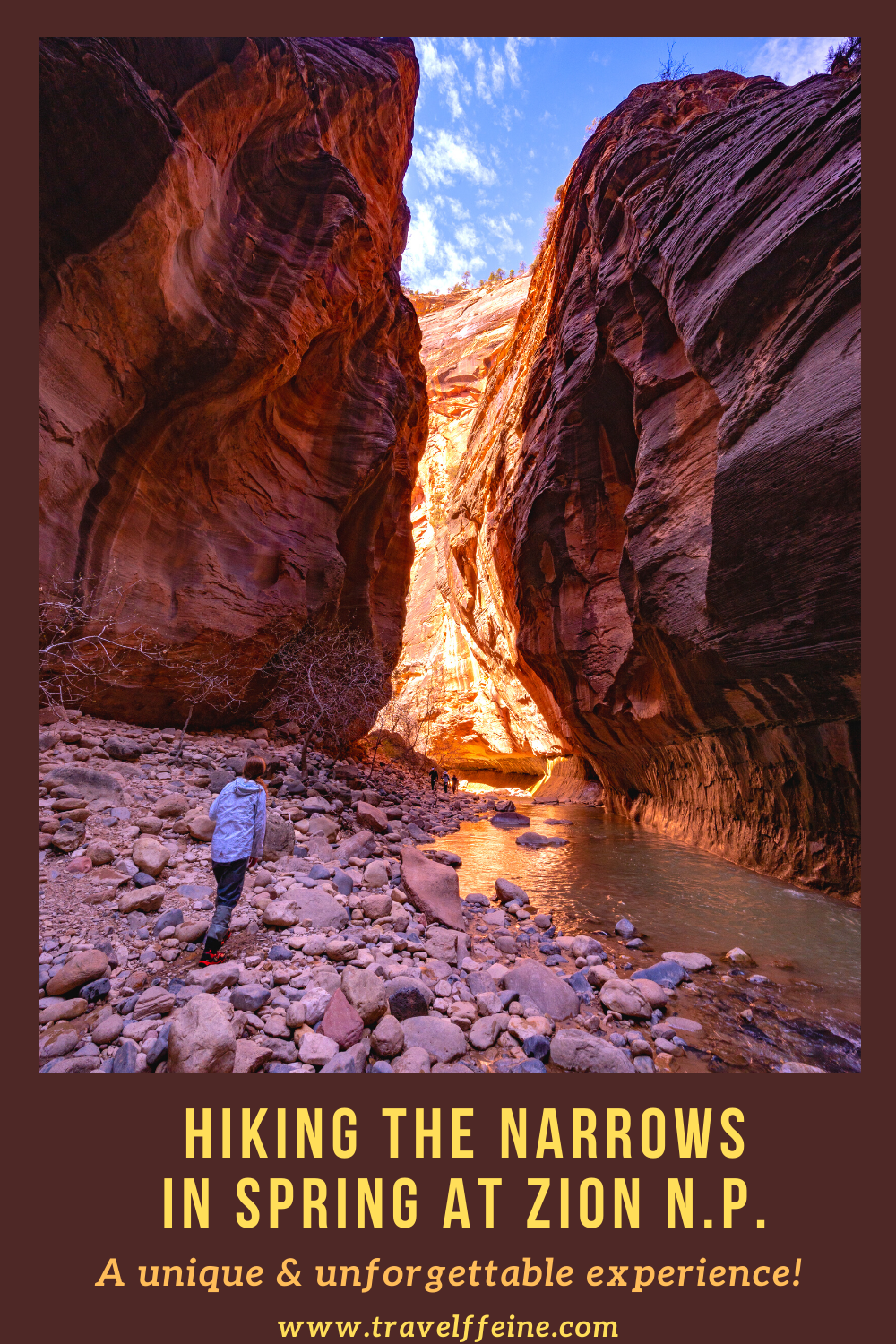
  • Hiking The Narrows in Spring at Zion National Park

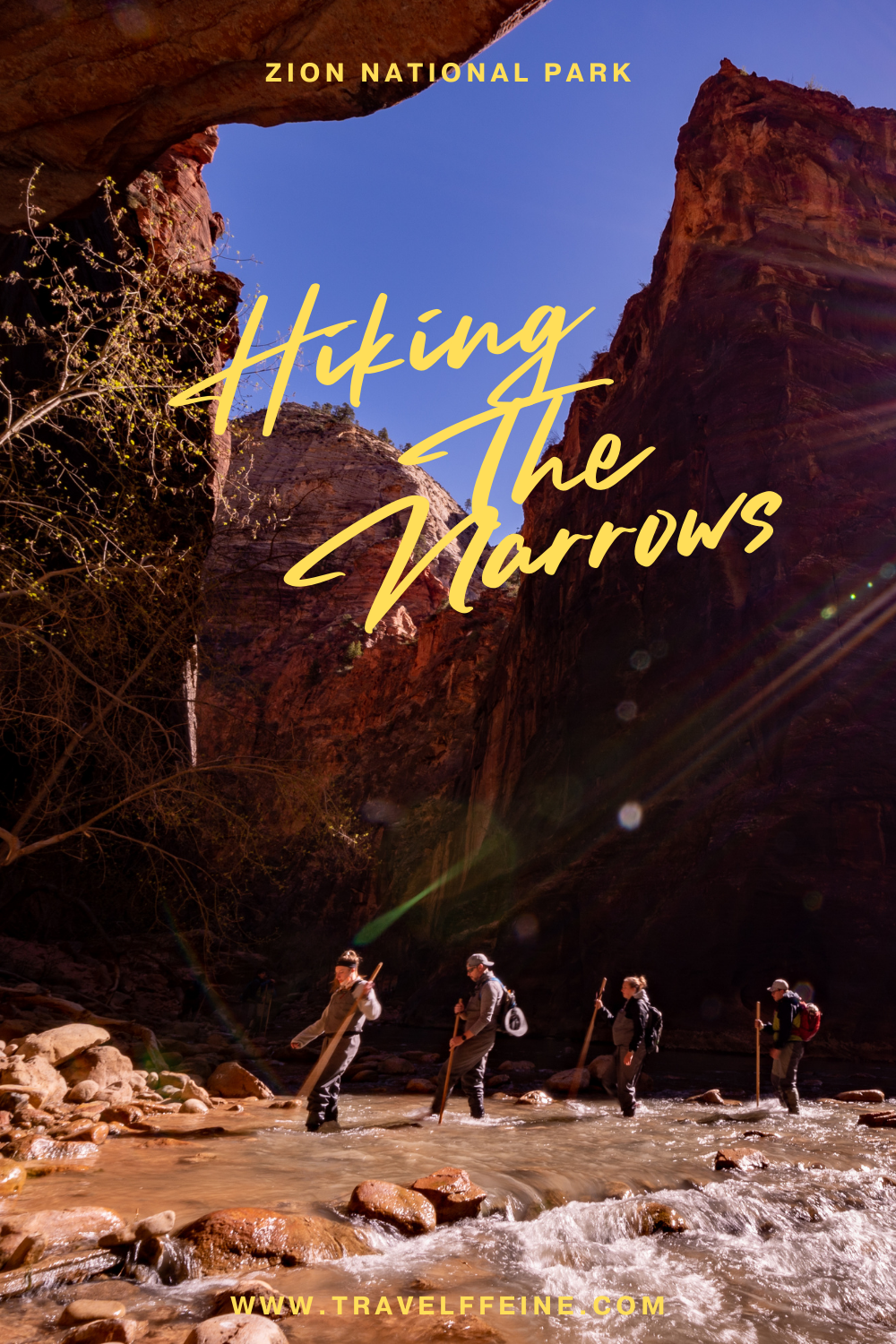
    Hiking The Narrows at Zion National Park is an experience you’ll never forget! The same could be said about hiking Angels Landing, but that’s for other heart-pounding reasons. The Narrows is the poster child for the saying, “it’s not the destination, it’s the journey.” 

    It isn’t just another trail to a beautiful vista or natural monument. It’s more about wandering up a river than reaching any particular destination. That’s part of its beauty. That and you’re hiking up the Virgin River the entire time! It’s guaranteed to be something you and your family talk about for years to come.

    The Narrows Bottom Up Day Hike

    This article is about hiking The Narrows from the Temple of Sinawava (also referred to as the bottom-up hike).  You can do a longer 16-mile-through hike, but it requires a permit.  The day hike in this post does not require a wilderness permit.

    Shuttle System

    Zion National Park operates on the shuttle system for most of the year. Starting in March, you are not permitted to drive your vehicle along the Zion Canyon Scenic Drive. Instead, you take a shuttle on a first-come, first-served basis. 

    For a while, you needed to reserve your time slot. Currently, Zion eliminated the need to purchase and reserve a shuttle ticket in advance. It is free but get there early. Check the park’s shuttle schedule for current hours of operation. Try to get to the park as early as possible to avoid the crowds.

    You also want to pay attention to the last shuttle, so you don’t miss it. If you miss the last shuttle of the day, you’ll have to walk back to your car. Depending on where you are in the park, that could be a long walk. So don’t miss it!

    Parking

    There is parking at the Visitor Center, but it fills up quickly! Usually, by 10 a.m., it is full. That is another reason for getting to Zion early and catching the first shuttle. If you can’t find parking at the Visitor Center, you can look for paid parking in the town of Springdale. The Springdale Shuttle takes visitors to the Zion National Park Visitor Center, and you can then catch a Zion National Park shuttle from there.

    Getting to the Trailhead

    To hike The Narrows, you want to take Zion’s shuttle to the last stop and get off at the Temple of Sinawava stop.  There is a restroom here, and the trail begins along the Zion Riverside Walk paved trail.
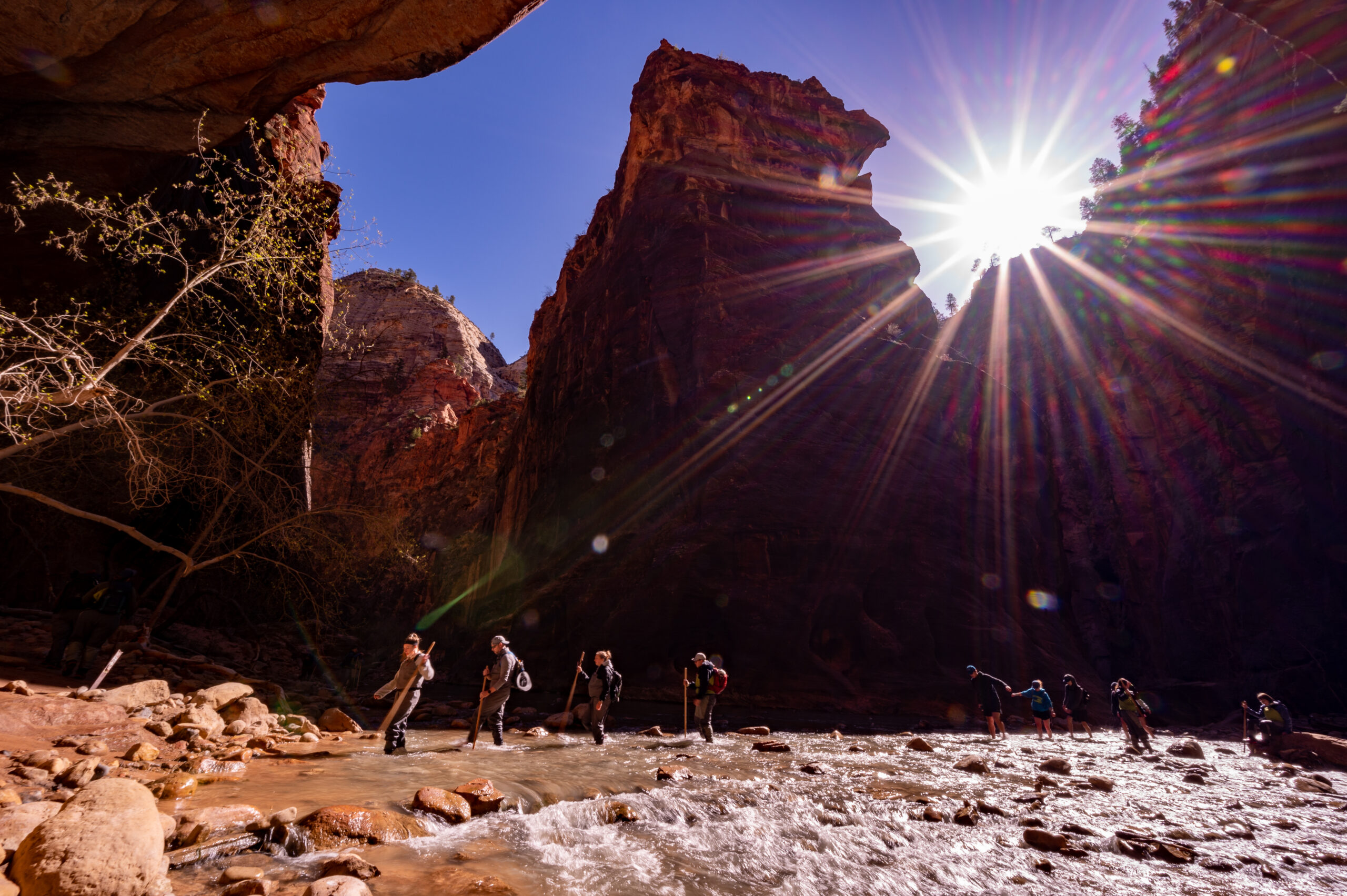
    The Narrows at Zion National Park

    About The Narrows Hike

    Trail Length: 5.0-10.0 miles (roundtrip)
    It depends on how far you decide to hike. The area referred to as “Wall Street” is about a 5.0-mile round trip hike. Hiking to Big Spring is 10 miles round trip. You can, of course, only hike in 1-2 miles and turn around. It’s up to you!

    Approx. Hiking Time: 4-8 hours
    Again, it will depend on how far you want to hike up the river and how many photo stops and snack breaks you take.

    Elevation Gain: No significant elevation gain.
    You’re walking up a canyon river bed with only slight increases in elevation. The first mile of the hike is along the paved Riverside Walk. The rest of the time, you are hiking up a rocky riverbed.

    Trail Difficulty Rating: Moderate to Strenuous
    The unique location of this hike makes it more difficult. You hike through a river, upstream, over slippery rocks, around boulders, and sometimes in waist-deep water. Depending on water levels, the current pulls at you more strongly too. All these factors combined make this a more challenging hike. That said, I saw families doing this. Just take your time and help each other out.

    Features: A unique hike up the Virgin River through the narrowest part of Zion Canyon. Gorgeous red canyon walls, waterfalls, and beautiful displays of light as the sun reflects off the canyon walls.

    Restroom Facilities: The only restrooms are at the Temple of Sinawava shuttle stop. There are no other restrooms along the hike, and all solid waste must be packed out.
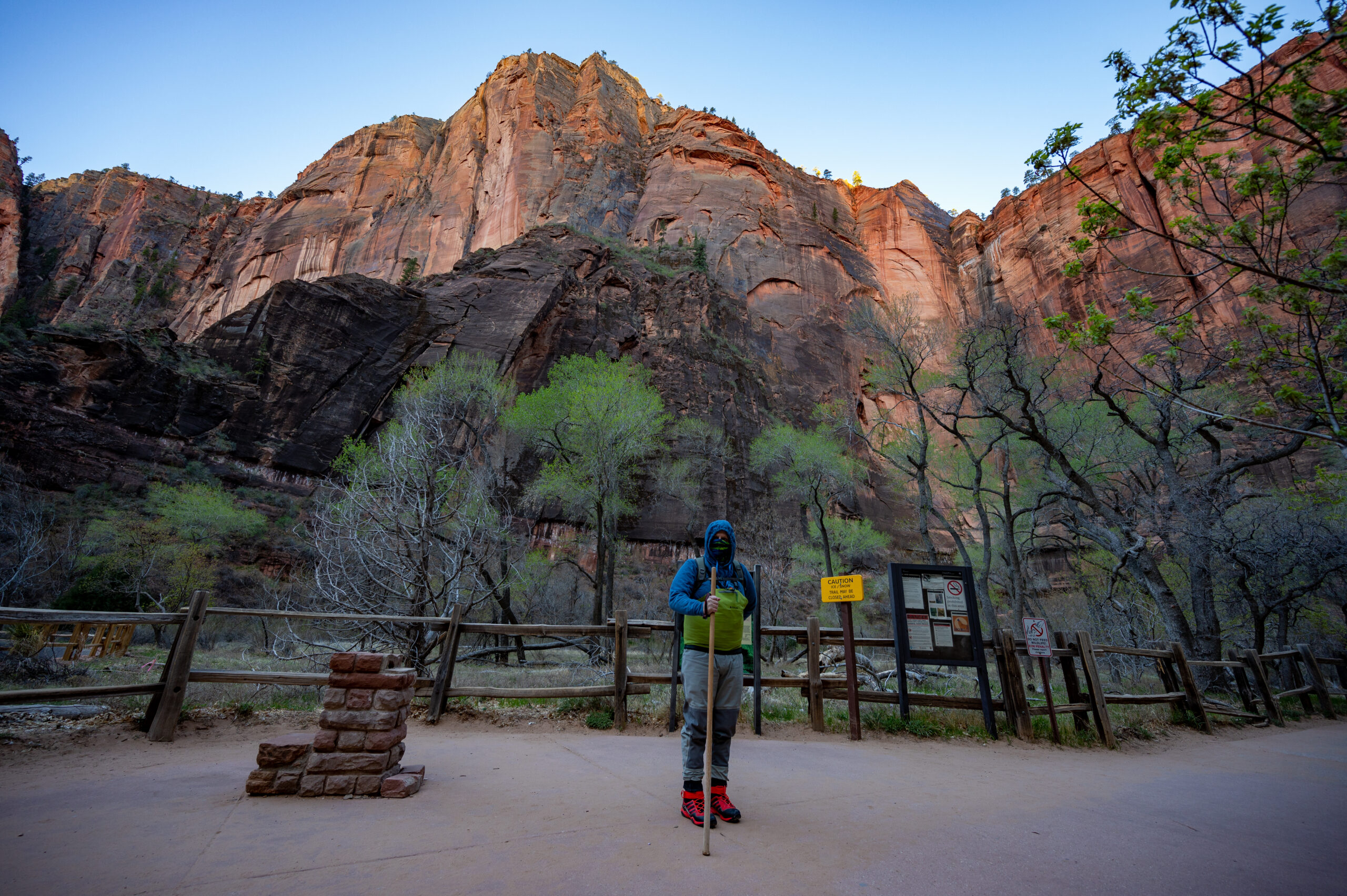
    Riverside Walk at Zion Narrows Bundled Up

    What To Bring

    Water.  Do not take this hike or any hike without water. The river water is unsafe to drink, and although it typically is cooler in the canyon, it still gets hot in the summer. Make sure to bring plenty of water for everyone in your group.

    Trekking Poles.  A hiking pole or two helps navigate the slippery riverbed. It is also helpful for checking water depths.

    Sunscreen.  You may be surprised by how much sunlight filters down to you and reflects off the water.

    Snacks/Lunch. I highly recommend you pack a lunch, but make sure to bring snacks and drinks at a minimum.  It may depend on what time of day you start your hike whether or not you want to bring lunch. We had a morning shuttle time and hiked this early, eating lunch deep inside the canyon. We also had snacks, and we were thankful for all of it. You work up an appetite hiking up a river!

    Waterproof Gear. This isn’t a requirement, but I highly recommend it if you’re hiking in the spring or winter. Cameras or electronic gear you want to bring will be best kept in a waterproof backpack. A waterproof bag is also good for sandwiches and snacks.

    Close-toed shoes: Rent waterproof shoes at one of the outfitters outside Zion (see a list below under Tips) or wear tennis shoes or hiking boots. You are bound to stub your toe on a rock below the surface. Flipflops are a big no-no.

    Layers. Wear layers of clothing. It might be cold in the morning but hot by the afternoon. Additionally, the narrower sections of the slot canyon are shaded and cool. So although it can be over 100 degrees out in the sun, it is significantly colder in the river in the shade.

    Important Information

    You will get wet. I know, surprise, surprise.  You can rent waterproof gear or hike in your clothes and shoes, but again, you will get wet.  It was spring when we hiked this, and it was in the upper 30s in the morning. We thought the money spent on our waterproof pants and shoes was one of the best decisions we ever made as we took that first step into the river.

    You may also want to rent a waterproof backpack or bring your own. Renting a large waterproof bag to carry our gear and food was money well spent! I had expensive camera gear, which I did not want to get wet were I to take a tumble in the river.

    There is an inherent risk involved whenever you’re in a river or a slot canyon. Zion closes The Narrows hike if the levels are too high or if the National Weather Service issues a flash flood warning. Check with Zion National Park for the weather forecast and water levels ahead of time.

    Stop at the Visitor Center on the day of your hike or the day before and ask about the most up-to-date conditions and get tips on what to do if you’re in a thunderstorm or potential flash flood. This isn’t Disneyland, this is nature, and it’s often unpredictable. Zion park rangers will do their best to mitigate the dangers, but there is always an inherent risk, and they can’t always accurately predict these things.
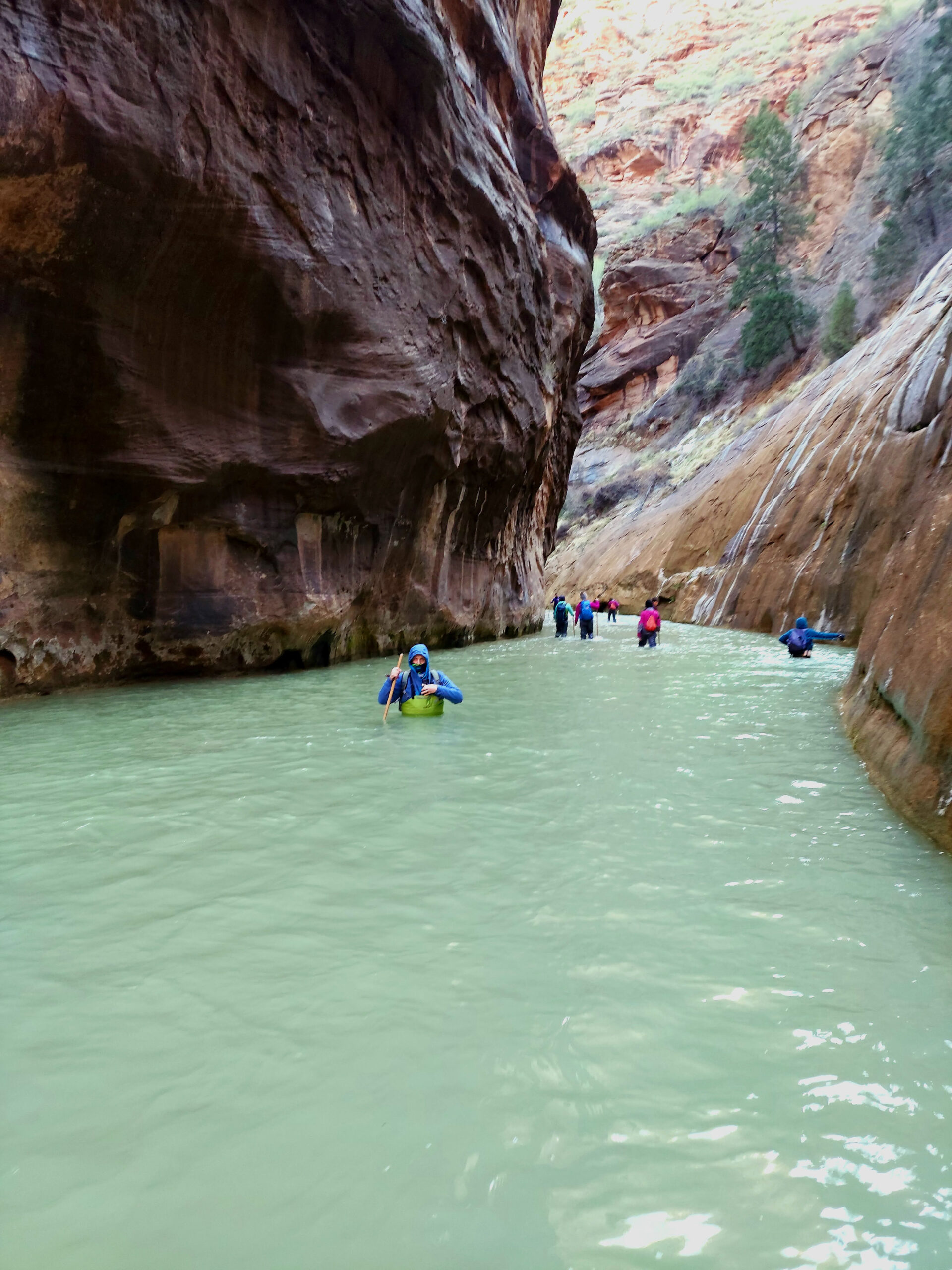
    Deep Water in The Narrows at Zion National Park

    My Experience Hiking The Narrows in Spring

    6:30 a.m. In Line at Zion Outfitters

    We were waiting in line to rent waterproof gear at Zion Outfitters. There were around ten people ahead of us in line. We’re nervous we’ll miss our shuttle window, but an employee said not to worry. They’ll still let us on the shuttle even if we’re a little late. We rented the Bib Package and waterproof shoes, and a waterproof backpack.  Money well spent!

    8:30 a.m. Starting our hike along Zion’s Riverside Walk

    We begin our hike along the Riverside Walk. It’s freezing out, and we are layered up underneath our waterproof bibs and wearing jackets over the bibs.  The wind was blowing, and it was in the upper 30s when we started. I am nervous about getting in the water. It’s a 1-mile walk along the paved Riverside Walk before we reach the end of the trail and the beginning of the river portion in The Narrows.
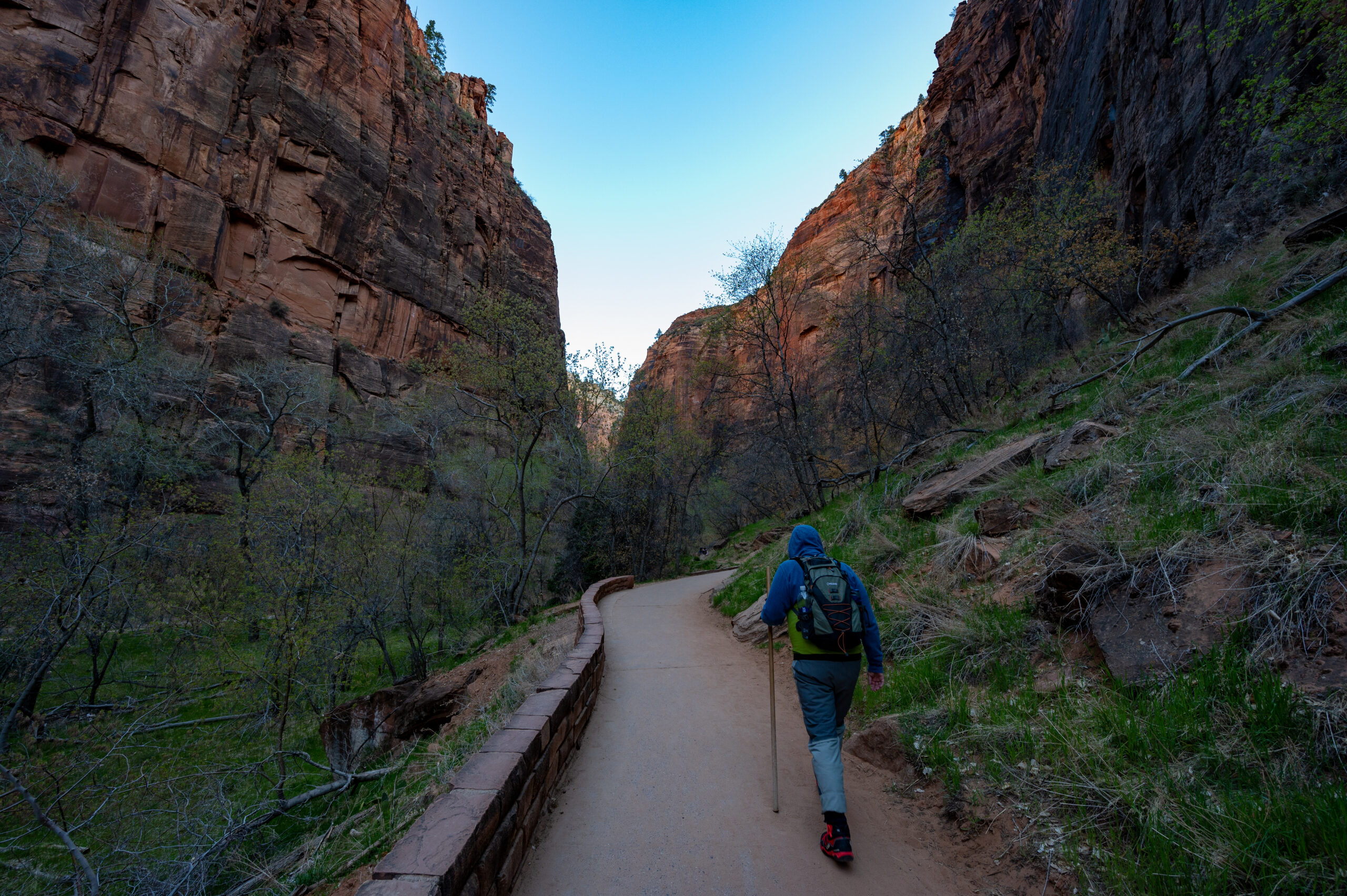
    Zion Riverside Walk trail

    9:00 a.m. Entering The Virgin River

    We reach the end of the Riverside Walk Trail and climb down to the river to begin our hike up The Narrows at Zion National Park.  It’s exciting as we take the first step into the river. I hesitantly put one foot in, then the other, and wait to see if water leaks in.  It doesn’t! It only feels a little cool on the outside of my feet and isn’t freezing as I expected. I couldn’t be happier with my waterproof gear!
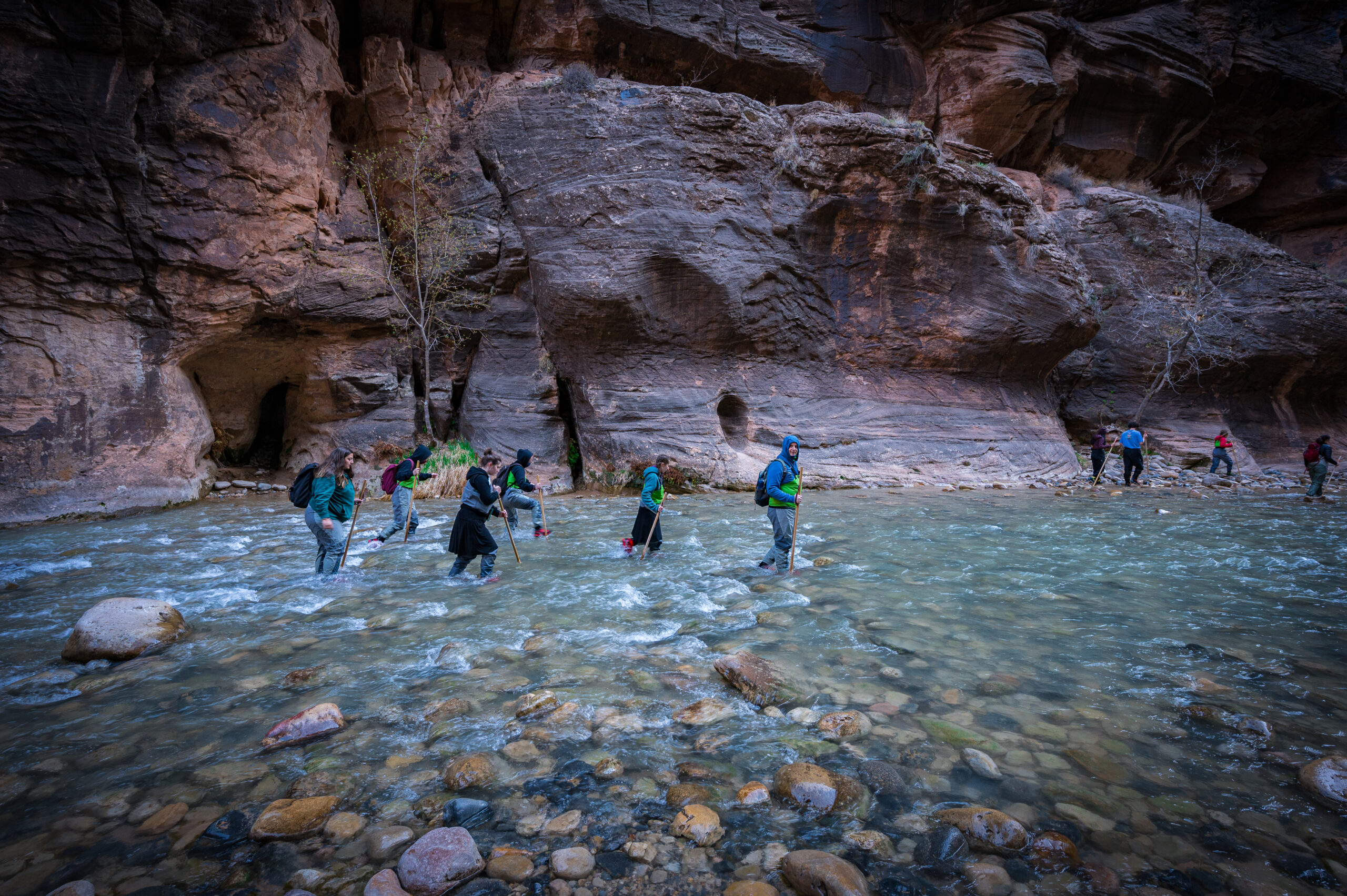
    Hiking up the Virgin River

    Never Alone in The Narrows

    One thing is true about the hike up The Narrows–you are never alone.  Even with our early morning start, there are at least 30 other hikers, and the number continues to grow to 100’s by the afternoon.  Early morning is your best bet if you want to get photos with the least number of people. 

    This is a community hike; we’re in this together, laughing and sharing in this utterly unique hiking experience. There were so many photo stops along the way! Look in both directions to capture how the sunlight filters into Zion Canyon. The colors change throughout your walk with the amount of light shining in.
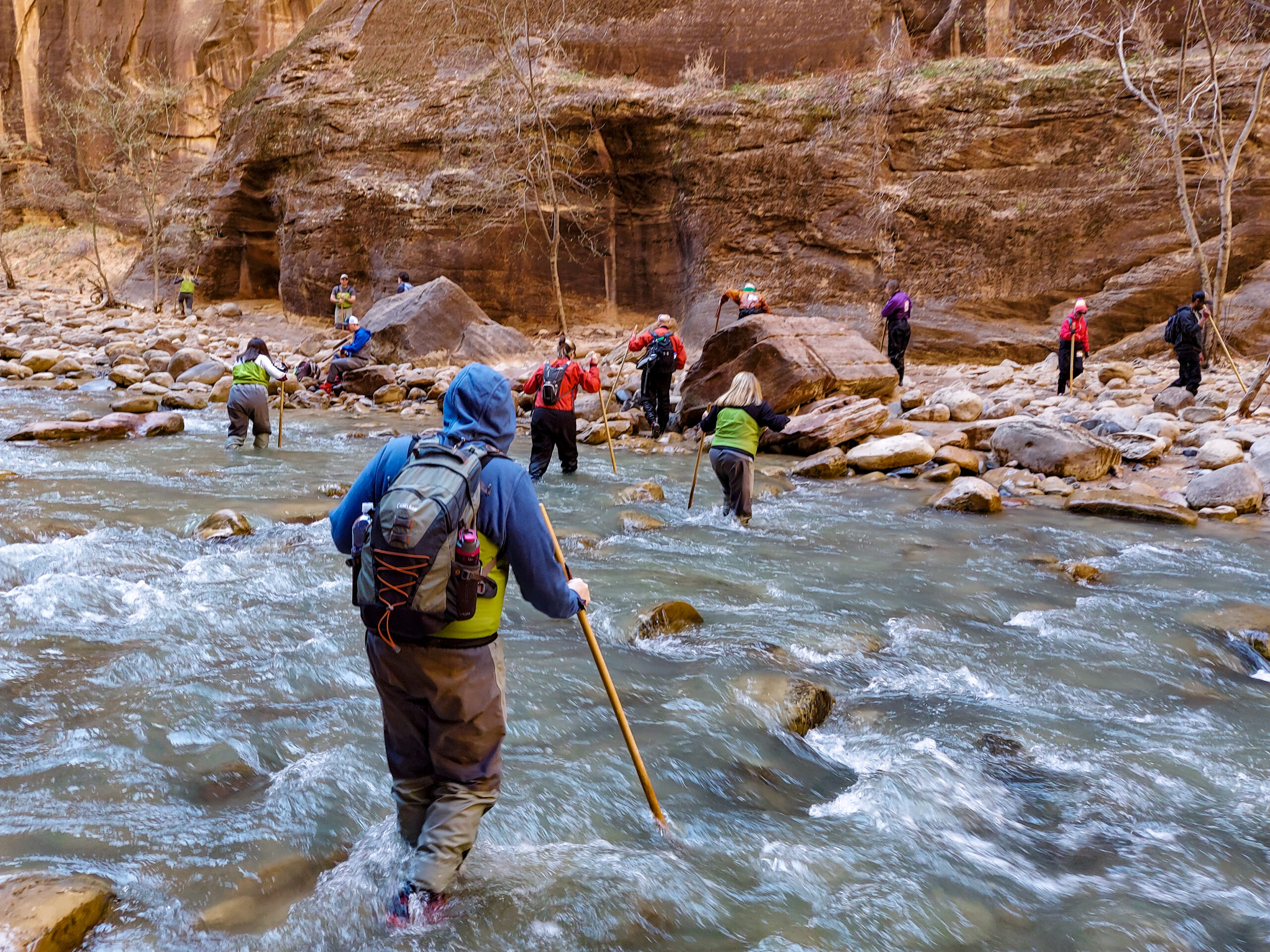
    crossing small rapids hiking in The Narrows

    Lunch and Snack Breaks

    There are a few different places along The Narrows where you can get out of the water and find a small patch of dry land to take a snack break or a lunch break.  If you start before lunchtime, I highly recommend packing a lunch. It is nice to take a break and enjoy the surroundings. It’s also easier to stop for a snack when you’re not actively walking up a river.
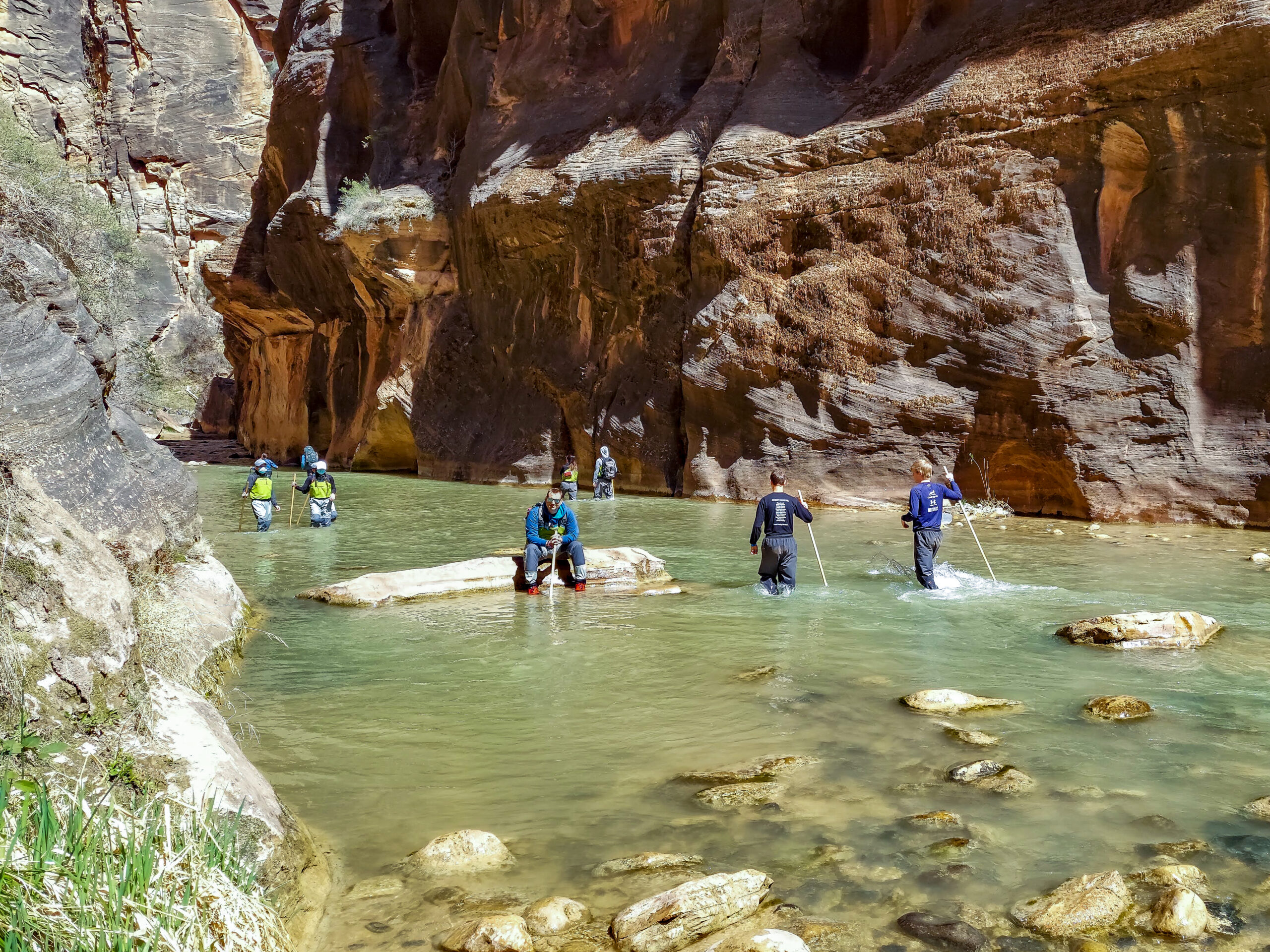
    Rest Break in the Virgin River

    Look Up

    Make sure to look up while hiking The Narrows. Zion Canyon towers above and looks so beautiful against the blue sky. Plus, you may find a ray of sunlight seeping down to the river, and you can basque in its glow as I saw other hikers doing. It gets a little chilly in the shaded parts of the canyon, so the sunlight is a welcome sight.

    2:30 p.m. Back on Dry Land

    We’re back where we started on the Riverside Walk. The trail is much more crowded now, with hundreds of people sitting around the end of the trail relaxing in the sun or playing in the river.  It is now in the 80s, and I can’t wait to be out of my gear and back into shorts! The hike back was faster, which always seems to be the case. You know where you’re headed on the walk back, and you’ve already taken most of the photos you want.
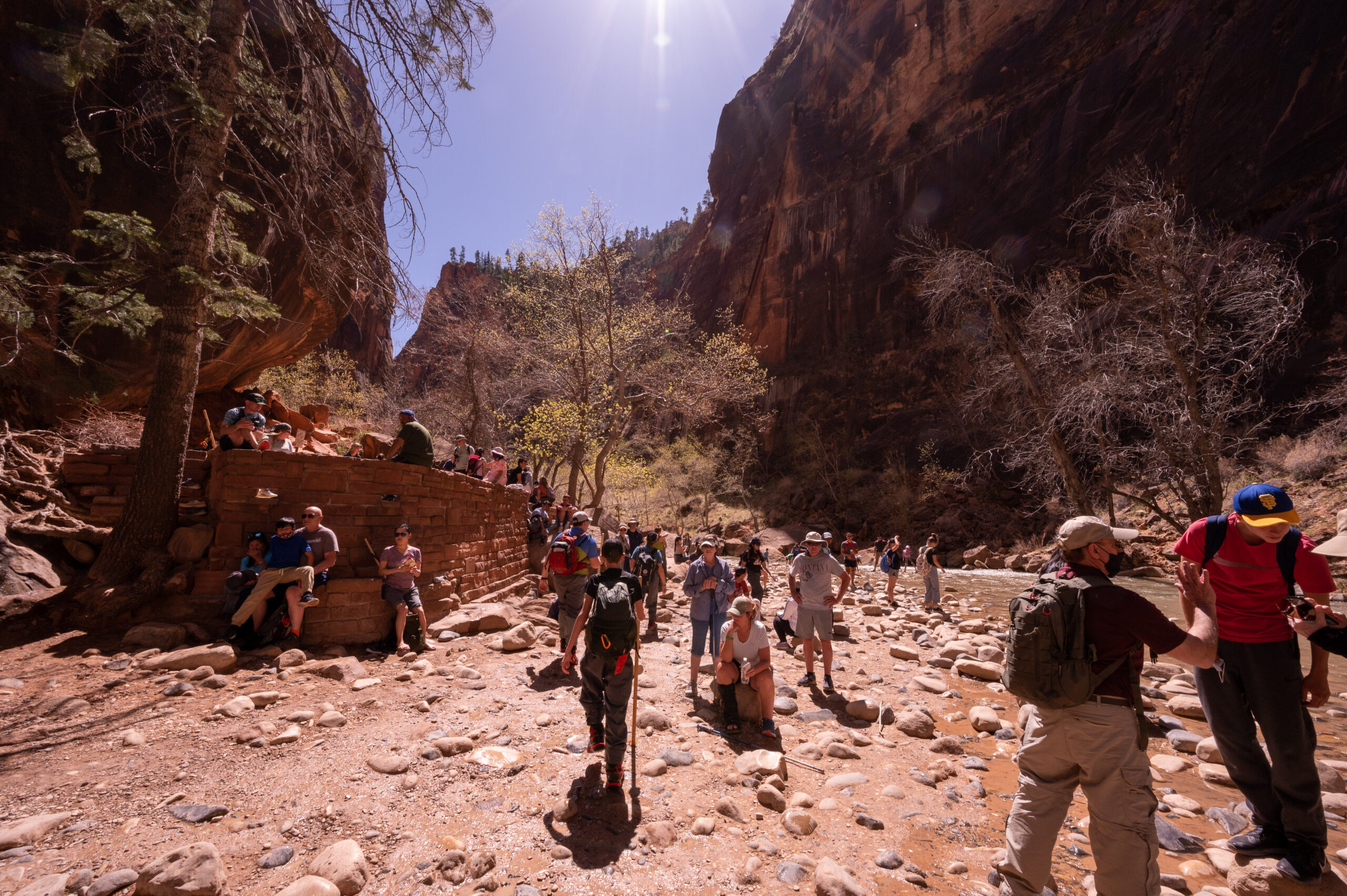
    Riverside Walk at Zion National park

    Overall Thoughts About Hiking Up The Narrows

    Who would have thought it could be so fun to spend the day hiking up a river? Not me. However, The Narrows was such a fun way to spend the day. It was beautiful to see the natural designs in the stone where the water carved it out and to gaze up at the canyon walls towering thousands of feet above. I think it is something you must experience for yourself to appreciate what the hype is all about.

    We visited in early spring, and water levels were still relatively low. A few deep spots went up to our waists, so I can only imagine what the current and levels are like a little later in the spring. Always check with the visitor center for the current conditions and prepare accordingly.
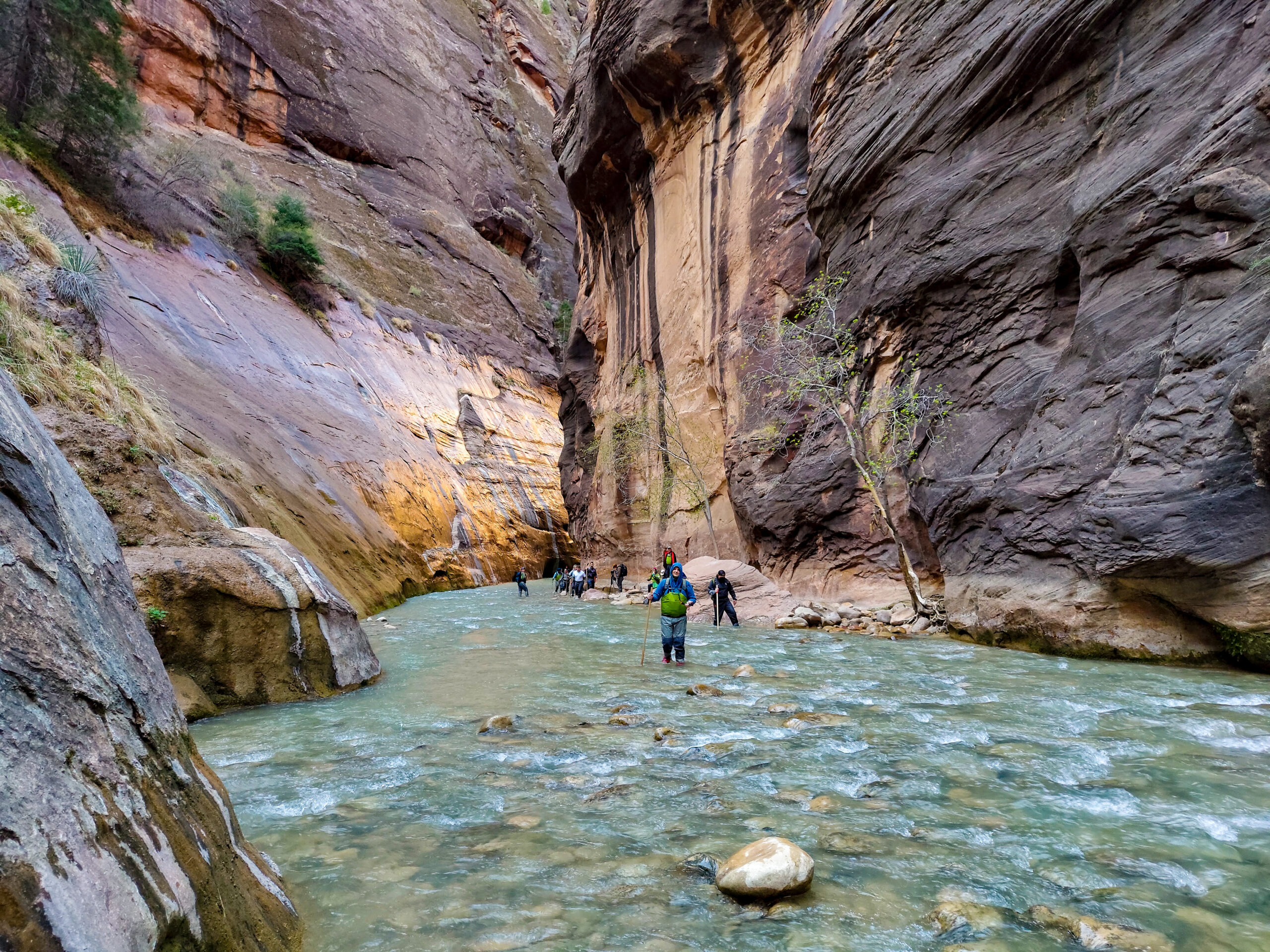
    A walk up the Virgin River

    Tips for Hiking The Narrows at Zion

    Reserve Your Gear Head of Time

    If possible, reserve your waterproof gear ahead of time. We did not have a reservation, but we got in line before Zion Outfitters opened, and we were fitted and checked out in around 30-minutes. It helped that they are right outside the main entrance to Zion National Park.

    Go Early

    Get to Zion National Park early to beat the heat and crowds and get parking so you won’t feel rushed for time or worry about missing the last shuttle out.

    Planning Your Day

    Don’t plan any other strenuous hikes for the day or any other hikes for that matter. If you’re anything like me, your feet will be sore after hiking over rocks for hours. I suggest grabbing some pizza and enjoying a leisurely day after your hike up The Narrows.

    Where to Eat

    The best tip I can give you is to drive to La Verkin and eat at River Rock Roasting Company.  They have incredible pizza with a view, plus the best cinnamon rolls you’ll ever eat.  They also sell their freshly roasted coffee beans to take with you. It’s your one-stop-shop for breakfast, lunch, and dinner! 

    Additional Articles You May Enjoy
    Hiking The Narrows in Spring
    Hiking The Narrows in Spring at Zion National Park
    Hiking The Narrows at Zion
  • Exploring the New Gnome Trail in Maple Valley

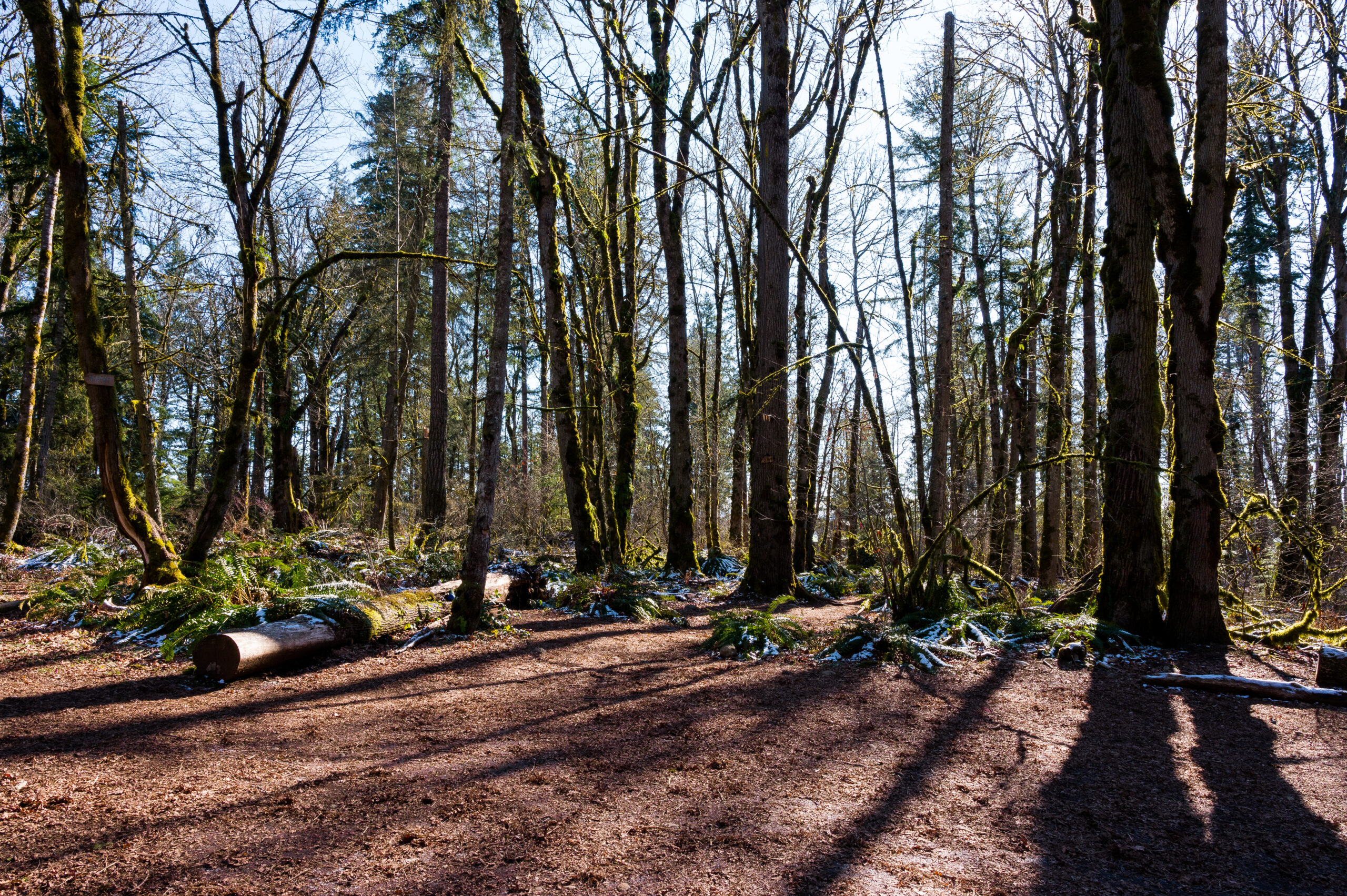
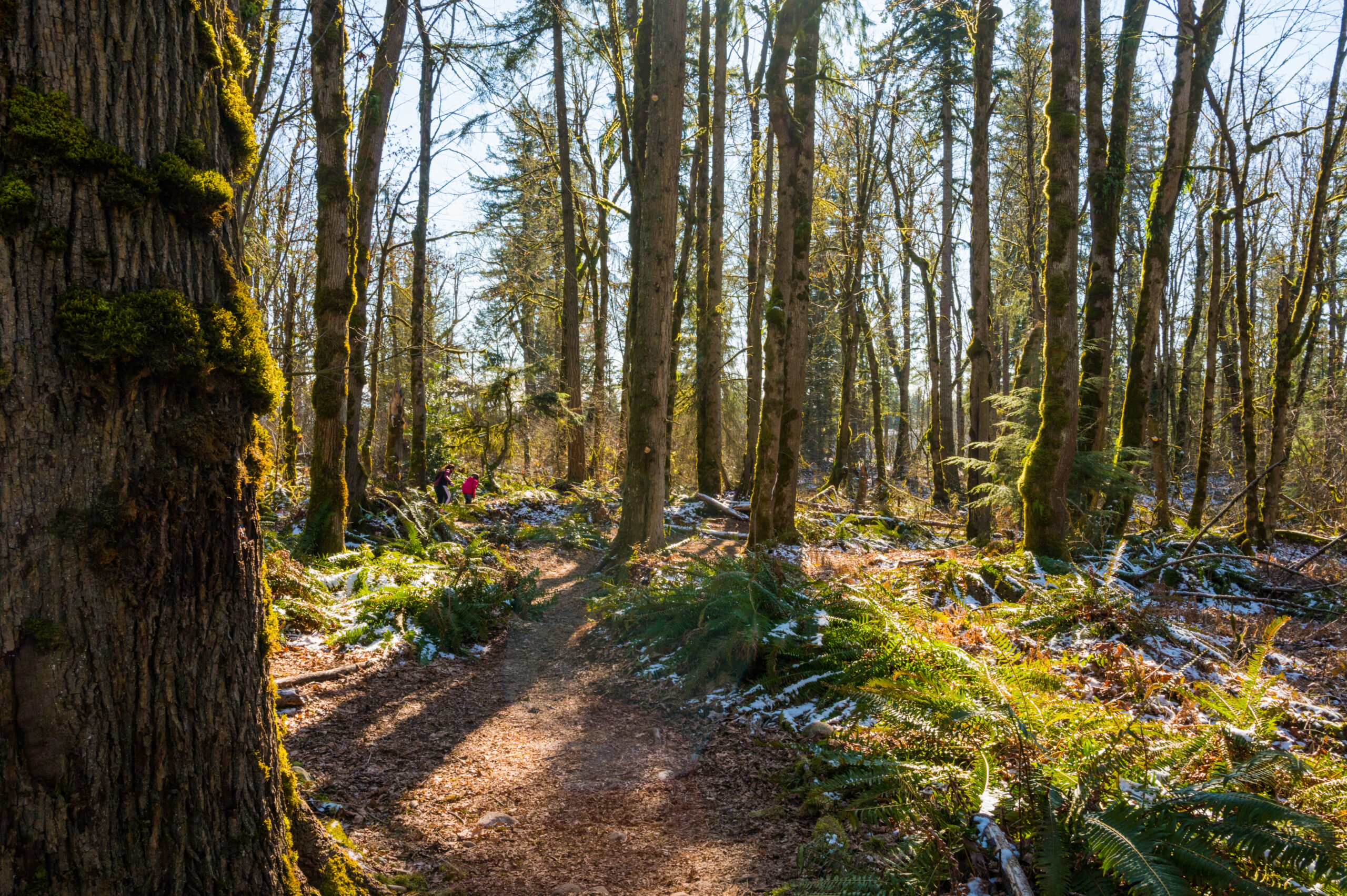
    The New Gnome Trail was created after the original Gnomes Trail needed a new location. The private neighborhood in which the original Gnomes Trail was accessed became too busy with outside traffic, so the neighborhood wanted it moved. It was previously in the Henry Ridge Natural Area, and with the help of the community, they moved the gnomes to the New Gnome Trail, almost two miles away from the original site.  Now that is a community in action!

    I love that the community came together to preserve this fun trail for future gnome hunters. The new path is much easier to find than the original Gnomes Trail, and there is ample parking here. 

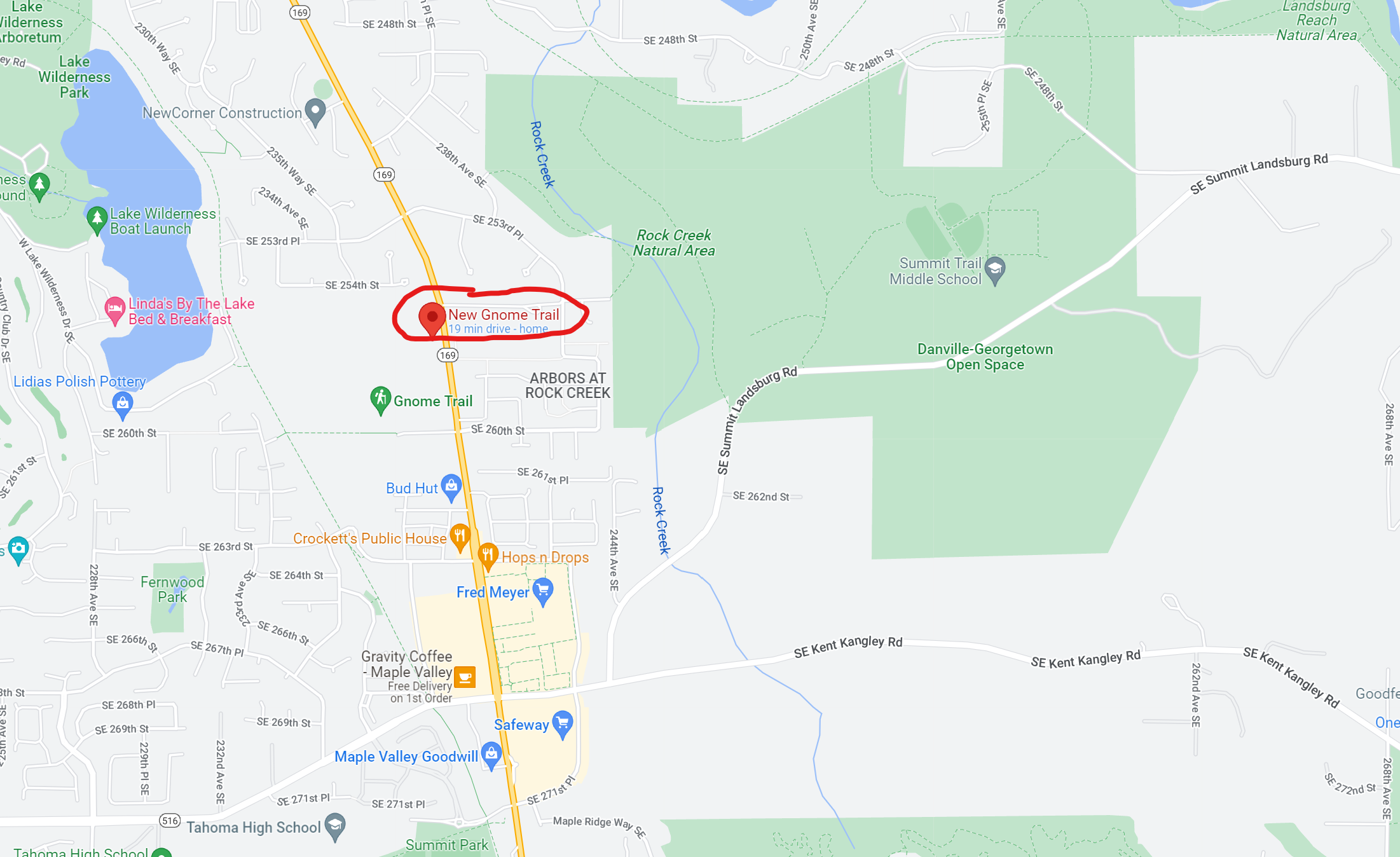
    The New Gnome Trail is at 25719 Maple Valley Black Diamond Rd SE, Maple Valley, WA 98038The Maple Valley Farmers Market uses the parking area from May through September, so if you come on a weekend during those months, be prepared for a crowded parking lot.  I visited in early Spring, and there were only three other cars there, with plenty of parking right next to the main trailhead.

    About the New Gnome Trail

    Trail Length: 0.7 miles (roundtrip)

    Elevation Gain: ~ 75 feet

    Trail Difficulty Rating: Easy

    Time Needed: 30 minutes to 1-hour

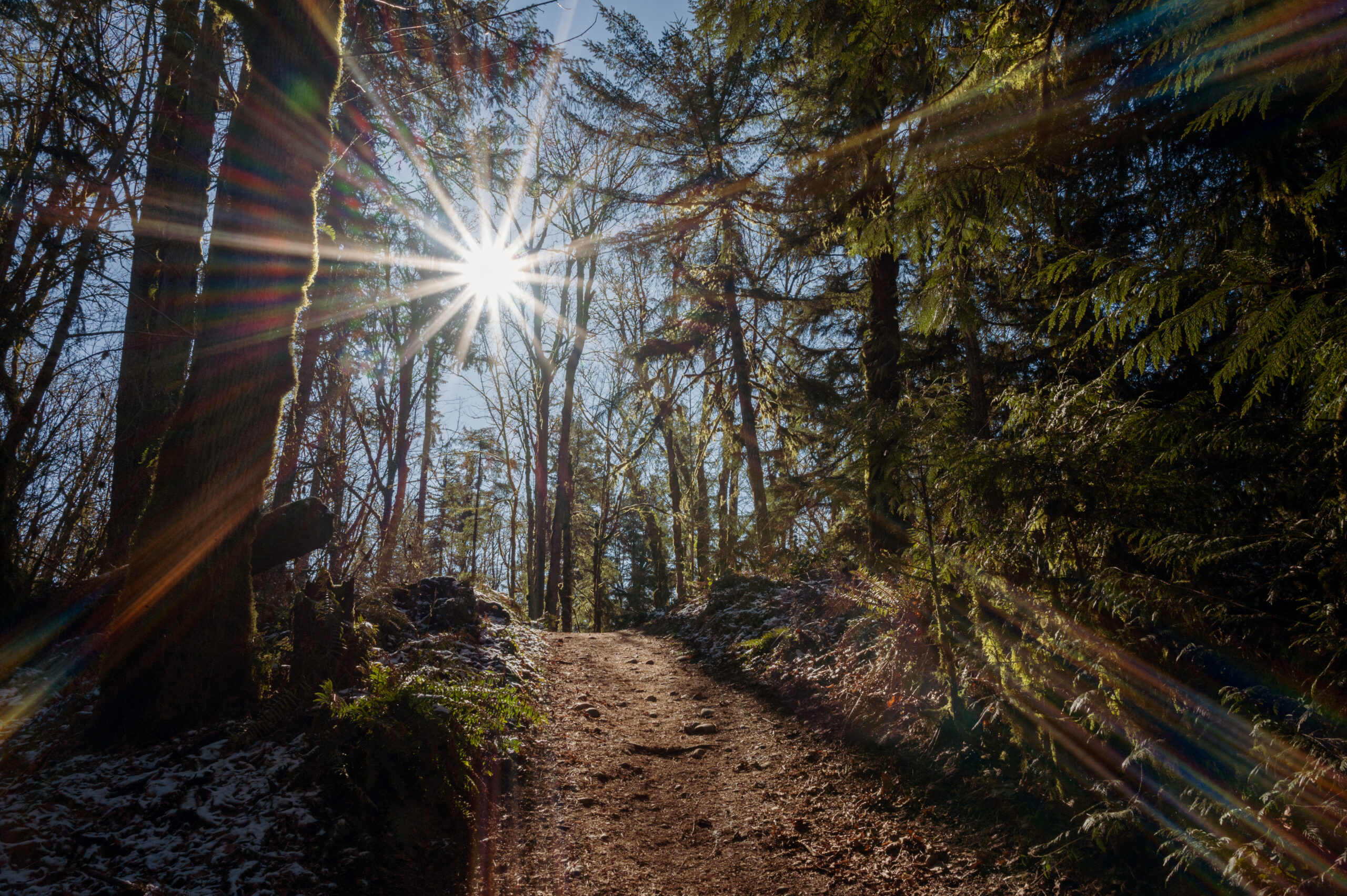
    Features: Gnomes hidden all around the trail, mossy trees and beautiful forest foliage, an easy walk in the woods, good for small kids

    Additional Facilities: Portable restrooms are available near the entrance by the covered picnic area. There are also some picnic tables and benches in this area of the parking lot.

    The New Gnomes Trail: Getting to the Trailhead

    Address: 25719 Maple Valley Black Diamond Rd SE, Maple Valley, WA 98038

    As you enter the parking lot, make a right and follow the one-way signs toward the back of the parking area, where it curves around and to the left. Here you will see the main trailhead on the right and parking to your left.

    There is another entrance further south from the main northwest entrance, referred to as the “Market entrance.” However, the northwest entrance is the primary entrance, and all directions in this post are from the northwest entrance.

    Hiking the New Gnome Trail

    Begin at the main northwest trailhead entrance. Walk about 20 feet, and you come to a “Y” in the trail. Stay left at the Y, and you should see a couple of Gnome trail signs on the trees on both sides of this path. 

    Continue up a short steepish hill.  This is the only hill along the New Gnome Trail.  At the top of the hill, you’ll come to a “T.” Take a left here to continue to the Gnomes Trail Loop. 

    short hill to T in the trail

    Beginning the Gnome Loop

    In about .10 miles, you will arrive at a clearing with multiple paths.  Go right here to begin your loop.  You will return to this clearing after completing the loop.

    The Clearing with three paths

    After taking the path on the right, continue straight, and soon the path will curve to the left as it loops back around. If you’re lucky, no one will have bothered the Bob Ross-looking tree gnome, and you can use it as your marker to veer left (see photos below).

    You will also see a smaller path that continues straight and passes around a cluster of trees. However, this is just a side path. You can take it if you want, and if you do, make sure you make left turns to bring you back to the main loop.  This, however, is not a part of the main trail loop.  

    There are a lot of small trails, all shooting off the New Gnomes Trail. The main route is typically the widest and most worn-looking. To stay on the main trail, you’ll take a left at this spot and follow the path.

    The Gnome Graveyard

    After turning left and following the curve of the loop, continue to go left as it curves around. Soon, you come across the gnome “graveyard.” You know you’ve almost completed the loop when you reach this point. Soon after passing the gnomes graveyard you’ll come back to the clearing and continue straight to return the way you came and back to the parking area.

    gnome graveyard

    Summary of New Gnome Trail Directions

    • At the “Y” (starting at the main northwest trailhead) go left.
    • At the “T” at the top of the short hill, turn left.
    • When you reach the clearing with three paths, the parking lot and market will be to your left, straight ahead is the exit to the Gnome Loop, and to the right is the entrance to the loop.  Go right.
    • After turning right walk a short way before the path curves to the left. You will also see a smaller trail that leads straight.  Turn left here to stay on the main path.
    • Continue to follow this main trail as it curves left each time. When you come across the Gnomes “graveyard” you’ll know you almost finished the short loop.  Soon after passing the “graveyard”, you’ll arrive at the clearing again.  Head straight to go back the way you came and return to your car.

    Some of My Favorite Gnomes

    Comparing the Original Gnomes Trail to the New Gnome Trail

    The Original Gnomes Trail was more of a hike than the New Gnome Trail. I preferred the original’s length as I felt like I got more of a hiking experience from it. The New Gnome Trail feels more like a meander in the woods. I liken it to an Easter egg hunt but for Gnomes. Kids will love it!

    The New Gnome Trail is one of the most kid-friendly trails I know of.  It is excellent for kids ten years old and younger.  I think kids older than that may get bored or not find it challenging enough.

    However, if you are bringing older kids that prefer a longer hike, there are many offshoots to the New Gnome Trail to extend your hike.  At the “T” in the trail at the top of the short hill where I said to make a left, you can take a right instead, and the path will take you as far as Lake Wilderness!  

    A Mom and Daughter walking the new gnome trail

    Contributing to the New Gnome Trail

    There is one more way you can enjoy and contribute to the New Gnome Trail. By bringing your own gnome to leave for others to enjoy. The New Gnome Trail was vandalized shortly before my visit and many of the gnomes had been damaged or moved. So other hikers and fellow gnome collectors have joined together to restore the gnomes living here. 

    I know some in the community come and take the gnomes to repaint after they are too weathered and others come with their kids and have fun adding their own additions to the trail. It is an interactive and ever-changing trail.

    Vandalism

    Also, on the note of vandalism, this community as well as its law enforcement officers do their best to discourage and prevent vandals. Unfortunately, that is not always possible.  There are some reports of hikers having their cars broken into while parked here.  I did not have any issues during my visit, but it does happen. Make sure you don’t leave any valuables in sight or anything a vandal might consider worth breaking in to get.

    Final Thoughts

    This trail is perfect for kids ten and younger and anyone who loves gnomes. It is less of a hike and more of a fun stroll in the forest where gnomes and fairy creatures abide. Parking is free, and there is fun for all! I spent around 30-minutes hiking the New Gnome Trail, and if you were here with kids who wanted to follow all the little trails to find more hidden gnomes, you could give it up to one hour.

    Happy Gnome Hunting!

    Other Articles You May Enjoy
     

    Note: Travelffeine is reader-supported. This post contains affiliate links. When you purchase using one of these affiliate links, we get paid a small commission at no extra cost to you. And as always, all opinions are our own. Thank you!

     
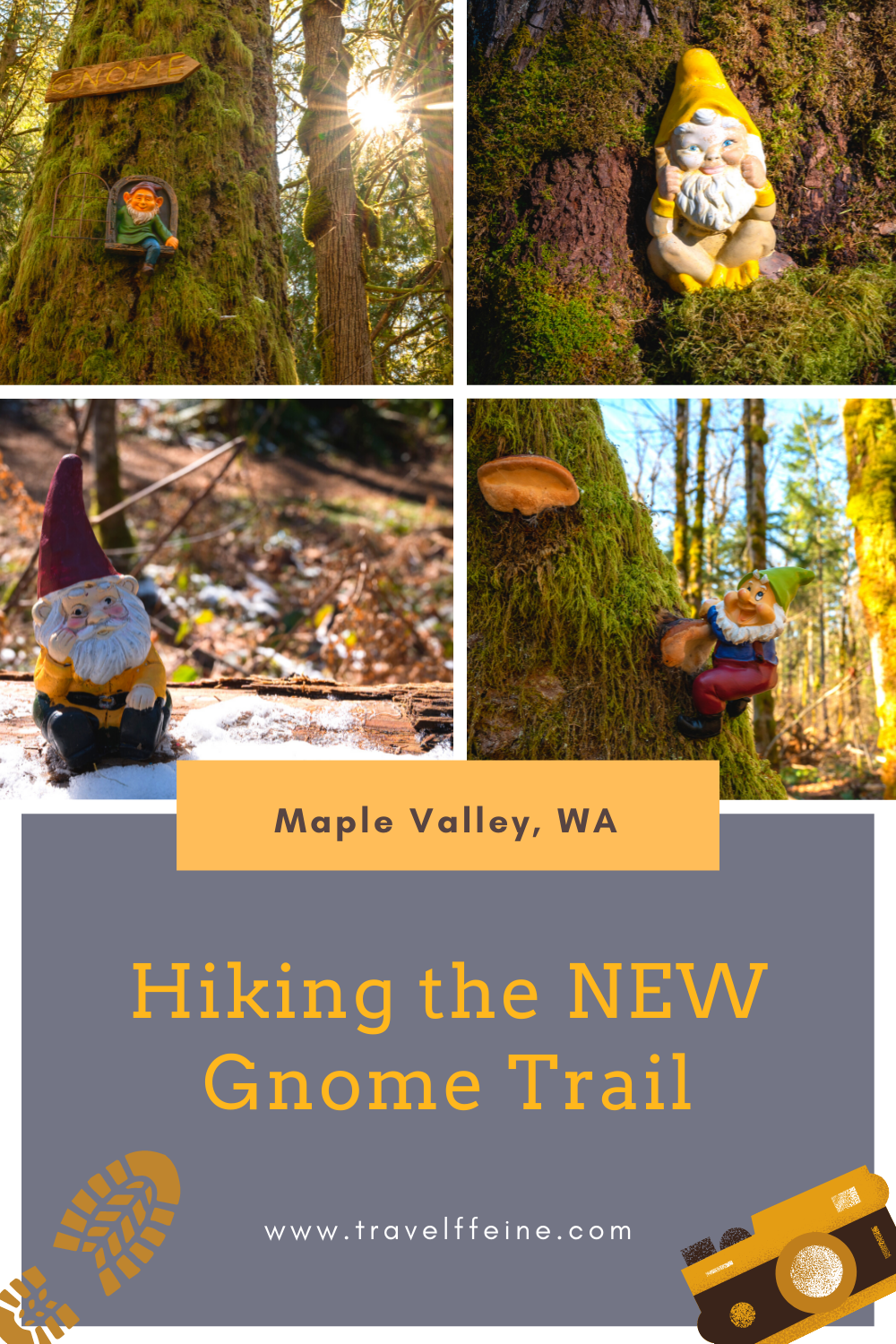
    Hiking the NEW Gnome Trail
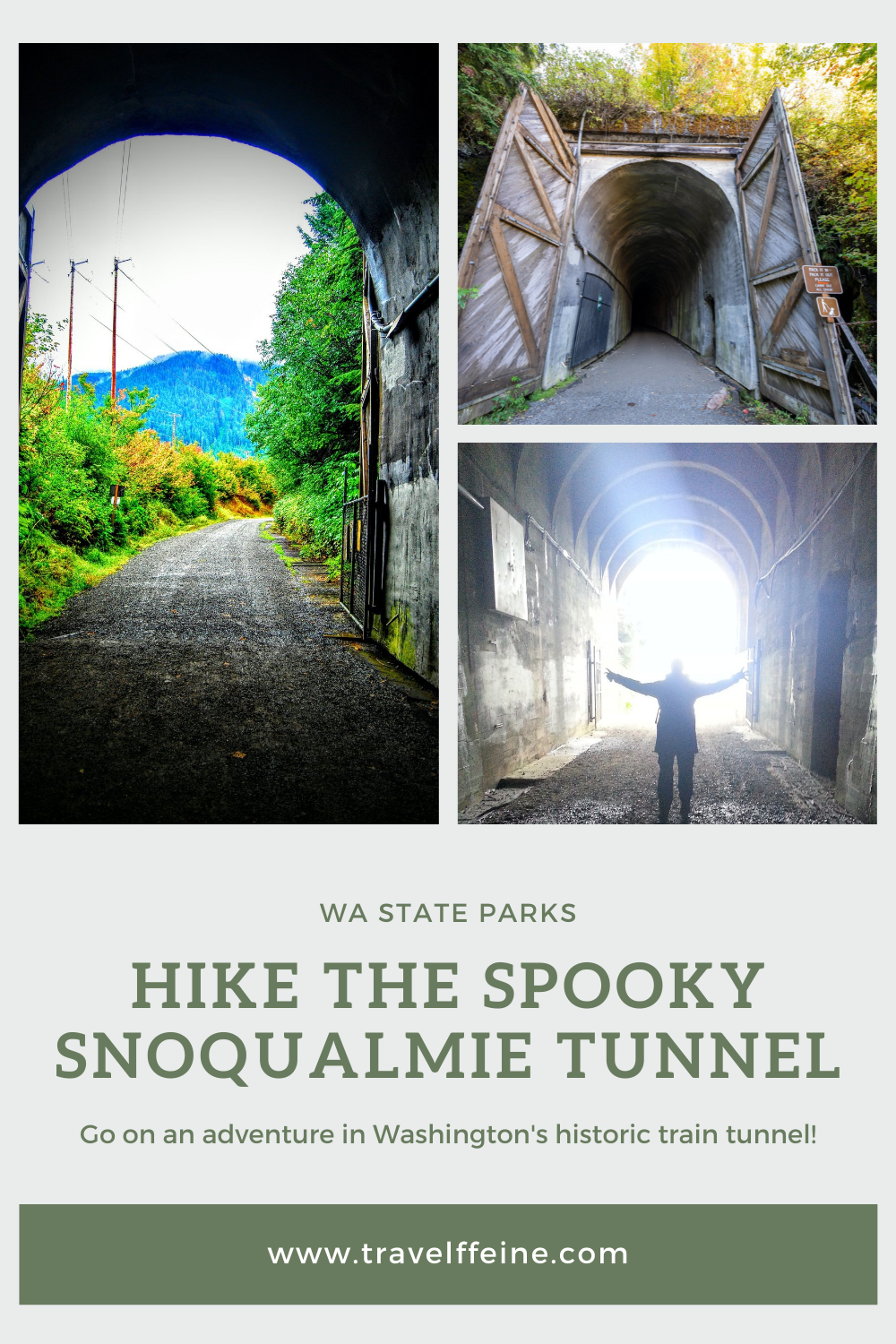
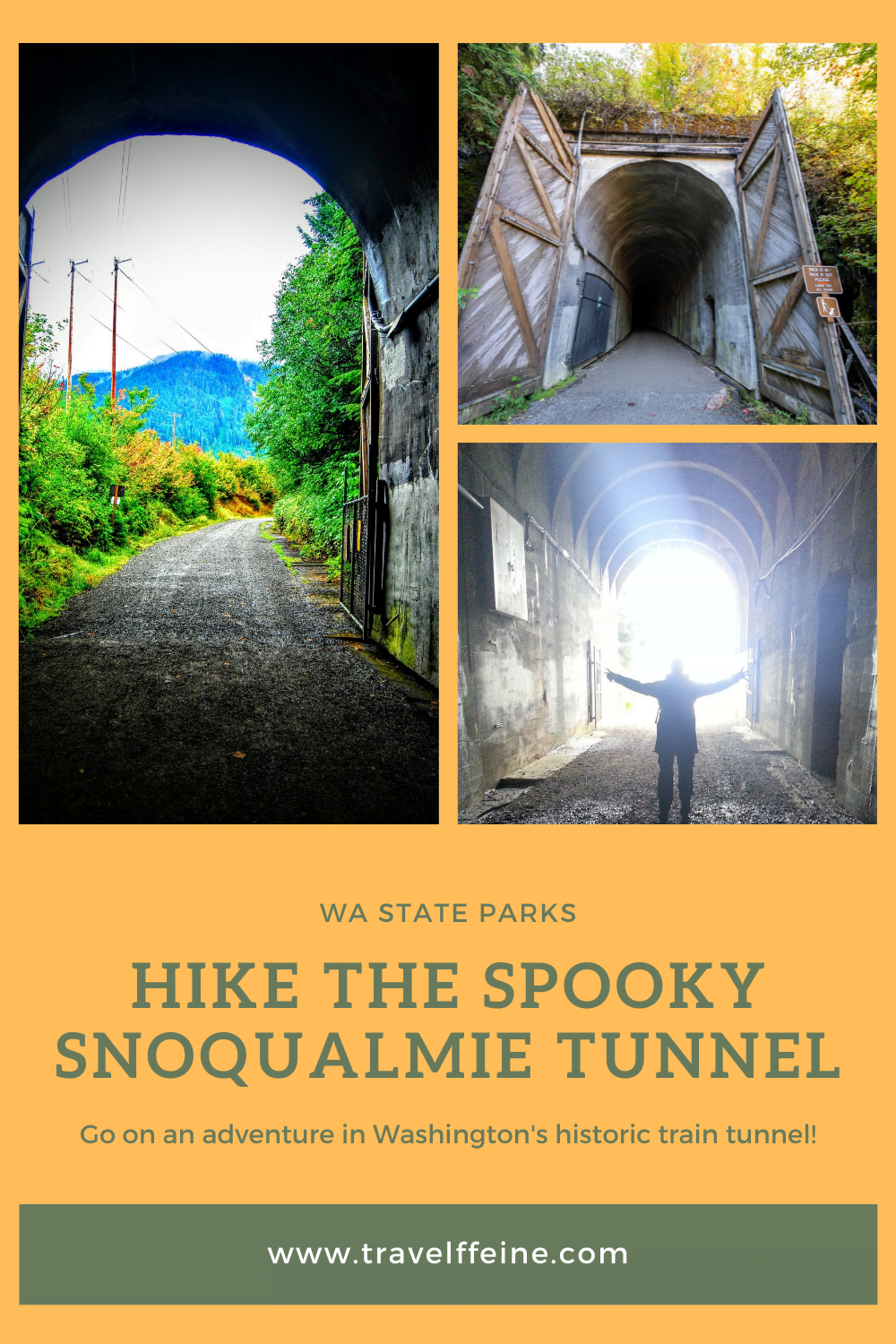
  • The Historic Snoqualmie Tunnel: A Spooky Adventure!

    If you’re looking for an easy trail that offers a unique and spooky experience, then you need to hike the Snoqualmie Tunnel Trail.  The Snoqualmie Tunnel is 2.3 miles long (one way), and it is a part of the Iron Horse Trail, sometimes referred to as the John Wayne Pioneer Trail. 

    Your journey is in almost total darkness the entire way, and this makes for a spooky adventure! As everyone walks into the dark tunnel, there are often whoops and hollers as people listen for an echo and begin experiencing walking in almost total darkness. 

    There might be a few scary movie reenactments or tales of ghost stories, or better yet, others pretend they are walking into the Mines of Moria on an epic quest. The Snoqualmie Tunnel trail is suitable for all ages and can be done either on foot or a bicycle.

    Interesting Facts About the Snoqualmie Tunnel

    • It’s the longest tunnel open to non-motorized traffic in the U.S.
    • This same path was once used as a footpath by the Native Americans before it became a railway that ran from Seattle to Chicago.  Ironically, it is now, once again, a footpath.
    • The Snoqualmie Tunnel is a part of the John Wayne Trail that follows the old Milwaukee Railway line.  You could go from Seattle to Chicago in 45 hours!

    Exploring the Snoqualmie Tunnel

    One of the great things about the Snoqualmie Tunnel is that it is good on even the rainiest of days.  That’s what first prompted me to hike this trail.  My brother was visiting, and we usually went hiking during his visits, but it happened to be one of the rainiest summers we’d had in a long time in the Seattle area.  

    After researching some ideas for things to do in the rain, I found an article online that mentioned the Snoqualmie Tunnel.  Eureka! We packed our raincoats, headlamps, flashlights, water, and snacks and drove toward Snoqualmie Pass.

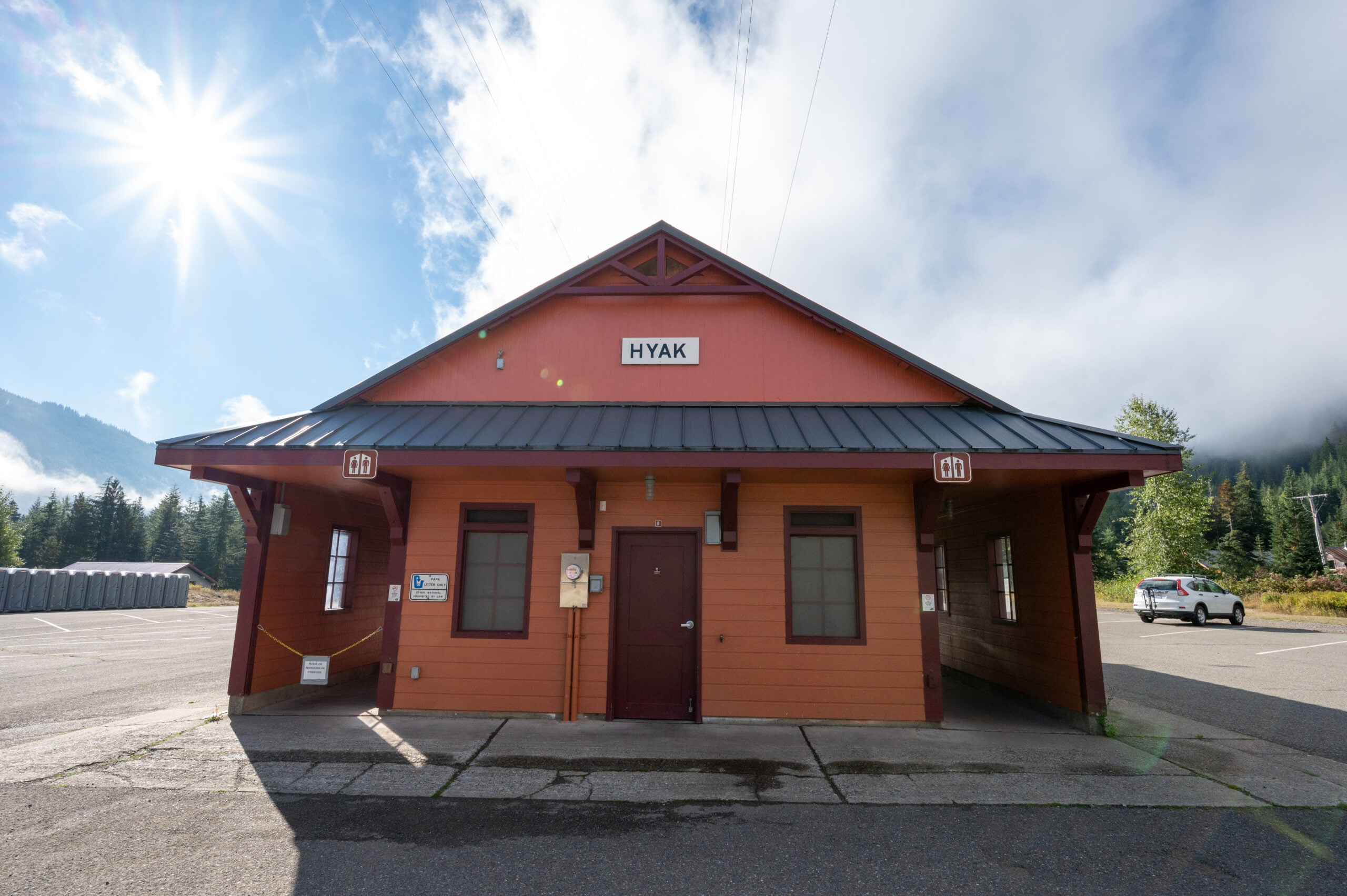
    Hyak Parking Lot Restroom Bldg

    At the Trailhead Parking Area

    There is a building with a “Hyak” sign in the parking lot with restrooms inside. There are also a couple of information boards regarding trails in the area and a parking fee dropbox in case you don’t have a Discover Pass.

    After grabbing our gear, we headed for the trail. The sign in the parking lot said it is 0.4 miles to the Snoqualmie Tunnel entrance. The wide gravel path is lined with blackberry bushes and trees, some of which were starting to show the fall colors.

    The Tunnel Entrance

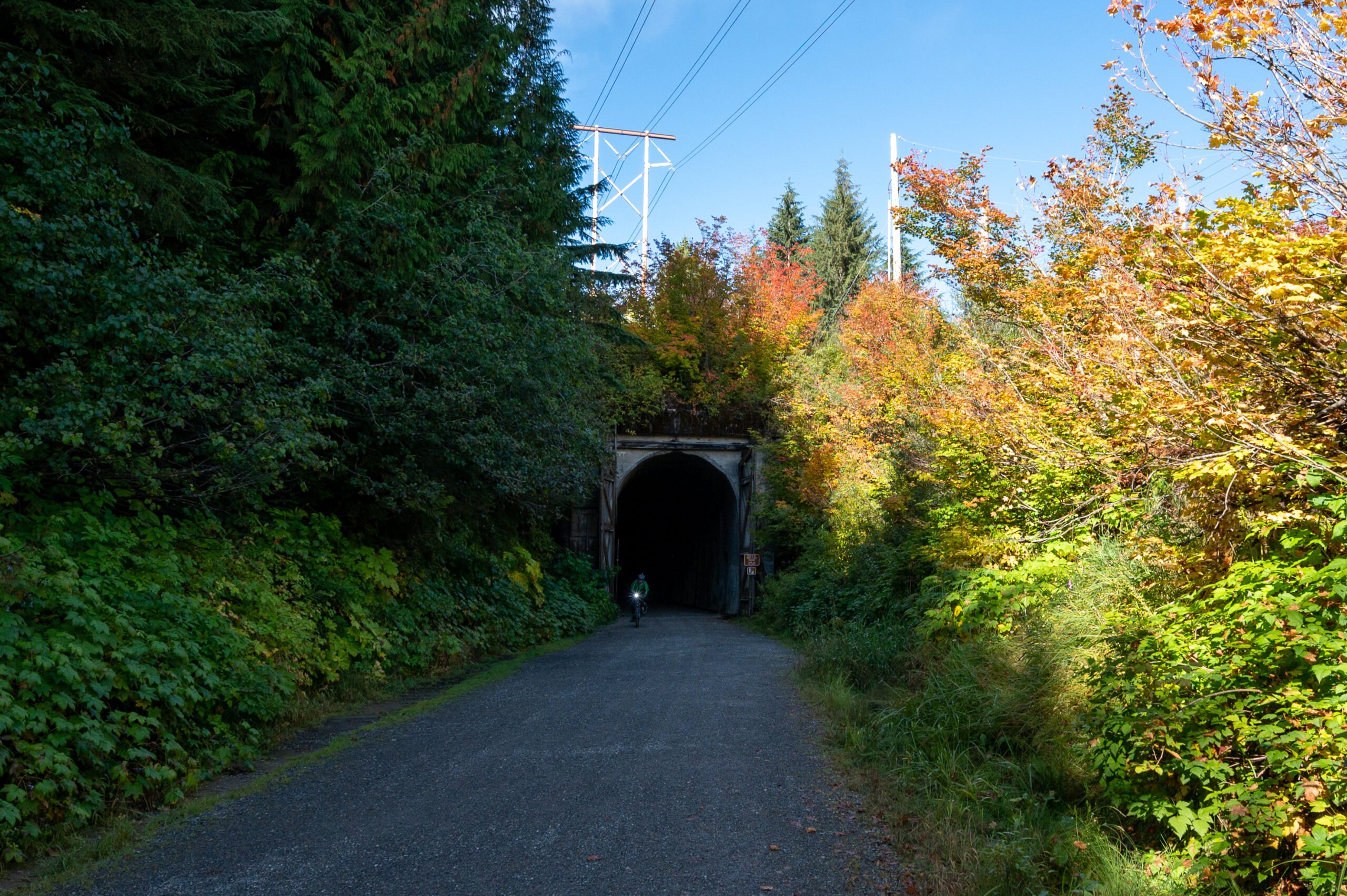
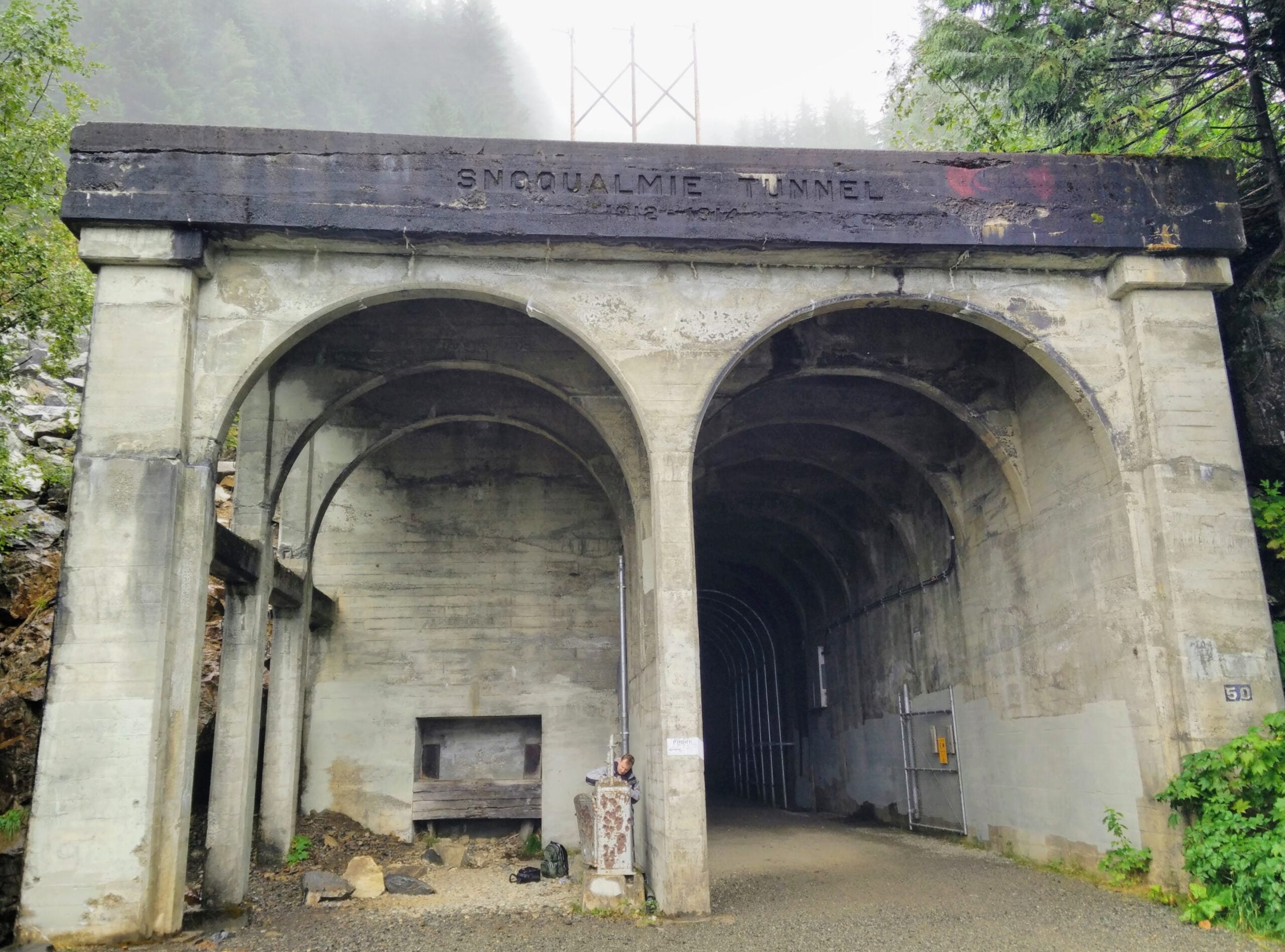
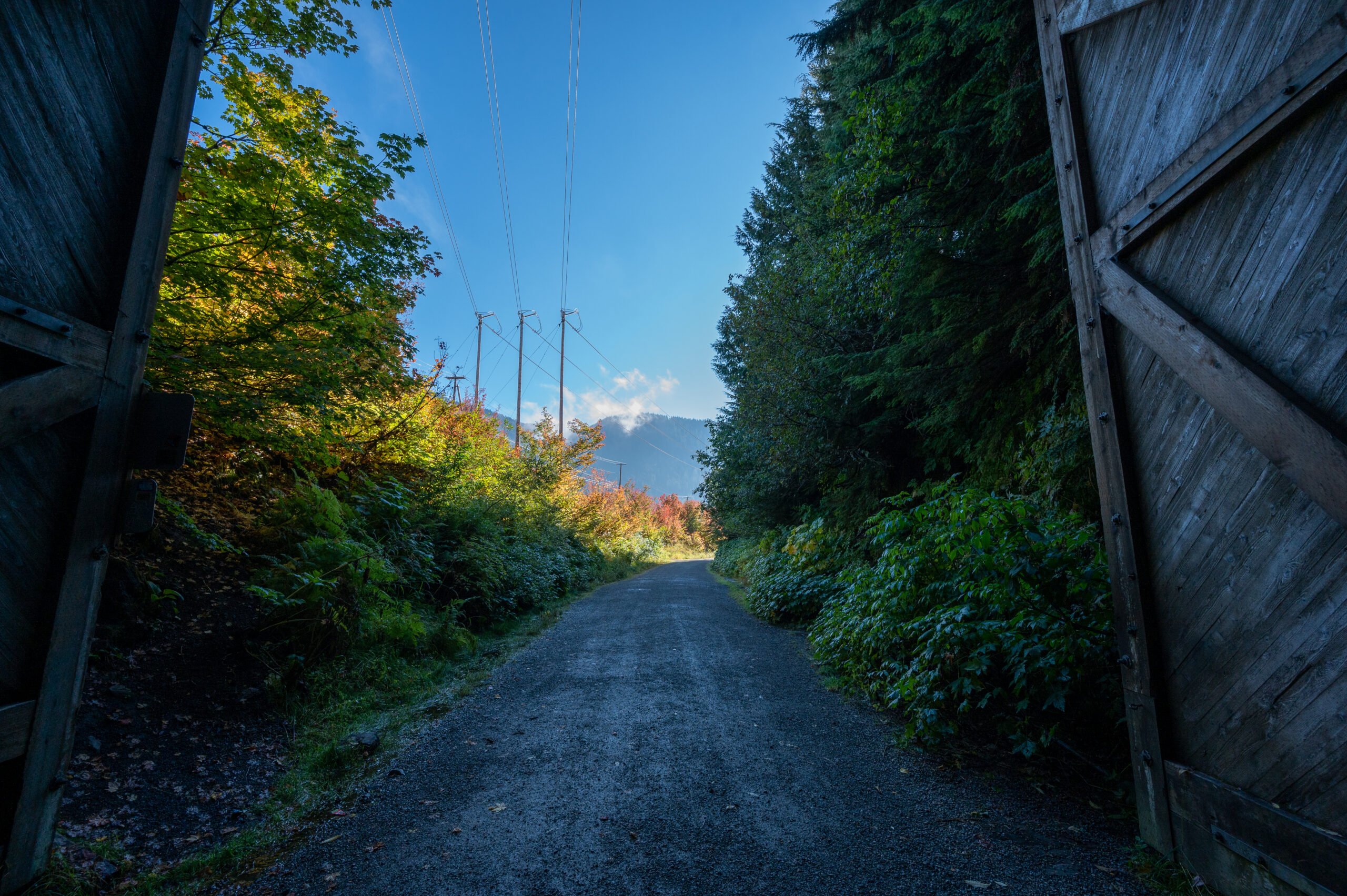
    Soon you arrive at the entrance to the Snoqualmie Tunnel.  The great tunnel doors tower above you as you look up and into the darkness. At this point, you want to make sure everyone has fully charged batteries in their flashlights and phones. Put on your headlamps and get out your flashlights as you step into the dark. Almost immediately, you will notice the coolness and dampness of the tunnel compared to the outside temperature. Enter if you dare.

    Snoqualmie Tunnel Cyclist

    Walking Through the Snoqualmie Tunnel

    After walking into the tunnel and getting further from the light at the entrance, we turned off our flashlights to fully experience what it’s like to walk in total darkness.  It is an experience you won’t forget! It is odd and feels a little disorienting.  Quickly we began having fun running in the dark and waving our lights around. We’d put them under our chins and make scary faces. We had so much fun hiding from each other and turning our lights off for this new experience of walking in the dark. 

    I recommend you try this during your hike as it is a fun and strange experience.  However, I don’t recommend it for long periods as other hikers and cyclists pass through the tunnel and need to see you.  You may even want to wear some reflective clothing or a backpack with reflectors to help cyclists coming through the tunnel see you in advance.

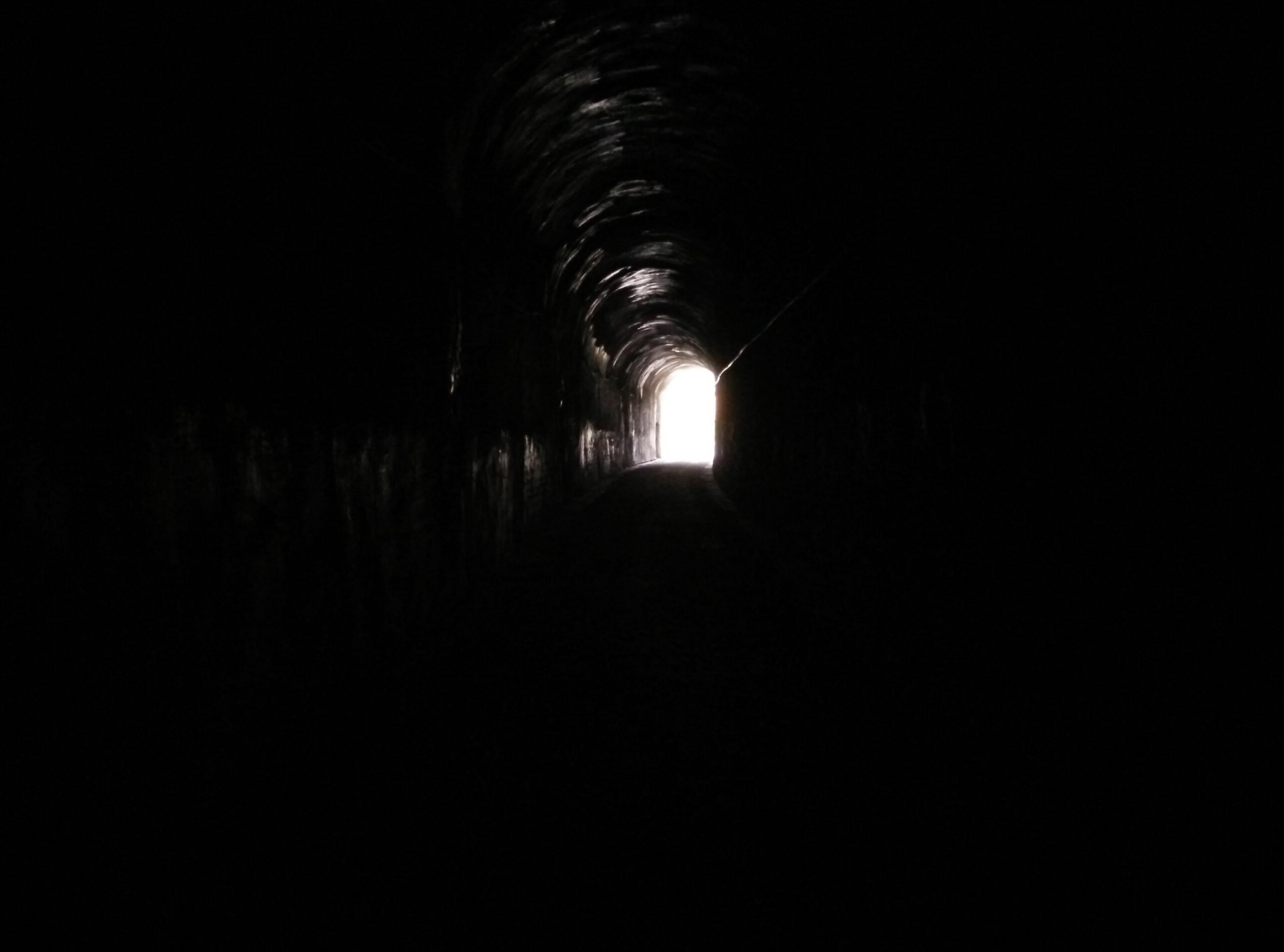
    There are small alcoves and pipes, and the sound of dripping water is constantly heard.  Although the Snoqualmie Tunnel is only 2.3 miles one-way, it feels much further when you’re walking in the dark with no views of the outside. There is a small bend halfway thru, and after that, you see a small light at the end of the tunnel.  It’s okay, go toward the light!

    Dark tunnel with a light at the end
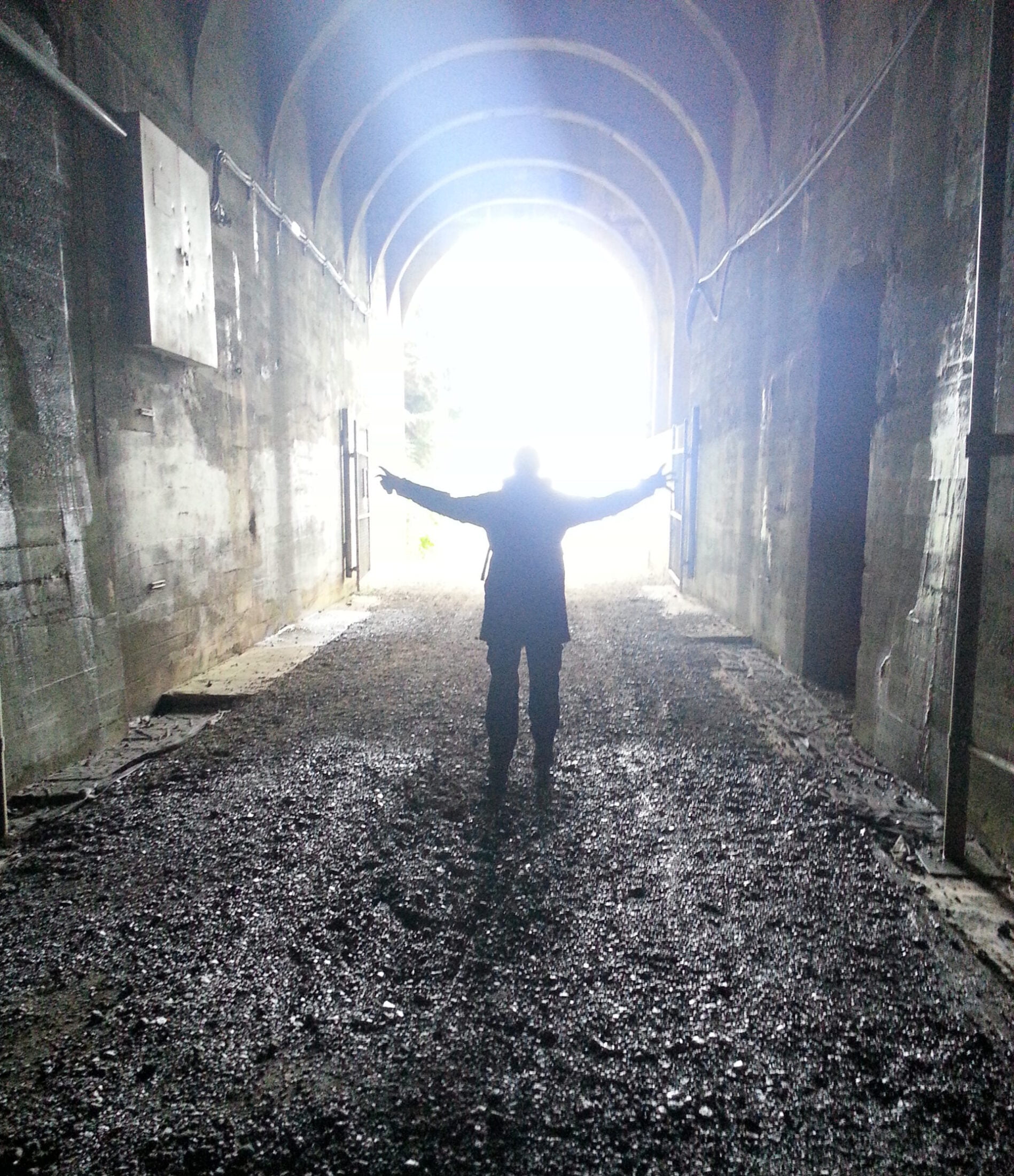
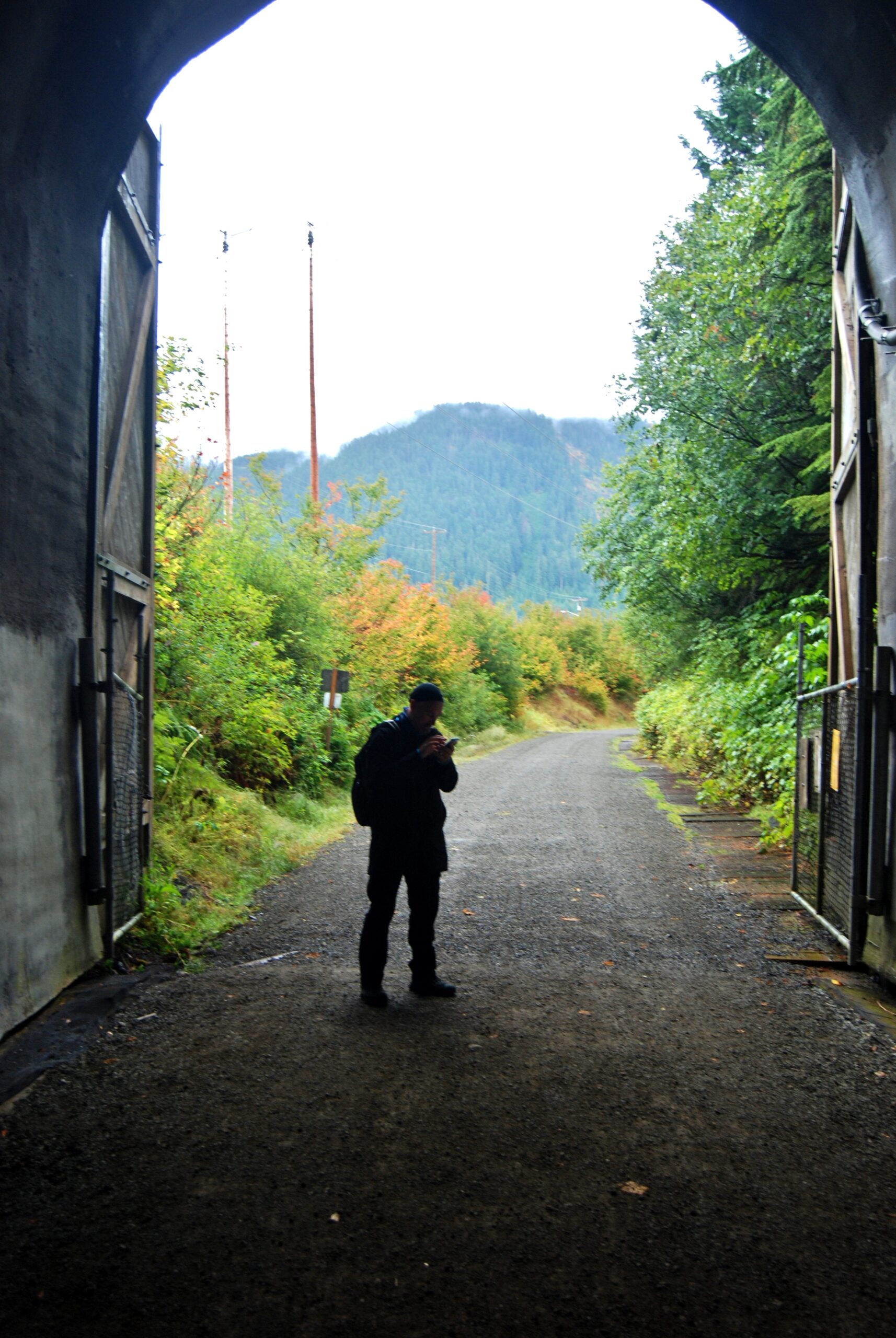
    tunnel silhouette

    On the Other Side

    As you reach the end of the tunnel and come outside you’ll see a picnic area with a tables a little further up the trail. This makes a good place to stop for a snack and talk about your experience with your group.  There is also a pit toilet here, but to be honest, I’d only use it if you absolutely have to. 

    After enjoying a snack and a break, it’s time to return to the darkness. The way back will seem even darker I think, but now you know what to expect.  Have fun and enjoy the experience!

    Snoqualmie Tunnel Exit Other side

    About the Snoqualmie Tunnel Trail

    Trail Length: 5.4 miles (roundtrip from the parking area)

    Trail Difficulty Rating: Easy (flat, gravel path)

    Features: Walk or bike in darkness through a historic train tunnel that goes through the mountain. Listen to water dripping down, examine the tunnel walls and create your own adventure!

    Entrance Fee:Washington Discover Pass is required to park here or purchase a one-day parking pass for $10 in the main parking area for the trailhead.

    Restrooms: There are restrooms at the trailhead parking area. There is also a pit toilet on the other side of the tunnel.

    Open Hours: 8 a.m. to Dusk (May to November)

    Different Names: The area is sometimes referred to by other names. Iron Horse State Park trail area, John Wayne Pioneer Trail, and the most recent name change to the Palouse to Cascades State Park Trail.

    Who Is This Hike Good For?

    It’s a flat trail, so it is suitable for all ages and abilities. However, if you have anyone who is seriously afraid of the dark, it’s best to leave them out on this hike. Except for the light from your flashlights, you are walking in darkness for over 2 miles. 

    If you love spooky adventures and enjoy something a bit different, this will be one you enjoy!  This hike is not about the views, it’s about the experience of walking in darkness through a mountain for over 2 miles.  It really is what you make it.


    What to Bring

    • Headlamp
    • Flashlights (with spare batteries)
    • Jackets
    • Sweatshirt/layers
    • Gloves
    • Hat
    • Water
    • Snacks
    • Reflective gear
    • Discover Pass or cash for parking pass
    Looking out the entrance of Snoqualmie Tunnel

    When is the Best Time to Go

    Rain or Shine the Snoqualmie Tunnel makes a great adventure.  The trail is open May through October and closes for the winter. Due to the snow and ice the area receives, it is not safe during this season.

    Since you are walking inside a tunnel in the dark, the weather outside won’t matter all that much! I hiked this on a rainy day because it was raining, and I wanted to go for a hike without being in the rain.

    I have friends that hiked this on a really hot day in the summer so they could go somewhere cool, and it is certainly cool inside the Snoqualmie Tunnel! It is chilly inside, and there is water dripping down, so no matter when you hike it, you’ll want to bring a jacket, sweatshirt, or other layers and perhaps even gloves and hats depending on the time of year.  I’ve hiked this in early September, and I appreciated having gloves and a hooded jacket.

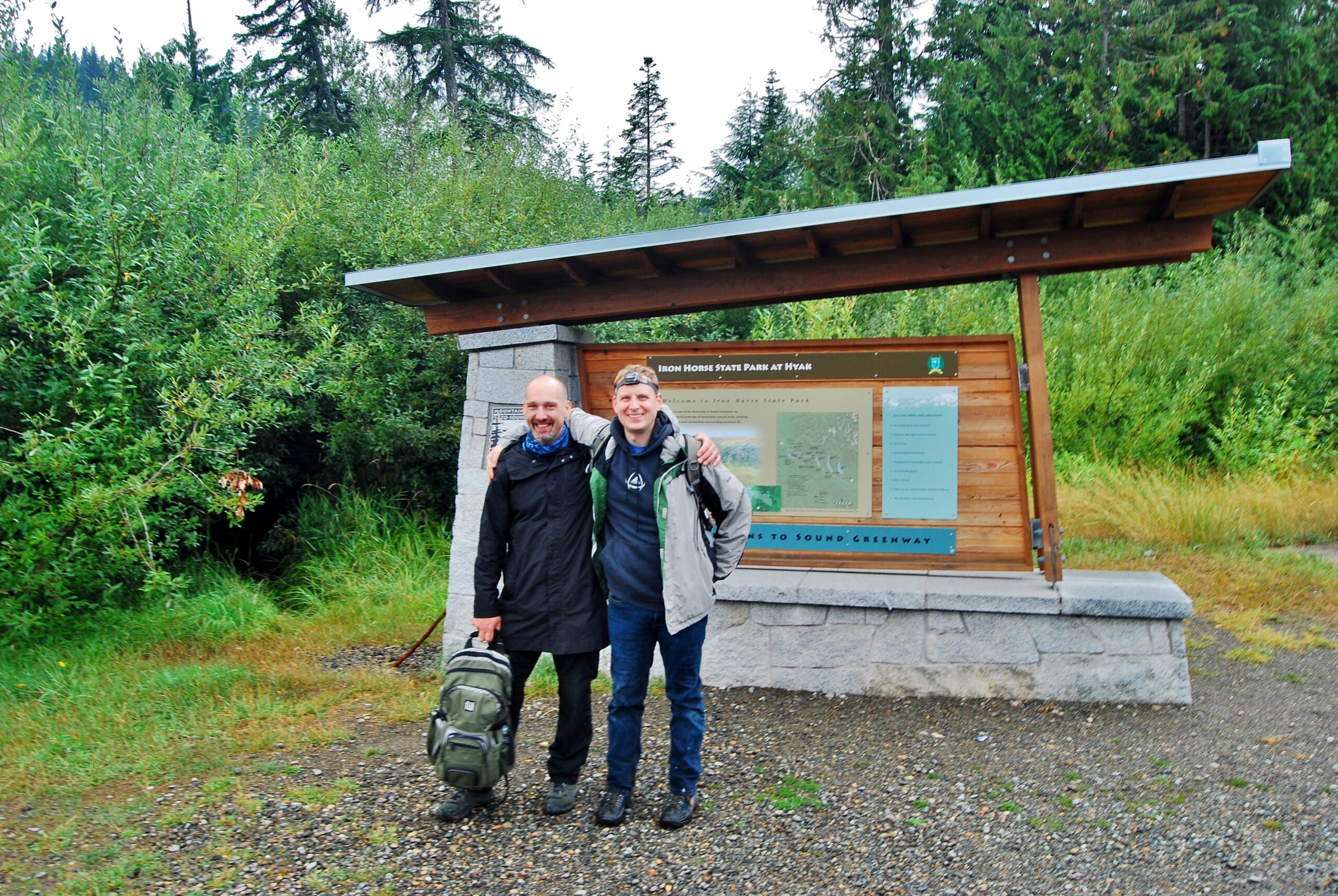
    friends at trail sign

    Getting to the Snoqualmie Tunnel Trailhead

    From Seattle, take I-90 East toward Snoqualmie Pass. Take Exit 54 for WA-906 and Hyak. Make a right off the exit ramp, then take a left at the next stop sign onto WA-906. Drive about 0.4 miles before making a right onto NF-906.  Then take the first right into the parking area; you’ll see signs for the State Park and Hyak.

    Google MapsIron Horse State Park – Hyak Trailhead, Iron Horse Trail, Snoqualmie Pass, WA 98068

    Final Thoughts & Tip for a Second Hike

    Although this hike is not about the views, you will not soon forget this experience of walking through a mountain in the dark. After you finish your adventure, if you find you’re still up for another hike, check out the scenic Gold Creek Pond Trail. It’s an easy 1.2-mile loop that packs in stunning views! You’ll find the trailhead on the other side of I-90 from the Snoqualmie Tunnel trail. Read my post, Gold Creek Pond: A Short Hike With Beautiful Views, for more information on getting there and what to expect.

    Happy Adventures!

    Travelffeine is reader-supported. If you purchase using links provided in this post, we may receive a small commission at no additional cost to you. 

    tunnel entrance
    Snoqualmie Tunnel
    Historic Tunnel
  • Top 7 Things To Do at Cape Disappointment State Park

    Cape Disappointment State Park is at the southwestern tip of Washington State, where the Columbia River meets the Pacific Ocean. It is a stunning stretch of coastline that, contrary to its name, does not disappoint.

    I don’t know why it took me so long to explore this beautiful stretch of coast in my home state, but now that I’ve been there, I’m looking forward to a return trip.  In this article, I share some of the top things to do at Cape Disappointment State Park, plus tips for what to see along with info on camping and accommodations in the park in case you want to extend your visit.

    Why is it Called Cape Disappointment

    Cape Disappointment isn’t the only name given to this area. The Chinook Tribe called the region Kah’eese, and Spanish explorer Bruno de Heceta referred to the Columbia River as San Roque.  However, when British trader John Meares came to the area searching for the Columbia River, he mistakenly believed it was only a bay. So, he was “disappointed.” Therefore he named the area Cape Disappointment, and that name stuck. 

    Ironically, we now know he did find the mouth of the Columbia River.  So, had he realized this, it might have been named Cape Discovery instead.  Perhaps there’s a life lesson here.  Sometimes, we think a dream or goal attained will look a certain way; our success will be obvious. When it doesn’t look the way we believe it should, we often give up, when in fact, we are at the precipice of a great discovery. If only we’d give it a second look and not give up so quickly. 

    Maybe, or maybe I’m looking too deeply into John Meares’ disappointment. It’s interesting to see things through the lens of hindsight if only Meares could see what we see today.

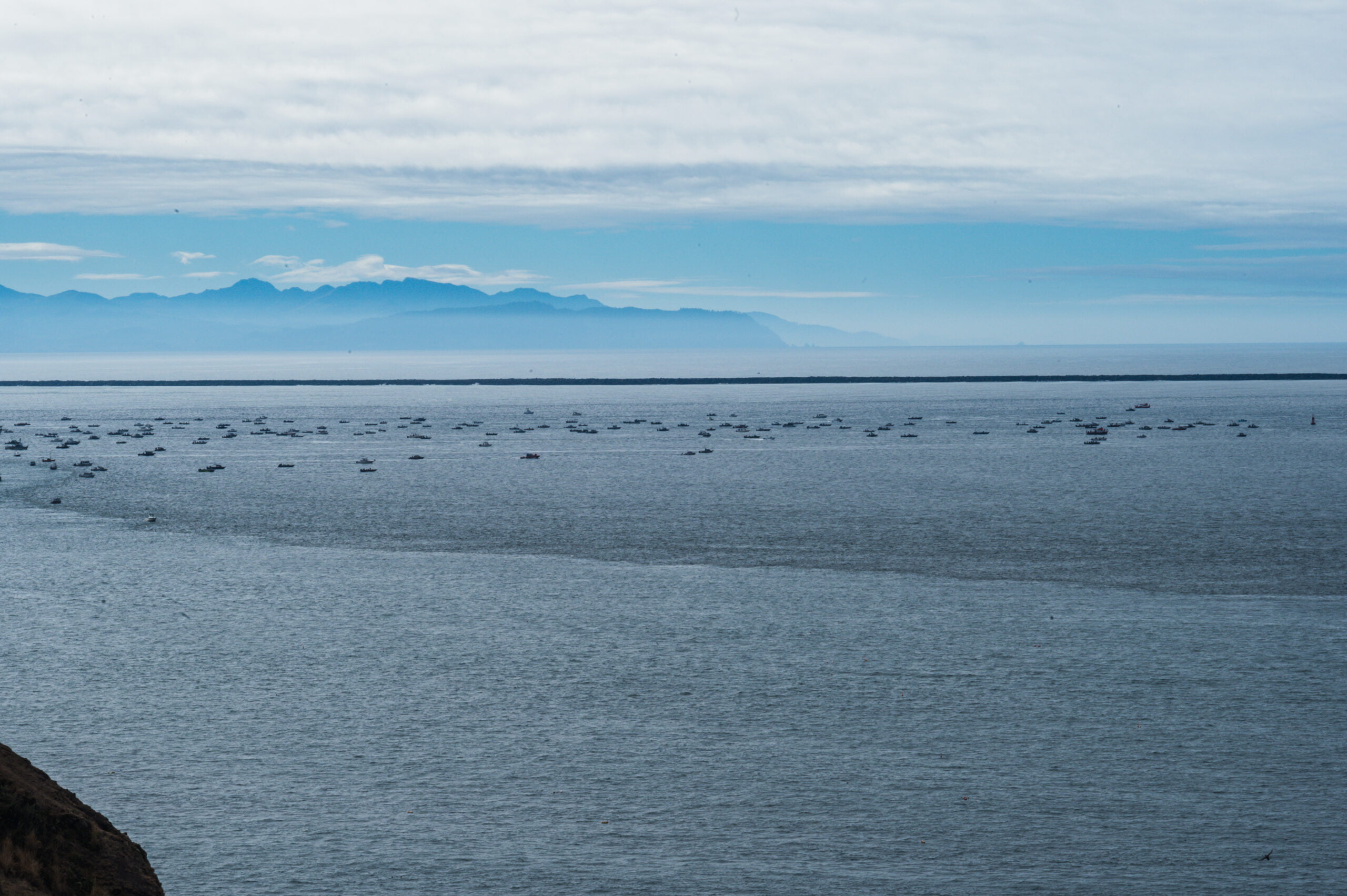
    Columbia River bar

    Columbia River Meets the Pacific Ocean

    Although John Meares named Cape Disappointment due to his erroneous assessment that he did not find the Columbia River, this stretch of coast has undoubtedly led to many sailors’ disappointment.

    This is one of the most hazardous stretches of coastline in the world. Where the Columbia River meets the Pacific Ocean, it creates a “bar.” This is a huge sandbar that changes due to the waves, strong currents, and ocean tides.

    Hundreds of shipwrecks have occurred here, and even today, a Columbia River Bar Pilot is required to guide large ships through this treacherous bar crossing. It is interesting to see in person the distinct line created where these two massive bodies of water collide. 

    Read this in-depth article to learn more about how the jetties were created and the two lighthouses in the area.  This region is full of fascinating history!

    Cape Disappointment Lighthouse Waikiki Beach

    Top 7 Things to Do at Cape Disappointment

    Cape Disappointment State Park is over 2,000 acres in size. You will certainly have no shortage of things to do during your visit here. Below I list what I think are the top 7 things to do here. You can see a lot in one day, but with two nights, you’ll enjoy a more relaxed visit with time to soak it all in.

    1) Beaches

    Beaches are always at the top of my list of to-dos.  I love the water! These three beaches at Cape Disappointment State Park are my top choices for your first visit here. They are great for flying kites, building sandcastles, looking through driftwood, seeing the lighthouse, and watching the surf.

    Benson Beach

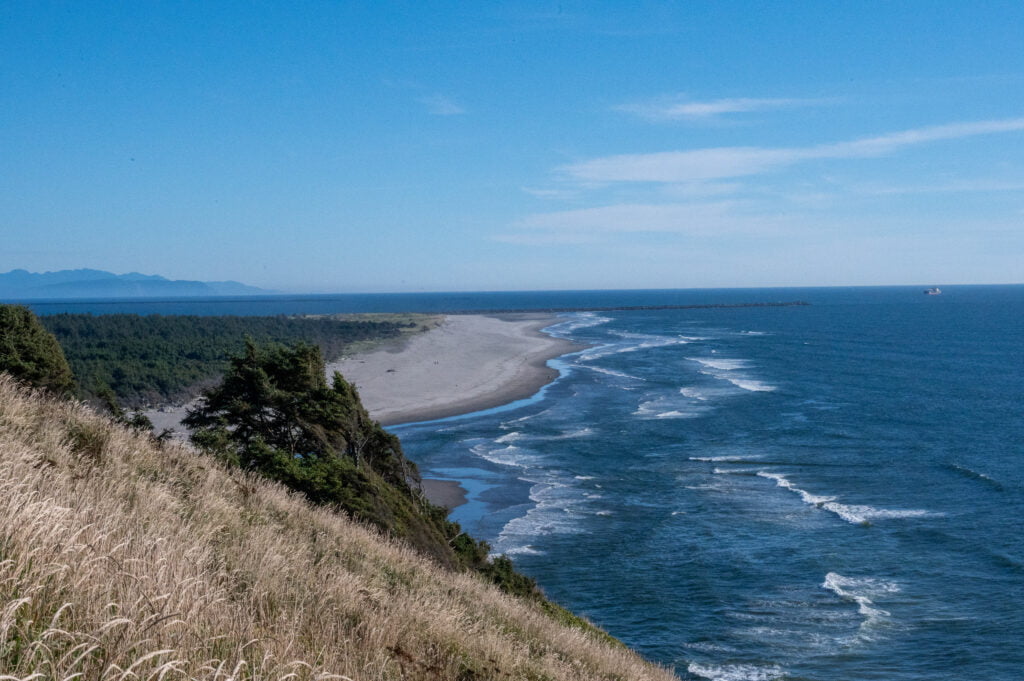
    From the main entrance to the campground area, at the three-way stop, take a left onto North Jetty Road and drive past Waikiki Beach to find the parking area for Benson Beach near the end of the road. There is also a trail to the beach near the campground amphitheater in Loop A. 

    This two-mile stretch of beach is vehicle-free.  I know that might sound strange for me to mention that, but actually, most of the Long Beach peninsula is open to vehicles.  So it’s nice to know you and your family can explore Benson Beach without worrying about a car driving up behind you.

    Benson Beach
    Benson Beach as seen from the North Head Lighthouse trail.

    Waikiki Beach

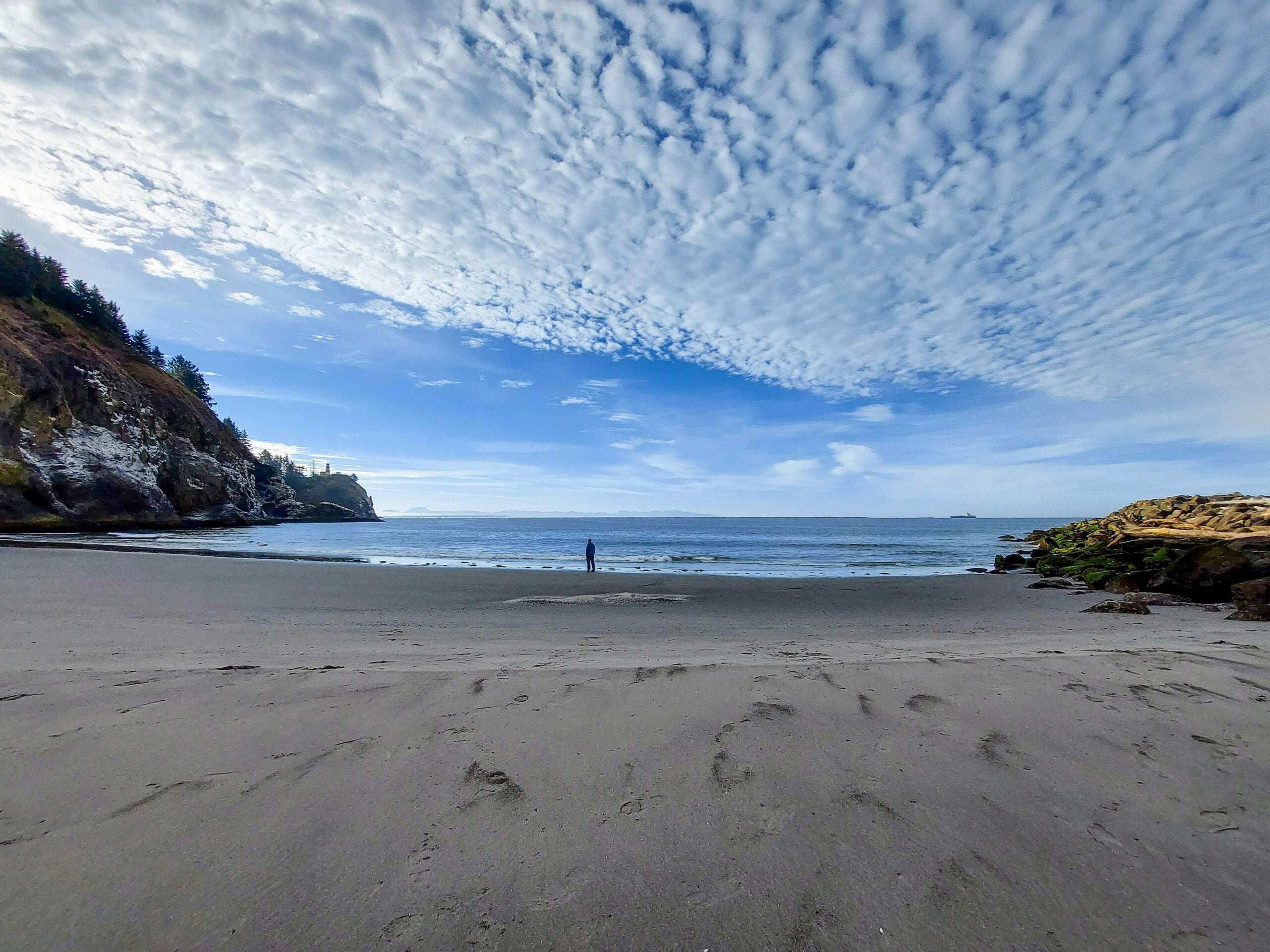
    I know you probably thought Waikiki Beach was only in Hawaii. Me too!  It turns out Washington State also has a Waikiki Beach. If you’ve ever seen the photographs of the enormous waves crashing below the Cape Disappointment lighthouse, this is the beach where those photographs were taken.  The winter storms that hit this part of the coastline are pretty epic.  You most likely won’t catch any wave action like that during the summer but visit October through March, and you’ll have a good chance of seeing this firsthand.

    If you camp in the D Loop area, it’s a short walk to Waikiki Beach. You can also drive to the parking area via North Jetty Rd. There is a lot of parking space, some with views facing the Cape Disappointment Lighthouse. Watch the sunset here while enjoying a warm cup of clam chowder.  That’s what I did! I also saw kids and families building forts out of driftwood on the beach. It looked like a great way to spend a couple of hours creating memories, and there certainly is no shortage of driftwood here!
    Waikiki Beach
    Waikiki Beach in the morning.

    Beard’s Hollow

    You may have seen Beard’s Hollow viewpoint on your drive to the main entrance of Cape Disappointment State Park. Drive south about a half-mile past the viewpoint to a turnoff and parking lot for the Beard’s Hollow trailhead. Take the paved path straight ahead of the parking lot to access Beard’s Hollow and the beach.  The path to the right leading over the wooden bridge is for the Discovery Trail. Beard’s Hollow beach allows vehicles, so please be aware as you’re dipping your toes in the surf and sand.

    Isn’t this the perfect kite for the beach?

    2) Metal Detecting

    Cape Disappointment State Park is 1 of around 50 Washington State Parks that allow metal detecting.  You’ll need to complete this form and bring your metal detector. Cape Disappointment has about 240 acres of beach area designated for metal detection.

    3) Trails

    Whether on foot or by bicycle, Cape Disappointment has a lot of great trails. 

    The following trails are accessible from the Cape Disappointment campground.

    • Mackenzie Head
      0.5 mile (roundtrip) This short trail leads you to an old WWII battery and information boards describing its historical significance. It also has a nice view of the forest and ocean. Head toward the main A Loop campground area, and you’ll find a small parking area on the left about 0.5 miles along Fort Canby Rd. 
    • Coastal Forest Loop Trail
      The entrance to this loop trail is near Cafe D. You can take a shorter 0.5-mile loop or the longer 1.5-mile loop. If you take the longer loop trail, there is a 0.1-mile trail with a view of Baker Bay. This trail is typically wet and muddy, so come prepared.
    • North Head Trail
      This 3.0 mile (roundtrip) hike starts opposite the road from the Mackenzie Head trail and ends at the North Head Lighthouse trail area.

    These hikes require driving to the trailhead parking areas:

    • Bell’s View 
      This paved 0.5 mile (roundtrip) trail takes you to beautiful views of the coast as well as passing by more WWII outposts. Learn about the history and the incredible winds that hit this coastline in this short, informative hike. 
    • Beard’s Hollow
      The trail to Beard’s Hollow is a nicely paved trail within Cape Disappointment State Park, suitable for bikes and wheelchairs.  I am not sure of the actual mileage of this trail. It was a 10-minute leisurely pace to the beach along this mostly flat trail, and I’d guess maybe 0.3 miles each way.
    • Discovery  Trail
      Starting from the North Head Lighthouse Parking area, this 7.3 mile (one-way) trail takes you to the town of Long Beach, with lots of beautiful views along the way. (You can also start this trail from the Beard’s Hollow Parking area, shortening the hike to 6.3 miles. However, I think this trail is best on a bike — see #6.)

    4) History

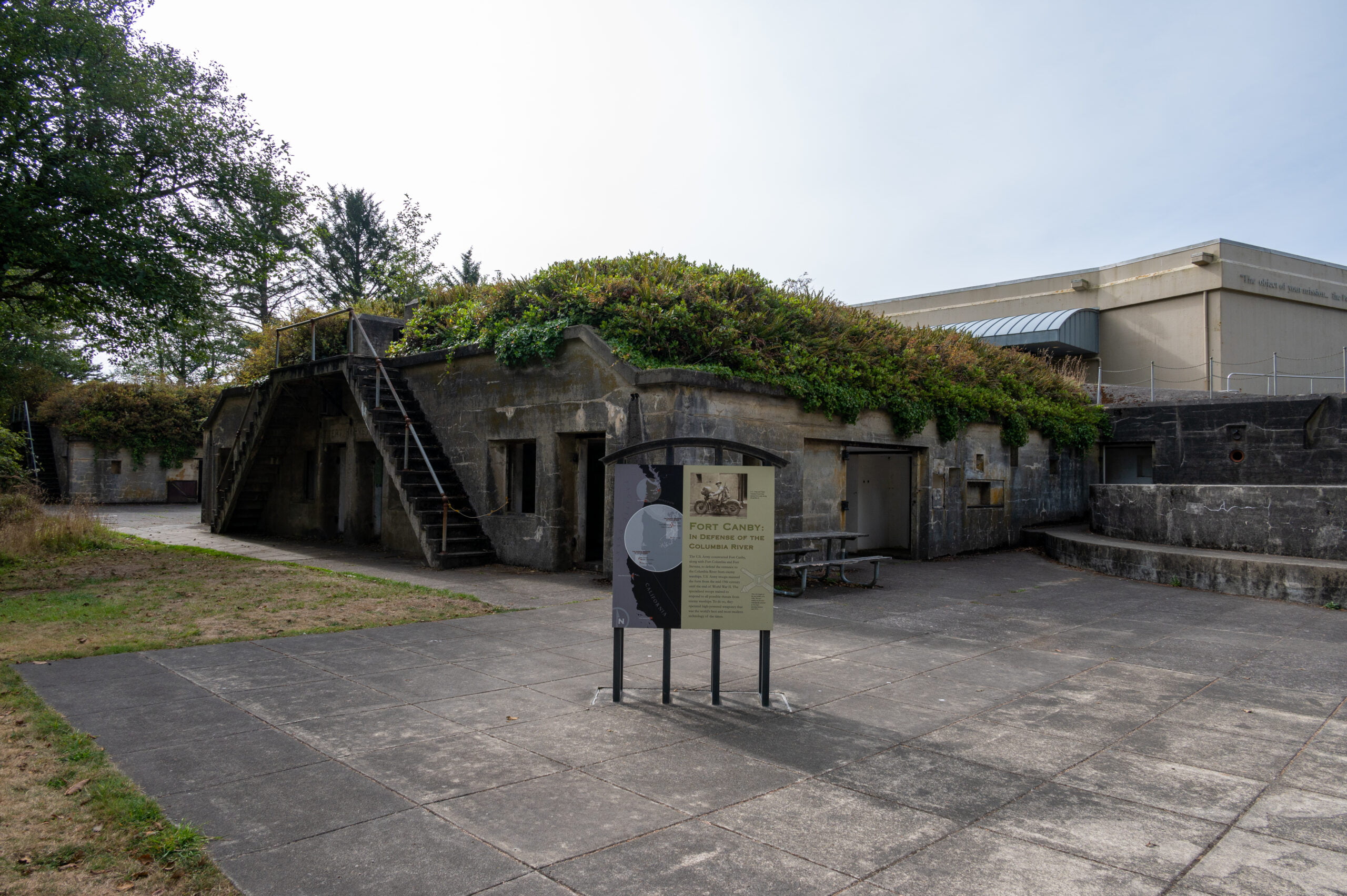
    In addition to seeing WWII sites along the trails, you can also visit Fort Canby and explore what’s left of this historical site. You can also tour the Lewis & Clark Interpretive Center and learn about two of our most famous explorers–Lewis and Clark! 

    The Lewis & Clark Interpretive Center is worth a stop, even if you aren’t sure about the historical exhibits.  Why? Because of the views!  The path in front of the interpretive center is one of the best spots in Cape Disappointment State Park to see where the Columbia River meets the Pacific Ocean.  It also offers a much closer view of the Cape Disappointment Lighthouse. 

    Fort Canby
    Fort Canby

    I think we stood along the viewpoint area in front of the Lewis and Clark center for at least 30 minutes, just seeing what we could see.  We watched double-crested cormorants as they searched for food, diving from the cliffs to the water and back again. Then we counted the 100’s of boats just past the line in the water created by the convergence of the Columbia River and the Pacific Ocean. 

    If that weren’t enough, though, the Interpretive Center is full of fascinating history and facts about lighthouses and early explorers.  The upper floor is free and worth taking a look around, and it has huge windows with views of the lighthouse and ocean.  

    Additionally, you can pay $5 to see the entire exhibit, which starts on the basement level. There is a wonderful video about Lewis & Clark’s incredible 4,000+ mile journey to come to their stopping point at Cape Disappointment.  I heard a small boy exclaim to his parent as he watched the video, “That’s here, that’s where we are!”  I saw history made real to him as he watched the video about Lewis & Clark’s journey.  That’s what it’s all about!

    Lewis & Clark Interpretive Center

    244 Robert Gray Drive Ilwaco, WA
    Ilwaco, WA 98624-8624

    Phone: (360) 642-3029

    5) Lighthouses

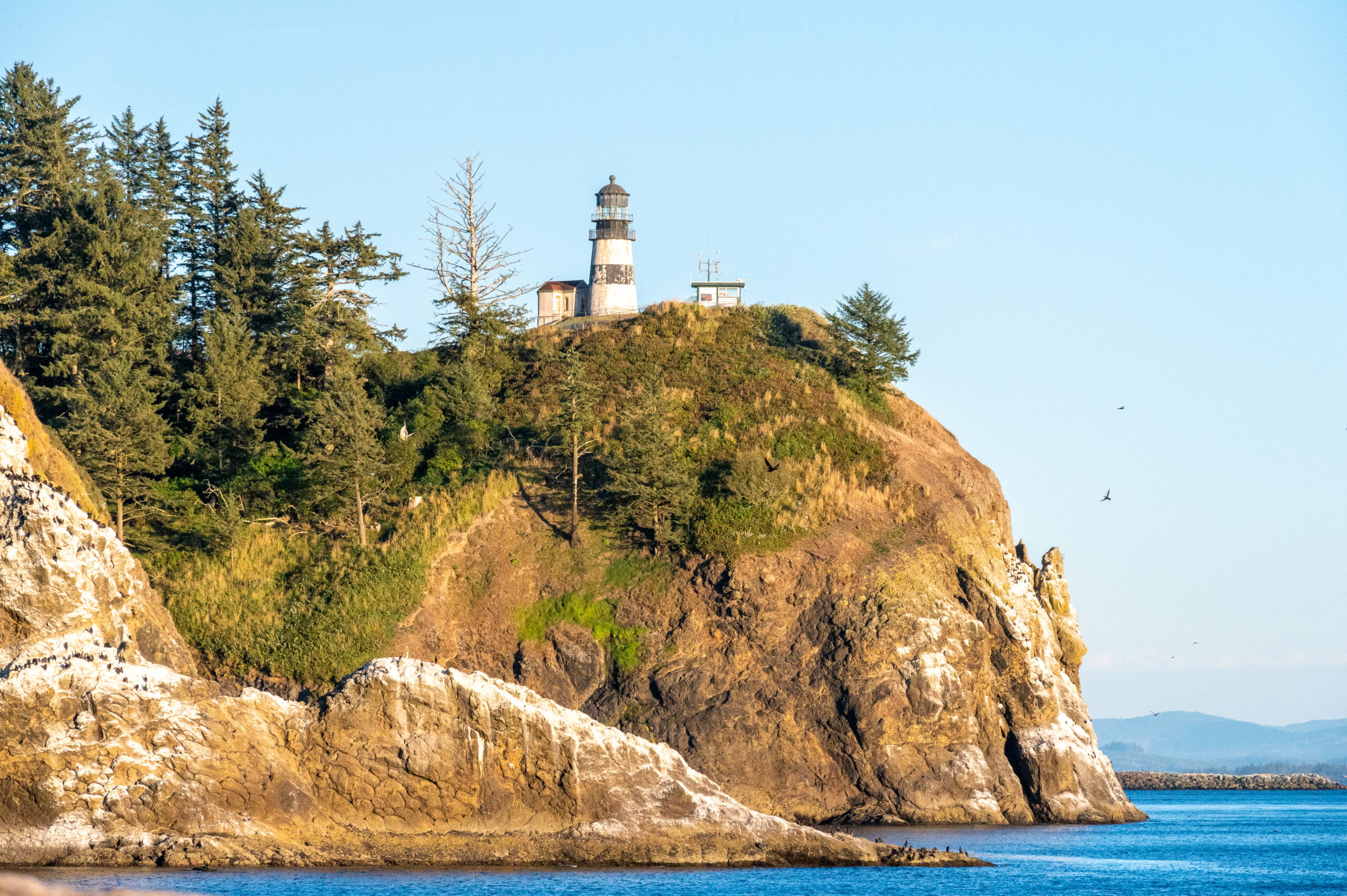
    Cape Disappointment State Park has two lighthouses within its borders.  This stretch of coastline was so dangerous they built not one but two lighthouses! I love looking at lighthouses. Their architecture and beautiful locations never disappoint (see what I did there). 

    During my visit, I learned that lighthouses were the original GPS. They not only emit light to keep ships from running ashore, but each one is uniquely painted, and they each emit a specific light pattern.  Sailors use these two distinguishing features to help them know where along the ocean they were. Pretty cool, right!

    Cape Disappointment Lighthouse 

    This is the lighthouse you see in the photos taken from Waikiki Beach.  It gets the huge waves crashing at its base during the winter. You can no longer access the lighthouse, but you can see it from both Waikiki Beach and in front of the Lewis & Clark Interpretive Center.

    North Head Lighthouse 

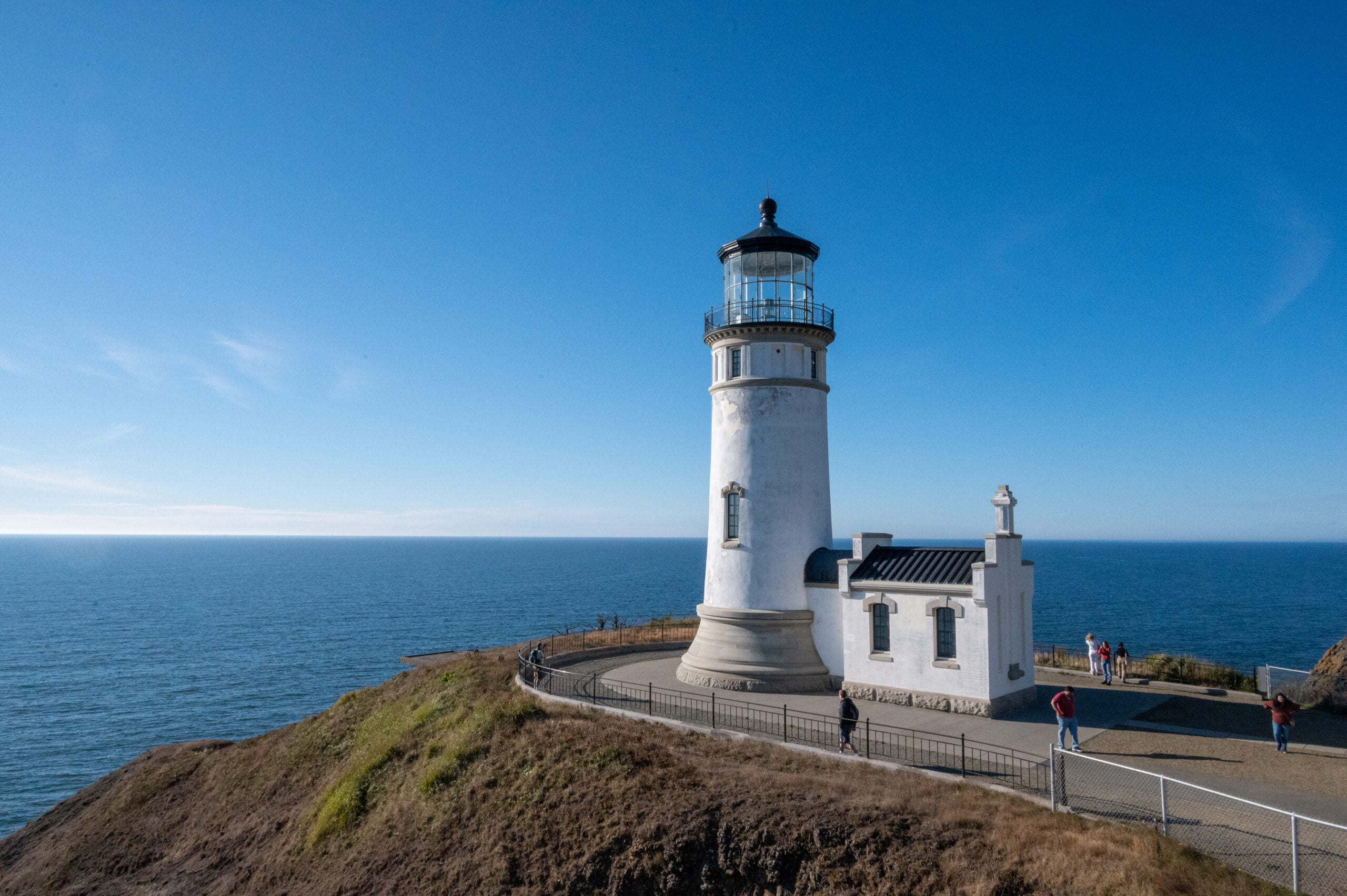
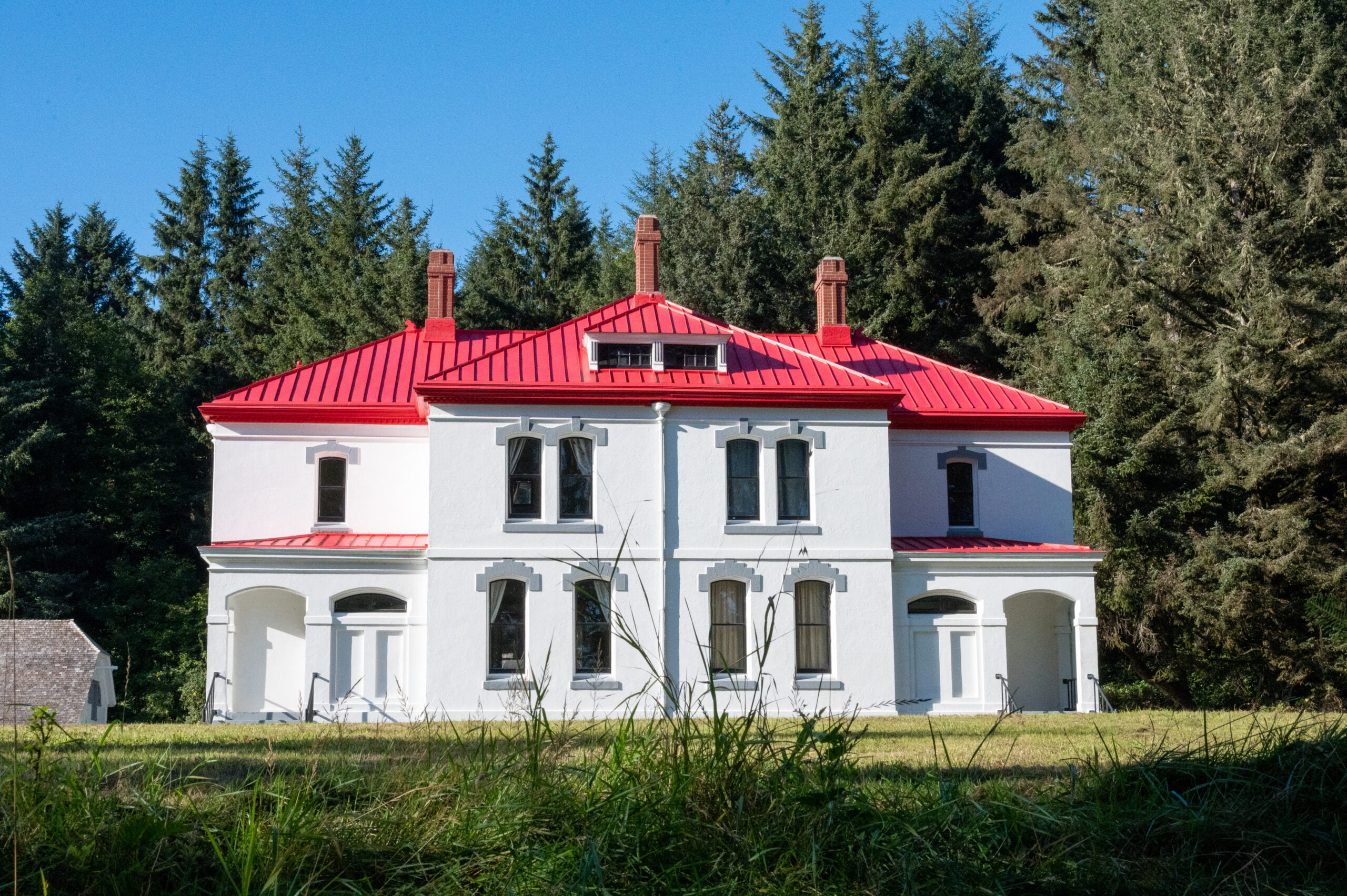
    Constructed in 1898 after continued shipwrecks along this rocky coast demonstrated the need for a second lighthouse.  The North Head Lighthouse is still used to aid in navigation today. It was currently closed for tours during my visit, but I’m optimistic it will reopen to the public again soon. The paved trail to the lighthouse is a beautiful walk, and you pass by the guesthouse for the Lighthouse Keeper.  You can stay here by reserving it online through the WA State Parks website.  Now wouldn’t that be a unique experience!

    North Head Lighthouse Cape Disappointment

    6) Cycling

    There are plenty of paved roads within the main campground areas for families to enjoy biking in a low-traffic area.  However, for a real adventure, consider cycling the Discovery Trail.  

    The Discovery Trail is a mostly paved 8.5 mile (one-way) trail that stretches from Cape Disappointment State Park to the town of Long Beach!  There are viewpoints along the route, historical markers, and even art sculptures to enjoy.  It is a beautiful trail, and even if you don’t feel like making the entire 16-mile round trip consider cycling at least a portion of the trail.  Here is a trail map that gives you an overview of the Discovery Trail route.

    Start the trail from the North Head Lighthouse parking area and ride toward Long Beach as far as you feel like, or if you have someone to drop you off, you could do a one-way shuttle. You could start in Long Beach and then cycle south back to Cape Disappointment State Park. No matter what you choose, you’ll enjoy this beautiful trail!

    crab on Beard's Hollow Beach

    7) Fishing

    You can go fishing and boating at Cape Disappointment State Park.  Although, if it were me, I think I’d try my hand at crabbing.  There were so many Dungeness crabs washed onshore here it made me hungry! 

    Fishing from the shore is allowed, but you can also bring a boat if you have your own. The Baker Bay Boat Launch is next to Cafe “D,” just across from the park’s main entrance. 

    Make sure to have all the appropriate licensing required for boating and fishing. Plus, you’ll want to check with the Washington Department of Fish & Wildlife to see what is currently open and allowed.  Some years the biotoxin levels close fishing here. 

    North Head Lighthouse Keeper's House

    Accommodations at Cape Disappointment

    Camping

    The best tent campsites are sites 1-180 toward the rear of the park.  There are a few tent sites in the D Loop near the main entrance, but these have less privacy and more road noise.  We ended up staying in one of these and could hear the loud ship horns and road traffic throughout the night.  There are also a lot of RV campsites, including those with full hookups.

    Rentals

    In addition to campsites, Cape Disappointment State Park also has cabinsyurts, and two vacation houses for rent. 

    Getting to Cape Disappointment State Park

    Cape Disappointment is a little over a 3-hour drive from Seattle, Washington, and a 2-hour drive from Portland, Oregon.

    You’ll either take Hwy 101-S from the Seattle area or Hwy 101-N if coming from the south/Oregon.

    For some reason, Google directions take you to the general area of Cape Disappointment State Park rather than to the entrance of the park.  So, the easiest way to get to the campground entrance and park’s pay station for Cape Disappointment State Park is to navigate to Cafe “D,” located directly across from the park’s main entrance.

    Cafe “D” Address: 243 Robert Gray Dr, Ilwaco, WA 98624

    Besides being a waypoint to the entrance of the park, Cafe “D” also offers Wi-Fi, miscellaneous camping supplies you may have forgotten, as well as ice cream cones and coffee.

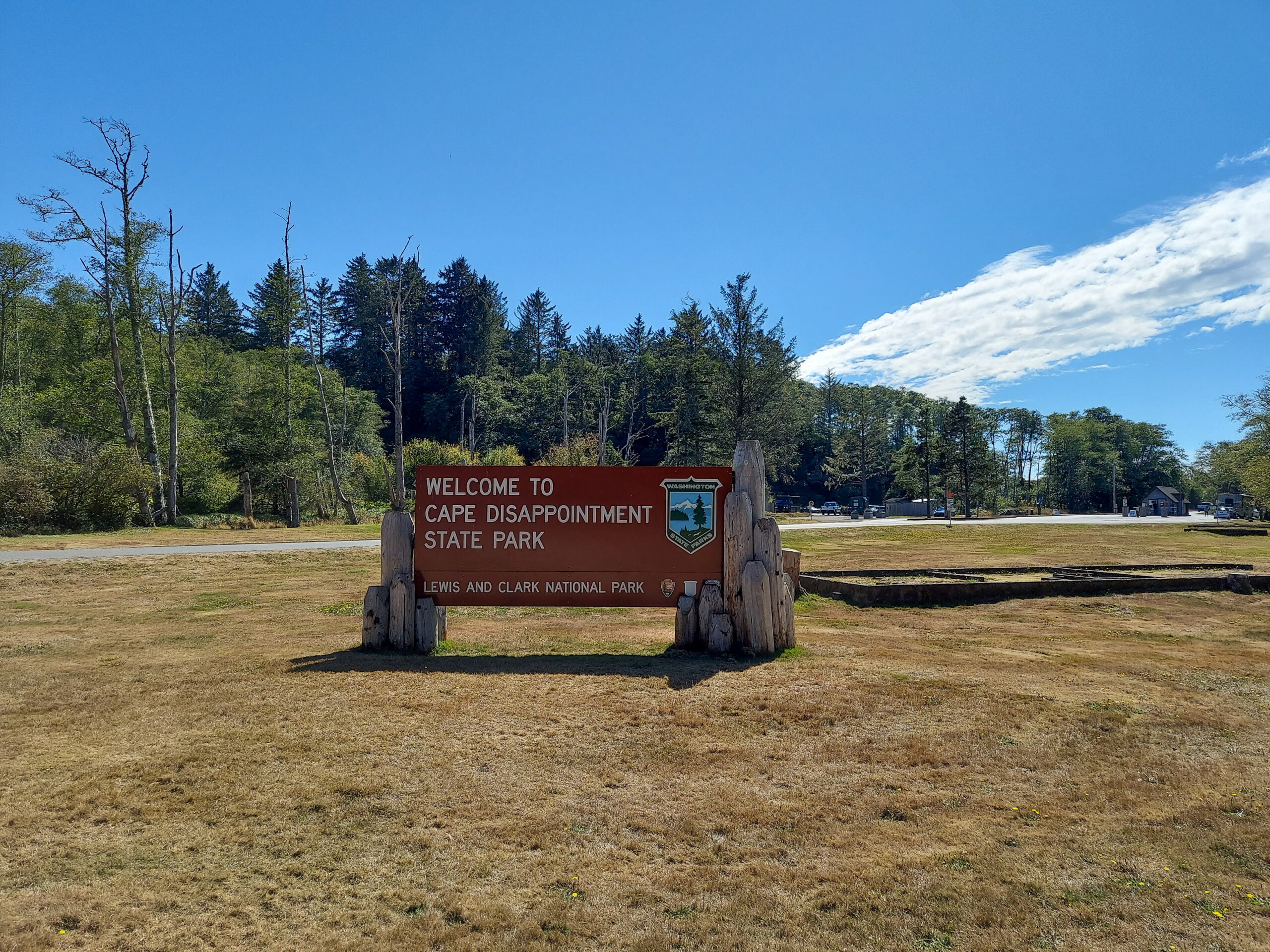
    Cape Disappointment Sign

    ADA Accessibility

    The following had paved trails and parking areas suitable for walkers and wheelchairs.

    • The North Head Lighthouse trail
    • Lewis & Clark Interpretive Center and viewing area that looks at Cape Disappointment Lighthouse
    • Bell’s View
    • Beard’s Hollow (the paved trail ends at the beach)
    • Beard’s Hollow Viewpoint (parking area with an overlook)
    North Head Lighthouse Trail

    Restaurants to Try Near Cape Disappointment

    The Chowder Stop (Makes great chowder and can easily pack it to go too.)

    The Chowder Stop
    203 Bolstad W, Long Beach, WA 98631

    42nd Street Cafe and Bistro (Amazing breakfasts here, plus they serve beignets!)

    42nd Street Cafe
    4201 Pacific Way, Seaview, WA 98644

    The DEPOT Restaurant (If you eat out only once, make it The DEPOT Restaurant. Reservations required, but they can often squeeze you in same day if you call ahead.)

    The DEPOT Restaurant
    1208 38th Pl, Seaview, WA 98644

    Roots Drive-Thru Coffee (This is small coffee shop is in Ilwaco just outside the park boundary. It’s a quick drive in the morning to get your coffee fix!)

    Roots Coffee
    111 First Ave N, Ilwaco, WA 98624

    Weather at Cape Disappointment

    The weather at Cape Disappointment could be the best reason to call it such a name. It is the stormiest stretch of coastline, with hurricane-force winds during the winter and unrelenting rain. If you plan to tent camp here, I highly recommend you look ahead to the weather forecast before deciding to come. 

    I do not enjoy tent camping in the rain.  Rain and wind at Cape Disappointment can make tent camping miserable or, should I say, “disappointing.” You may decide a cabin or hotel in town would be better if your forecast appears to be stormy and grey.

    I used my new Coleman 4-Person Pop-Up Tent, and it did fine with the light rain we received early in the morning, however anything more, and we’d have had wet gear, I think. So plan to spray your tent ahead of time with waterproofing spray and pack some waterproof jackets for exploring.

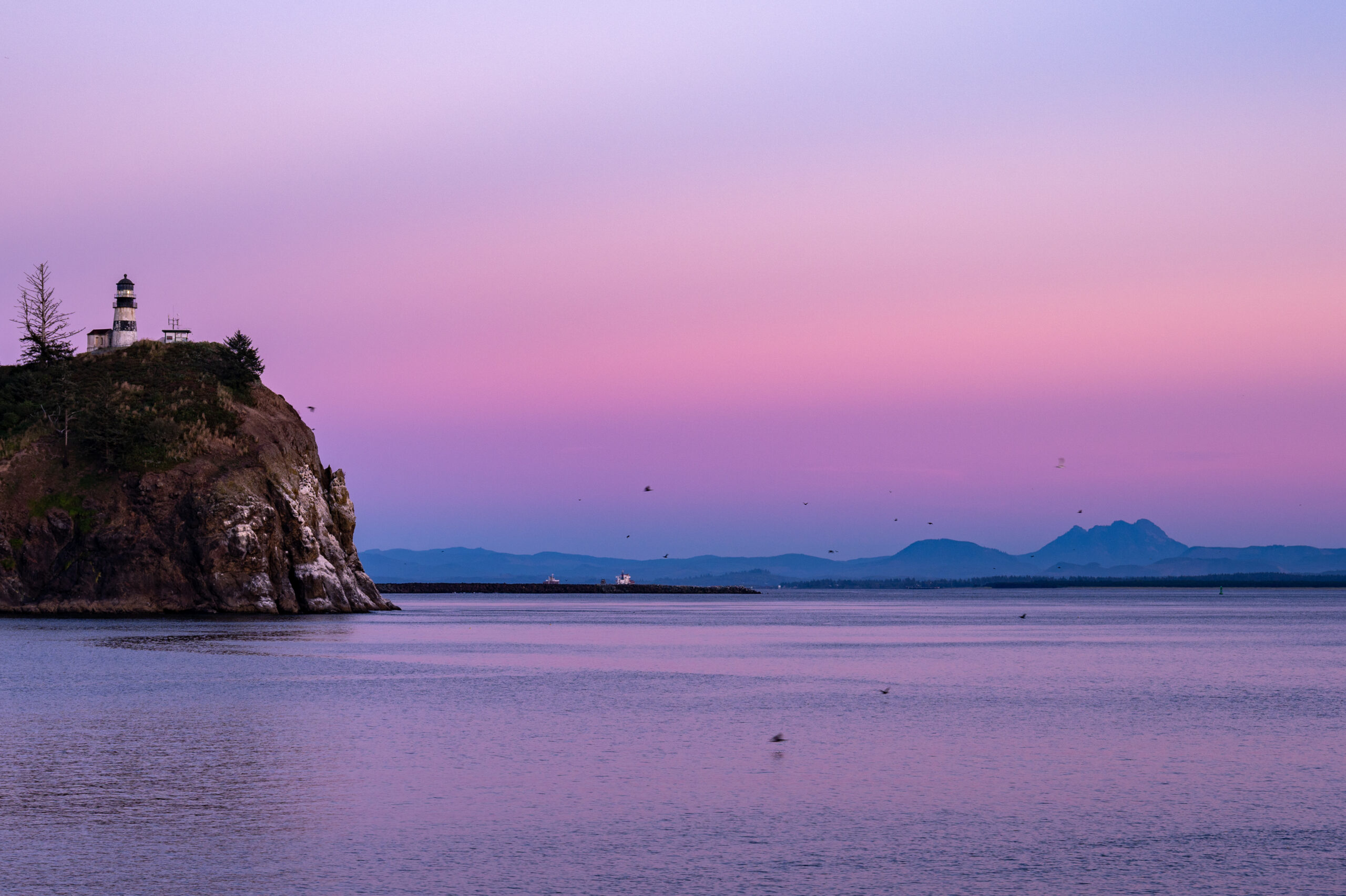
    Sunset by Cape Disappointment Lighthouse

    Final Thoughts

    I loved visiting Cape Disappointment State Park! There is so much to do along the Long Beach Peninsula outside the park too. Washington State has some of the most beautiful coastline. I enjoy every opportunity I get to explore it.  I hope you will get a chance to visit here soon. Let me know if you have any questions regarding this area or if there’s a favorite activity here that I missed. 

    Here are a few articles that might interest you:


    Note: Travelffeine is reader-supported. This post contains affiliate links. When you make a purchase using one of these affiliate links, we get paid a small commission at no extra cost to you. And as always, all opinions are our own. Thank you!


    Happy Exploring!

    Cape Disappointment State Park
    North Head Lighthouse at Cape Disappointment
  • Hiking to the Fire Wave at Valley of Fire

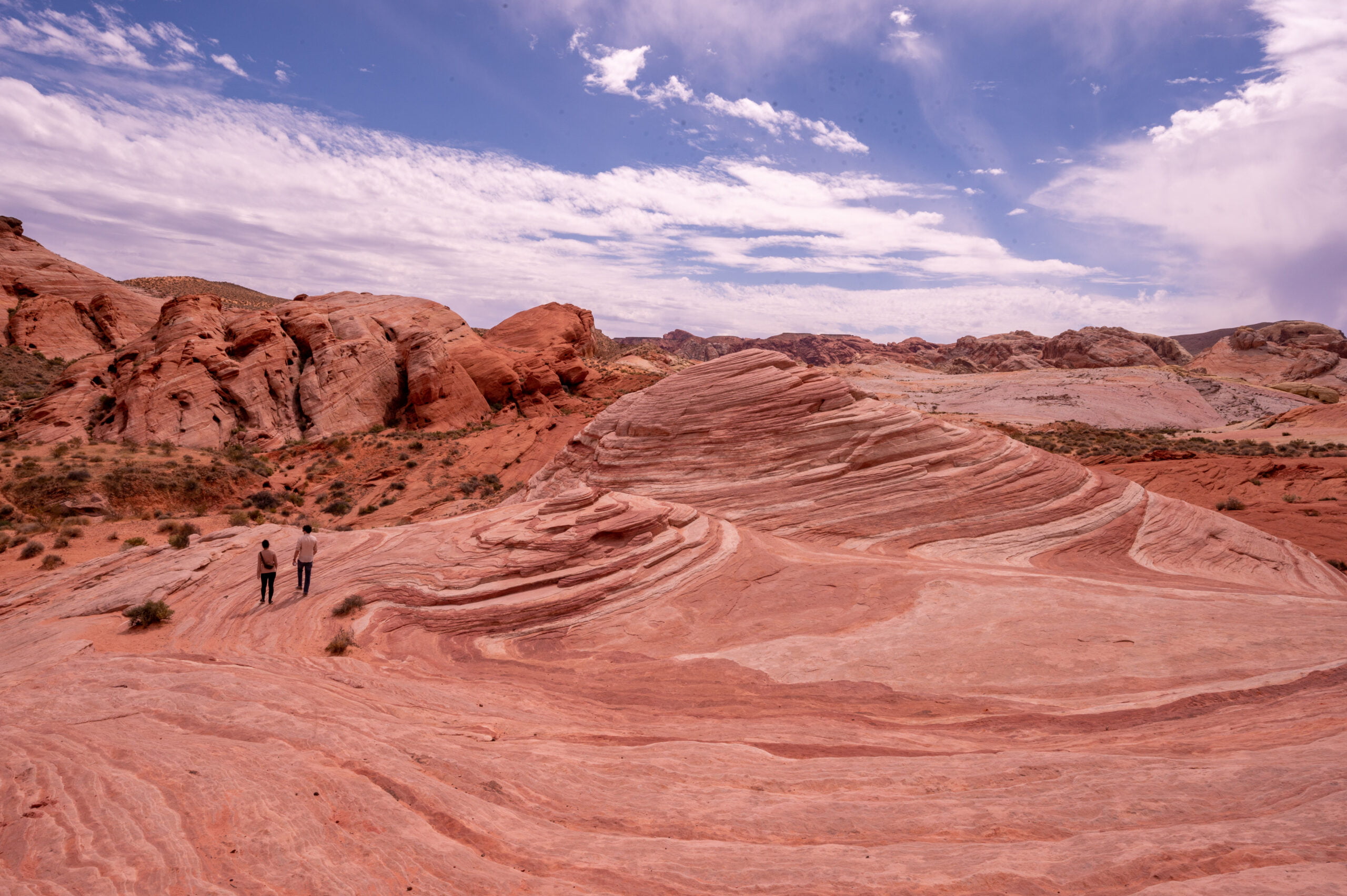
    The Fire Wave at Nevada’s Valley of Fire State Park is a gorgeous sandstone formation. With its swirling patterns of reds, pinks, and white, the Fire Wave makes for beautiful landscape photography.  In less than a 1-hour drive from Las Vegas, you enter a photographer’s paradise. Plus, for those looking for an alternative to “The Wave” in Utah, the Fire Wave at Valley of Fire makes a great choice! No special lotto is required. 

    The Fire Wave trail was one of my favorites during my day trip to Valley of Fire State Park. Below I share my experience hiking to the Fire Wave, plus information on an alternate route I discovered while hiking to the Pastel Canyon. 

    Getting to the Fire Wave Trailhead

    From Las Vegas, take I-15 N to Exit 75. After exiting, follow signs for Valley of Fire. It is about another 12 miles along the Valley of Fire Highway before you reach the entrance station for the park.  It takes about 1-hour to drive there from Las Vegas.

    After entering the park, and paying the park entrance fee, continue straight for about 2.5 miles. Make a left onto Mouse’s Tank Rd (you’ll see signs for the Visitor Center and White Domes). Continue up Mouse’s Tank Road for almost 5 miles before coming to Parking Lot 3 (P3 on the map). 

    The trailhead starts from the parking area on the right when heading north toward White Domes. Park in the gravel parking lot on the righthand side of the road. If that lot is full, you can check the parking lot on the opposite side of the road.

    About the Fire Wave Trail

    Trail Length: 1.5 miles (roundtrip)

    Elevation Gain: ~ 236 feet

    Trail Difficulty Rating: Easy

    Features: Colorful Sandstone and limestone, swirling wave-like sandstone rock formation, desert landscape and native plants

    Entrance Fee: There is a $15 day-use park fee per vehicle ($10 for NV plates)

    Restrooms: There are no restrooms at the trailhead. You can stop at the Visitor Center on the way to the trail.

    Open Hours: Sunrise to Sunset

    What to Bring

    Lots of water! This trail has only a small portion of shade at the beginning of the hike when you descend the sandy trail. After that, you are completely exposed to the sun for the rest of the hike. The Park rangers have closed this hike during extreme temperatures due to many hikers needing to be rescued for heat-related illnesses.

    I own a collapsible water bottle like the one below, and it’s great for traveling! You can easily stow it when you don’t need to keep water in it, and they’re great to bring to the airport and then fill up at the water fountain.

    Sunscreen. Make sure to apply sunscreen before the hike. Although the hike itself probably only takes about 1-hour, you are totally exposed to the sun. 

    Sunglasses and hat. Don’t forget your sunglasses. They are sunscreen for your eyes.  Also, a hat or some form of shade for your head is a good idea.

    Trekking Poles: If you’re unsteady on uneven ground, you may want to bring some hiking poles. 

    Overview of the Fire Wave Trail

    The trail to the Fire Wave is mostly flat. The first part of the trail has an initial descent, but after that, it is mostly a flat, rocky, and sandy trail. The trail is well marked in the beginning. However, after your initial descent, you’ll want to continue straight and look for the few trail markers scattered along the rocky stretch leading to the Fire Wave.  Chances are you won’t be alone, so you can also look ahead for other hikers.

    hiking trail marker

    Hiking to the Fire Wave

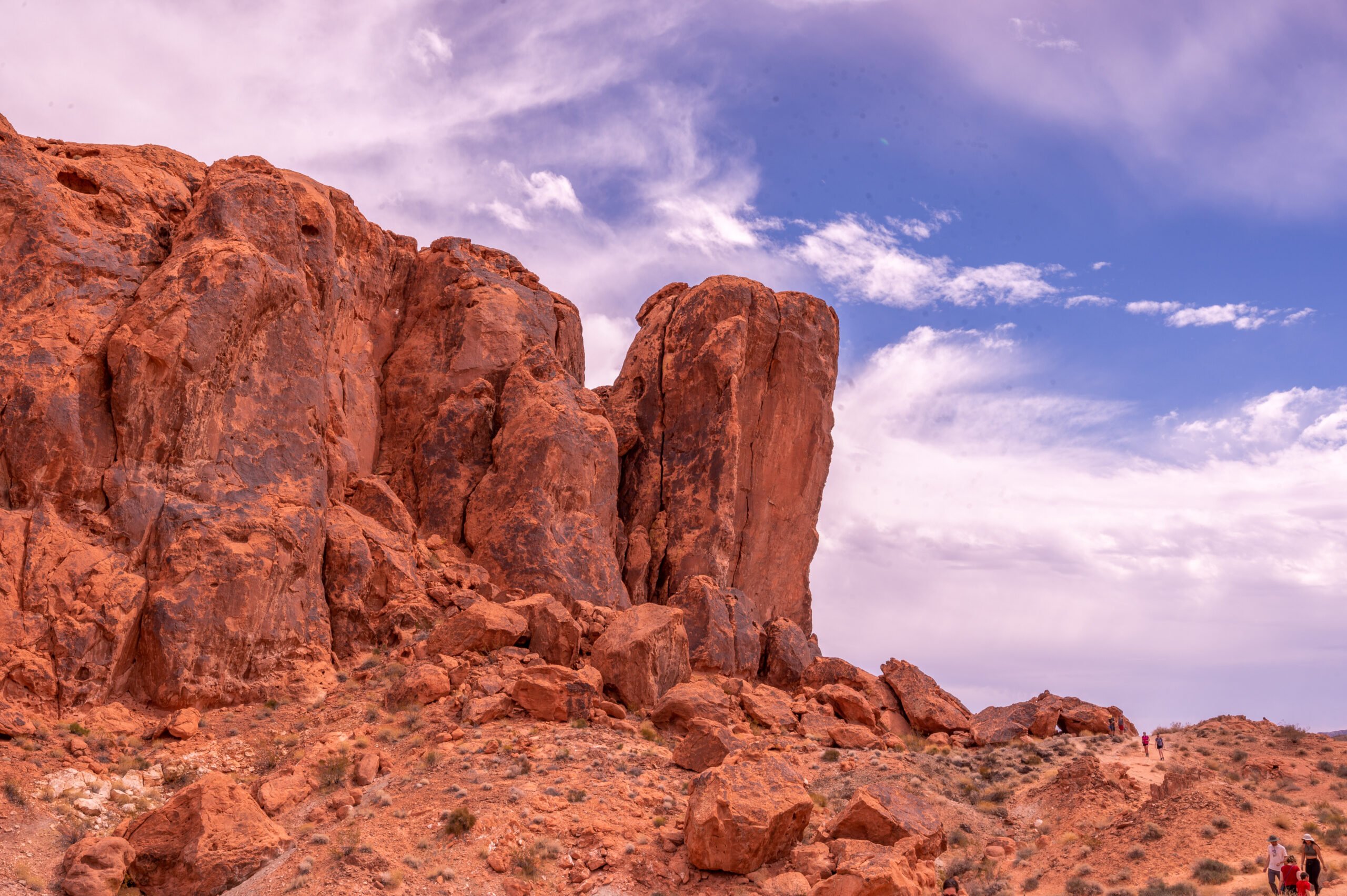
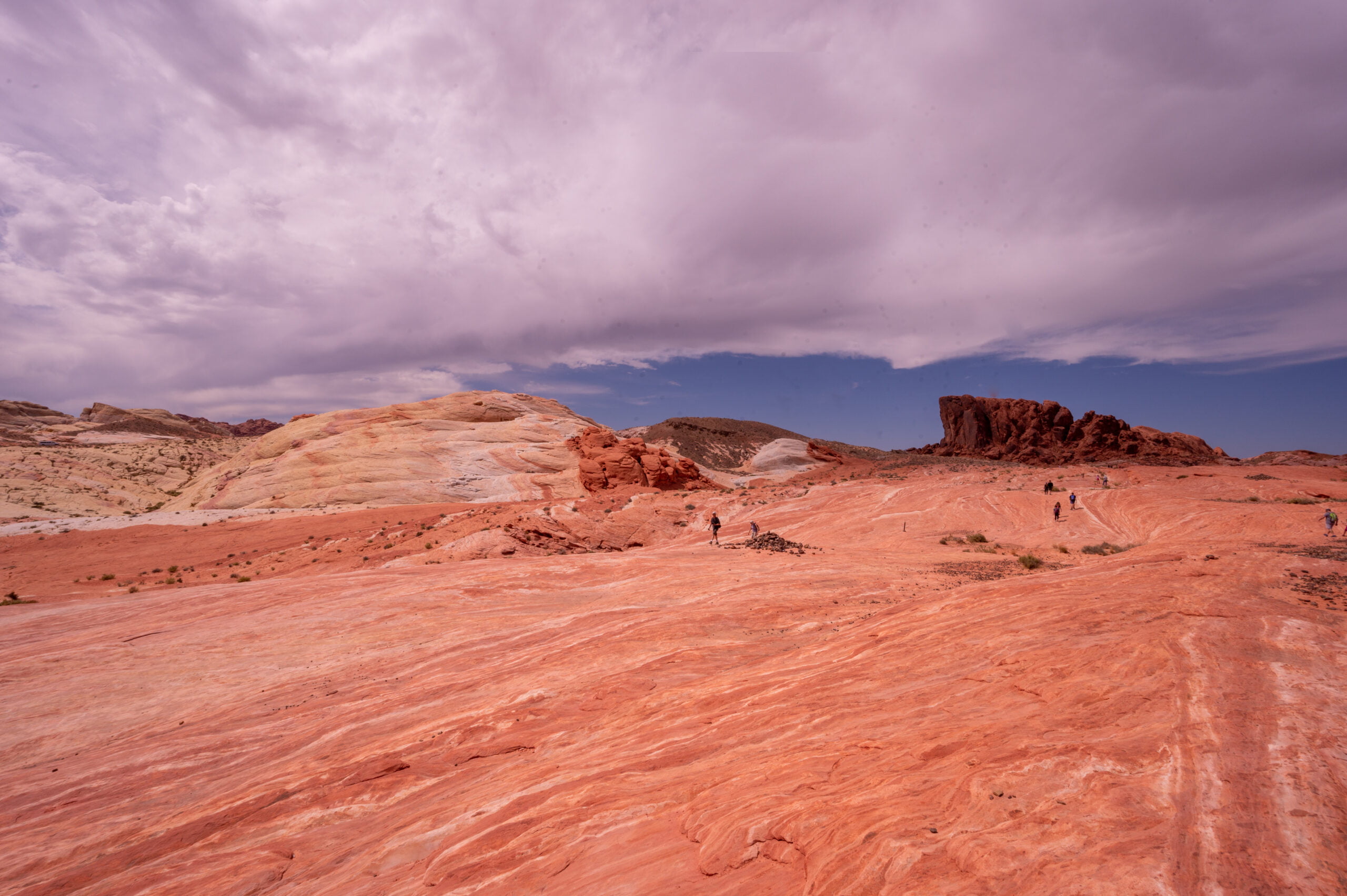
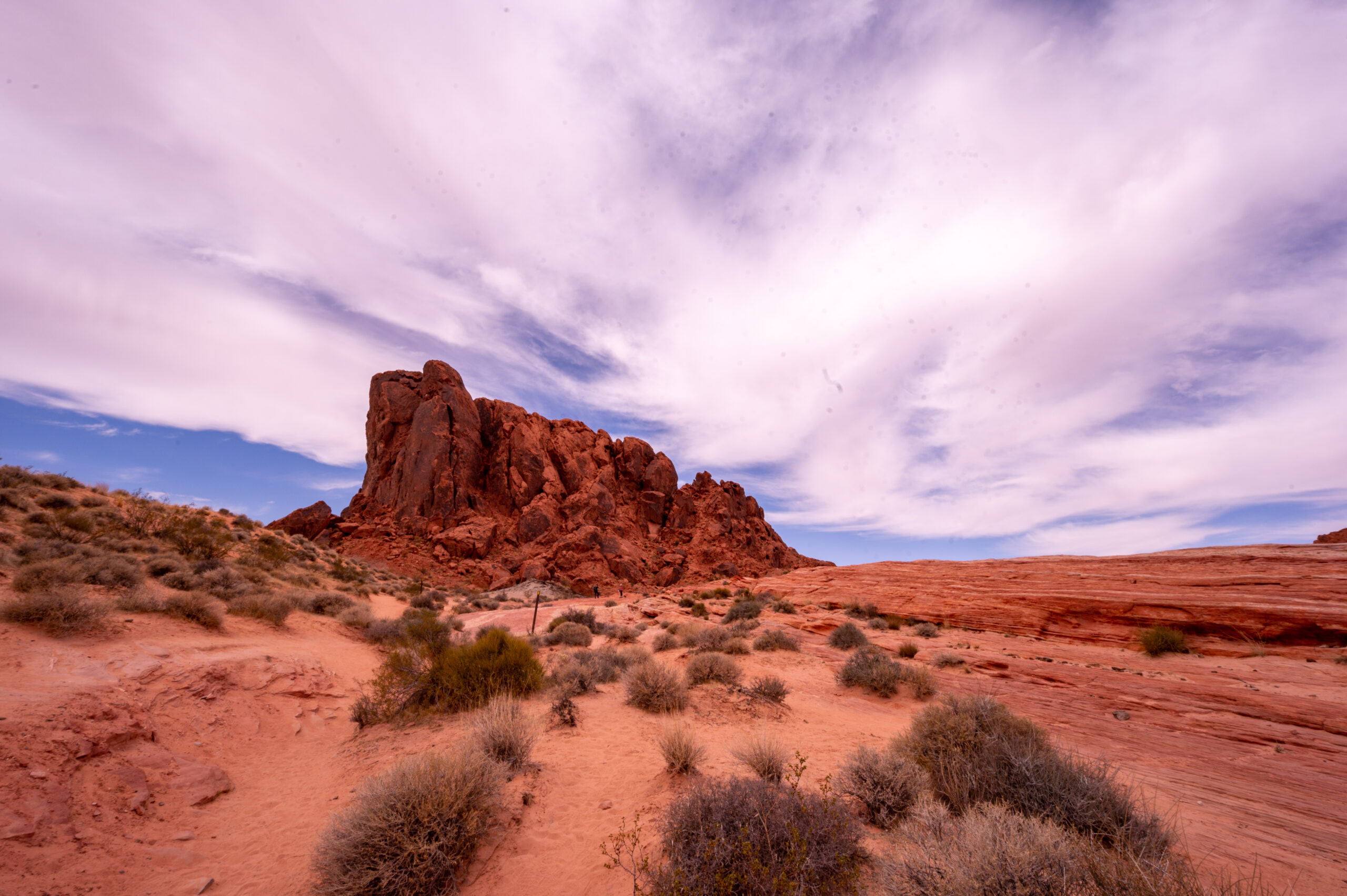
    The start of the trail is on the far side of the gravel parking area. It is a sandy trail leading you toward these giant red rocks rising above the desert. This rock formation is a guide for you to know which side of the road the trail starts on and guide you on your return hike to the parking lot.

    The trail curves around to the right of the giant red formation, and you follow it down a hill before it curves back around and to the right. From this point on, it is pretty much a straight hike to the Fire Wave.

    Start of Fire Wave Trail

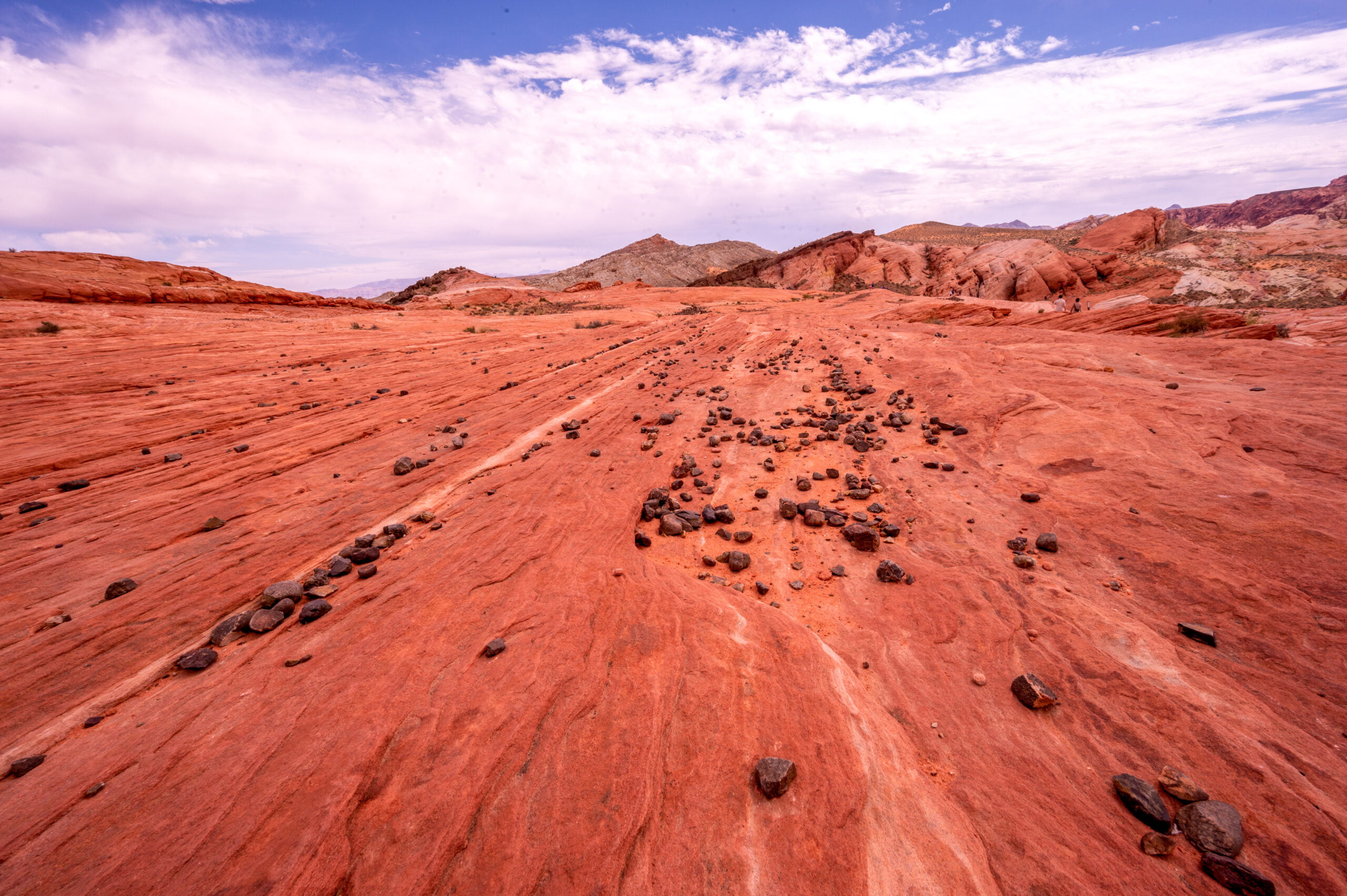
    Follow the striped sandstone that makes up most of the trail. You’ll see a few trail markers scattered along this way, but mostly I looked for the direction other hikers were taking to keep me on track. 

    beautiful red rock near fire wave - Copy

    In about 20-minutes from the start of the trail, you’ll arrive at The Fire Wave. It is beautiful to see it sweeping before you and swirling around like a giant stone wave frozen in time. 

    You can hike down onto the Fire Wave or climb to the top for a better vantage point. You’ll probably need to get in line to do this, but be patient, and you’ll get your chance. Most people come and find a place to sit along the wave, admiring this unique and beautiful landscape. The red, pink, and white hues pop against the blue sky.  Most won’t stay too long as the sun is unrelenting here in the desert. 

    Hydrate for the Return Hike

    After enjoying the view and taking as many photo ops as you wish, head back toward those huge red rocks that mark the beginning of the trail. 

    If you’re like me, you’ll be surprised at how hot it gets and how an easy hike quickly becomes more difficult due to the heat. Drink some water, and then drink some more! It’s that final ascent where you’ll need to push yourself, but then you can return to the air-conditioned car and continue to more gorgeous hikes during your day at Valley of Fire State Park. 

    The Fire Wave is one of the most popular hikes, but make sure to take time for at least one more. My pick would be the White Domes Loop Trail. 

    looking back over trail

    Pastel Canyon – An Alternate Route to the Fire Wave

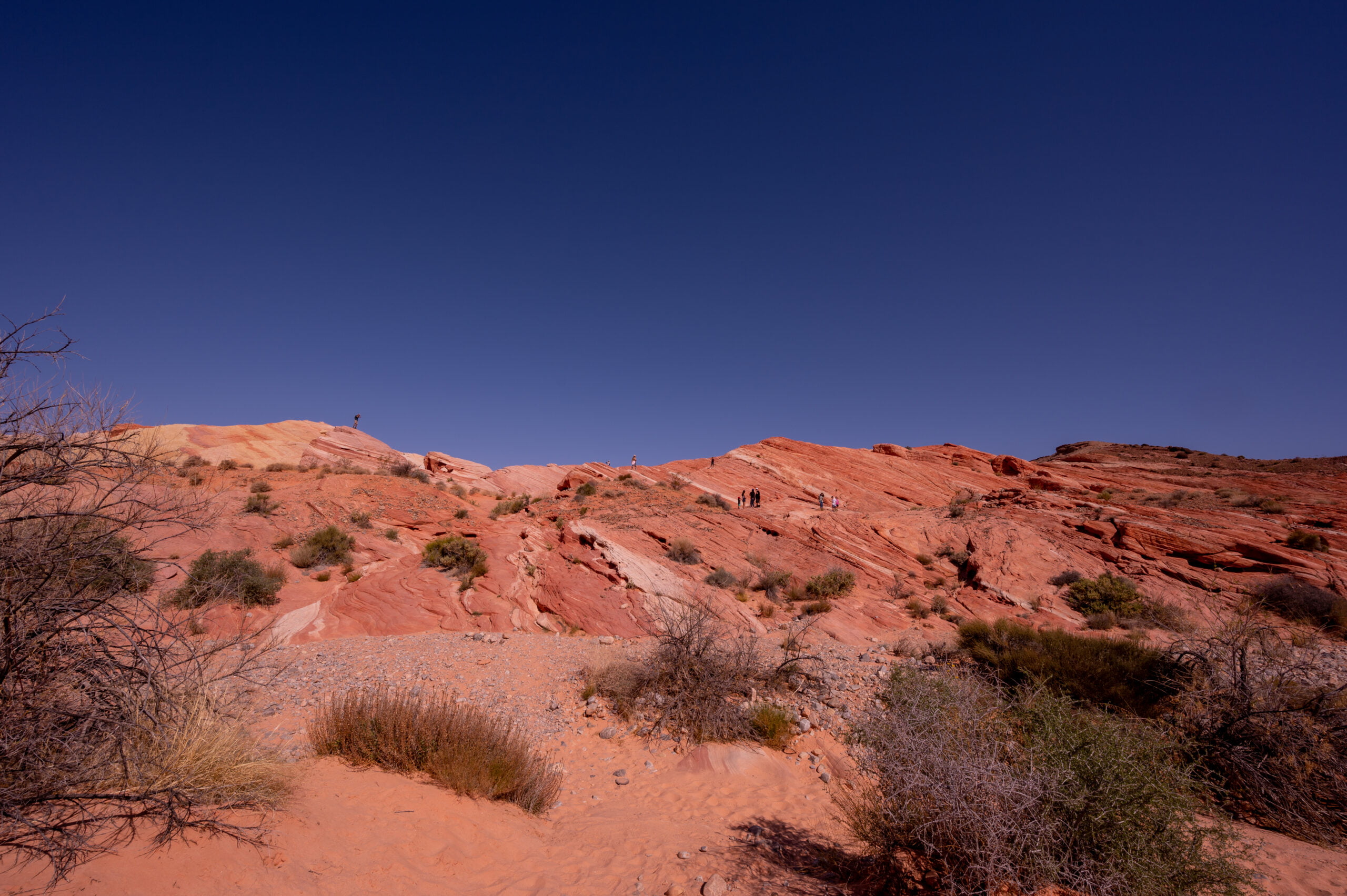
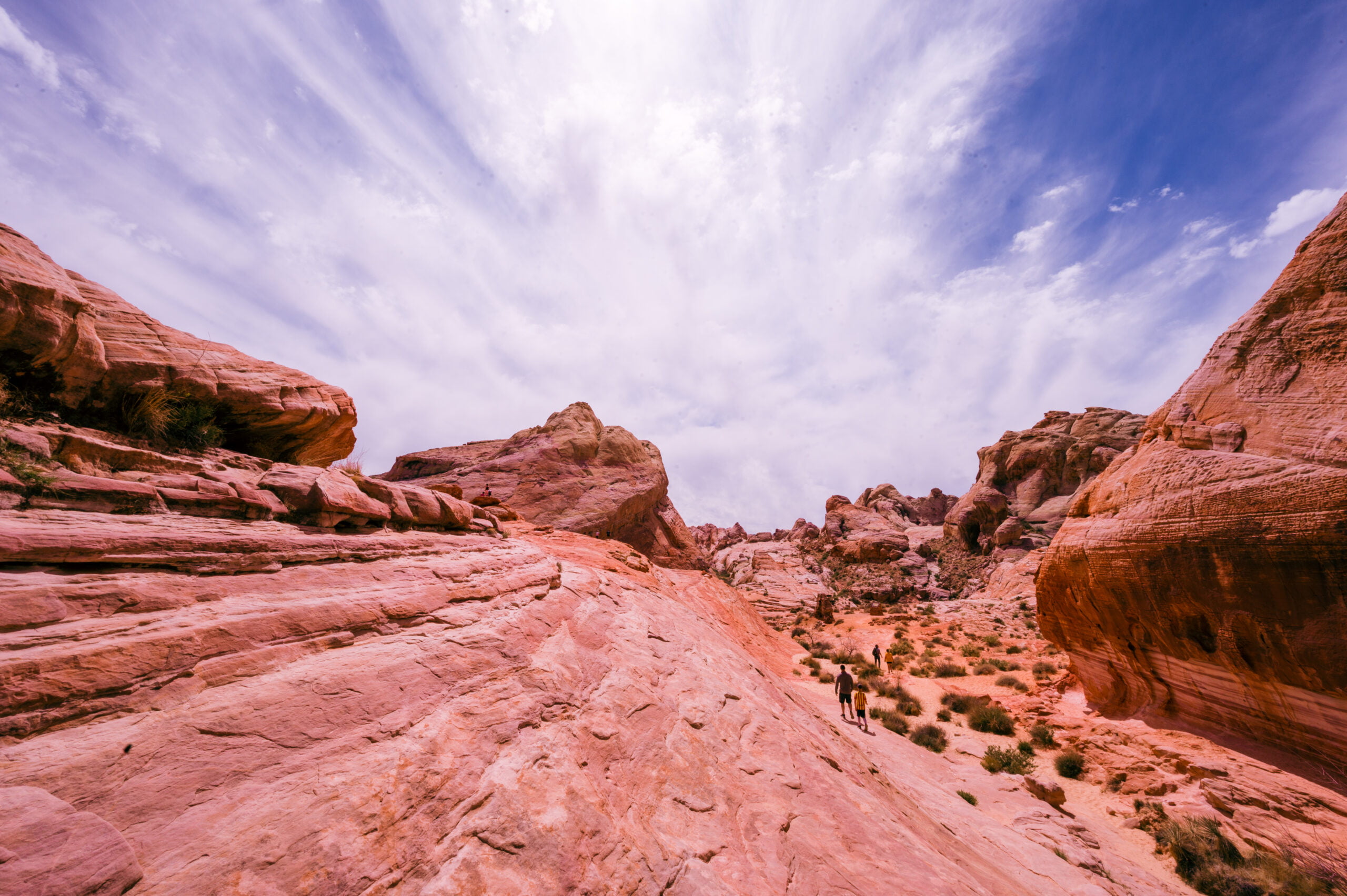
    Although I think the main trailhead is the best way to hike to the Fire Wave, there is one other way you can reach it. I discovered it when I was hiking to the Pastel Canyon.  This short, unmarked trail takes you through a small canyon with striped rocks colored in pastel pinks and yellows. 

    If you continue along the wash that winds through the small canyon, you’ll soon come to a bend where if you look to your left, you’ll most likely see people standing around on top of the Fire Wave! Yep, with only about a 10-minute walk from the road through the Pastel Canyon and wash, you will arrive on the opposite side of the Fire Wave.  You can walk over and up the Fire Wave, where you’ll then see the large red rocks in the far distance that mark the start of the main trailhead.

    Outer Edge of Fire Wave in the distance
    You can see the edges of the Fire Wave in the distance.

    If you can’t find parking at the Fire Wave trailhead or prefer the flattest and shortest route, you might look to see if there is any parking at the Pastel Canyon.  Just note there is no official parking here, only a small pull-out big enough for around 5-6 cars. 

    The Pastel Canyon is worth the quick stop, even if you don’t hike to the Fire Wave from here.  It only takes about 10-minutes total to walk to the small canyon and admire its beautiful hues. There are no signs, though, so you’ll need to add it to your Google Maps. It is about 4 miles up the Mouse’s Tank Road and before you arrive at P3.

    Final Thoughts on Planning Your Visit

    There are no restaurants or food amenities inside Valley of Fire State Park. Make sure to plan ahead and bring lots of water, at least 1-gallon per person, for your day at Valley of Fire State Park. You will also want to bring snacks and a picnic lunch.  Please read my article on how to plan the perfect day trip to Valley of Fire and get tips on camping here as well as other hikes to do.

    Have a “rocking” day! (Sorry just had to throw that pun in there.)

    Note: This post contains affiliate links. When you make a purchase using one of these affiliate links, we get paid a small commission at no extra cost to you.

  • Valley of Fire State Park: A Perfect Day Trip From Las Vegas

    Valley of Fire State Park is magnificent with its red and pink striped rock formations.  It is home to the Fire Wave, pastel-colored slot canyon, Elephant Rock, mountain sheep, and other plants and animals. It’s full of historical and cultural history too! It has many hiking options to choose from as well as a gorgeous scenic drive.

    Valley of Fire State Park makes for a perfect day trip from Las Vegas! Although one could easily spend a couple of days here, in this article, I share my tips for what to see and how to prepare when you only have one day at Valley of Fire.

    About Valley of Fire State Park

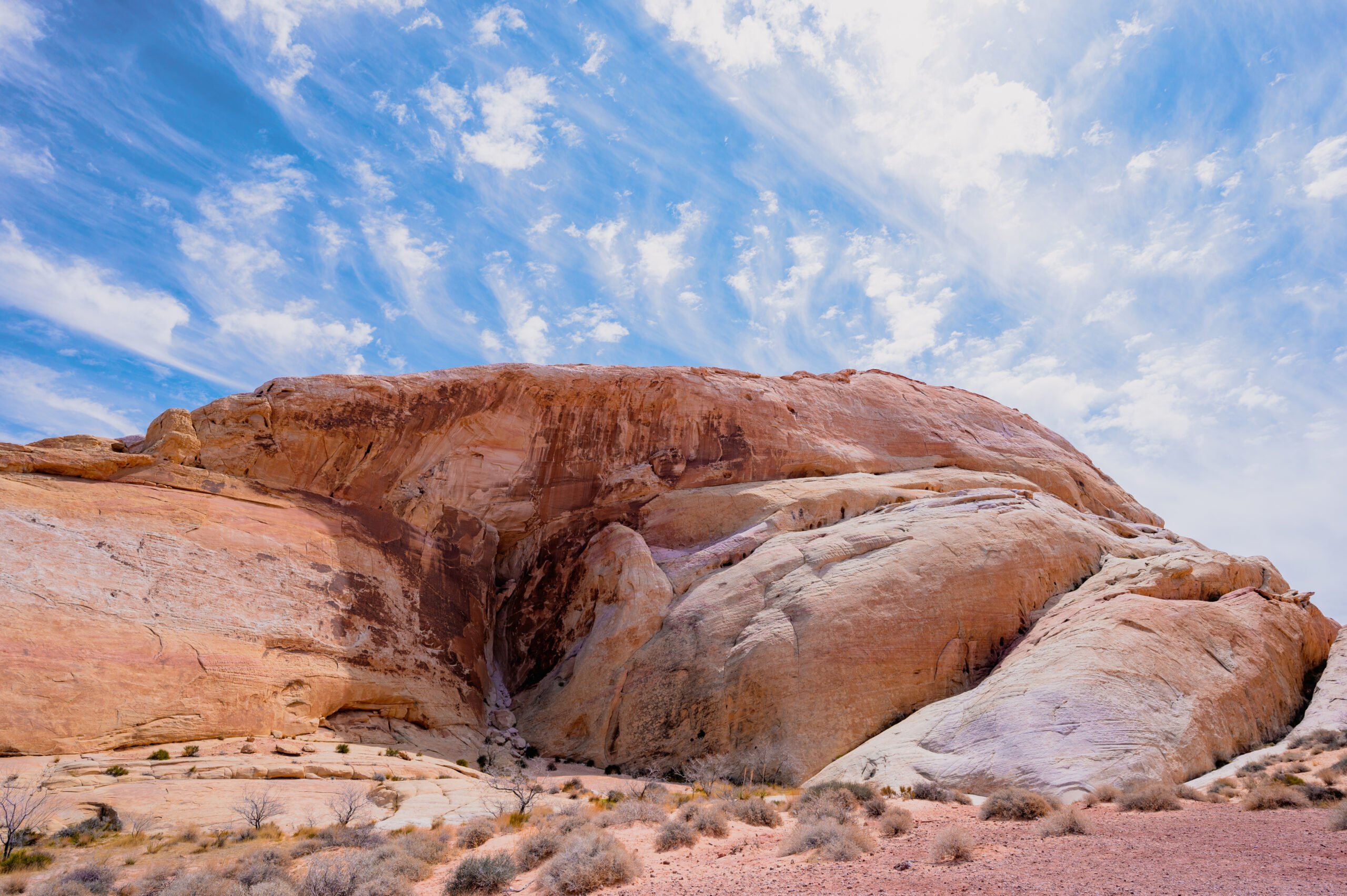
    Valley of Fire State Park spans almost 42,000 acres. It features beautiful red Aztec sandstone, multiple types of limestone, and shale. It is also home to a variety of wildlife and desert plants. It is home to roadrunners, lizards, coyotes, foxes, and desert tortoises, to name just a few of the creatures that live here .  Valley of Fire State Park is also home to mountain sheep. I saw both rams and female mountain sheep during my visit.  They are so majestic as they climb with ease on what appears to me to be sheer rock faces.

    Valley of Fire History

    According to information in the park, the area was once inhabited by the Basket Maker people and later the Anasazi Pueblo farmers.  They have found examples of rock art and other evidence suggesting they lived here from 300 BC to 1150 AD.  Additionally, the park has well-preserved petroglyphs dating back almost 4,000 years!

    Park Fees

    Valley of Fire is a part of Nevada’s State Parks system.  If you have a National Parks Pass that will not work here at Valley of Fire.  The entrance fee for vehicles with non-Nevada plates is $15 per vehicle. For vehicles with Nevada plates, it is $10.

    Hours of Operation

    Open daily from sunrise to sunset. 24-hour access is given to those camping at one of the campgrounds inside the park.

    Overlook near White Domes trail

    Park Amenities

    Camping

    There are two campgrounds at Valley of Fire State Park. With only a total of 72 campsites, these campgrounds fill up fast during the peak seasons.

    In addition to the entrance fee, there is a per night camping fee.  It is $25/night for non-NV vehicles and $20/night for Nevada vehicles. RV camping with utility hookups costs an additional $10/night.

    If you can get a campsite, I highly recommend it! You’ll have more time to explore the park, plus you get to experience sunrise and sunset and see how the sun’s light illuminates the fiery red rocks the park is named for.

    All campsites are first-come-first-served, so you need to plan to get there early to get a spot! I arrived around 10 a.m., thinking I was early enough. Boy, was I wrong!  There was already a line to enter the park, and the ranger at the entrance station told me the camping spots were full.  

    Tip: You can also camp for free on Bureau of Land Management (BLM) land located outside the park boundaries, you will see RVs parked on the BLM land as you drive toward the park along the Valley of Fire Hwy after exiting off I-15 N.

    When I visited Valley of Fire, I was on a road trip to see some Southwest National Parks. While doing this, I tried SUV camping for the first time.  I considered camping on the BLM land outside of Valley of Fire, however, due to the fauna in the desert, there is next to no privacy, and since BLM land has no amenities like a bathroom, I opted for staying in Las Vegas instead.

    White Domes Trailhead
    White Domes Trailhead

    Wi-Fi

    Valley of Fire is one of the few parks I’ve found with Wi-Fi for purchase. I did not use it during my visit, so I can’t say how well it works. Cell data is very spotty inside the park, so if you plan to stay here longer than one day, you may find it useful to pay for one of their Wi-Fi plans.

    Picnic Areas

    There are no restaurants or food amenities within the park, so make sure to bring picnic supplies for your day trip to Valley of Fire State Park. There are small briquette BBQ grills at the picnic areas, so you can BBQ  while enjoying the view. Peanut butter and jelly sandwiches are always a good go-to option for hiking that doesn’t require a cooler.  

    Bring lots of water, Gatorade, and drinks for your day trip here. I tend to go with what’s easy.  So I stick with PB & J sandwiches or bring meat and cheese snackables.  Snack bars are also nice to have during your hikes, and make sure to hydrate! This is especially important if you visit during the summer as it gets hot here!  You are in the desert, so the heat brings its own element of challenge to hikes that would be easier if not for the heat.

    Tip: One of the best picnic areas I found in the park is the Seven Sisters picnic area. It has good shade, BBQ grills, and great views!

    Best Time of the Year to Visit Valley of Fire

    Spring: I visited in late spring, and it was beautiful! The morning air was still cool, but by the afternoon, the temps were in the upper 80’s. When you’re hiking in the open with no shade, even springtime heat can begin to take its toll.

    Summer: This is probably the busiest time to visit Valley of Fire State Park. It is also the hottest time of the year, with highs between 100 degrees and even sometimes reaching as hot as 120 degrees F! If you visit in summer, plan to get an earlier start than normal and bring lots of water and sunscreen!

    Fall: Temperatures in the fall can range anywhere from the mid-60s to the low 90’s.  It’s closer to summer temperatures in the Pacific Northwest.  

    Winter: Temperatures can get as low as freezing during the winter, but typically the daytime temps are mild and are often in the mid-70s.

    Make sure to pack lots of water and sunscreen!

    Welcome to Las Vegas Sign

    Getting to Valley of Fire State Park

    Valley of Fire State Park is only a 1-hour drive from Las Vegas.  It is about 55 miles outside of Las Vegas off Interstate 15. Take I-15 N to Exit 75. After exiting, follow signs for Valley of Fire. It is about another 12 miles along the Valley of Fire Highway before you reach the entrance station for the park.  

    If you’re staying closer to Henderson, NV, you can also access Valley of Fire via Northshore Road (highway 167) through the Lake Mead National Recreation Area. However, be aware that there is an additional National Park Recreation Fee of $25 per vehicle.  The fee gives you access to the Lake Mead National Recreation Area for 7 consecutive days.  It is a separate fee from the entrance fee at Valley of Fire State Park.

    Two Entrance Stations:

    If you drive up I-15, you will arrive via the West Entrance Station.  There are maps and restrooms here.  If you come before the pay station opens, there are self-pay envelopes you can complete in the little parking area to the right.  Make sure to have exact cash if paying using the envelopes.

    If you come via Lake Mead, then you’ll enter the East Entrance Station.  This station is closest to Elephant Rock.  It also has maps and restrooms in the parking area by the entrance.

    Giant Red Rocks that Mark the beginning of the Fire Wave trail

    Things to See During Your Visit

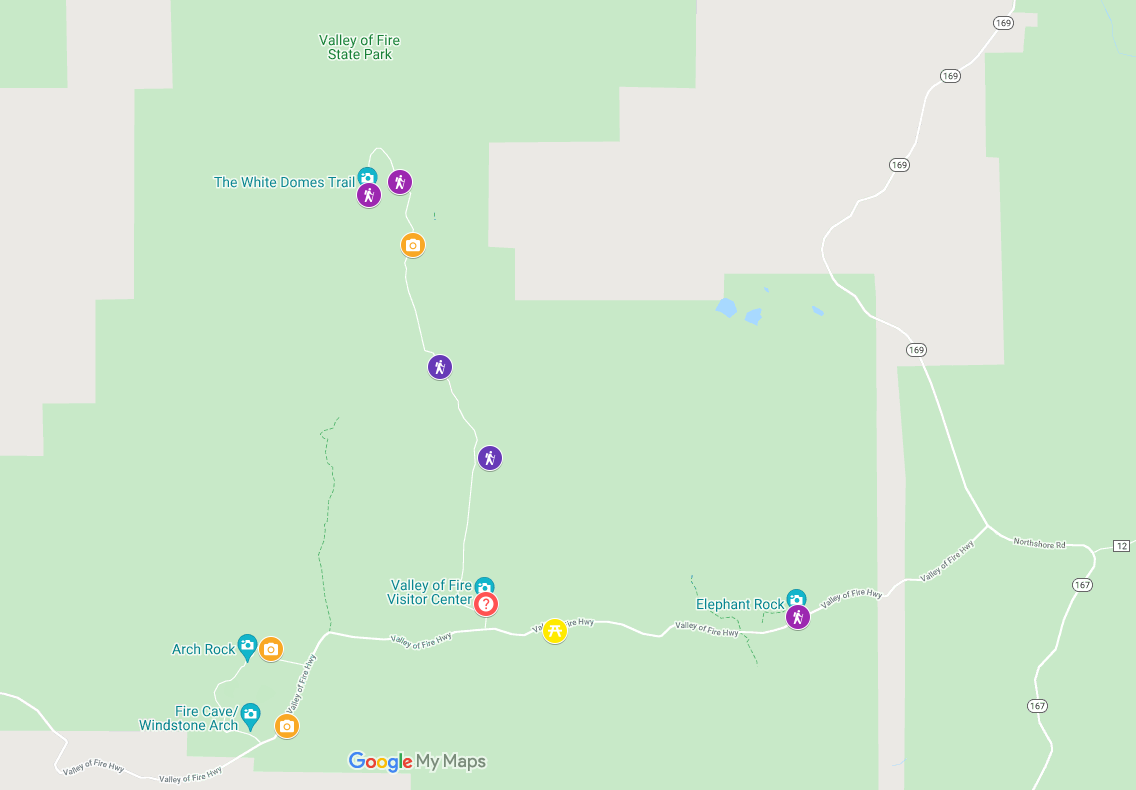
    There are more stops and hikes to do at Valley of Fire than you will want to do with only one day to spend here.  Below is a list of the main stops within the park. I also provide a suggested one-day itinerary below, as well as a Google Maps itinerary you can download for your trip.  Make sure to download an offline map of the area before your drive to Valley of Fire.

    • Beehives (Quick photo stop from the parking area. ~5 min)
    • Atlatl Rock (Short walk and some stairs to climb to see these well-preserved petroglyphs. ~ 15 minutes)
    • Visitor Center/Ranger Station (look up times) (good for info and additional hikes for longer stays)
    • Mouse’s Tank Trail (0.75-mile roundtrip, sandy trail with petroglyphs ~ 1 hour)
    • Rainbow Vista (This 1-mile hike is along a sandy trail, best suited for the coolest part of the day as there is also no shade.)
    • Fire Wave (1.5 miles round trip to photogenic rock wave)
    • Pastel Canyon (0.25-mile unmarked trail through the short canyon to see pastel striped rocks. ~10 minutes)
    • White Domes (1.25-mile loop. Scenic loop trail where movies like Star Trek Generations and The Professionals were filmed. There’s also a picnic area here.)
    • Seven Sisters (Great picnic area)
    • Elephant Rock (quick stop by East Entrance)

    Scenic Drive: Even if you’re unable to do the hikes listed above, you make sure to drive Mouse’s Tank road (later becomes White Domes Road) for an incredibly scenic drive. It is gorgeous driving both up and back down, and there’s a high chance you’ll also see mountain sheep during your drive.

    In the one-day itinerary below, I share what I think are the best stops for your first trip here.  Remember, depending on when you visit, the weather may be very hot.   You might be surprised by how the heat affects your stamina, especially if you come from a milder non-desert area.  I realized this after visiting Joshua Tree and Death Valley the week before I came to Valley of Fire. I found I could not pack as much into my day as I might in a cooler environment.

    Suggested One-Day Itinerary to Valley of Fire State Park

    Try leaving Las Vegas by 8:00 a.m. or before.  The earlier you get there, the better your daytime heat and also the more time you’ll have before the crowds come.  Make sure to bring your picnic lunch, snacks, water, and other drinks to stay hydrated and fueled for your hiking and sightseeing.  Also bring extra sunscreen and a sunhat of some sort is also a good idea.  This itinerary assumes you’re starting at the West Entrance Station.

    Arriving at Valley of Fire State Park

    Arrive at Valley of Fire State Park by 9:00 a.m., pay the entrance fee, and make the quick stop for a photo of the beehive rocks.

    Beehives

    This is a quick photo opportunity of some rocks that look like, you guessed it, beehives! It’s a quick stop on the right side of the road. Unless you’re really running behind, you might as well stop. Probably only 5-minutes to hop out and snap a few photos and hop back in the car!

    Fire Wave
    The Fire Wave at Valley of Fire State Park.

    Valley of Fire Visitor Center

    After leaving the Beehives, continue straight until you see the (left) turn for the Visitor Center and Mouse’s Tank Road.  The Visitor Center is a good place to stop and use the restroom and learn more about the desert environment at Valley of Fire State Park. 

    After your pit stop at the Visitor Center, continue up Mouse’s Tank Road. This is the most scenic drive in the park, well worth the drive alone! 

    The Fire Wave – 1.5 miles roundtrip

    You’ll pass several stops as you make your way up to Parking Lot 3 (P3). The parking for the Fire Wave is on the right side of the road. The trail also starts on the right side. The Fire Wave is the longest hike on this itinerary, and it is also the most popular. I recommend getting it out of the way while it is cooler and before the crowds come. This hike will not disappoint! Plan 1-2 hours for this stop.

    Sometimes during the summer, they close this trail due to a high number of heat-related emergency calls. The desert is no joke, so make sure always to have plenty of water with you and do your best to stay out of the sun during the hottest part of the day.

    White Domes – 1.25-mile loop

    After your hike to the Fire Wave, continue up Mouse’s Tank Road, and soon it turns into White Domes Road. You’ll follow the road all the way to the end, where you’ll find parking and a picnic area for the White Domes trail area. You may want to take a snack break or have a picnic here either before or after completing the White Domes loop trail.

    The return loop makes a gradual ascent back and around to the parking area. The steepest part of the hike is that initial descent. This hike is a beautiful one, don’t let the steep sandy descent stop you as the trail levels out at the bottom, and you get a nice cool slot canyon to hike through before popping back out onto the trail. This stop takes 2-3 hours.

    Picnic Stop

    You can either have your picnic lunch at the White Domes picnic area or hop back in the car for what I think is the best picnic spot in Valley of Fire. You’ll drive back down to the main road (near the Visitor Center). At the “T” intersection for the main road, make a left, then drive about a mile where you’ll come to the Seven Sisters picnic area.  This picnic area has good shade, large spaces, and BBQ grills too! Make sure to look for mountain sheep along your drive. 

    Elephant Rock
    Elephant Rock

    Elephant Rock

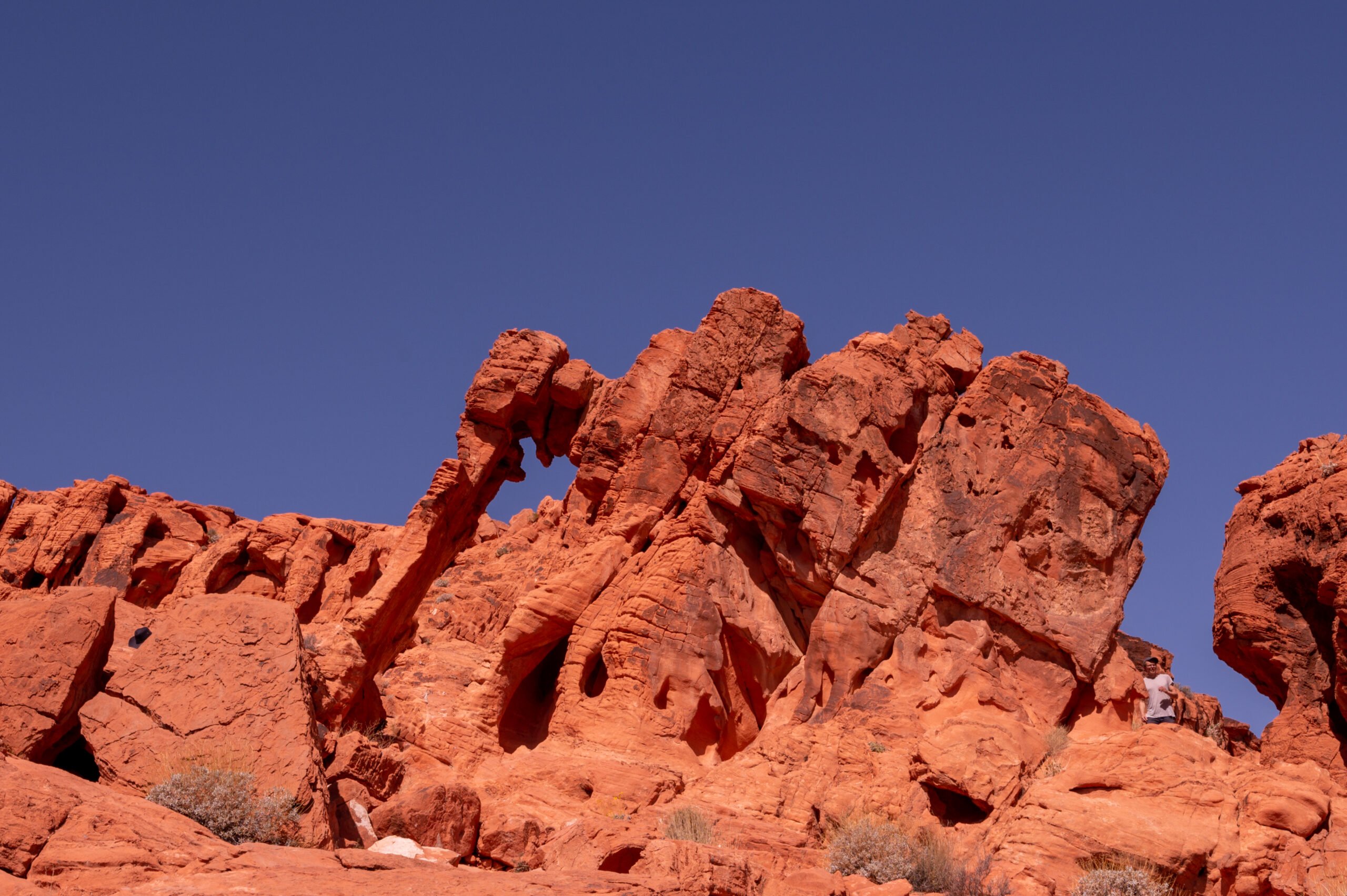
    After you’ve had lunch, continue along the main road toward the park’s east entrance. You’ll see a parking area by the entrance station. Park here for the short walk back to Elephant Rock. It’s a 0.3-mile hike there and back from the parking area to Elephant Rock.  You’ll follow the trail that goes alongside the highway. There is also a longer 1.2-mile loop that takes you up and around Elephant Rock. Please do not climb on the rock itself.  It is fragile, and they want to preserve this as long as possible for future visitors to see.

    Atlatl Rock

    After visiting Elephant Rock, return the way you came, heading back toward the West Entrance. It’s about 5.5 miles from Elephant Rock to the Atlatl Rock Parking lot. From the road, you can see Atlatl Rock with its staircase rising above the desert.

     The petroglyphs at Atlatl Rock date back to almost 4,000 years and are so well preserved they are worth this short stop. If it’s busy, you may need to wait in line to go up the stairs to see the petroglyphs. 

    By this time, you will most likely be ready to head back to Las Vegas to get some dinner and enjoy a relaxing evening in the city and possibly an In-N-Out burger on the way back.

    With Extra Time

    If you have time or want to add to your one-day itinerary, then you might consider adding one of the following short hikes to your itinerary.

    Mouse’s Tank Trail, 0.75 miles. This is a sandy trail with no shade. It features more ancient petroglyphs.

    Rainbow Vista – 1-mile hike, also sandy and hot, leads to a viewpoint of the rocky terrain. I do not recommend doing this during the hottest part of the day. It’s not worth it.

    An optional 10-min stop on the way to the Fire Wave: The Pastel Canyon

    This is an optional quick stop you can add to your one-day itinerary on the way to the Fire Wave. It only takes about 10-minutes to walk to this short but beautiful pastel-colored canyon and back again.  There is no designated parking lot and only a small pullout on the right side of the road that fits 2-3 cars.  You begin hiking on the right, following the rocky wash to a very short canyon with beautiful striped rocks of varying hues of reds and pinks. 

    Please read my article on hiking to the Fire Wave for tips on visiting it from this trail. (5-10 minute stop at Pastel Canyon unless using this as an alternate route to the Fire Wave)


    Now to get that In-N-Out Burger…

  • Hike to Mount Rainier’s Dege Peak For 360° Views

    If you want a hike with 360-degree views of Mount Rainier, Mount Adams, Mount Baker, and the North Cascades, but with minimal effort, then consider hiking to Dege Peak. 

    Dege Peak is one of the less crowded trails from the Sunrise Visitor Center at Mount Rainier.  Most of the people I saw were headed toward the Burroughs Mountain or Frozen Lake trails. Once I passed the turn-off for the Sourdough Ridge Nature Trail,  I only saw about 10 people on my way to and from Dege Peak.  On a clear day, you have wonderful views, and along the way, you might even be fortunate enough to spot mountain goats, marmots, elk, or even bears!

    Getting Here: Which Mt Rainier Entrance to Use

    Mount Rainier has four main entrance stations from which to enter this large National Park. For this hike, you’ll enter the east side of the park using the northeast White River Entrance Station. Get directions for all the entrances to Mount Rainier National Park here.

    Two Ways to Access the Dege Peak Trailhead

    Sunrise Point

    You can begin this hike from the Sunrise Point parking area or Sunrise Visitor Center. If you start from Sunrise Point, it is 1.0 mile shorter round-trip (3.0 vs. 4.0 miles) than starting from the Sunrise Lodge parking lot, but there are no restroom facilities, and you have around an 800 elevation gain vs. 600 from Sunrise.

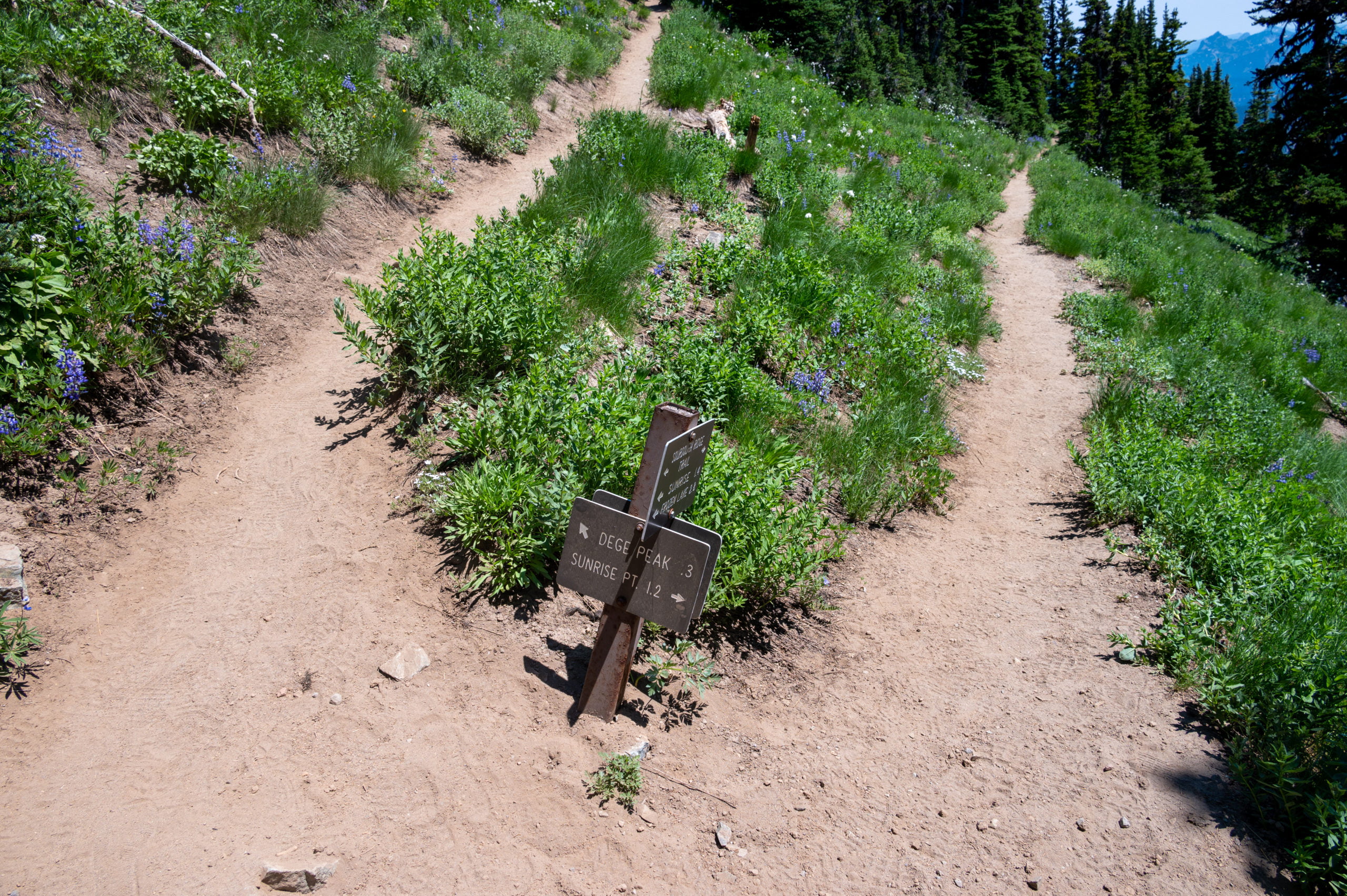
    Getting to the Trailhead:  Park at Sunrise Point parking lot.  From the west end of the parking lot, look for trail signs for the Sourdough Ridge Trail.  You’ll start your hike to Dege Peak here, and at about 1 mile in, you’ll come to the trail junction for Sunrise and Dege Peak. Make a right here. It’s just another .3 miles from the junction to Dege Peak summit.

    Sunrise Lodge and Visitor Center

    I prefer to start the hike to Dege Peak from the main Sunrise parking lot. There are restroom facilities here (there are none at Sunrise Point). Plus, with the Sunrise Lodge, there’s the ability to purchase a snack or drink before/after your hike.  You can also shop for souvenirs to remember your visit to Mount Rainier or buy gifts to take home. If this is your first visit to Mount Rainier, you’ll definitely want to spend some time at Sunrise exploring the meadow area and visiting the Sunrise Lodge and Visitor Center.

    Getting to the Dege Peak Trailhead: Follow the broad path next to the bathrooms (you walk past the Sunrise Lodge, and you’ll see the path on your right). From there, you hike up the dirt path, and soon you come to a large sign with a map of the Sunrise area trails. Follow the trail on the right side of the signs as it climbs up, and soon you come to a “Y” in the trail. Go right (away from Mount Rainier) for Dege Peak.

    About Dege Peak Trail – Starting from Sunrise Lodge

    Trail Length: ~ 4.0 miles (from Sunrise Lodge)

    Elevation Gain: ~ 606 feet

    Approximate Hiking Time: 2 hours (round trip)

    Trail Difficulty Rating: Easy to Moderate
    Overall I would rate this hike as easy. Even kids should be able to do this hike with minimal difficulty. However, I give it an easy to moderate rating given its exposure to the sun.  I hiked this on a hot summer day, and there is almost no shade for the entire hike.  In the summer, the heat combined with the elevation gain nudges this hike into the moderate range.

    Features: 360-degree views, stunning views of Mount Rainier, wildflowers, wildlife, lake views, and multiple glacier views

    Entrance Fee: There is a $30 single-vehicle entry fee good for 7-day consecutive use. 

    Restrooms: There are restrooms just past the Sunrise Day Lodge and snacks and drinks at the Lodge. Potable Water just outside the Sunrise Lodge entrance.

    How to Pronounce Dege

    Dege Peak was named after James Henry Dege, a notable businessman from Tacoma, Washington. During my visit here, I heard a variety of pronunciations. The two most common pronunciations were “deh-gay” or “day-gay.” The Park Ranger at the Sunrise Lodge pronounced it like “day-gay,” so perhaps that’s the correct one.

    What to Bring on the Hike

    • Water (I only brought 16 ounces and wished I had 32, so bring plenty, especially on a hot day.)
    • Bug Spray (The bugs were pretty bad, so make sure to apply before you hike and possibly during too.)
    • Hiking Boots (I hiked in running shoes, but the rocky areas made this a little uncomfortable for my feet, plus hiking boots are good for ankle support.)
    • Trekking Poles (I didn’t use these, but they would be helpful in the rocky areas and last 200 yards or so to the summit.)
    • Sunscreen (This hike is really exposed to the sun.)
    • Sunglasses (Sunscreen for the eyes.)
    • Snacks (Or possibly a picnic lunch for the summit.)
    • Camera (You’ll definitely want a photo or two!)

    Important to Know: Sunrise Parking lot is at 6,400 ft elevation and Dege Peak Summit is at 7,006. If you are not used to being at higher elevations you might get a little dizzy. Make sure to hydrate and snack during your hike to help avoid any elevation sickness symptoms.

    Hiking to Dege Peak

    I drove up to Mount Rainier that morning and settled into my campsite at White River Campground before driving up to Sunrise.  It was a gorgeous day, with clear skies and warm weather.  Warmer than I expected!  By noon it was already 77 degrees at Sunrise!

    I grabbed my camera and a bottle of water (later, I realized I should have brought two bottles), put on a bit of bug spray, and headed for the trailhead.  It was almost 1:00 p.m. when I started up the broad path just past the Sunrise Lodge.

    I stopped at the “Y” trail intersection to take a few photos of Mount Rainier and the meadow.  As I began hiking up the trail toward Dege Peak, I was chased by a very persistent wasp.  This is not the first time I was chased by a wasp while hiking at Mount Rainier.  During my hike to Spray Falls, I also had to flee for my life for a long way down the trail. 

    Perhaps “flee for my life” is overly dramatic, but it was a little traumatizing for me.  I won’t get into all my childhood run-ins with bees, but one only needs to watch My Girl once to realize these small creatures also come with a dark side.  I jest, but needless to say, although I love honeybees, I am less a fan of wasps. 

    Multiple times along my hike to Dege Peak, I was chased by bees. One even began circling me over and over again.  When I returned home, I did a little research and discovered bees and wasps alike are attracted to bright colors. Red, in particular, is perceived as a threat. What color do you think my favorite hiking shirt is?  Yep! You guessed it– bright red! I guess I may need to find a new favorite hiking shirt after learning this new information. 

    Sourdough Ridge Nature Trail

    Onward and upward.  Soon, I reach the ridgeline and turn off for the Sourdough Ridge Nature Trail.  The nature trail goes to the left, and Dege Peak continues to the right. The Sourdough Ridge Nature Trail is a great option if you’re hiking with smaller kids and want a shorter hike that still offers beautiful views of Mount Rainier. The loop only takes about 1-hour to complete and is mostly flat.

    Wildlife Viewing Opportunities

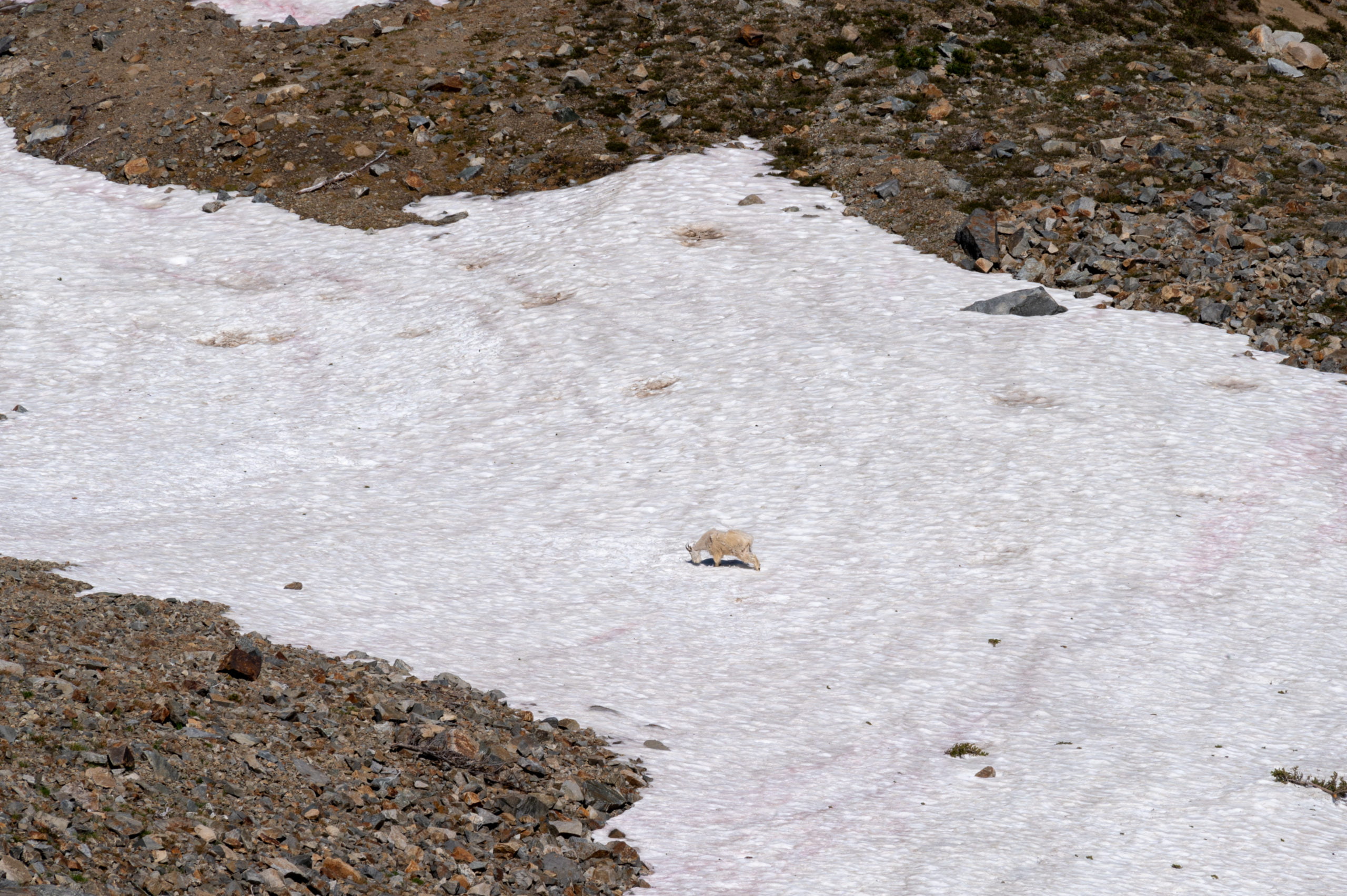
    Make sure to stop and look over the ridgeline along this section of the Dege Peak trail, as you’ll often spot wildlife below.  I saw a lonely mountain goat (pictured above) during my hike. (To my dismay I did not see any lonely goatherds.)

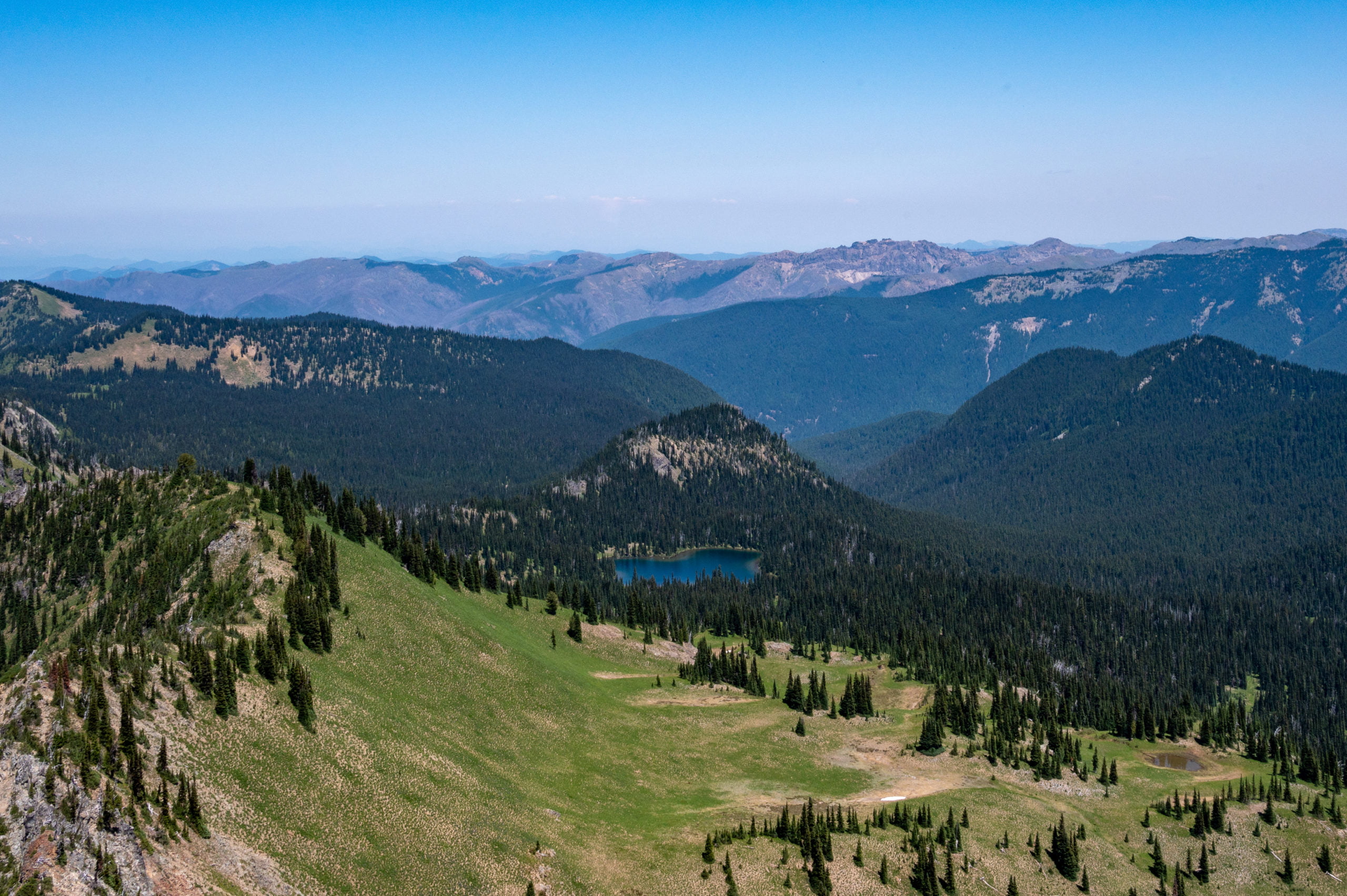
    I talked to another couple who frequently hikes at Mount Rainier, and they told me how they once hiked to Dege Peak, and at the top, they looked over the edge and saw a bear splashing around in the lake below!  What an unforgettable memory!  They also mentioned seeing elk here as there is an elk path that leads down the backside of Dege Peak.  So make sure to bring a camera and stop to look for wildlife during your hike.

    Sunset Point Trail Junction

    I continued along the ridgeline with views of Dege Peak in front and Mount Rainier at my back. I didn’t worry too much about taking photos of Mount Rainier on the hike up, as I knew I’d be looking at it the whole way back down and have plenty of opportunities to photograph it then.

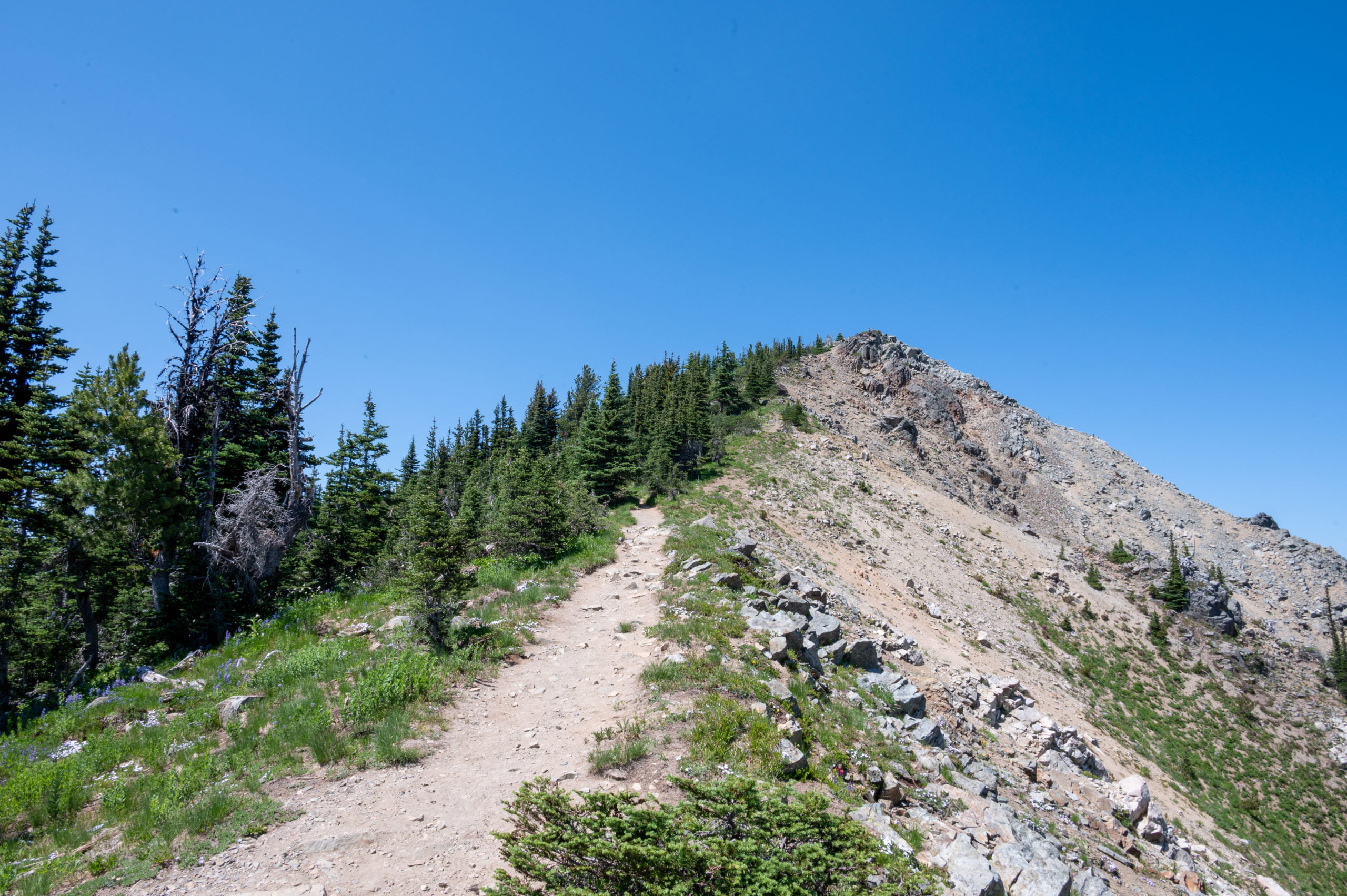
    After the initial climb to the ridgeline, the trail flattens out for a long stretch before you dip down again and come to a fork in the trail.  This is the turnoff for the Sunrise Point parking area and where you’ll pop out should you start your hike there instead of at Sunrise. From here, it’s only 0.3 miles to the summit.

    The trail narrows and gets rockier as it begins a steady climb back up.  Soon the trail curves sharply to the left for the final 200 yards or so to the summit.  At this curve, there are nice views of the Sunrise Point parking area and Sunrise Lake. 

    Dege Peak Summit

    I begin the final rocky climb to the summit and stop at every tiny shade spot possible.  My water is now warm rather than cold, but I still appreciate having it!  I get to the top, and there is one group leaving as I arrive.  I have the entire summit to myself unless you count the 100’s of moths, flies, bees, and mosquitos who seem to think they own this place!  Sadly, the bugs were so bad during my visit that I didn’t hang around very long.  I took a few photos, admired the view in all directions, and headed back down the trail.  I didn’t pack any bug spray with me. Otherwise, I would have reapplied it at the summit.

    Bugs aside, the views at the top of Dege Peak are fantastic!  You are at over 7,000 feet from here and with minimal effort!  The summit would make a great picnic spot on a day when the bugs aren’t as bad. 

    The hike took me around 2 hours 10 minutes, and that’s with a lot of stops for photos and chats with other hikers.  I think most will complete it in around 2 hours, but with kids, you could plan for up to 3 hours and go at a leisurely pace.

    Now to enjoy staring at Mount Rainier for the hike back to Sunrise.

    Final Thoughts About Hiking to Dege Peak

    This trail typically has fewer hikers than the other trails in the area. The climb up is a gradual one, and during the summer, you have gorgeous wildflowers that line the path.  The trail is dusty, and as I mentioned, there is very little shade. Definitely remember to apply sunscreen and bug spray before heading out. 

    For a slightly longer hike, start from Sunrise and follow the route outlined in this post, but on the return hike to Sunrise, take the Sourdough Nature trail to the right along the ridgeline. You’ll follow the ridgeline before you loop down and to the left to Sunrise again. This adds a little over a mile of mostly flat terrain and about 45-minutes more hiking time.

    I bought a Klondike bar at the Sunrise Lodge.  The hot sun along the hike to Dege Peak and back left me wanting something cold to drink (filled up with potable water just outside the lodge) and a cold treat before heading back to camp.

    If you stay at White River Campground, consider hiking to Emmons Moraine Glacier from the campground and planning to hike the Naches Peak Trail the following day. I love hiking the Naches Peak Loop Trail! It has beautiful lakes, mountain views, and wildflowers everywhere!

    Do you have a favorite hike at Mount Rainier National Park?  I’d love to hear about it.  This place is like a second home to me, and I’m always interested in learning about new trails and hikes I haven’t discovered.


    Happy Trails!

  • Navajo Loop Trail & Peekaboo Loop Hike: The Best of Bryce Canyon

    Bryce Canyon National Park is a gorgeous park worth spending a couple of days (minimum) exploring.  The Peekaboo Loop and Navajo Loop Trail combo is one of the best, if not “the” best option for sampling all that is Bryce Canyon, National Park.  Gaze up at the hoodoos as they tower over you, walk through an alpine forest and experience the Wall of Windows up close in all their glory. If you only have time for one hike in Bryce Canyon, this should be it!

    About the Hike

    This hike combines both the Navajo Loop Trail and the Peekaboo Loop Trail into a mini figure-8 combination loop. Depending on when you hike this trail, portions of it may be closed due to ice.  Bryce Canyon is at over 9,000 feet in elevation. It often has snow that lasts into late spring.  I visited in early April, and the Wall Street portion of the Navajo Loop Trail was closed due to ice.  

    • Trail Length: ~5 miles (roundtrip) 
    • Hiking Time: 3-5 hours (This really depends on how many photo stops you make, snack breaks, and overall pace.)
    • Elevation Gain: ~ 1580 feet
    • Trail Difficulty Rating: Moderate
      The National Park System rates this trail as “strenuous.” I found it to be moderate compared to other hikes I’ve done. However, I will say the heat certainly adds an element of difficulty to the hike, so I can see why they would give it a strenuous rating when factoring in elevation change and weather.
    • Features: Close-up views of hoodoos, the Wall of Windows, pine forest, and opportunities to walk through natural “doorways.”
    • Restroom Facilities: Yes. There are restrooms in the parking lot at the trailhead, and there is also one restroom on the Peekaboo Trail near the junction for the Bryce Point Trailhead.  This restroom is only open during the summer.

    What to Bring

    Water.  Do not take this hike or any hike in Bryce Canyon without bringing ample water. The temperatures here can be intense. It may start cold, but by afternoon, you’ll be very thankful to have enough water to drink. I always say you never regret having too much water!

    Trekking Poles.  A hiking pole or two will be handy for the steep descents/ascents and the loose sand and rock that make up the trail. Trekking poles are useful for anyone with knee problems.  My hubby had a bad flare-up with his knee bothering him, and his trekking poles were the only thing that made it possible for him to complete the hike.

    Sunscreen.  You will want to reapply during the hike. Trust me.

    Snacks. It’s always good to carry a little extra energy for the hike.  There are many great spots to sit and enjoy the views and have a little lunch break if you want to pack sandwiches and have a picnic among the hoodoos.

    Important Information:

    Hike this combination trail as early as possible.  It gets hot during the middle of the day, and the Navajo Loop Trail, in particular, gets incredibly busy!  Don’t allow the crowds to scare you off, though. Once you get on the Peekaboo Loop Trail, the crowds thin out considerably! When you are hiking back up the steep switchbacks of the Navajo Loop trail, you will be so happy you got an early start! 

    Plus, parking fills up at the Sunset Point parking lot, so the sooner you get here, the better. You can also park outside Bryce Canyon and take the park shuttle.

    Bryce Canyon Parking & Trail Map

    Here is a link to a map that gives you an overview of where the parking lots are located and the trailheads.  For this hike, you’ll want to park at the Sunset Point parking area. If you’re taking the Bryce Canyon Shuttle, you will also get off at the Sunset Point shuttle stop. Follow signs from the parking lot to the Navajo Loop Trailhead. It’s near the Sunset Point overlook area.

    Hiking the Navajo Loop & Peekaboo Loop Trails

    I hiked this trail in April.  I got up early to watch the sunrise at Inspiration Point and then drove to the Sunset Point Parking lot closest to the Two Bridges entry for the Navajo Loop Trailhead. My hubby was with me, and we ate a quick breakfast in the car before packing some water and snacks for the hike. 

    We started the hike a little after 9:00 a.m.  It was still cold out when we left, so we wore layers, which we removed about halfway through the hike. Due to Bryce’s high elevation, you experience both mountain weather and desert weather.  We started our days at freezing temps and then, by late afternoon, hovered near 80 degrees. 

    The Navajo Loop Trailhead

    Make sure to enjoy the Sunset Point overlook before starting the Navajo Loop Trail.  Chances are when you return to this spot, you’ll want to grab a bite to eat and relax, so take the time now while you’re still full of energy!

    We made our way down the first series of switchbacks before coming to a small viewing area near the turn-off to the Wall Street section of the Navajo Loop Trail.  Unfortunately, Wall Street was closed due to icy conditions, so we continued down the trail on the left side.

    The next series of switchbacks is beautiful and similar to the switchbacks on the Wall Street portion (see photo above), however not as narrow. You’ll pass by the “Two Bridges” before popping out from among the hoodoos and into the tree line.  

    A Fork in the Road: Queen’s Garden & Peekaboo Trail

    This trail continues a short way down from the Two Bridges before coming to a “T” in the trail. This is where you’ll have the option to go left for the Queen’s Garden Loop or head right to continue to the Peekaboo Loop Trail. 

    If you come down Wall Street, you pop out a little below this sign; however, the direction you go is the same. Go right for the Peekaboo Loop Trail. The left will take you back to the Queen’s Garden Loop and also the Navajo Loop Trail, which returns you to the top where you started.

    Peekaboo Loop Trail

    As you continue to the right, follow the connector trail as it crosses a big open section with pine trees and juniper bushes scattered around.  After about .25 miles, you come to another sign for the official start of the Peekaboo Loop Trail.  

    This trail is shared by both foot traffic and people on horseback. We followed the sign pointing to the right for foot traffic, which had us hiking the Peekaboo Loop Trail counterclockwise. After hiking it this way, I believe this also points you in the direction to give you the best views and vantage points straight ahead. Plus, I felt this half was the more interesting of the Peekaboo Loop Trail.

    From here, the trail quickly climbs back up into the hoodoos.  The Navajo Loop and Peekaboo Loop Trails take you down to the canyon floor, back up above, back down again, and finally back to the top where you started.  So prepare yourself for the ups and downs, but also know you will see so much beauty that it will all be worth it in the end.  This combo loop trail could quite possibly end up on your list of favorite hikes of all time.

    I did my best not to stop every 5 seconds to take a new photo, but it was still probably about every 30 seconds!  My hubby is a good sport and goes with the flow.  Both of us were enthralled by the variations in color and shapes of the hoodoos as we hiked along the Peekaboo trail.  It’s a lot of fun pointing out different shapes in the hoodoos, much like cloud gazing.  We’d say, “do you see that gnome over there?” Or “look at that elephant trunk!”  Kids will also enjoy finding “creatures” among the hoodoos.

    Nature’s Doorways

    It wasn’t too long after hiking up the Peekaboo Loop Trail that we walked through our first “doorway,” or perhaps “window” is a better word to use.  It’s like nature created a live polaroid for us to enjoy.  As we walked toward it, the light was so bright that we couldn’t see the view on the other side.  However, as we walked through the small tunnel, the view “developed” before our eyes.  I don’t know why I love these as much as I do, but I was excited to walk through each one.  I think we walked through three of these on the Peekaboo Loop Trail.

    A Tricky Washout

    The trail descends through another series of switchbacks similar to the Wall Street section on the Navajo Loop Trail, and briefly, you’re back among the trees. A washout area forked to the right, and we took a short snack break here.  This was probably a good thing, as two hikers came by and started walking to the right up the wash, not realizing they were no longer on the trail.  We let them know the trail was on their left, they thanked us and continued on their way.  I think this was the only part of the Peekaboo Loop Trail where one could get off track. However, you would figure it out pretty quickly if you did accidentally miss the trail.

    The Wall of Windows

    Almost immediately after your descent through the short switchbacks, the trail heads back up, and we hike toward the Wall of Windows. We loved this section of the trail as we gazed up at the towering Wall of Windows.  It looked so small earlier this morning as we peered down at it from Inspiration Point, and now here we were right next to it!  There are many great points along this section to take photographs of the Wall of Windows and the view of the hoodoos in the canyon below.

    Bryce Point Trailhead – The Halfway Point

    After leaving the Wall of Windows, you descend into the tree line and out of the hoodoos.  Soon you pass the trail which takes you to Bryce Point.  Bryce Point is another starting point for those who want to hike the Peekaboo Loop Trail without hiking the Navajo Loop Trail.  The Bryce Point trail was, however, closed due to snow when we visited in April. At this point, you are now about halfway through your hike around the Peekaboo Loop Trail.

    Trail Restrooms

    Not long after you pass the trail for Bryce Point, you come to a shaded resting area with a sign on the right for restrooms.  These are closed from fall to spring.  The main trail continues past the sign for the restrooms.  There is also an area here where people on horseback can let the horses take a water break. 

    Back in the Hoodoos

    I’ll admit, the section of trail after leaving the Wall of Windows was probably my least favorite of the whole Navajo and Peekaboo Loop Trails.  It was a lot of walking through trees without a lot of scenic viewpoints. You do get a good amount of shade here, though, which you will soon miss when you pop back out above the treeline and into the hoodoos.

    Soon, you’re admiring hoodoos, and there’s another “window” to walk through and more beautiful views to look forward to before you begin your descent back to the start of the Peekaboo Loop Trail. There is very little shade along this section of the trail.

    Once back at the start of the Peekaboo Loop, retrace your steps (heading left) back to the fork for the Navajo Loop Trail and Queen’s Garden Trail and begin your climb back up to Sunset Point.

    Alternative Hiking Options

    Shorter Hike Option: For those who aren’t up to the longer Navajo Loop combined with the Peekaboo Loop, hike the Navajo Loop on its own for a shorter option.  You won’t see the Wall of Windows up close or walk through the “doorways” carved in the rocks, but you still get a sense of the grandeur of the hoodoos and their colorful features.  Plus, you also walk through a small section of the pine forest.  

    Longer Hike Option: For those wanting an even longer option, consider the “one hike to rule them all,” which combines the Navajo Loop Trail, Peekaboo Loop Trail, and the Queen’s Garden Trail! I still recommend starting at the Navajo Loop trailhead by Sunset Point and following the directions for the Navajo Loop & Peekaboo Loop combo listed above before exiting out via the Queen’s Garden Trail. 

    This gets the steeper portion of the loop out of the way on the descent.  Then, you come up the Queen’s Garden Trail and end near Sunrise Point when you return. You take the paved footpath from here back to the Sunset Point parking lot.  This is the easier option for the ascent. This figure 8 hike is considered a strenuous hike and is around 6.4 miles round-trip.

    Sunrise Recommendation

    To complete your scope of Bryce Canyon, I recommend watching the sunrise at either Sunrise Point or my choice, which was Inspiration Point.  I watched the sunrise at Inspiration Point and then drove over to the trailhead for the Navajo Loop Trail. I think the morning hours are the best time to experience Bryce Canyon’s hoodoos as the sun causes them to glow red and orange.

    At Inspiration Point, I looked out over the Bryce Canyon Amphitheater and saw the Wall of Windows far below. Later, as I hiked next to the Wall of Windows, it gave me a greater appreciation for the scale of Bryce Canyon.  My hubby and I said to each other, “remember this morning when the Wall of Windows looked so far away?”  It was a neat way to spend the day going from a bird’s-eye-view to the ground level.

    More Articles You Might Enjoy
     

    If you hike the Navajo Loop Trail and Peekaboo Loop Trail, I’d love to hear your thoughts about the hike and your visit to Bryce Canyon.  I loved my time here and would like to go back to explore it and the surrounding area more.

    Happy Hoodoo Hunting!

  • Willis Creek Slot Canyon: A Fun & Easy Hike

    If you want a fun and easy slot canyon that doesn’t require any big scrambles over rocks or narrow squeezes that require months of dieting to perform, then look no further than the Willis Creek Slot Canyon! The Willis Creek Slot Canyon is located in Utah’s Grand Staircase-Escalante National Monument. 

    This hike is perfect for families and anyone looking for a mostly flat slot canyon hike. I saw multiple families with young children, probably around the age of 5 or possibly younger doing this as well as older kids and teens.  It’s a beautiful and enjoyable slot canyon hike good for all ages.  

    We chose to do this hike on a day where we spent the morning at Bryce Canyon, but we still wanted a short hike to do that afternoon.  The Willis Creek Slot Canyon Hike is about 1-hour from Bryce Canyon National Park and only 30-minutes from Kodachrome Basin State Park. If you’re in the area, you’ll want to consider this fun hike!

    Getting to the Willis Creek Slot Canyon Trailhead

    The turn-off for the road to Willis Creek Slot Canyon is just outside the small town of Cannonville.  Stop at the visitor center in Cannonville to double-check road conditions.  If it has rained or will rain, then skip this hike.

    Directions:

    From Cannonville, head south on Kodachrome Road/Main Street for about 2.5 miles before it turns into Cottonwood Canyon Road. Take a right on BLM 500/Skutumpah Road.  Stay on BLM 500 for about 6.1 miles before arriving at the parking area for the Willis Creek Slot Canyon trailhead.  You will come to multiple forks in the road, but as long as you stay on BLM 500, you will arrive at the parking area after about 30-minutes of driving time.

    *I used Google Maps to navigate to the Willis Creek Slot Canyon trailhead and had no issues. However, I read reports online of others who had issues with Google Maps telling them to turn down private roads.  Perhaps Google fixed that issue? 

    About the Willis Creek Slot Canyon Hike

    Distance: ~2.8 round trip

    It’s approximately 1.4 miles one-way to the end of the slot canyon portion of this trail. We hiked to this point and then turned around.

    Difficulty: Easy

    It is a mostly flat, uneven, and rocky trail. Most people can navigate it without any issues.

    Duration of the Hike: 2 to 2.5 hours

    This will depend on how far you hike down the trail. We took around 2 hours to hike the 2.8 miles to the end of the slot canyon portion and back.

    Road Conditions: 

    The dirt road to the trail is rough but typically doable with a 2WD vehicle.  I saw everything from small cars, RVs, camper vans, and trucks on this road. It is a lot of washboard gravel road with some large potholes here and there.

    Make sure to check road conditions at the Visitor Center in Cannonville. If it has rained the day before your visit or will rain, save this for another day. When the sand on this road gets wet, it turns into a muddy mess you do not want to deal with. It’s also not safe to hike in slot canyons if there is the potential for a flash flood. You can also call the Visitor Center at 435-826-5640 for more information.

    The Trail:

    The Willis Creek Slot Canyon trail starts across the road from the parking lot.  Follow the dirt path through some brush and down to the creek bed.  This is a mostly flat trail with very little elevation change.  You’ll hike through a small section of slot canyon before it opens up into a wide wash area which you’ll follow for approximately 10-minutes before you’ll wind around another bend and find both a small waterfall and entrance to the main Willis Creek Slot Canyon area.

    What to Bring

    Bring hiking poles, plenty of water, and a snack bar or two. Make sure to apply sunscreen before starting the hike. Although you’ll be inside a slot canyon or the majority of the hike, there are a couple of stretches out in the open sun where it gets really hot.

    Depending on when you visit, you will either encounter ice (we did in April), muddy conditions, or you’ll be walking through the creek water as you make your way through the slot canyon.  Because of this, you will want to consider wearing shoes that you’re comfortable getting wet.

    Things to See Nearby

    Closing Thoughts & Places to Eat Nearby

    Willis Creek Slot Canyon is an easy hike, good for kids and families or for someone who wants an easy but beautiful hike to add to their day.  This is another one of those hikes where it’s about enjoying the journey, not necessarily getting anywhere in particular.  Enjoy the shapes of the canyon as far as you want to go and then turn around and head back when you’re ready.
    We enjoyed this hike after a morning spent at Bryce Canyon and after a long day of hiking at Bryce the day before.  Sometimes you just want something fun and easy, or maybe you’re like us and need to work off that pie you ate for lunch. If you decide you want to do what we did and eat some really yummy cherry pie before your hike, check out Bryce Canyon Pines. Or maybe you need a pick-me-up before your hike, then stop at Bryce Canyon Coffee Co on your way. They have great coffee and friendly service too!

    If you want some dinner after your hike, then grab some BBQ at i.d.k. Barbecue in the town of Tropic, Utah. A warning though, lines can be ridiculously long here. We had to wait over an hour to place our order! The good news is your food is ready within 10-minutes of ordering.

    Other Articles You Might Be Interested In for Your Trip to Utah:

  • Mesa Arch at Sunrise: A Photographer’s Experience

    Mesa Arch is a pothole arch in Canyonlands National Park.  Although the hike out to the arch is relatively uninteresting, the arch and the view at the overlook make for a big payoff with minimal effort.  And if you decide to hike out to Mesa Arch to see the sunrise, you will be doubly rewarded!  Sunrise at Mesa Arch is an unforgettable experience worthy of the loss of sleep.

    My Sunrise Experience at Mesa Arch

    My hubby and I stayed at a motel in Moab, Utah. Moab is a common starting point for many of the area’s attractions, such as Arches National Park, Canyonlands National Park, Dead Horse Point State Park, and many other hiking and recreational opportunities.  It’s about a 45-minute drive from Moab to the Mesa Arch trailhead, and I wanted to be at Mesa Arch at least an hour before sunrise.

    This meant getting up at 4 a.m.!  I’m fine with getting up at 6 a.m., I do that almost every day, but for some reason, any time before that just seems wrong.  However, I knew that photographing Mesa Arch at sunrise was a popular activity, and I would not be alone.  If I had any hope of getting a spot in front of the arch, I needed to sacrifice a little sleep to make it happen.  My hubby is a good sport and was willing to sacrifice his sleep as well.

    As we made our way up the winding road to Canyonlands National Park, we had one vehicle in front of us, and soon I had another behind.  All I could think about was that I had to get there to get a spot!  I had read other articles that talked about spots filling up even 2 hours before, but I was not ready to get up at 3, so I hoped (and prayed) that 1 hour before would be enough.

    We arrived in the dark at the parking lot for the trailhead, with one other car following close behind.  There were already a few cars in the lot, so I quickly grabbed my gear, put on my headlamp, and headed down the trail, walking as quickly as possible. 

    Hiking to Mesa Arch

    The hike to Mesa Arch is only .50 miles (out and back), and so it takes around 15 minutes to hike to the arch.  We visited the day before, so I could walk the trail in the daylight and get a feel for the area before visiting in the dark.  I recommend you do this if you plan to photograph the sunrise.  Not necessary, but helpful.

    About the Hike:

    • Length: 0.50 miles (loop option or out and back)
    • Time to hike to the arch: ~ 15-20 minutes
    • Trail: First half of the trail is a wide dirt trail, then turns into more uneven terrain with some rock and stairs. Look for the cairns for help staying on the trail.
    • Difficulty: Easy

    This hike is good for all ages, but it is not wheelchair accessible. Most people (including kids) can hike this trail with relative ease. 

    Important to Know: 

    Mesa Arch is set on the edge of an overlook that drops down 1200′ into the canyon below.  Please keep your kids close by and be careful when getting close to the arch, as it is a long way down on the other side!

    1-Hour Before Sunrise

    I reached Mesa Arch a little over an hour before sunrise.  There were only two other photographers there. I was so relieved!  Since they were first, I asked them where they were setting up, and then I chose a spot to the left of them.  However, before I really had time to set up my tripod, a fourth photographer arrived and placed her tripod right next to mine.  

    PHOTOGRAPHY TIP

    Set up your tripod as soon as you get there, get your legs placed as wide as you need them because once other photographers arrive you may not have the room to change this. Also, the ground in front of Mesa Arch is rocky and uneven, so you’ll want to adjust your tripod legs to allow you the freedom to move your tripod height up and down as desired. All this needs to be done before you are crowded out by other photographers. 

    This was the main mistake I made, and I was somewhat restricted with my shots because of it.  If this happens to you, you can always take your camera off the tripod and try some shots that way. If they don’t turn out, you can delete them, but you’ll most likely get some keepers. 

    Also, after you get your shot from the front of Mesa Arch, try moving around and capturing it from various angles. You might be surprised at which photos turn out to be your favorites.

    45-Minutes to Sunrise

    About 15-minutes after I arrived, there were around 10 photographers, with most of the prime spots filling up fast.  One latecomer had the tenacity to ask if he could squeeze in between the two photographers who had been at Mesa Arch when I arrived.  They graciously allowed him to, but I wouldn’t expect this.  For most photographers, if they’ve made the effort (and sacrifice of sleep and coffee) to get there and get a spot, and you slept in, they’re going to be pretty territorial and expect you to find your own place on the edges.

    While we were waiting, the photographer next to me, who was from Indiana, told me about a scene a friend of his observed during his visit to Mesa Arch.  He said two guys actually took to fighting right in front of the arch because one of them wanted a spot in front. Let’s not forget that there’s a 1200 ft cliff on the other side, either! So, yeah, I guess things can get a bit ugly. Personally, I blame it on a lack of sleep and coffee.

    30-minutes to Sunrise

    With only 30-minutes to sunrise, all the main spots in front of Mesa Arch were filled shoulder to shoulder with photographers.   Then a row started forming behind me.  When the sun did finally start coming up, I’d be so busy taking photos I wouldn’t realize I had people behind me leaning over me. I raised up only to bump into the person behind me.

    Honestly, the crowd is part of the experience. Everyone had to get up early to get there before sunrise, which means we’re all a tiny bit crazy, and we all love seeing beautiful displays of nature.

    Go-Time: Sunrise at Mesa Arch

    Things quiet down a little bit as the sun starts to peek over the La Sal Mountains. Everyone is waiting with anticipation as it finally breaks from behind the mountain range and casts its warm glow over the canyons below.  The sun reflects off Mesa Arch, first starting as a subtle glow and then intensifying into a beautiful bright orange arc of glowing rock.  The layers of shadows in the White Rim canyon below are a stunning backdrop to the glowing Mesa Arch.

    The sound of shutters fills the air as if the paparazzi had just spotted some celebrity. Every photographer furiously tries to capture this beautiful sight.  People with cell phones peer over the photographers’ shoulders to capture this moment, too; others walk along the fringes trying not to get in the view of the cameras. Some just came to see it. They stand back in awe, with no “device” in hand. They stand there capturing it with their eyes and mind.  It was such a beautiful experience!

    10-Minutes After Sunrise

    I look around, and almost every photographer I had just stood shoulder to shoulder with has vanished.  They packed up and headed off, most likely for coffee. However, I stay. I love golden hour, and the light and shadows in the canyon are too good to pass up. 

    I came to photograph Mesa Arch at sunrise, but here’s a little tip: the glow remains even after sunrise, and the lighting that bathes the canyon is incredible!  So, if you really, really can’t make it for the actual sunrise, then get here as soon after as possible, and you’ll enjoy a relatively un-crowded view and still get to see some gorgeous light.

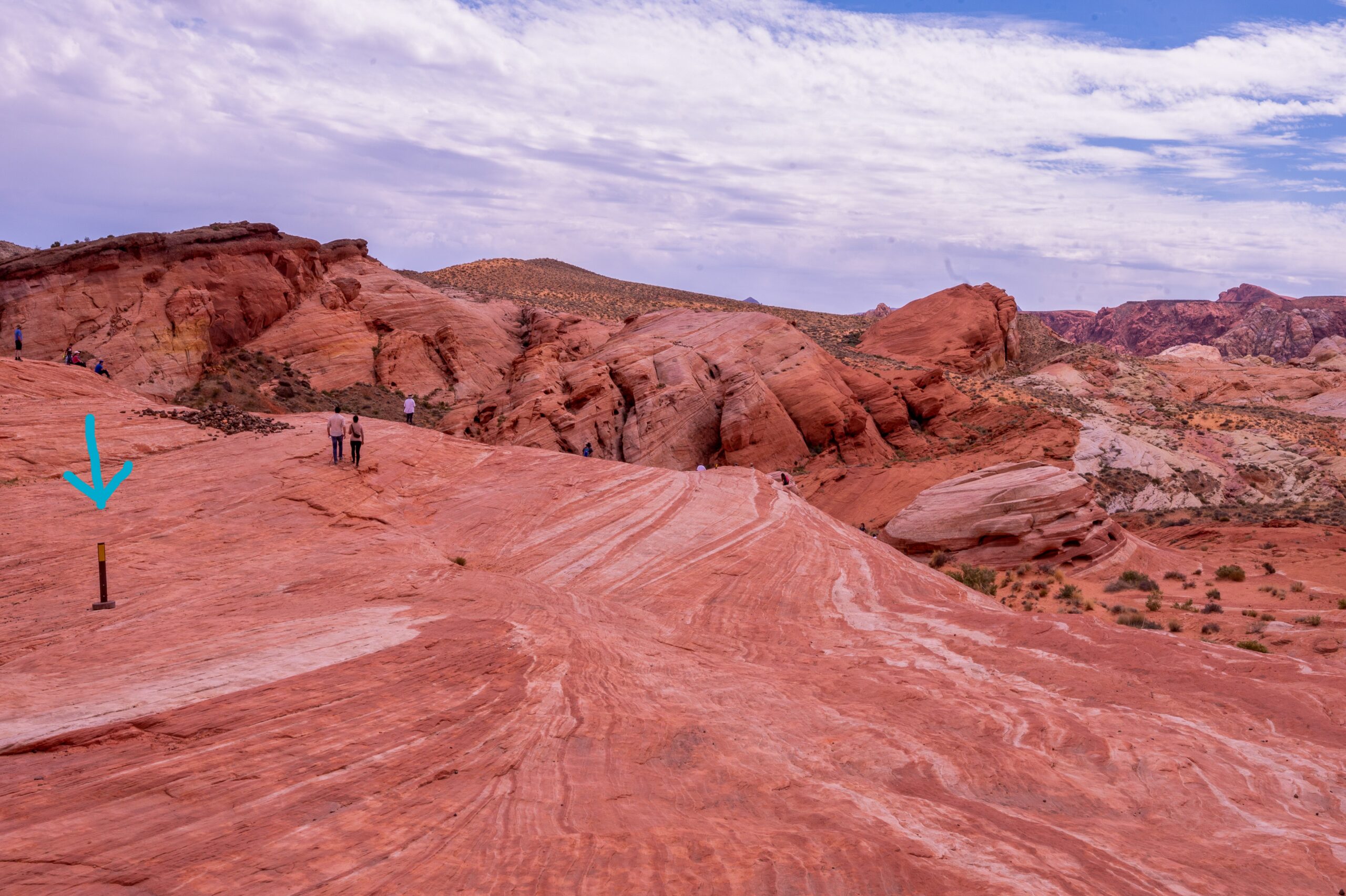
    What to Bring When Visiting Mesa Arch for Sunrise:

    • Pack layers. Depending on what time of year it is, it might be fairly cold in the morning.  We were there in April, and I wore gloves, a warm hat, and a sweatshirt and jacket.  By the time we left, around 8:00 a.m. I no longer needed the gloves, hat, or jacket.
    • Water. Even though this is a short hike, it’s still a good idea to bring a bottle of water and a snack.
    • Trekking Poles. If you have any issues with uneven ground, these are a good idea. Also, in a pinch, a trekking pole can be used as a monopod for your camera.
    • Headlamp. Very useful when arriving in the dark. A headlamp with a red light is also a nice plus if you plan to arrive to photograph at twilight or plan to do any night photography.

    Photographers:

    • Camera
    • Lenses (A wide lens is needed as everyone stands relatively close to the arch. I shot with a 14-30mm lens.)
    • Extra Batteries
    • Tripod
    • Dust cleaner for your lens. It gets windy here and dusty. Learn from my mistake and dust off the front of your lens mid-shooting to keep it clear of dust particles on your images.
    • Shutter Release Cable (optional)

    The Night Before Your Hike to Mesa Arch

    Make sure to charge all your batteries the night before and put a fully charged battery in your camera before going to sleep.  Pack your bag with all your essentials and layout your warm clothes and things you’ll want to bring.  If you’re like me, your brain doesn’t function at optimal levels that early in the morning.  So having it all ready to go the night before really helps!

    Getting Your Coffee Fix On the Go

    We brewed a quick cup of hot coffee in the hotel for the drive to Mesa Arch, which was the bare minimum to get me by.  I also pack a large bottle of cold brew in our cooler, which I drank after photographing the sunrise.  Having cold brew with me when I’m on a road trip is a must! 

    Coffee Tip: Always keep a bottle of cold brew in your cooler.

    Because I’m often getting up early, I don’t always want to take the time to heat water (if I’m camping) and brew a cup of coffee. With cold brew, I can get my caffeine fix quickly before anyone else gets hurt. Really it’s a safety measure for anyone traveling with me.  

    I love using oat milk or almond milk when I travel as it doesn’t need refrigerated until after opening.  I make quick cold brew lattes like this vanilla oat milk cold brew using bottled cold brews, it takes one minute to make, and I’m ready to go!

    Getting to Mesa Arch in Canyonlands National Park

    Mesa Arch is located in Canyonlands’ Islands in the Sky section of the park, a 30-minute drive from Moab, Utah.

    From Moab  

    Take US-191 N for about 11 miles.  Then turn left onto UT-313 W. Continue on this road all the way into Canyonlands National Park and until you see signs for the Mesa Arch parking lot and trailhead (about 20 miles). 

    Parking

    The parking lot is not very big, so during the day, it fills up quickly.  However, I noticed that even during busy times, there seems to be a regular coming and going of vehicles because it is such a short hike.  If it is full and there don’t seem to be any spots opening up, then continue driving toward the Grand View Point Overlook and stop at Mesa Arch on your way back.

    Tip: There is a great overlook across the street from the visitor center and there are water filling stations at the visitor center as well. Make sure to stop here!

    With Extra Time

    The Islands in the Sky portion of Canyonlands National Park is really a beautiful place with gorgeous views from above.  It also has the Shafer Canyon Road, a 4×4 road you can drive into the canyon, but it’s recommended you have a high clearance full off-road vehicle or motorcycle for this.  

    With extra time in the area, make sure to also visit Arches National Park and Dead Horse State Park.  This is a beautiful area of Utah that you can easily spend a week (or more) exploring. However, even with only 2-4 days, you can see a good portion of these three parks.

    Final Thoughts Regarding Mesa Arch

    I know getting up early is not fun for most of us, but Mesa Arch at sunrise really is an incredible experience.  For me, it wasn’t just the gorgeous sunrise and observing the glow of the sun on the arch. It was the crowd of people experiencing it with me, the anticipation, and the hike in the dark.  I chatted with people from all over the country, Indiana, New York, Florida, and even a fellow Seattlite was two shoulders down from me.  It was a way to connect with fellow humans and with nature.  

    It’s also such an easy hike, and it provides gorgeous views that often are only found on hikes that take miles of uphill climbing to reach.  Again, if you can’t make it there by sunrise, then I highly recommend you try coming as soon after sunrise as possible.  The lighting for the hour and even two hours after is beautiful!  

    Even if you arrive at Canyonlands National Park later in the day and are unable to visit for sunrise, you’ll still want to visit Mesa Arch. It is an interesting natural feature, and the overlook there offers spectacular views.

    Have you visited Canyonlands National Park?  If so, I’d love to hear about your experience.  If not, I hope you’ll add it to your travel bucket list.

    Happy Exploring!