author.travelffeine.com

Category: Europe

Europe is often the continent found on so many bucket lists and for good reason! It’s full of history, art, food, and gorgeous cities! Pick a country and start planning your bucket list adventure today!

  • Peneda-Geres National Park: A Day Trip From Porto

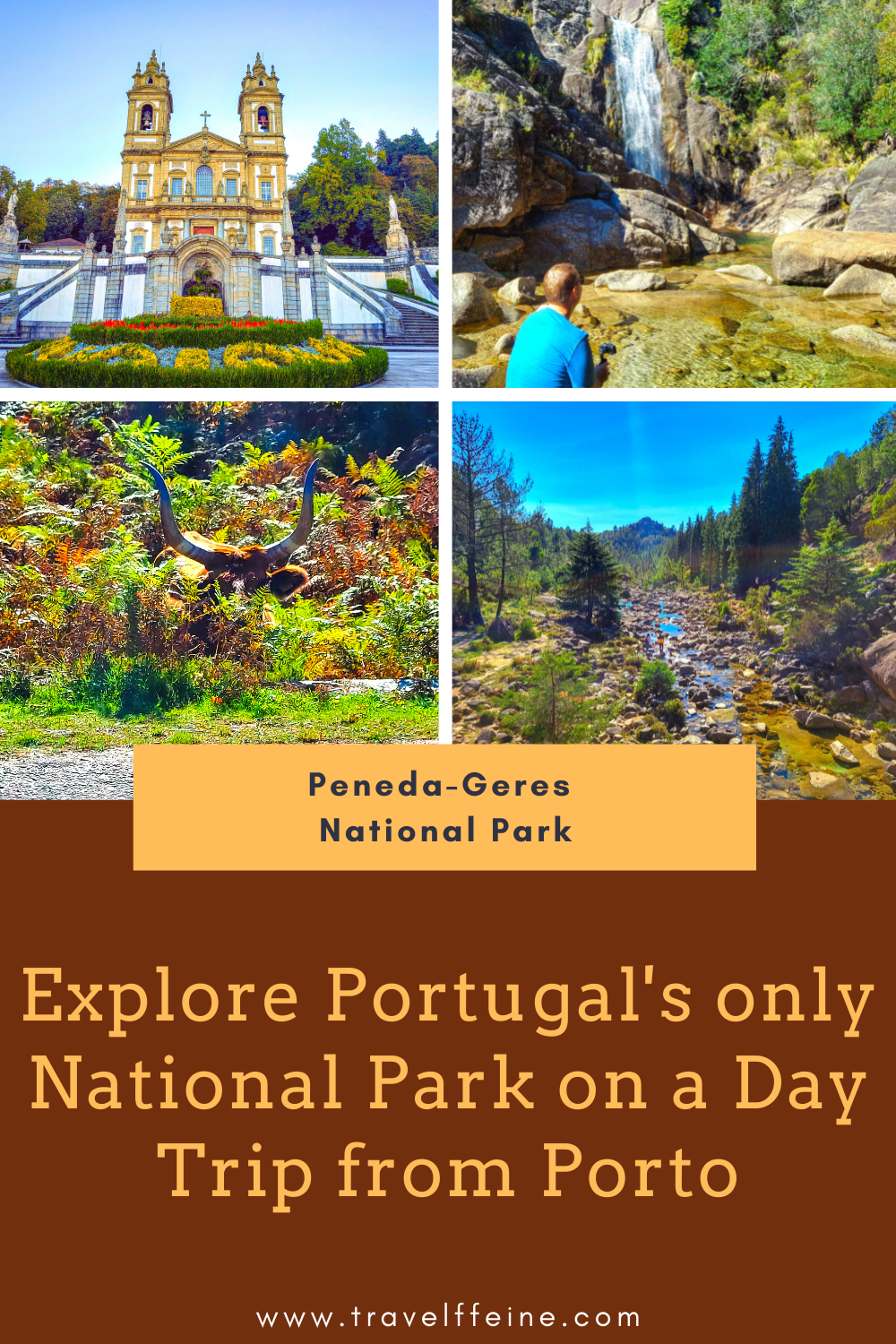
    Peneda-Geres National Park is Portugal’s only National Park, and it is well worth visiting! Go for a hike, breathe in the fresh air, admire one or more of the many waterfalls within the park, and maybe even see a goat or two along the way! In as little as 1.5 hours, you can drive from Porto to Peneda-Geres National Park and escape the hustle and bustle of the city for a break in nature.
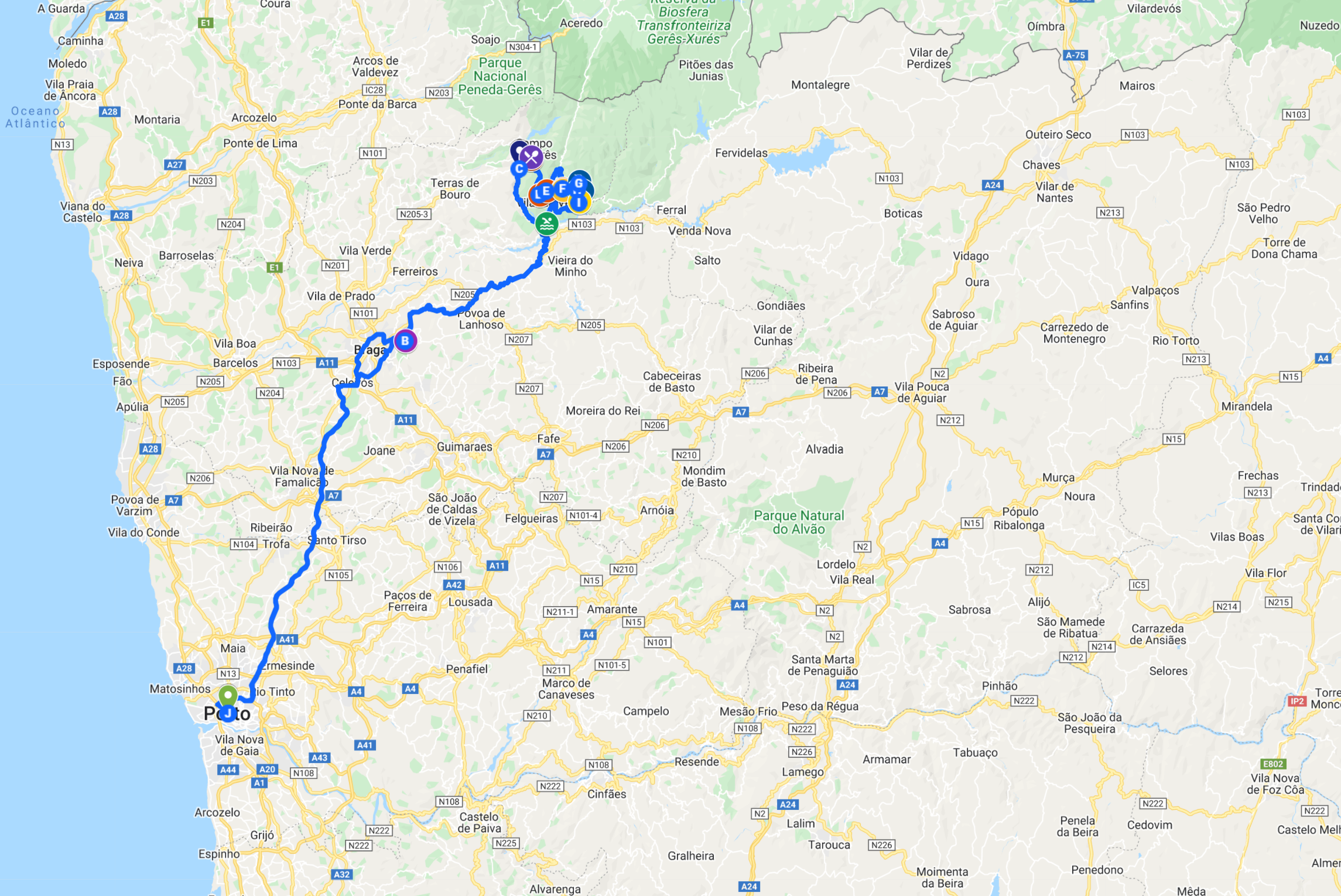
    This article is all about how to take a one-day self-driving road trip from Porto to Peneda-Gerês National Park. I share the itinerary I used and some tips and information for planning your trip, setting expectations, and what to do if you have more time. 

    Planning Your Day Trip to Peneda-Geres National Park

    First, accept that you cannot see it all.  

    With only one day to drive from Porto to Peneda-Geres National Park and make the return back to Porto, you will need to decide what’s important for you to see. Research the hikes, waterfalls, and stops you’re most interested in, and pick one or two. Then, enjoy the drive.

    Plan for extra time between stops.

    As with most national parks, whether in the U.S. or abroad, the roads inside the park are typically narrower and have much slower speed limits than outside the park. Although the distance between stops may not be very far, you need to plan for it to take longer than you expect, especially if it is busier during your visit.

    Points of Interest Inside Peneda-Geres National Park

    We thoroughly enjoyed our day trip, and I know you will too if you decide to follow it. However, I also want to provide some additional options for things to see and do to help you tailor your trip according to your interests. 

    Waterfalls

    There are so many waterfalls inside this park, so here are just a few to consider seeing.

    • Cela Cavalos
    • Cascata do Arado
    • Lagoa do Poco Negro
    • Poco Azul
    • Fecha das Barjas (Tahiti waterfalls)
    • Portela do Homem 

    Hiking

    With over 300 trails in Peneda-Geres National Park, there are too many to list. However, I will list a few links to get you started in your research. 

    • Poço Azul Loop Starting at Cascata do Arado (~5.5 miles, moderate)
    • Miradouro da Pedra e Cascada de Rajada (easy ~2 mile hike starts near the town of Ermida and takes you to a waterfall)
    • Giera Romana (Walking Trail for the old Roman Road) You can walk the old Roman Road from Braga, but I doubt you’ll have time for that. Instead, I suggest hiking a portion from Campo do Geres to Portela do Homem. You could also park on the Spanish side near Portela do Homem and walk a short part of the trail there.
    • Ponte da Misarela (0.5 miles, easy hike to a historic bridge and waterfall)
    • Calcedónia Fault (A Fenda da Calcedónia 5.5 miles, a strenuous hike requiring some rock scrambles and bouldering.) You can also hike a 4.1-mile portion that skips the Calcedonia Fault and rock climbing portion. This is still considered a challenging hike. 

    If you’d like to research more trail options or if you have one or two nights to spend inside the park and want a longer hike, this list from All Trails is a good starting point.

    Camping

    You have a lot of great options for camping around Peneda-Geres National Park. Many of these include cabins and hot showers.

    Picturesque Towns to Explore

    There are so many unique towns surrounding Peneda-Geres National Park. Here are a few to consider exploring in combination with your day. These would also be great options for spending a night or two close to the park.
    • Ermida
    • Lindoso
    • Soajo
    • Sistelo
    • Rio Caldo
    Below, I discuss the route we took, our hikes, and the viewpoints we stopped at during our day trip from Porto to Peneda-Geres. You are welcome to follow the route we took using the below map or create a unique itinerary using some of the above-listed points of interest.

    Our Road Trip from Porto to Peneda-Geres National Park

    We spent five nights in Porto during our two-week road trip in Portugal. We took two days to take day trips outside Porto. One was a day trip to see the Douro Valley, and the other was a day trip to Peneda-Gerês National Park. You can read more about additional day trip options and planning a road trip in Portugal in this article.

    We left Porto early in the morning while it was dark out and most of the city was still asleep. I enjoy seeing a city early in the morning. You catch the bakery getting their deliveries, you see the early morning commuter waiting at the bus stop, and you notice things you wouldn’t when the lights are on, and everyone is hustling and bustling around. Plus, it’s much easier to drive in the city with almost no traffic!

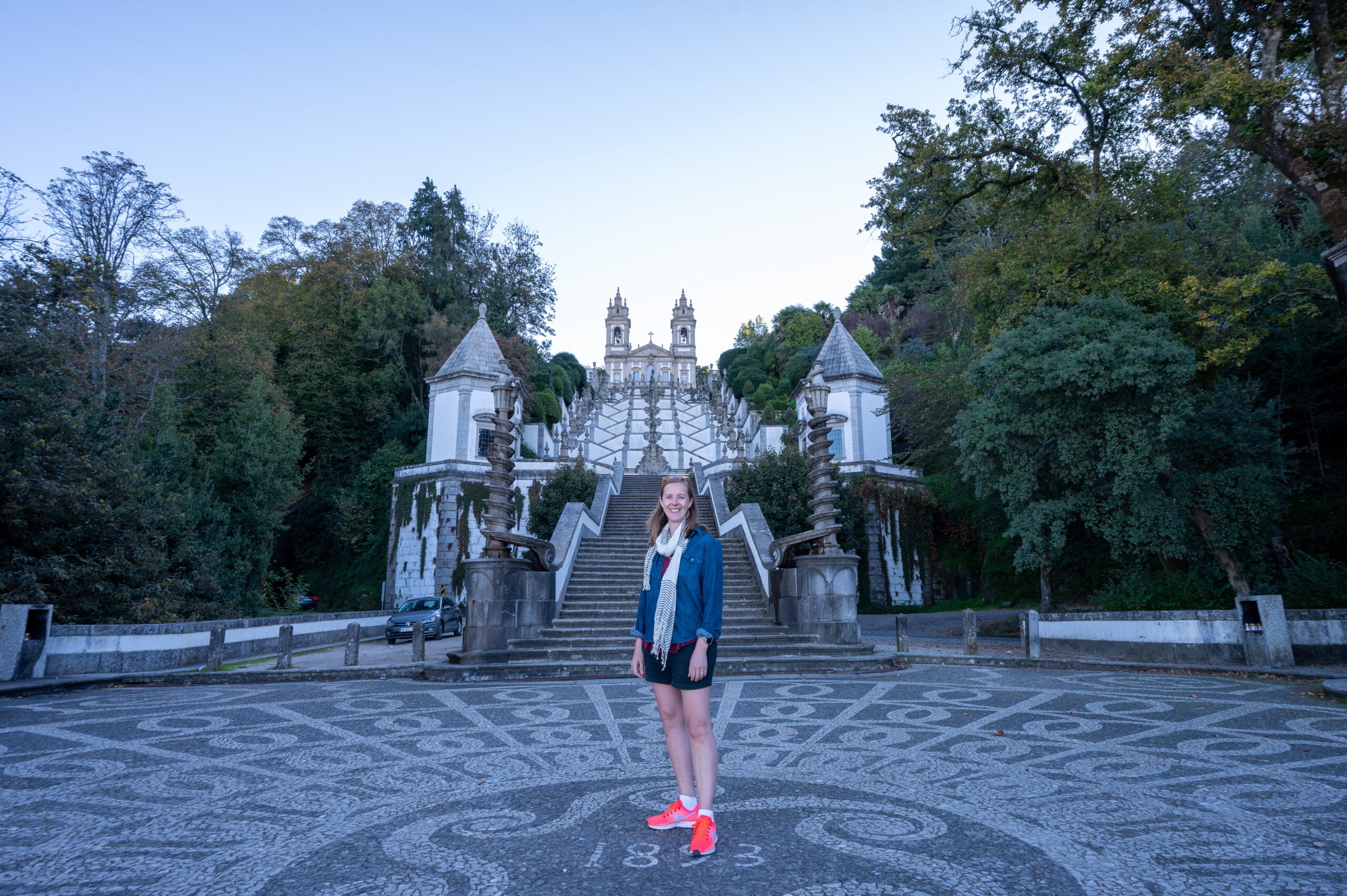
    We drove to Braga for our first stop along this day trip from Porto. I wanted to see Bom Jesus do Monte during my visit to Portugal, and since it was on the way to Peneda-Geres National Park, we decided to make a quick stop there first. It was well worth the time!

    Side Trip to Braga’s Bom Jesus do Monte
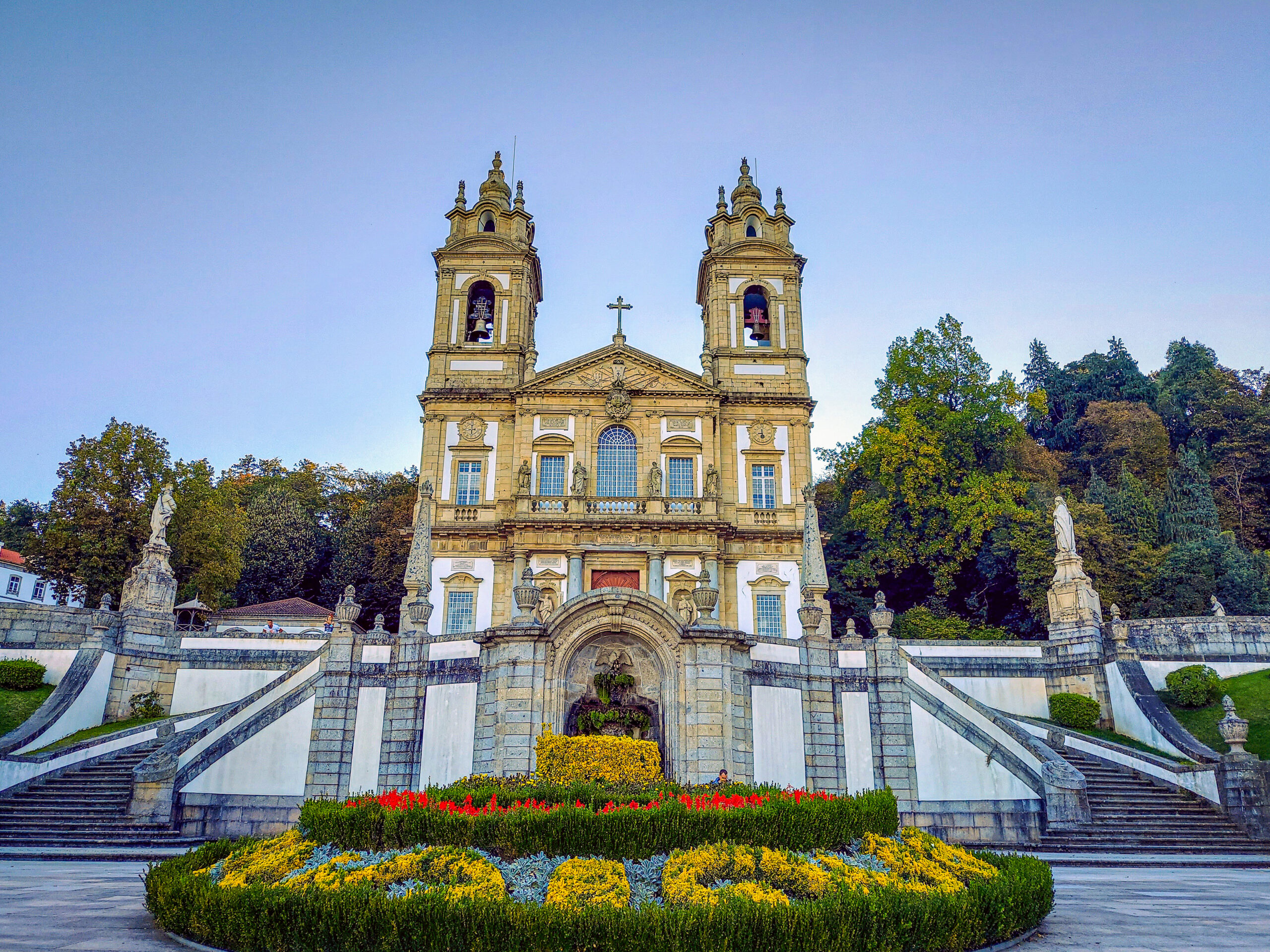
    Braga Bom Jesus do Monte

     Braga’s Bom Jesus do Monte is a beautiful sight to see early in the morning. There were hardly any other visitors except the ambitious morning runners using its many stairs for their morning workout. The church is open to look inside, and the manicured flowerbeds and landscape surrounding the church are also quite stunning. It is beautiful and worth the quick stop even if you don’t have time to explore the city of Braga.

    We worked up quite an appetite after watching the joggers climb the stairs at Bom Jesus do Monte, so we went into Braga to grab a quick breakfast before continuing to Peneda-Gerês National Park. 

    Covide, Portugal: Our Entrypoint to Peneda-Gerês National Park
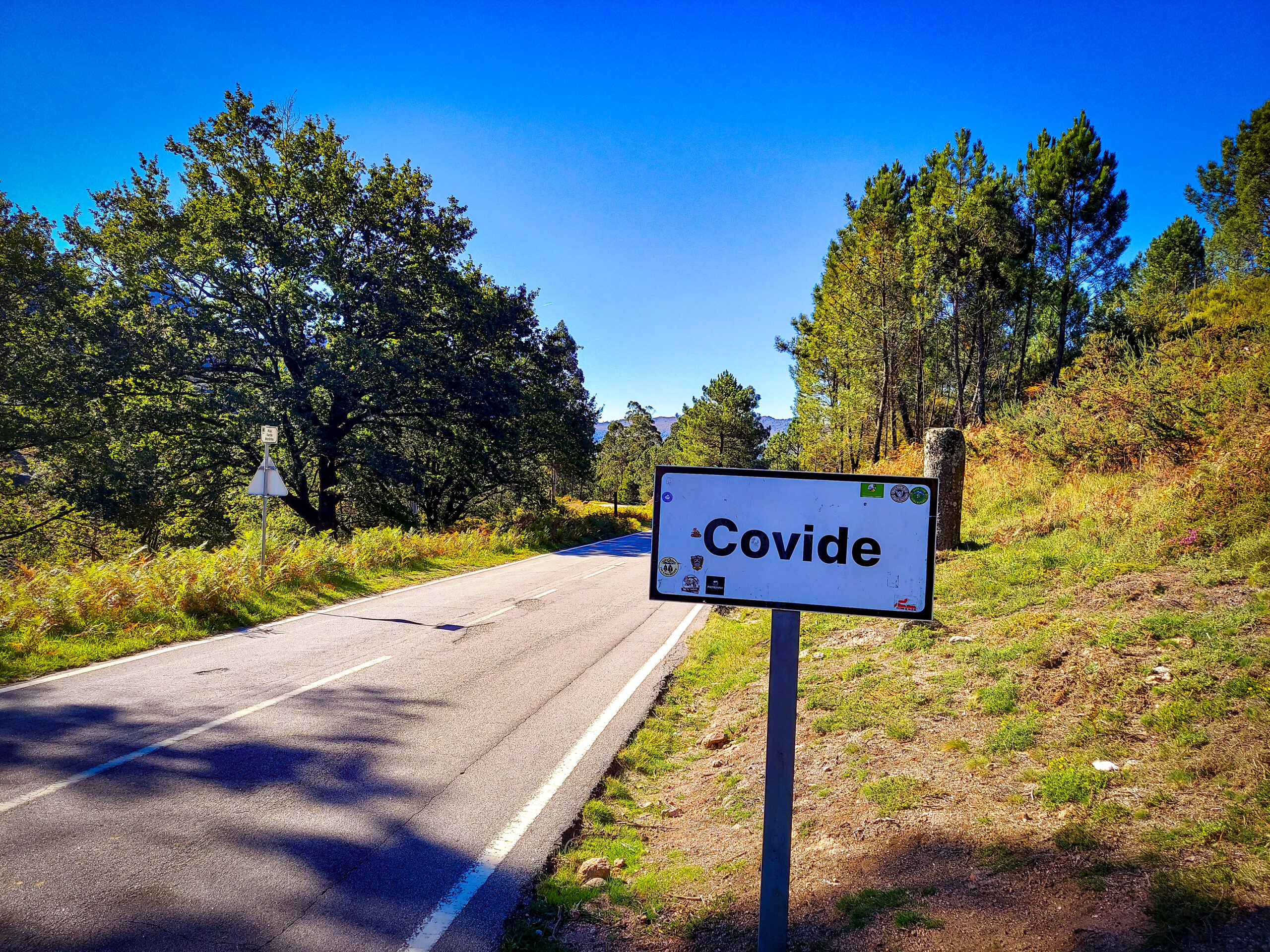
    town of Covide Portugal

    Our route took us through the town of Covide, we found this ironically amusing, and I took this photo as we left the city limits shortly before you entered the Peneda-Gerês National Park park boundary. 

    A little further up the road, we came across a goat herder. Little did we know, but we would reencounter his goats just a bit further into our drive inside the national park. I love goats! They are some of the funniest creatures! I joke with my husband that someday we will have a farm, raise goats, and make goat cheese. It’s unlikely to happen but fun to consider. I do love goat cheese…

    Covide is also the starting point for the very popular Calcedónia Trail in Peneda-Geres National Park. 

    Entering Peneda-Gerês National Park
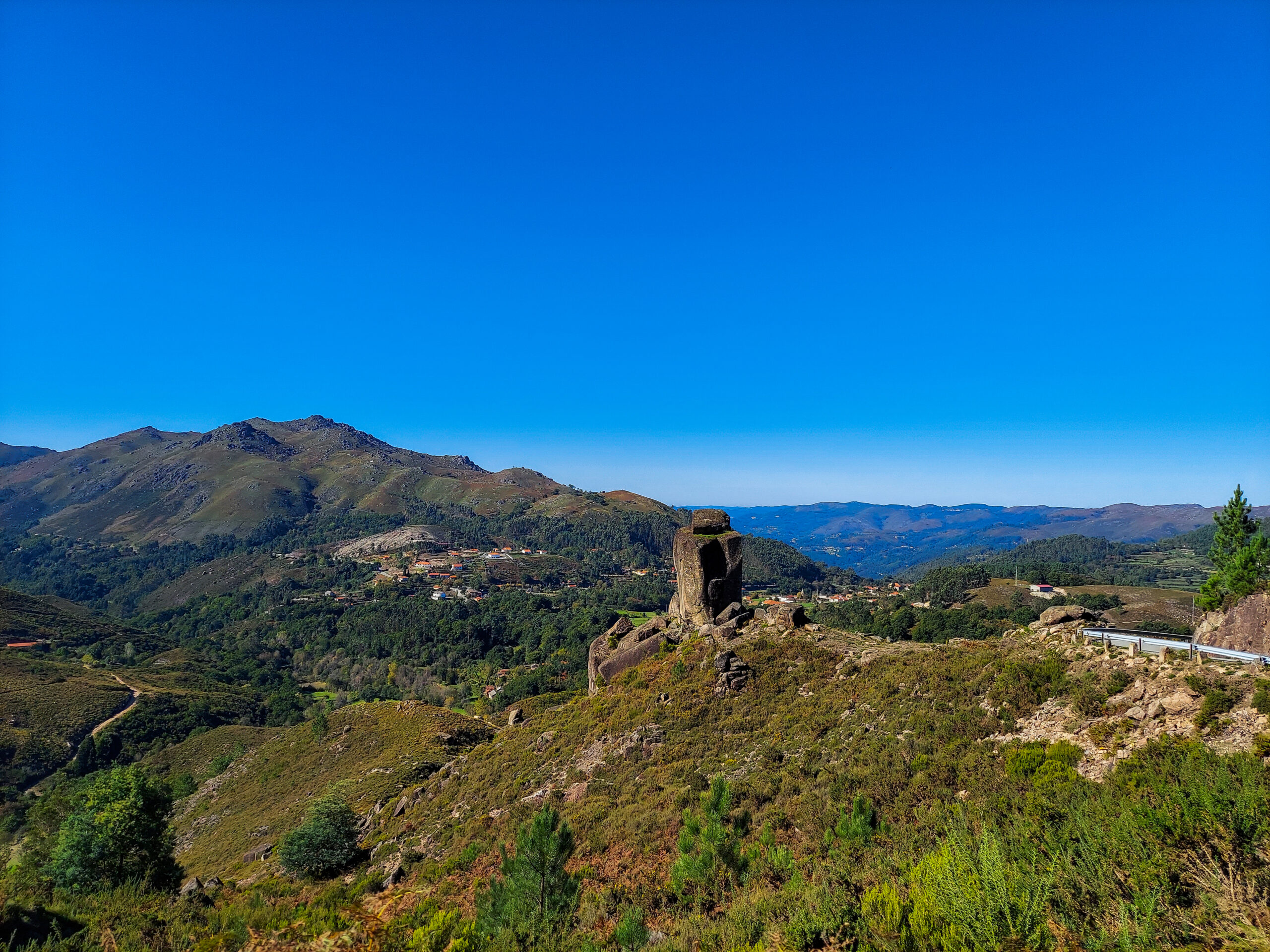
    driving in Peneda-Geres National Park

    Soon after entering Peneda-Gerês National Park, the road begins to climb upward and narrows into a narrow road with possibly enough space for two small cars to pass. Thankfully, we did not see any vehicles along this section.

    It is a beautiful drive as the road climbs above the town of Covide below, and we begin to see expansive views of large rocky formations, trees, shrubs, and even lakes below. I breathe in the fresh air and smile. It is nice to be in nature. I love the city, but I also love and need these breaks in nature to replenish my spirit.

    It felt as though we had the entire Peneda-Gerês National Park to ourselves! Well, besides the Cachena cows we saw hiding in the grass with their long horns peering out at us. The Cachena cows were initially bred not only for their milk and meat but also as draft animals. Today, they are sold primarily for their meat and the milk is used for making delicious cheese.
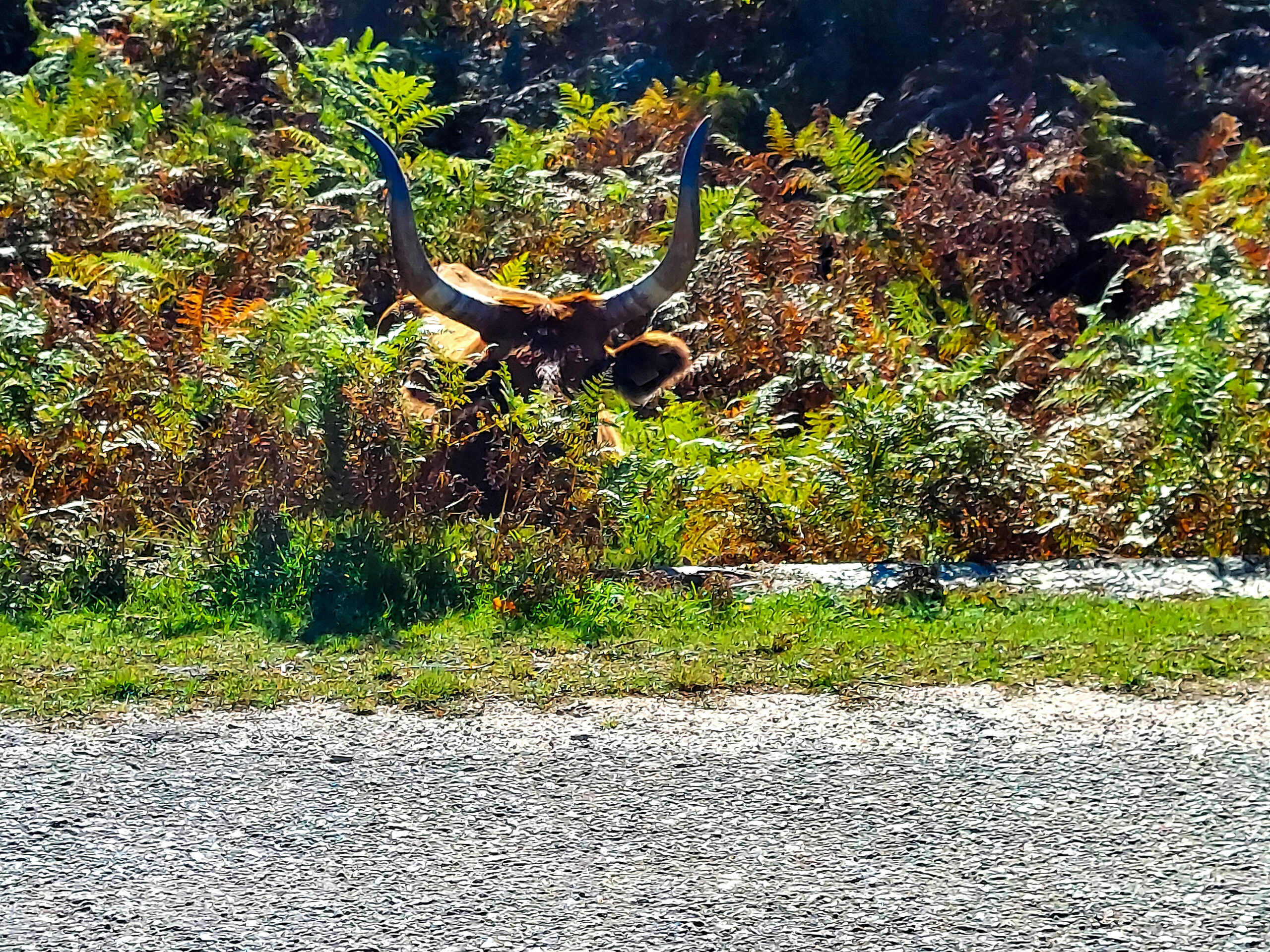
    Cachena cow in Peneda-Geres National Park Portugal

    The Ancient Roman Road near Campo do Geres

    Shortly before you arrive at the junction for Campo do Geres and the National Park junction with M533, you’ll pass Marco Miliário de Covide e Campo. This is a historical mile marker from the ancient Roman Road.

    Miradouro Voltas de São Bento

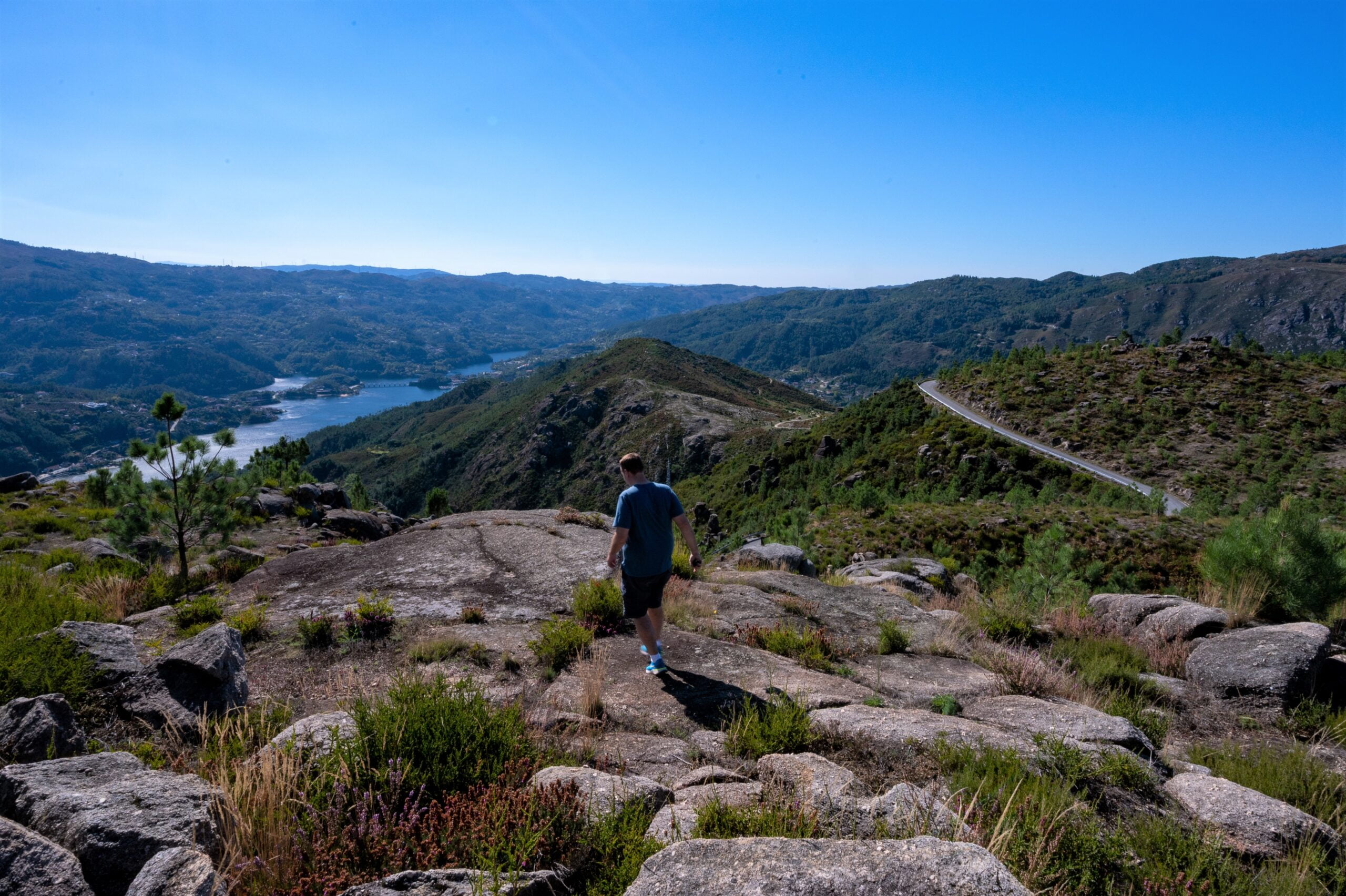
    There are many miradouras (viewpoints) within Peneda-Geres National Park.  These are great opportunities to get out, take in some fresh air and stretch your legs while enjoying the view.  The first one we stopped at was Miradouro Voltas de São Bento. You’ll enjoy views of the Cávado River below as well as rocky outcroppings scattered around. 

    Mirante Velho Viewpoint

    Just a short drive up the road from the São Bento Viewpoint, you come to Mirante Velho Viewpoint or Mirante Velho Miradouro in Portuguese. This one gives you a slightly higher view of the Cávado River and the surrounding area. It also had some neat rock formations that reminded me of rocks I saw in Joshua Tree National Park. There is also a picnic area here, and when we visited, they were replacing the picnic tables and restoring the area around this viewpoint.

    Gerês

    Gerês is an excellent place to stop and eat if you didn’t bring a picnic lunch. It is the last stop for food along this route. Gerês is also where the thermal spa is if you need a therapeutic soak. The road climbs steadily after leaving the town with sharp hairpin corners and poor visibility on such a narrow road. It reminded me of the Road to Hana in Maui, Hawaii.  I commented that it would give the Road to Hana a run for its money with the sharp curves and s-turns.

    Next Stop: Miradouro Novo da Pedra Bela

    Miradouro Novo da Pedra Bela or the New Beautiful Stone viewpoint has a beautiful vantage point high above the valley below. There is also a lovely picnic area here, so if you packed a lunch, this would make a great place to get that out and enjoy this beautiful viewpoint. There was plenty of parking when we visited. We stopped at a small pullout about a 1-minute walk from the picnic area only to realize that we could have driven to the end and parked.  

    Once you walk past the picnic area, you’ll see a sign for the viewpoint and, to the right, a small path leading up some rocky stairs. Follow this path as it leads you up and throw a somewhat narrow gap between two rocks before popping out on an open viewing platform made of stone. The stone slab is also a nice picnic area if it isn’t too crowded.

    We took a quick snack break before returning to our car and driving to the Arado waterfalls trailhead.

    First Hike: Cascata do Arado

    It’s about a 10-minute drive to Cascata do Arado (Arado waterfalls) from the New Beautiful Stone viewpoint. You first come to the parking area for the Rocas viewpoint. You can park here and walk down the dirt road to the trailhead for Cascata do Arado, or you can do what we did and continue driving after the pavement turns into a dirt road. 

    The dirt road was in pretty good condition when we visited, with just a few potholes here and there to drive around. Our car made it without any issues, and we saw many other cars driving down the road. There are quite a few pullouts for parking along the dirt road and parking across from the trailhead. If you decide to park in the parking area for the Rocas Viewpoint, it probably adds 15-minutes each way to your walking time.

    The hike to the Arado waterfalls is short and easy. There is an initial climb up a series of rocky stairs before the path turns to loose rocks and dirt, and within 10-minutes of walking, you reach the viewing area for the waterfalls.  Hikers wanting to see the falls from below hiked up the riverbed instead of taking the trail to the upper overlook. We were here in late fall, so the water level was pretty low. I don’t know whether it is possible at other times of the year, so take the necessary precautions and be safe!
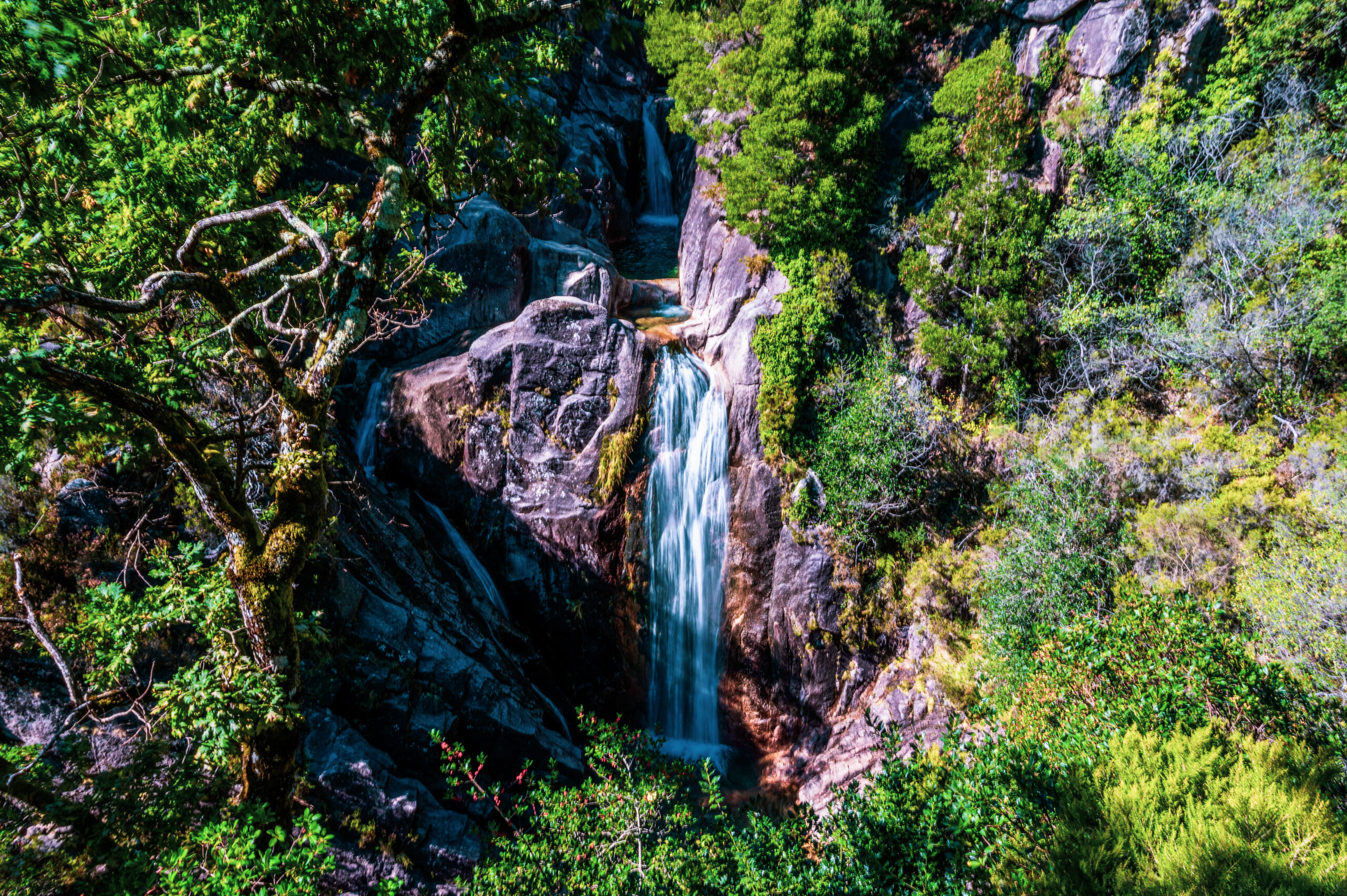
    Arado Waterfalls in Peneda-Geres National Park

    Hiking to Rocas Viewpoint

    After hiking to Cascata do Arado, we walked back to our car and returned to the parking area for the Rocas viewpoint. Miradouro das Rocas is a short hike, but I enjoyed climbing this rocky formation. I had fun ducking and climbing as the trail engineers did their best to create a path around the rock.

    At the top, you have 360-degree views of Peneda-Geres National Park from over 2,600 feet in elevation. It was a lovely way to end our visit here. I did not properly plan our day trip and forgot to pack a lunch, so the snack bar we ate earlier was wearing off, and we were ready to head back to Porto and get some dinner. Had I packed a lunch, we would have done one of the other hikes in this same area as there were multiple hiking trails all centered around this one parking area.  

    We took a slightly different route back to Porto, passing through Rio Caldo and the Geres Water Park. You can rent boats here, swim, and sunbathe. It makes a good base point for families wanting to spend a night or two in the area. 

    Tips & Final Thoughts

    Drive slowly! This road does not allow for fast driving, so although the mileage may not seem much for a day trip, remember you’re driving on narrow roads, plus making multiple stops for photos and possibly a picnic.

    We visited in October, and it was still sunny and warm. We wore shorts, t-shirts, and tennis shoes and brought light jackets for the morning, but they were not needed by afternoon. 

    Make sure to fuel up in Braga or a town outside the park. Bring extra water, snacks, sandwiches, and food for the afternoon. A hat, sunglasses, and sunscreen are good ideas too.

    What Would I Do With a Second Day?

    • Spend a night in one of the villages, such as Sistelo, Soajo, or Ermida.
    • Walk along the old Roman Road walking trail.
    • Explore a little of the Spanish side of the park.
    • Visit the Cela Cavalos and Poço Negro waterfalls.

    With only one day, though, you have to accept that you can’t see it all. It’s like a sampler plate, you take a small bite, and then you know what you like so you can return and explore more of that area. 

    Additional Articles You May Enjoy

    Tips for Planning a Two Week Road Trip in Portugal

    5 Tips for Renting a Car & Driving in Portugal

    Douro Valley Day Trip: A Self-Driving Tour Porto to Pinhão

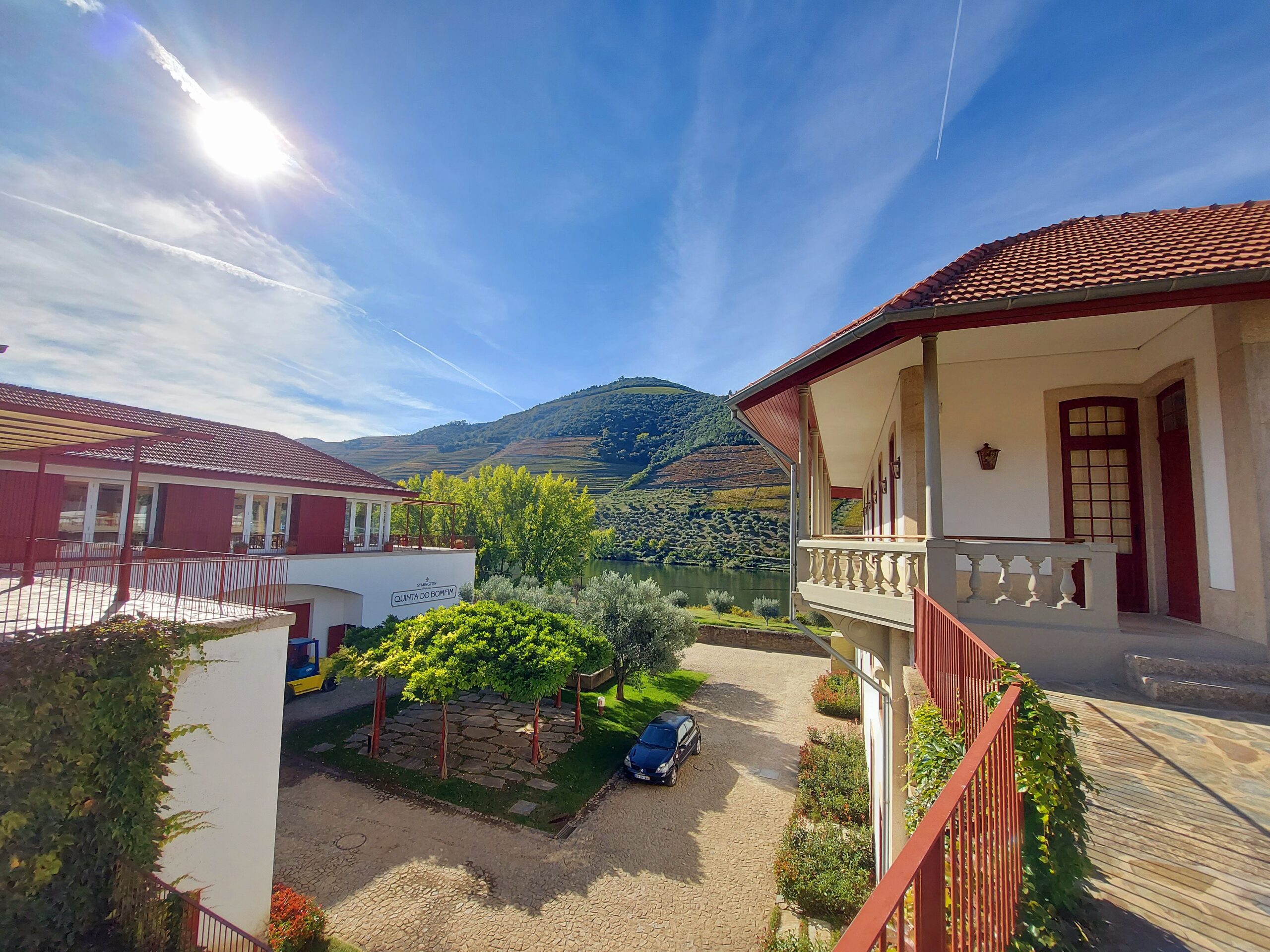
    Quinta do Bomfim: The Perfect Douro Valley Winery Tour

    Happy Exploring!
    Peneda-Geres National park day trip from Porto Travelffeine
    Peneda-Geres National park day trip from Porto
  • Douro Valley Day Trip: A Self-Driving Tour Porto to Pinhão

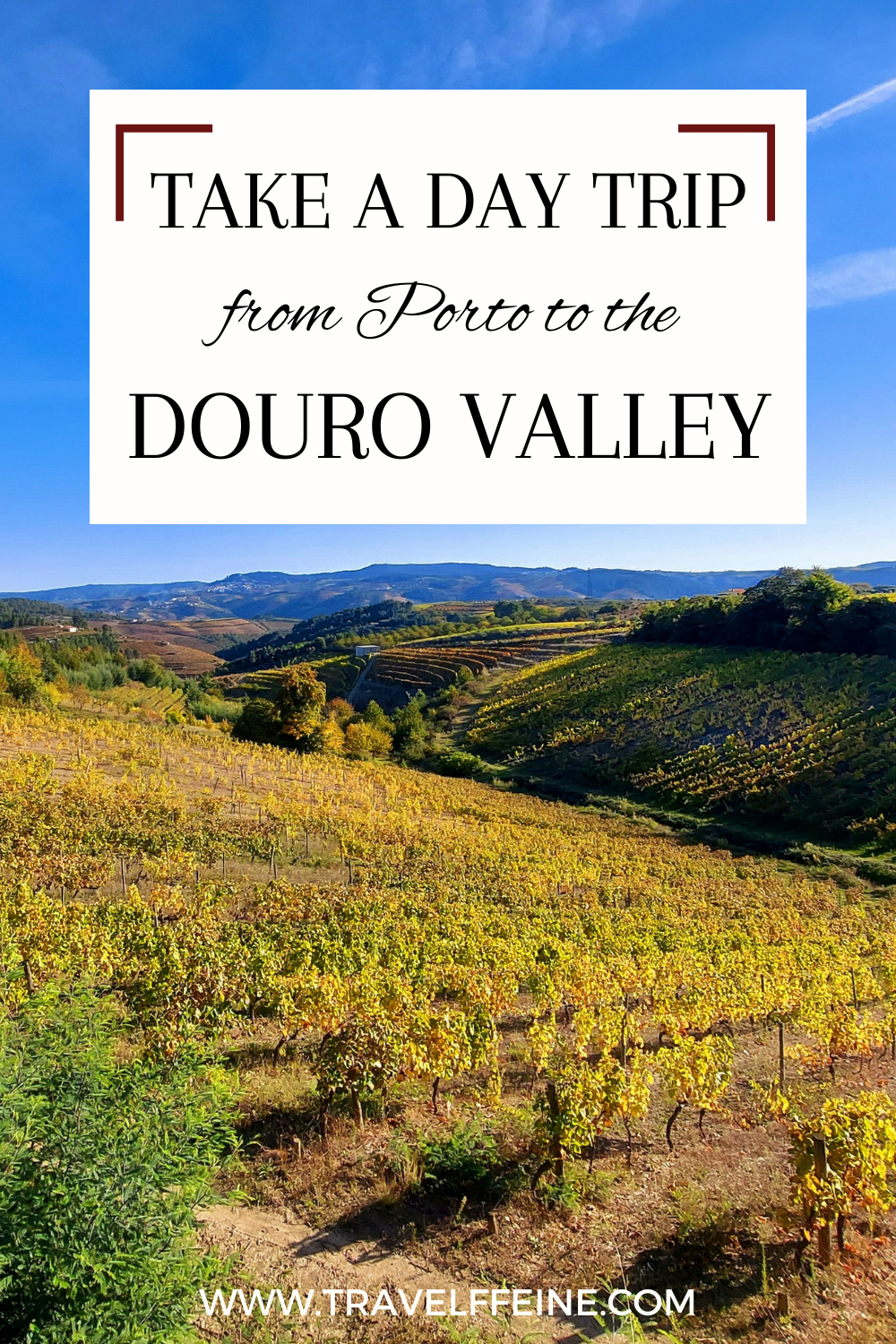
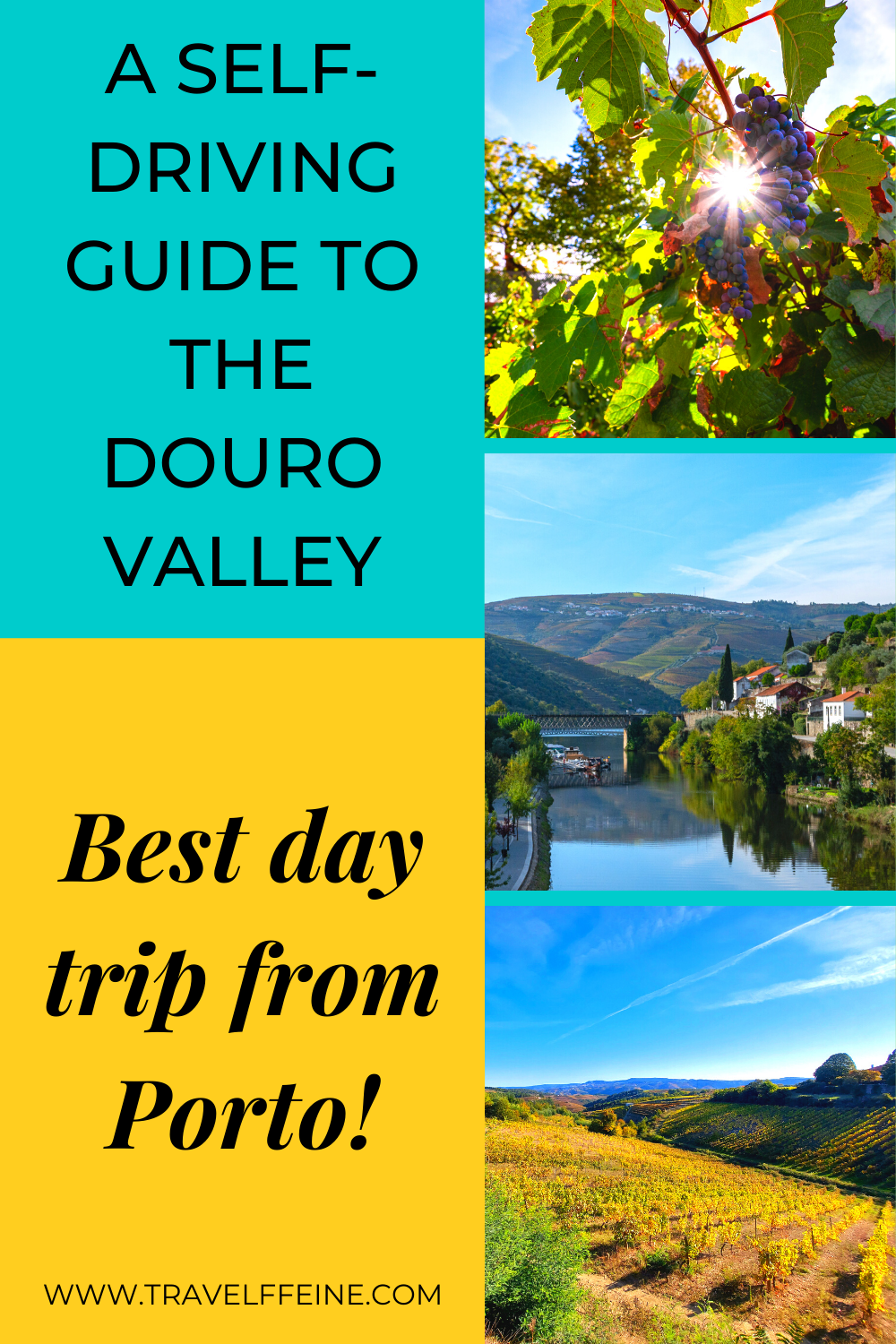
    Driving from Porto to Pinhão in the Douro Valley was one of my favorite day trips during our two-week road trip in Portugal.  The Douro River Valley is a gorgeous region in Portugal with terraced landscapes reminiscent of the rice fields in certain parts of Asia. With only a few days in Porto, we knew we only had time for a day trip to the Douro Valley. I read that Pinhão was one of the prettiest towns along the Douro River, so we made that our destination and turn-around point.

    I booked a tour ahead of time with Quinta da Bomfim in Pinhão.  Many vineyards in the Douro Valley allow drop-ins. However, since the changes brought on by COVID, most were not accepting walk-ups during my visit there. So, to be on the safe side, I recommend reserving a tour in advance.  Then, you can always stop at various vineyards if they allow drop-ins, but at least you’ll have one “for sure” visit planned.

    If you only have one day to visit the Douro Valley, this self-driving tour from Porto to Pinhão will give you a complete picture of this beautiful part of Portugal. You’ll take in stunning views, learn about the region’s history, take a tour, and eat an incredible meal. If you’re looking for a great day trip from Porto, put this one at the top of the list!

    Tip: Before heading to the Douro Valley make sure to make any necessary reservations for winery tours and dining in advance.

    The Douro Valley is one of the oldest wine-producing regions in the world. It is also a UNESCO World Heritage Site famous for its vineyards and production of port and wine. Originally, flat-bottom boats called rabelos took the wine down the Douro River to the Gaia district across from Porto. 

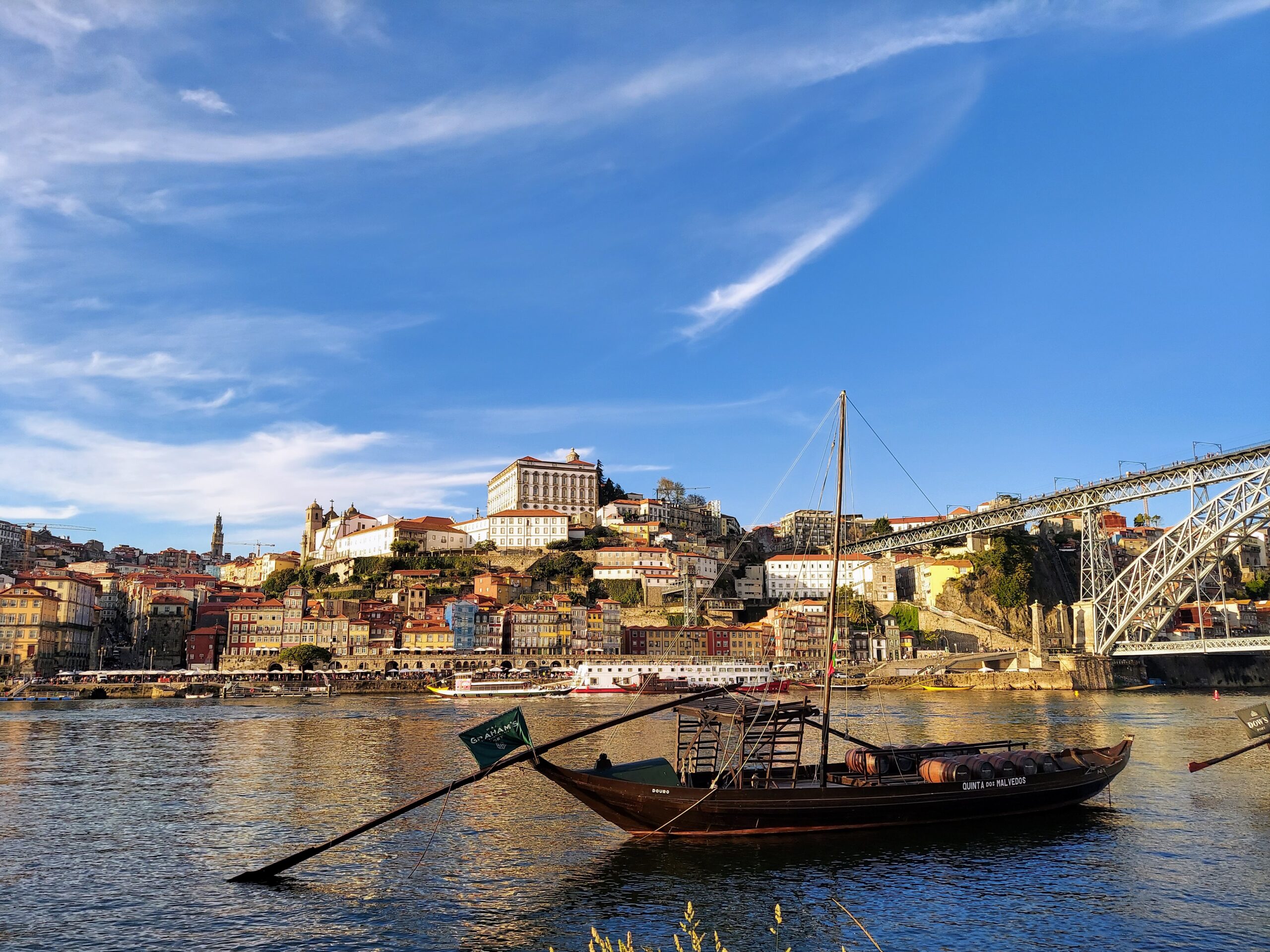
    Now the wine is transported via trucks, but you can see these traditional rabelos in Porto and Gaia. You can even take a rabelos boat tour to experience this traditional mode of transport.

    Douro River rabelos traditional boat

    Options for Visiting the Douro Valley

    There are three main options for visiting the Douro Valley from Porto, Portugal. You can rent a car and drive there, book a tour from Porto, or take the train. 

    Driving from Porto to the Douro Valley: This is my choice for the ideal way to visit the Douro Valley. Depending on traffic, Porto to Pinhão is about a 1.5 hour to 2-hour drive. You can plan to stay a couple of nights and explore the region, or for those with limited time, you can easily take a one-day self-driving tour from Porto to the Douro Valley.  

    Take the Scenic Train from Porto: You can also take a train from Porto to Pinhão. The train ride takes about 2 hours and 17 minutes. You won’t, of course, be able to take any side roads or stop for photos, but you can enjoy the beautiful scenery from your seat on the train. Additionally, the train goes as far as Pocinho with multiple stops along the way, making it possible to plan a multi-night stay in the Douro Valley along the train’s route.

    Book a Tour: There are many tour options available for those wanting to take a guided trip to the Douro Valley.  You can take boat trips up the Douro River, take an all-day or multi-day driving tour, and there are even combo tours that include visits to wineries as well as a short cruise on the Douro River.  I cannot list all the options for tours here, but if that’s up your alley, you’ll have no lack of options from which to choose.

    What to Expect on this One Day Self-Driving Tour

    • You’ll see the beautiful Douro Valley River and Landscape.
    • Visit a Douro Valley winery and take a wine tasting or vineyard walking tour.
    • Eat at an incredible restaurant with views of the Douro River.
    • Go home happy and full of unforgettable memories.

    Don’t feel like you won’t get to enjoy the beauty of the region with only one day. Even the fast route, which we took, provided many stunning viewpoints and vistas to stop at and enjoy. Even though we only visited one Douro Valley winery, it still gave us a perfect taste for the region’s beauty and history. It had everything we wanted all wrapped up in one day full of beautiful memories. 

    Our day trip from Porto to the Douro Valley became one of our favorites from our entire two-week road trip in Portugal. I highly recommend making time for at least one day in this beautiful and unique region.

    Hwy N322-3 in the Douro Valley

    Who This Douro Valley Road Trip is Designed For

    This Douro Valley self-driving tour is best for people who want to experience the region’s beauty and history but aren’t necessarily into sampling a bunch of wine. Meaning if you want a tour that hops from one Douro Valley winery to the next to sample ports and wines, then one of the guided tours might be a better option.

    My husband and I are not wine drinkers, and I had never tried port until I visited Portugal. So our day trip to Pinhão was more about exploring the region and learning about its history.  We drove through the scenic vineyards and along the Douro River, toured a family winery, walked through its vineyards, and ate an incredible meal that was locally sourced. It was a perfect day spent in the Douro Valley.

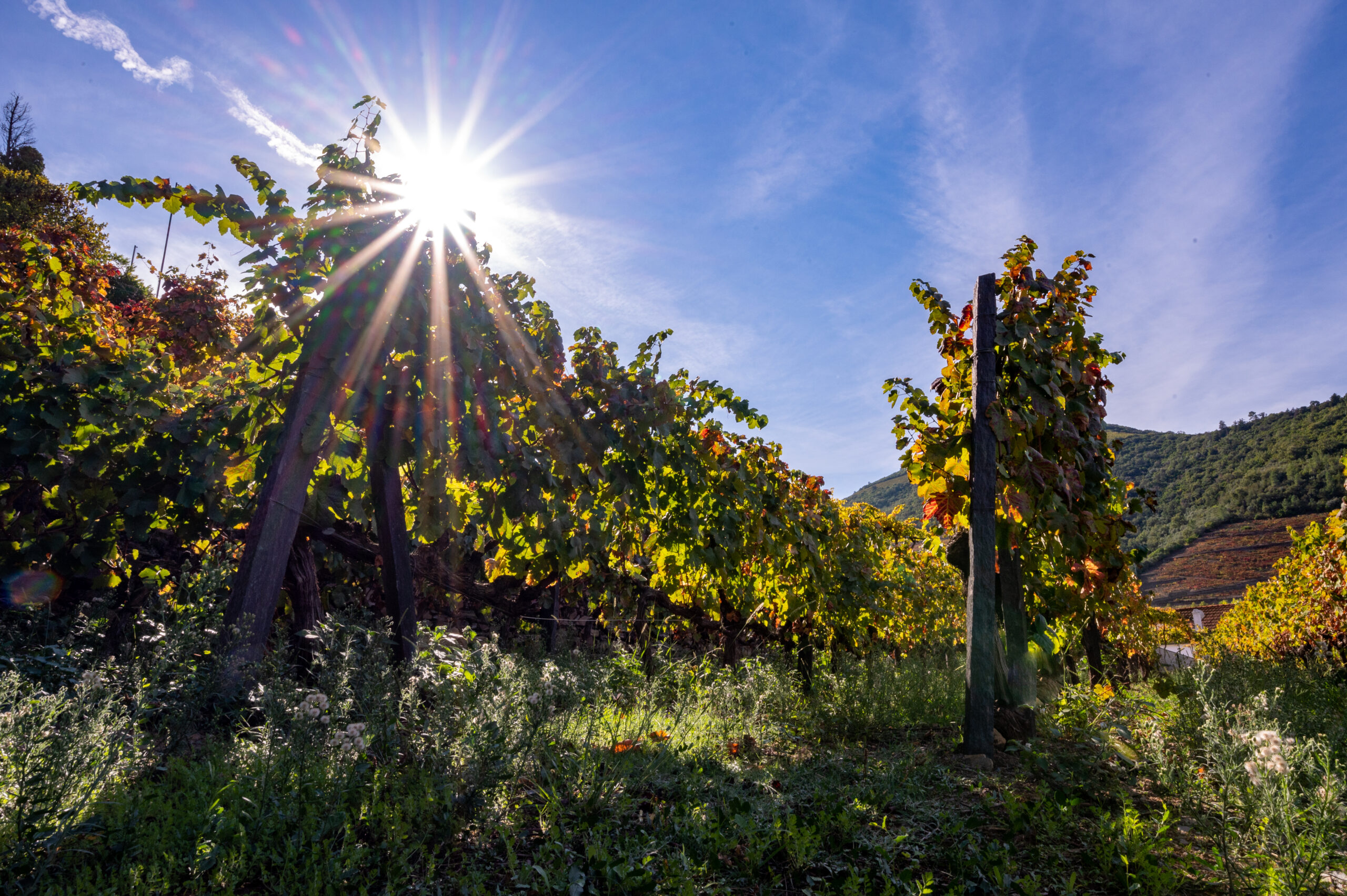
    Douro vineyard at Quinta do Bomfim
    Walking through the vineyards at Quinta do Bomfim. 

    Non-Alcoholic Drinkers

    If you do not drink wine at all, a trip to the Douro Valley is still worth your time. In addition to winery tours and tastings, Quinta do Bomfim offers self-guided vineyard walks. They provide you with a map, hat, and bottle of water. There is signage throughout the vineyard to guide your walk and inform you of the history. I highly recommend this, as it was beautiful to walk around the vineyard and learn about the history of the rugged landscape that is now so famous for its wines and ports.

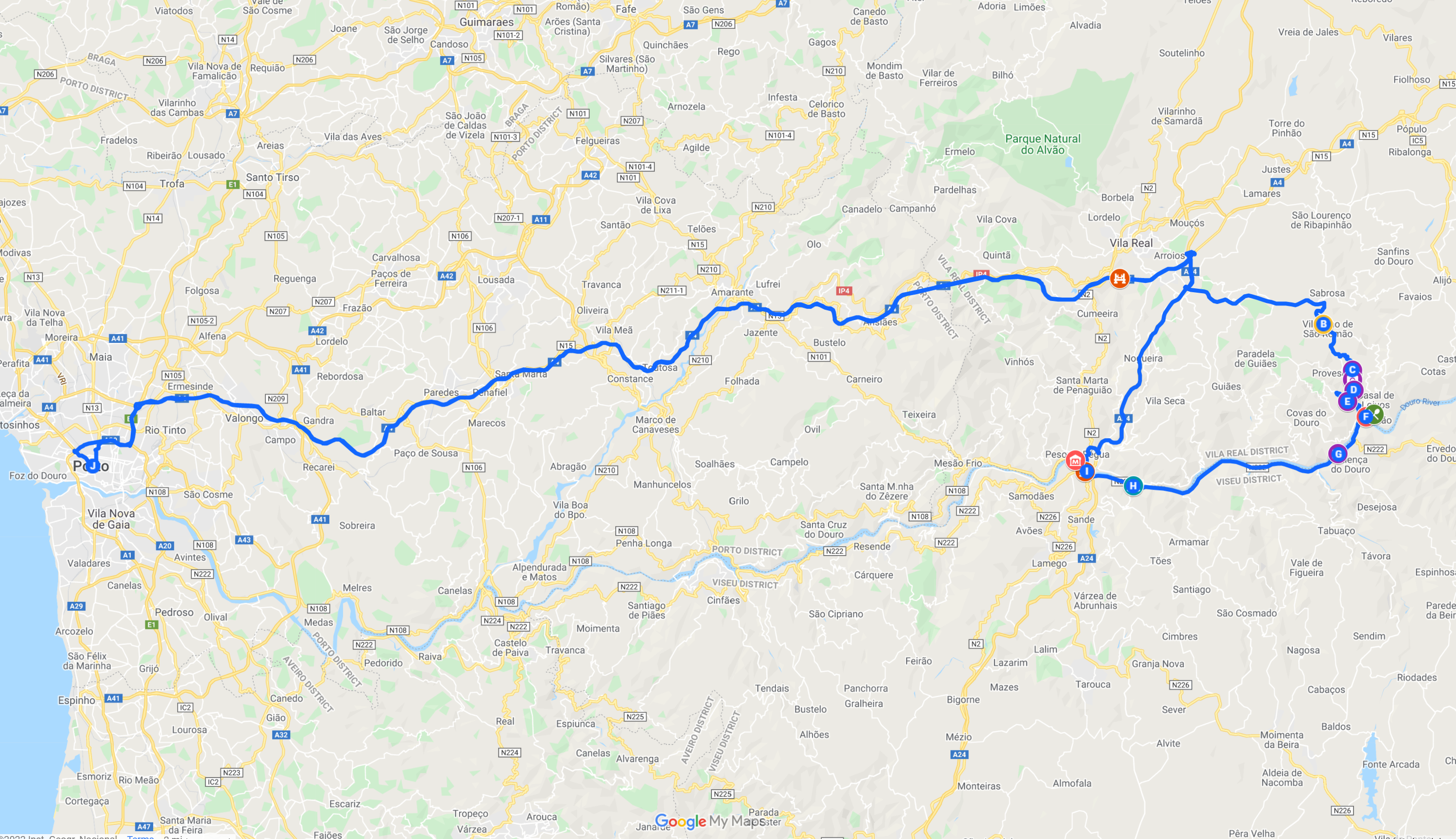
    Our Driving Route from Porto to the Douro Valley

    During our two-week road trip in Portugal, my husband and I took one day to drive from Porto to the Douro Valley. I made reservations in advance to tour the Quinta da Bomfim vineyard. Our reservation was for 11:30 a.m. We left early and took the quickest route to Pinhão, which included a scenic drive with viewpoints for photos along the way.

    Click the map to see the stops I marked for miradouros (viewpoints), the winery, our choice for where to dine, and the loop we took from Porto to Pinhão and back.  This drive is an excellent option for a day trip from Porto. 

    The entire route takes around 3.5-4 hours of straight driving (round trip), and with stops, a visit to a vineyard, and lunch/dinner, you won’t make it back to Porto until the evening.  We left the Douro Valley shortly before 5:00 p.m., and my hubby was hoping to miss rush hour traffic, but we still hit some and made it back around 7:00 p.m.

    Highlights Along This Douro Valley Route

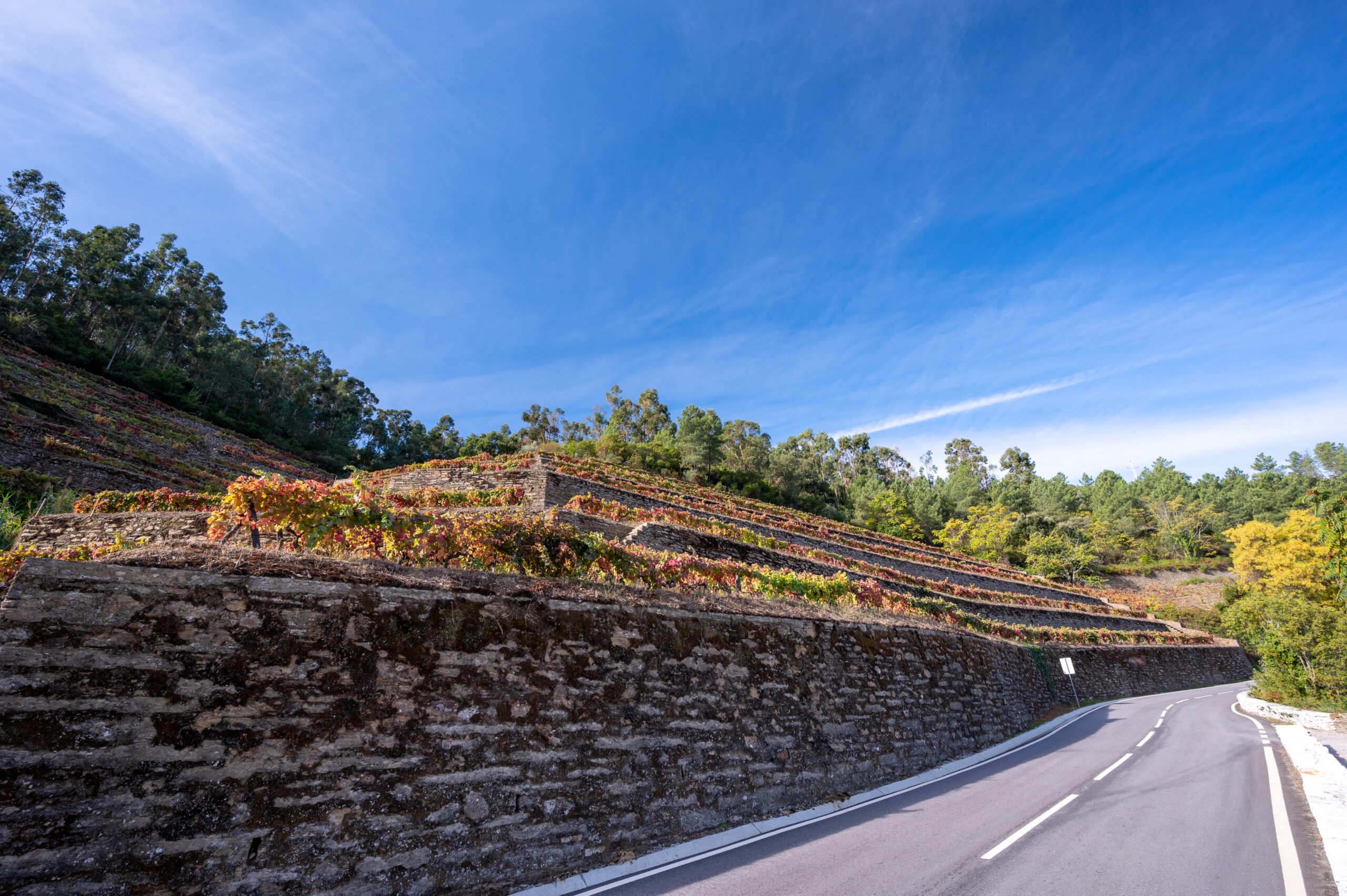
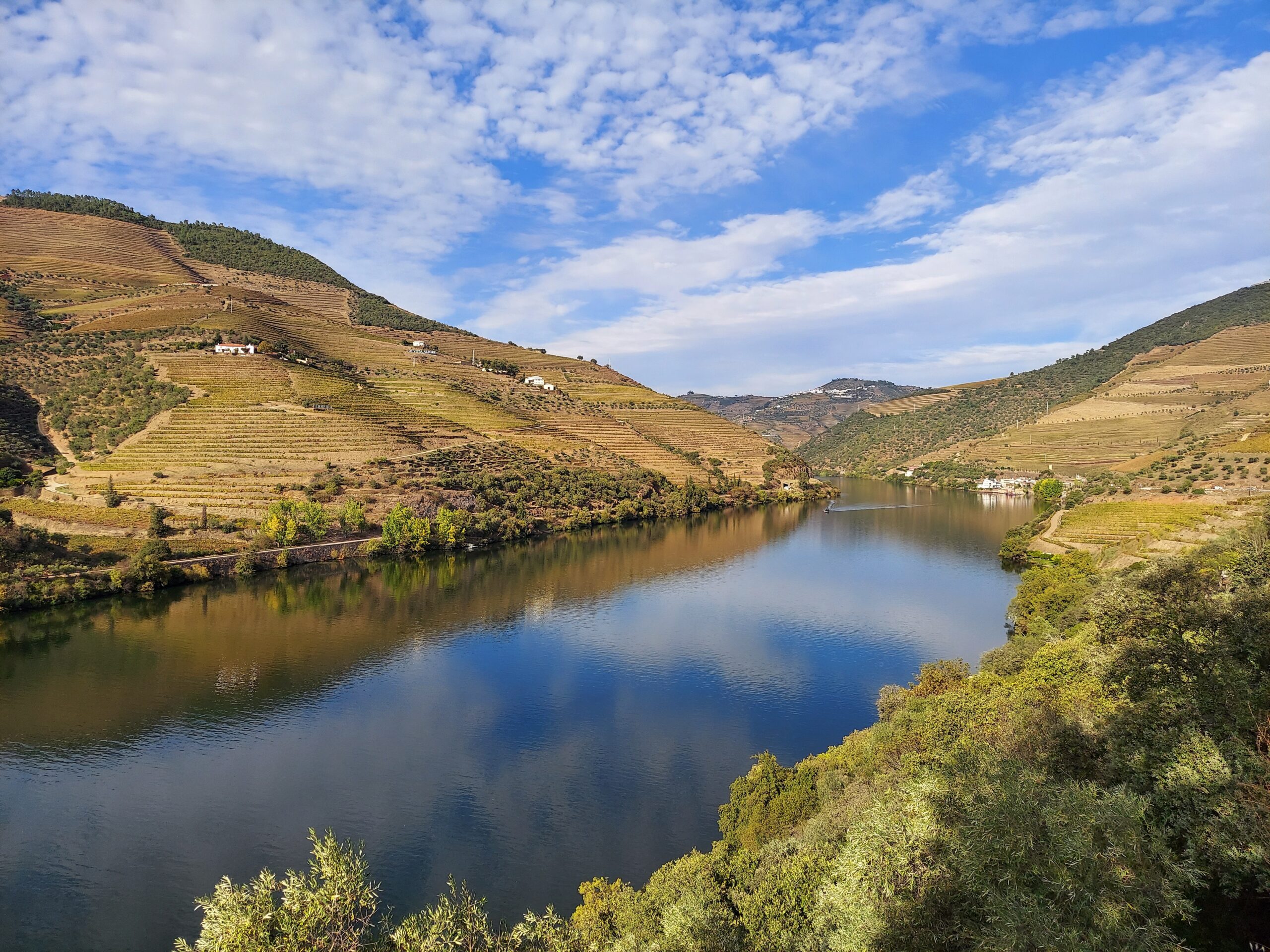
    I loved the route we took! After jumping off the A4 by Vila Real, we hopped on the N322. After passing through the town of Sabrosa, the natural beauty of the Douro Valley and the scenic drive began. The fall colors were out during our visit in October, and it was so beautiful!

    N323 Scenic Drive in the Douro Valley
    This photo was taken across from the picnic area off N323 near Sabrosa, Portugal.

    Small Picnic and Parking Area

    There is a little picnic area with parking about 10-minutes outside the town of Sabrosa, where we stopped to take the above photo. It was the first of many stops along this scenic driving route.  N322 becomes N323 along this stretch, and the road sort of goes back and forth between the two, but it’s all the same route.

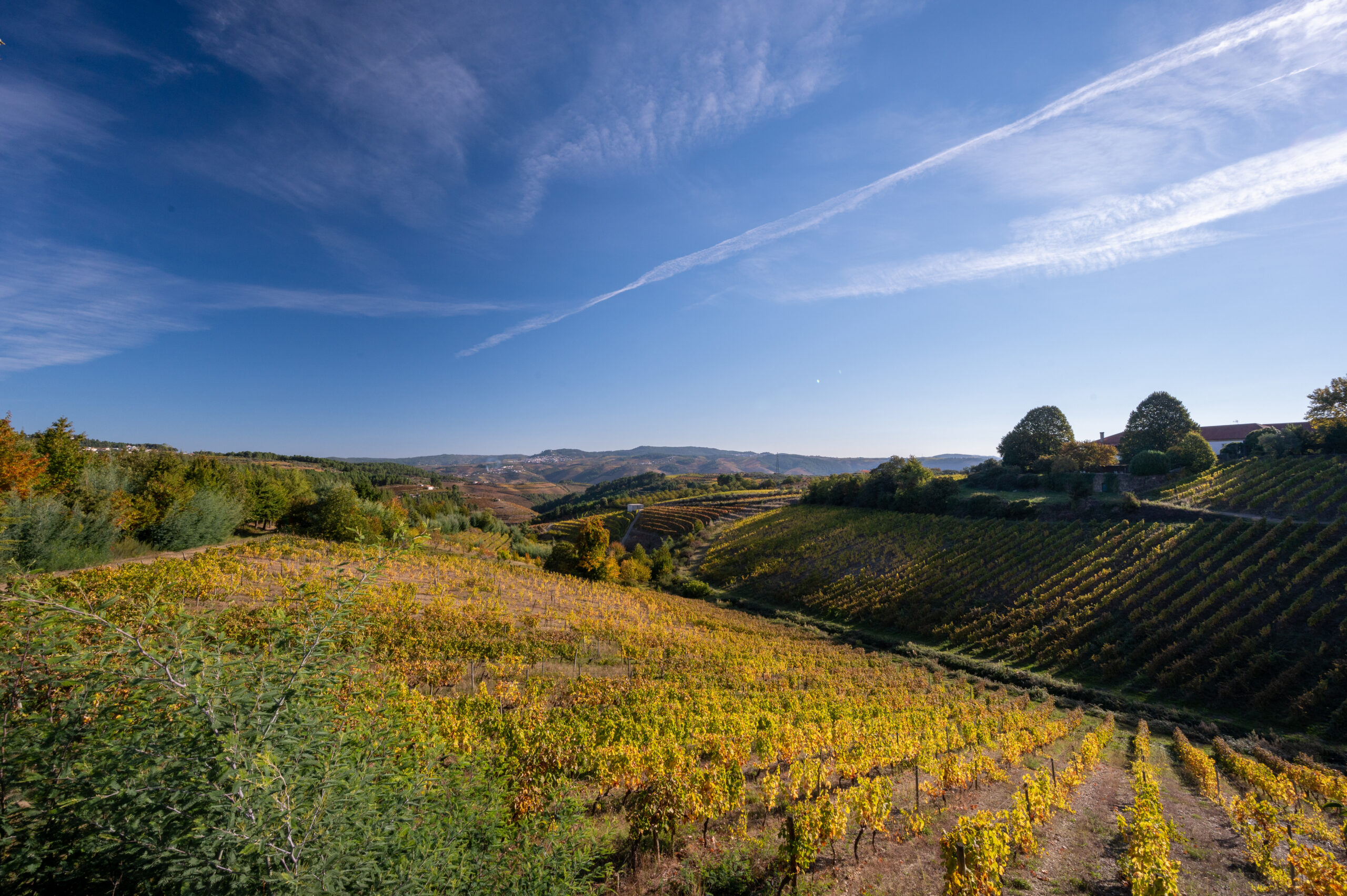
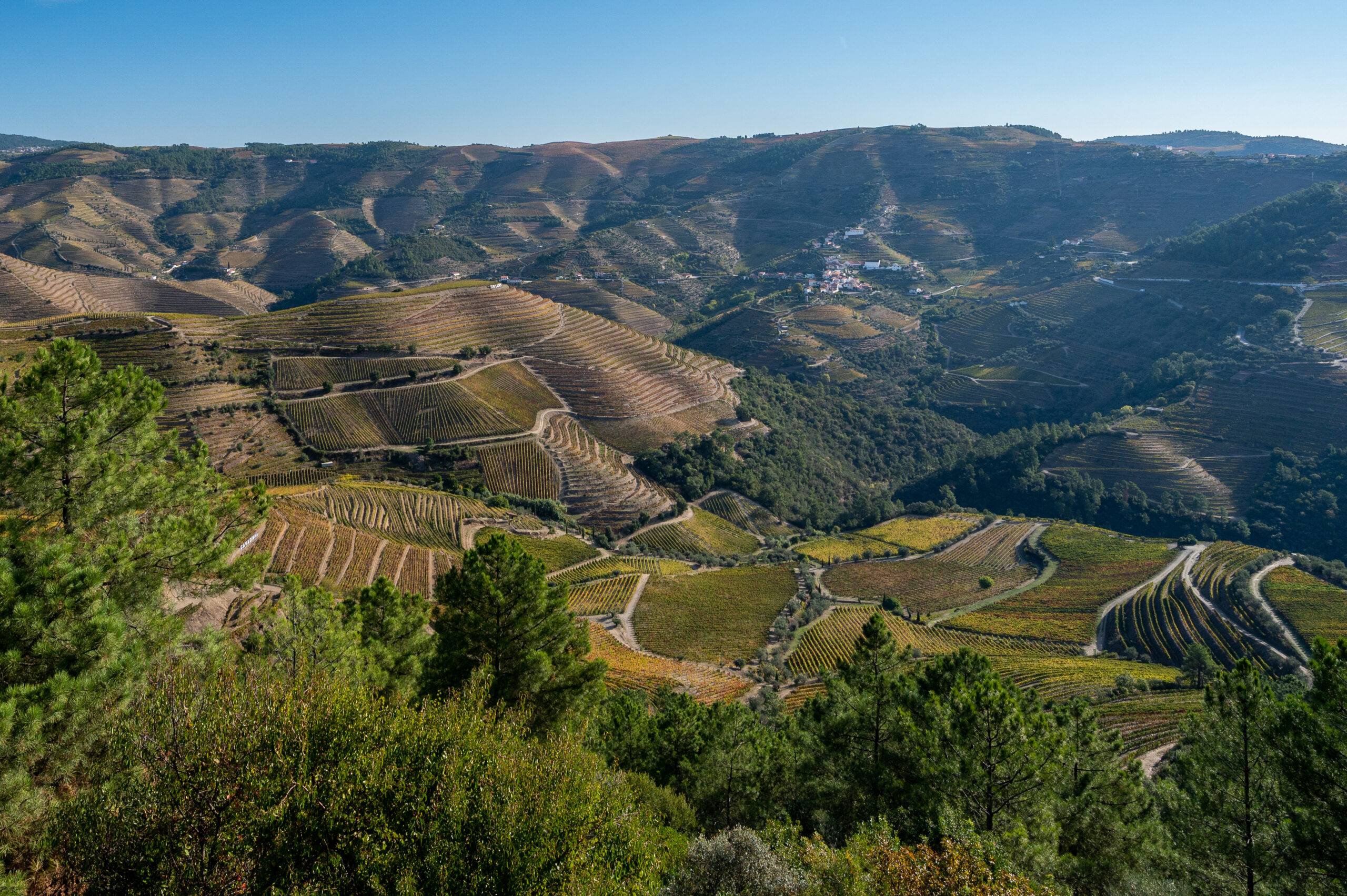
    Douro Valley Terraced Vineyards
    One of the many viewpoints along this scenic route.

    Miradouros (viewpoints)

    Make sure to pay attention to the brown signs along the road, as these are sightseeing stops. Most of the signs along this road are for the miradouros (viewpoints).  We stopped at quite a few of them, and each one had an informational sign telling us about the area’s history and the family-owned vineyards in the Douro Valley.

    I recommend at least stopping at the following four viewpoints on the way to Pinhão.

    • Aldeia Vinhateira de Provesende
    • São Cristovão
    • Vale do Pinhão
    • Terra de Fernão de Magalhães

    Pinhão

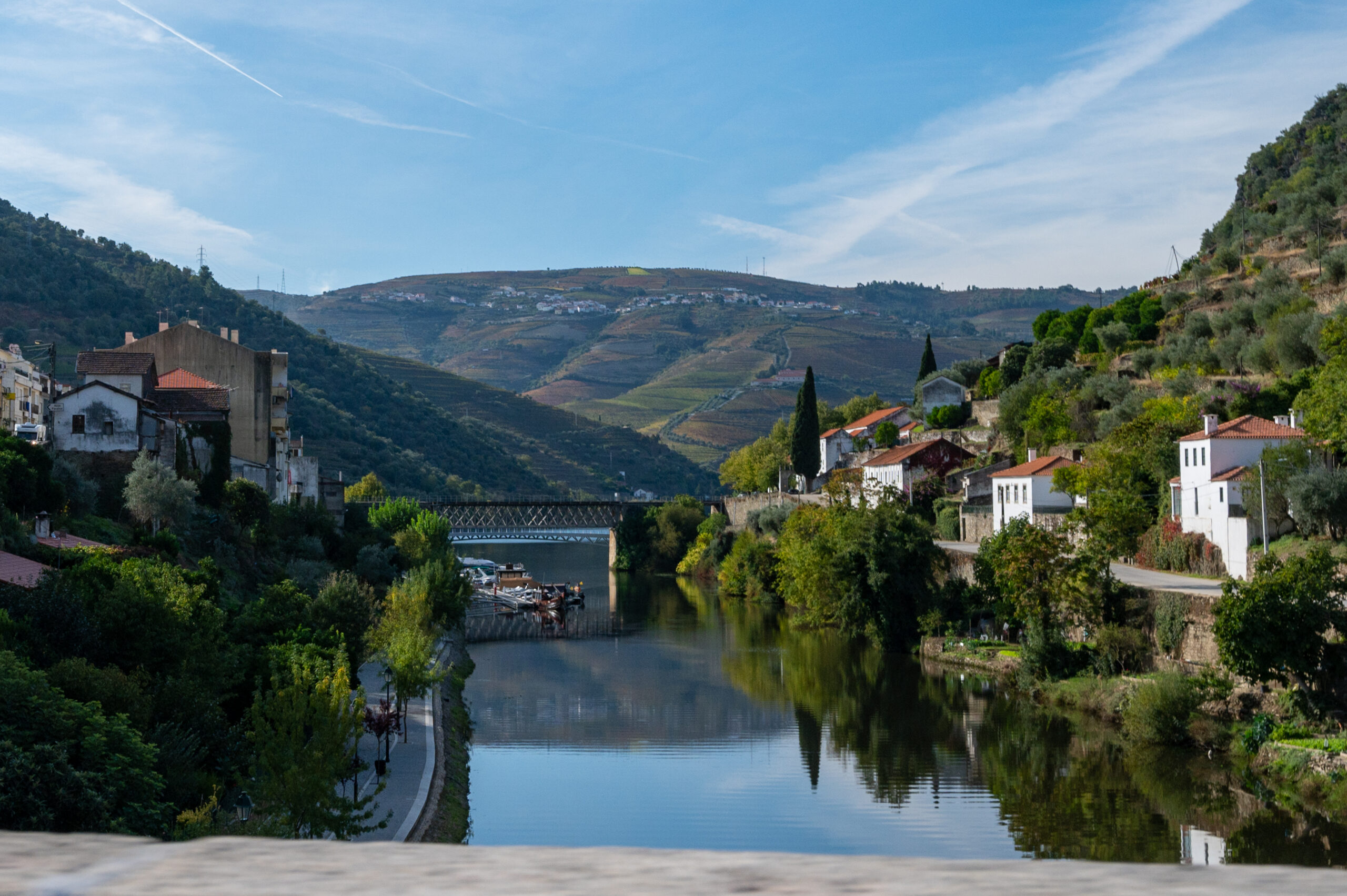
    If possible, give yourself extra time to spend in the town of Pinhão.  There is a walking/biking path that goes along the Douro River that is perfect for a scenic stroll. There are also some hiking trails through the vineyards as well as shopping, and great dining options with views of the Douro River.
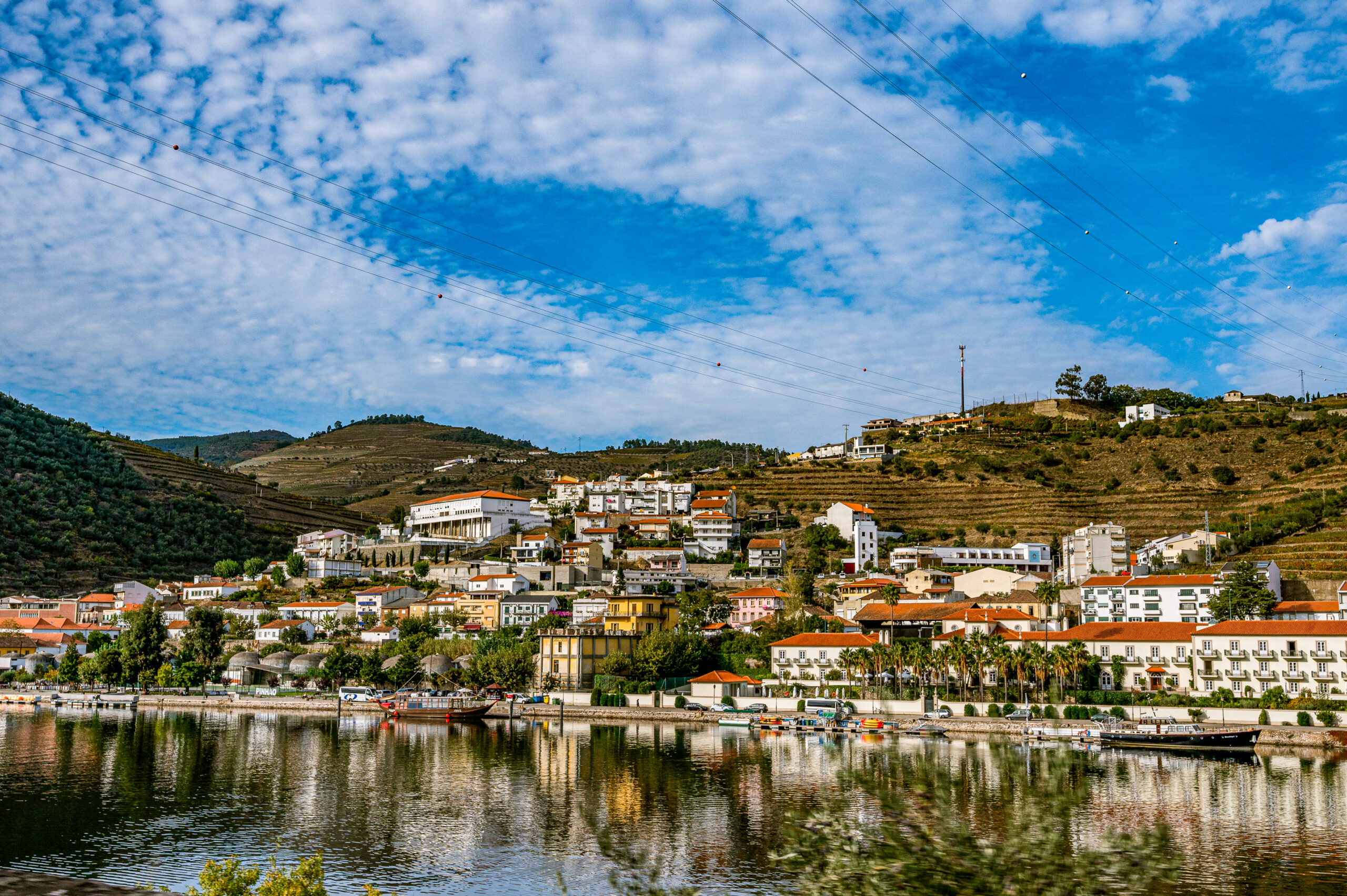
    Pinhao and the Douro River
    Driving into the town of Pinhao.

    Quinta Do Bomfim & Casa dos Ecos by Pedro Lemos

    I highly recommend you reserve a tour at the Quinta do Bomfim winery or at a minimum take the self-guided walking tour through their vineyard.  I also can’t recommend enough reserving lunch or dinner at Casa dos Ecos by Pedro Lemos. The food is superb and the view over the vineyards and the Douro River is incredible!  Read more about my visit to the Quinta do Bomfim winery and my dining experience at Casa dos Ecos.

    Quinta do Bomfim
    Quinta do Bomfim winery in Pinhao, Portugal.

    N222

    This is the scenic drive on the opposite side of the Douro River from Pinhão. Make sure to stop at the few viewpoints along this river route to soak it all in. 
    The Douro River along N222.
    The Douro River along N222.

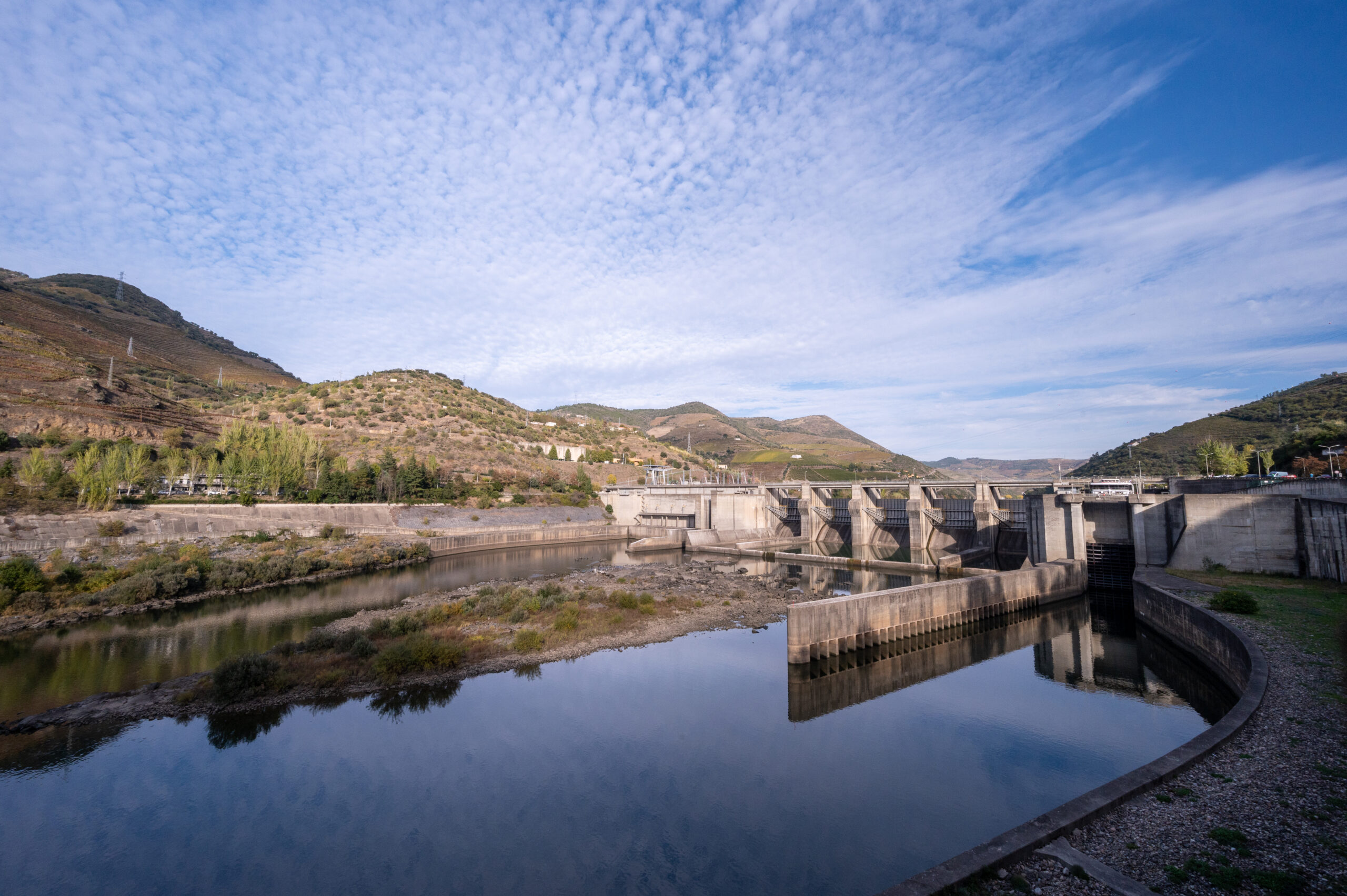
    Régua Dam Lock

    The Régua Dam is a gravity dam and makes for a quick stop along this route. You can watch the tour boats as they enter and exit through this lock on their way up the Douro River.
    The Regua Dam Locks
    The Regua Dam Locks

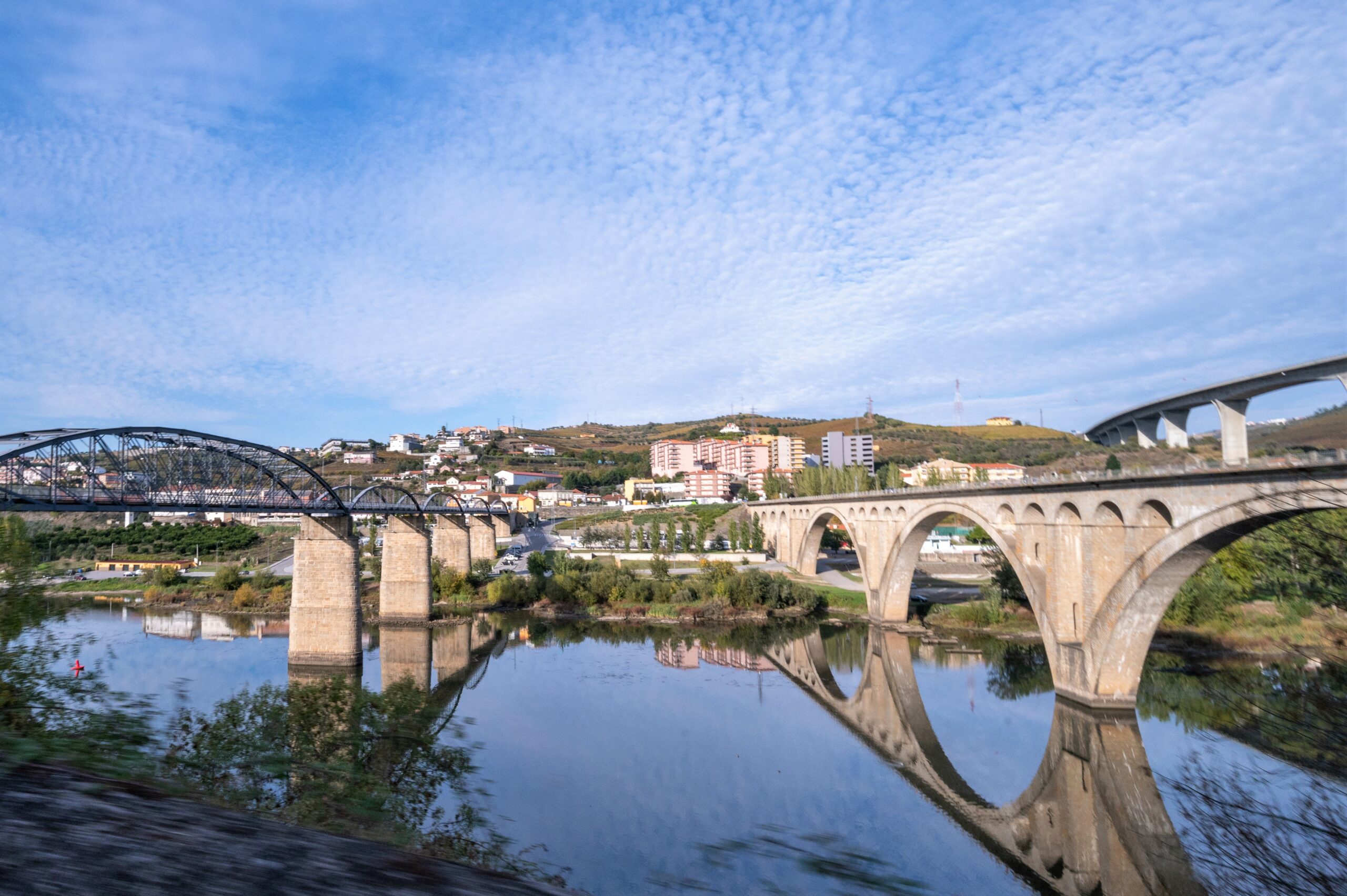
    Régua Bridges

    The three bridges outside the town of Peso da Régua are beautifully designed. One of them is a pedestrian bridge, and if you have time, I recommend taking a walk across it for stunning views of the river and bridges. It was especially beautiful when we visited in the fall.

    Regua's Bridges
    The three Regua Bridges.

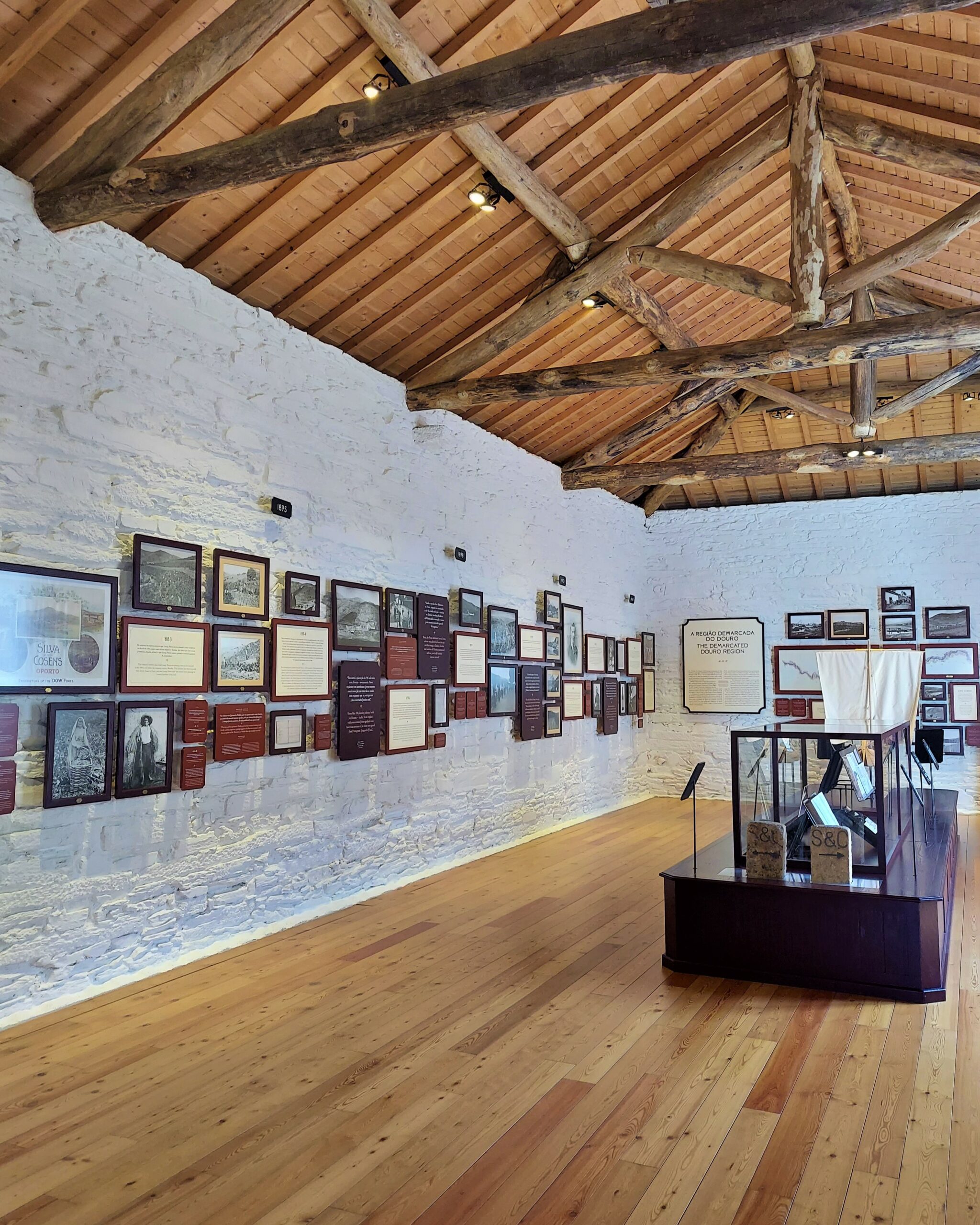
    Douro Museum

    If you want to learn more about the Douro Valley and its wine-making history then give yourself about an hour to tour this small museum. The cost of admission also includes a small port tasting.

    What Would I Do Differently on a Second Visit?

    I would spend at least one night in the Douro Valley.  Although we thoroughly enjoyed our day trip to the Douro Valley, spending a night there would give us more time to relax and enjoy a stroll along the river and perhaps do a little shopping. Plus, for anyone who loves photography, experiencing the Douro Valley at sunrise and sunset will make for some stunning photographs. 

    I would also like to explore more towns along the Douro River and perhaps make a trip further north to the town of Tua. I found this incredibly informative site that gives many options for an in-depth driving route through the Douro Valley for visitors with more time.

    The Douro Valley is such a picturesque area with a slower pace that is a nice change from the city. After staying in Porto, and learning about the cities namesake drink, it felt like a full-circle trip into the region’s history. I highly recommend a visit to the Douro Valley during a trip to Portugal.  If you’ve been, I’d love to hear what stops you made while in the Douro Valley.

    Boa Viagem!

    Additional Articles You Might Enjoy


    Note: Travelffeine is reader-supported. This post contains affiliate links. When you make a purchase using one of these affiliate links, we get paid a small commission at no extra cost to you. And as always, all opinions are our own. Thank you!

    Douro Valley Day trip Porto to Pinhao Travel Planning to Europe
    Douro Valley Day trip Porto to Pinhao Self Guided Road Trip Planner
  • Quinta do Bomfim: The Perfect Douro Valley Winery Tour

    There are an overwhelming number of choices for Douro Valley winery tours, and when you only have one day to spend in the Douro Valley, it becomes even harder to decide which one to visit. We chose Quinta do Bomfim for our day trip from Porto to Pinhão, and we couldn’t be happier with our choice!  

    If you’re considering a day trip from Porto to the Douro Valley and want to visit a family-owned vineyard, I highly recommend you consider Quinta do Bomfim. Our one day spent in the Douro Valley was a highlight during our two-week road trip in Portugal, and it was largely due to our visit to Quinta do Bomfim.

    Why We Chose Quinta do Bomfim

    We chose Quinta do Bomfim for a couple of reasons. One, it was in Pinhão, which we read was one of the prettiest towns along the Douro River, so we chose it for our day’s destination. We also chose Quinta do Bomfim based on reviews and its choices for tours. It offers self-walking tours of the vineyard, port, and wine tasting tours and a picnic option on their terrace overlooking the Douro River.  It was easy to book online and communicate with them via email.

    Tour Options:

    Quinta do Bomfim offers four main tour options when visiting their winery.
    1. Guided Winery Tour and Tasting (You get to choose which tasting selection you prefer, port only, or port and wine.)
    2. Guided Tour Only (no tasting)
    3. Picnic on the Terrace (includes a meal, wine, and port)
    4. Vineyard Self-Guided Walking Tour (Includes a hat, map, and bottle of water.)
    Quinta do Bomfim

    Our Quinta do Bomfim Tasting Tour

    The tour starts in the main lobby. You check in at the front desk, where you make your final tasting selection and pay. Since we arrived 30-minutes early, we decided to walk through their vineyards. They gave us a map, and we followed the information signs, which are color-coded according to the length of time the trail route takes.

    The main lobby also has a lot of information regarding the history of Quinta do Bomfim and the Symington Family wineries.  They own several, and you can tour many of their other wineries, too, should the opportunity arise. 

    Our guide, Marta, met us in the main lobby and took us outside to begin the tour. Marta did a great job of giving a complete picture of all that goes into owning a vineyard and getting your ports and wines certified.  She also gave a good overview of the difficulties in growing grapes in this rocky terrain and the limitations of using modern equipment given the terraced landscape.  

    Quinta do Bomfim Main Lobby

    Storage & Processing

    After a short overview of the vineyards, and the certifications involved in running a winery, Marta took us inside the building where they press and store the grapes to prepare them to become wine or port.  It was interesting to learn of the different processes for making both port and wine.  

    Marta also told us how they still adhere to the old traditions of pressing the grapes with their feet.  Due to recent restrictions, they had to revert to using machines only, but they plan to pick up the tradition of stomping grapes once again when it is possible.  

    The Tasting

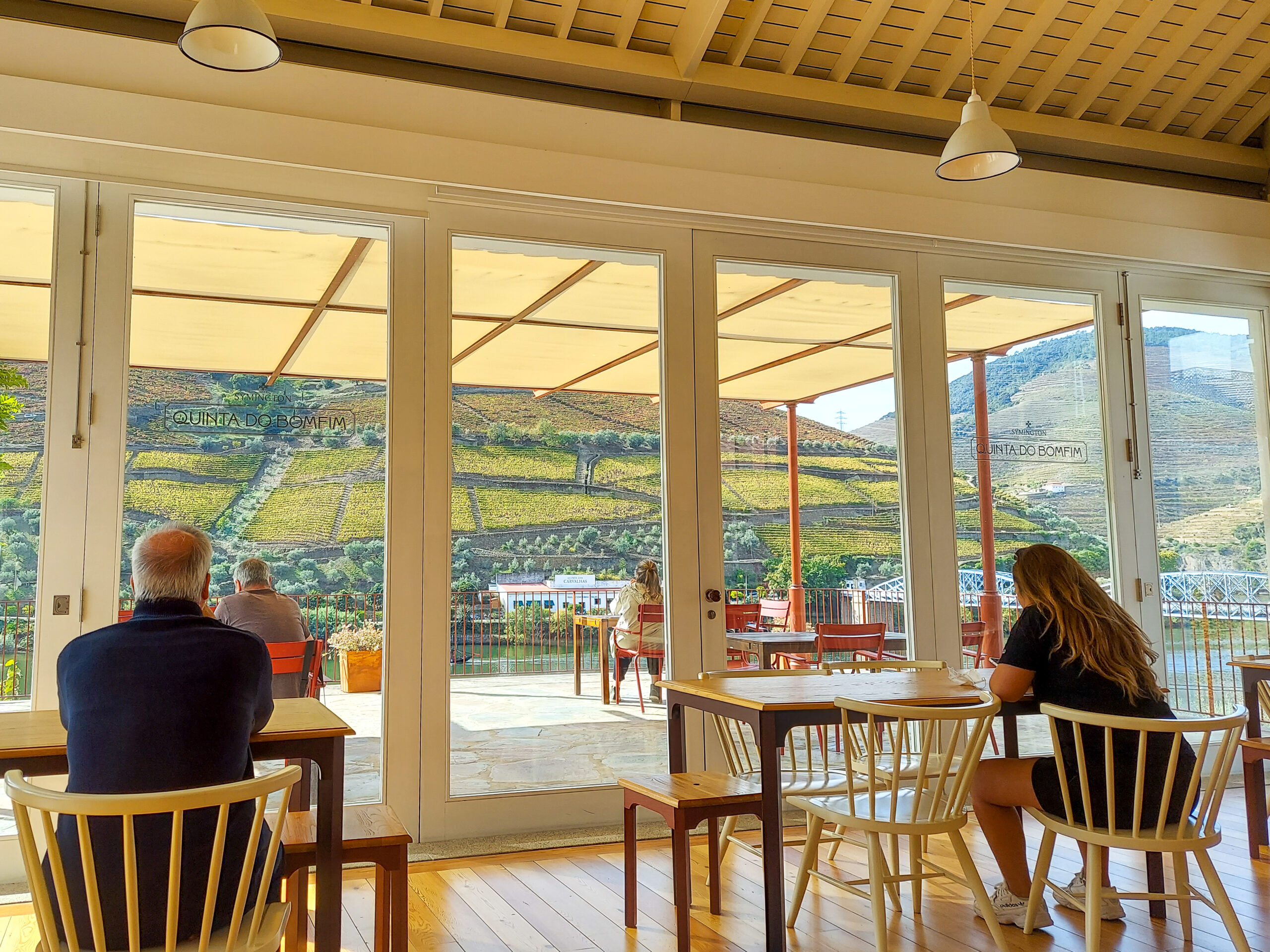
    After the tour of the wine-making facilities, Marta took us back to the dining area for our tasting. We were in the indoor section, and those who purchased the picnic option sat outside on the terrace overlooking the Douro River. I loved the design of the rooms on the Quinta do Bomfim estate. Many of them had beautiful wood beam ceilings and lots of natural light. It is a lovely space to sit in and soak in the surroundings. 

    It’s also worth noting that they provide the best quality wines and ports for their tastings. I read reviews on other wineries that sounded like some offered lower-quality ports for their tastings.

    It was an informative tour, and a peek behind the scenes into a global industry. At the end of our tour, I had a greater appreciation for the work that goes into making a bottle of wine or port. It is a more in-depth process than I knew, and although I am not really a wine or port drinker, I appreciated the care this family-owned winery took to create a quality product. 

    So, whether you consider yourself an oenophile or not, I think if you’re someone who is curious and loves learning new things, you’ll enjoy this tour. 

    Quinta do Bomfim's wine tasting room looking onto terrace

    Self-Guided Vineyard Walking Tour

    You can take a self-guided walking tour in addition to a tour of the winery or on its own if you prefer to skip the winery or tasting tours. Whatever you decide, spend at least 15-minutes walking one of the shorter paths in the vineyard at Quinta do Bomfim.  They did an excellent job creating a map of trail options in their vineyard. 

    We loved our walk through the vineyard! It was great to go at our own pace, taking photos and soaking it all in. Along the way, they have signs that tell you more about the region’s history.  These were informative, and I was impressed with the organization of their walking paths. I enjoyed learning about the history of the rugged landscape that is now so famous for its wines and ports.

    The vineyard walk combined with the winery tour gave us a complete picture of life on a Douro Valley vineyard. Don’t skip it!

    Eating at Casa dos Ecos by Pedro Lemos

    In addition to your reservations to tour, Quinta do Bomfim, make sure to book reservations for Casa dos Ecos by Pedro Lemos. This incredible restaurant with its Michelin-rated chef sits on a hill above the Quinta do Bomfim winery. You drive up to it via the winery’s private road. 

    Dining at Casa dos Ecos is equally as memorable as touring Quinta do Bomfim. You get an incredible view of the valley below and the Douro River. In addition to 5-star views, you will experience top-notch service and an outstanding meal.

    We enjoyed a meal of oven-baked cheese for our starter and roasted kid and roasted beef rib along with seasonal vegetables cooked outside in a traditional wood stove. For dessert, the perfect ending to our meal was the delicate and fragrant orange cake made with oranges grown on the property.

    This was the best meal we had during our two-week road trip in Portugal. We are still talking about it, and the wonderful day we spent in the Douro Valley. I highly recommend you make reservations to experience it yourself!

    Tips for Visiting Quinta do Bomfim

    As I mentioned, make sure to make reservations in advance. Contact them directly if you have any further questions not answered on their website.

    Give yourself at least two hours to arrive at Quinta do Bomfim when driving from Porto. If you want time to stop and take photos on the way, then I suggest you leave 3-4 hours before your reservation. This gives you plenty of time to stop and enjoy the scenery along the way. 

    Plan to wear or pack comfortable shoes for walking in the vineyard. Also, depending on the time of year, you want to pack extra water bottles for the drive and any hiking you may do. Snacks for the road are always a good idea, as well as sunglasses, hats, and sunscreen. It can get very hot in the Douro Valley during the summer months.  In the fall, when I visited, it was still relatively warm during the day but cool enough in the morning and evening to wear a light sweater or scarf.

    Read about my experience driving to Pinhão for more help when planning your day trip from Porto to the Douro Valley.

    Additional Articles For Planning a Trip to Portugal

    town of Pinhão
    Douro Valley Day trip Porto to Pinhao Road Trip
    Quinta do Bomfim Pinhão Portugal Winery Tour
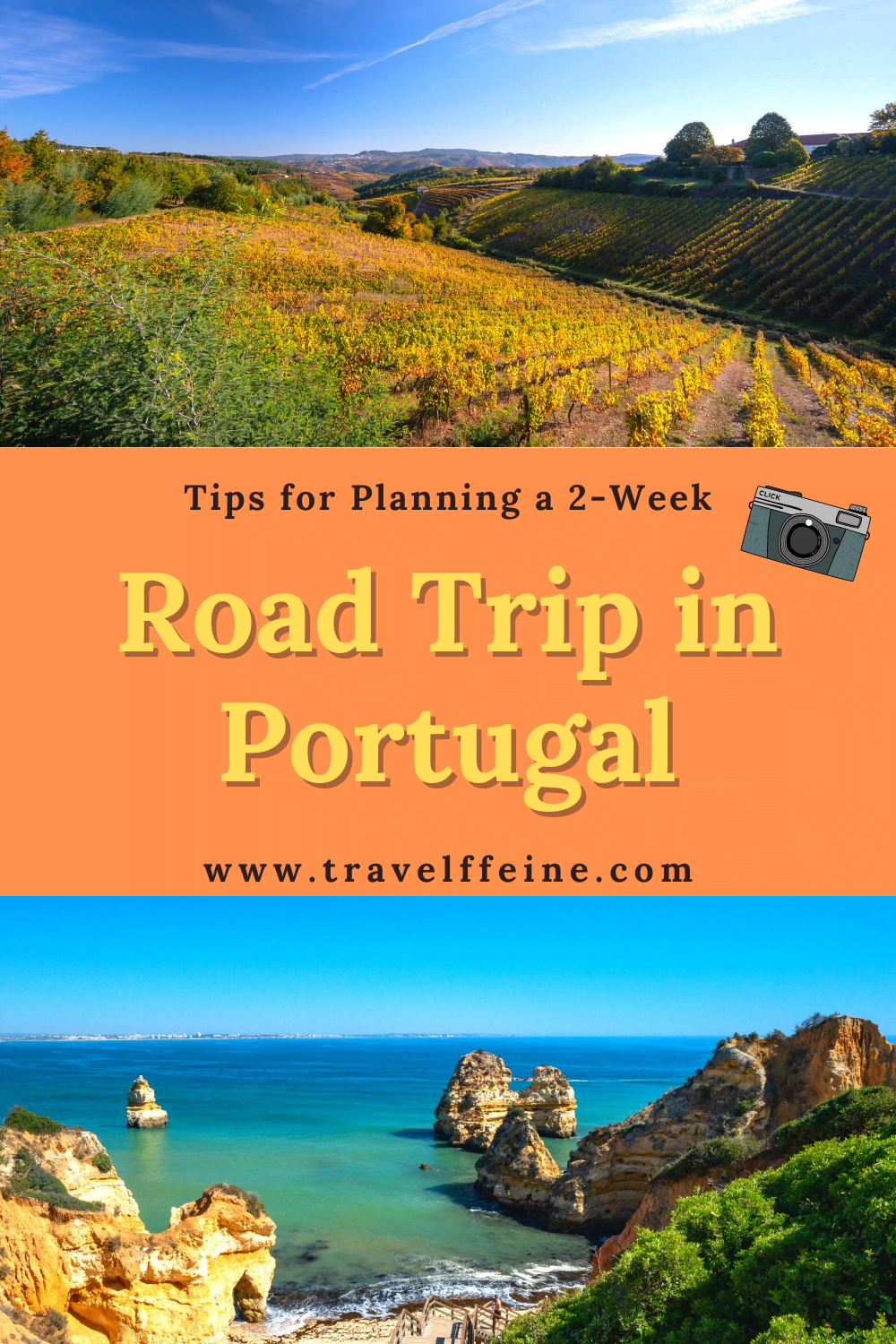
  • Tips for Planning a Two Week Road Trip in Portugal

    This 2-week road trip in Portugal outlines a route using three base locations from which to take day trips, thus minimizing the need to frequently change accommodations.  You need a rental car, and you will also want to make sure each of your accommodations has parking. Read 5 Tips for Renting a Car and Driving in Portugal to learn more tips for your road trip in Portugal. 

    If you’ve never visited Portugal, it really should be at the top of your list. It is one of the sunniest destinations in Europe, and it has fantastic food, gorgeous scenery, and historic cities. There is something for everyone!

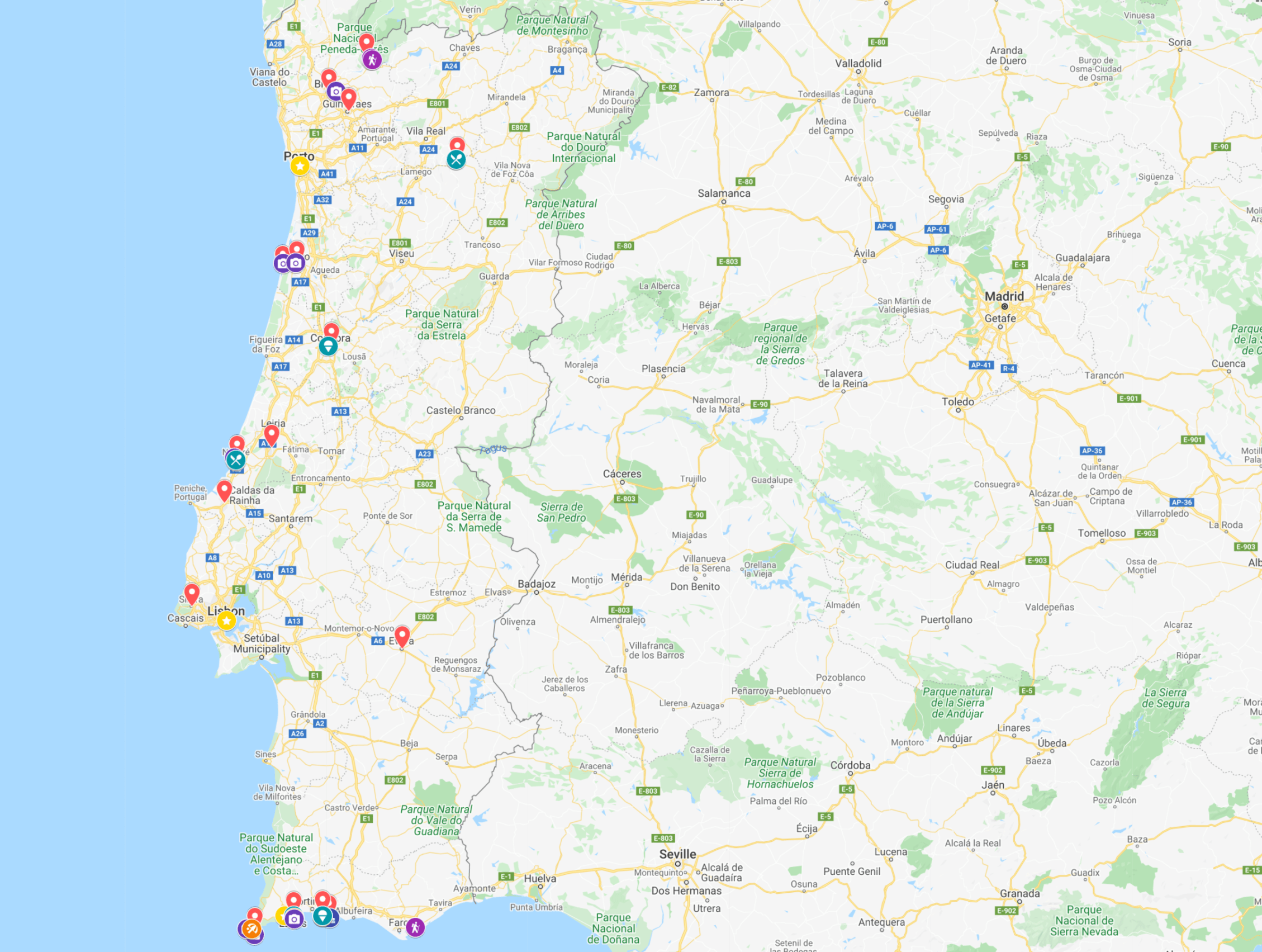
    2-Week Road Trip in Portugal – Map of Destinations

    Planning a Road Trip in Portugal

    I planned this two-week road trip in Portugal with a minimal amount of accommodation changes. This trip was a vacation with my hubby, who prefers longer stays vs. 1-2 night stays before switching accommodations. It creates a more enjoyable experience when we’re not checking in and out of AirBnbs or hotels every day or two.  

    So with that in mind, I broke up our road trip in Portugal into three sections.  Using this method, I created three main bases from which we could then take day trips.

    Three Base Locations in Portugal

    1. Lisbon
    2. Luz (the Algarve)
    3. Porto

    Using these cities as our base of operations, I created a list of activities, points of interest, and day trips we could take from each of these three locations. I listed all possible day trips I was interested in, knowing that we might not get to all of them. 

    Additionally, I did not list out every possible attraction in each of the day trip locations. You need to research which options you’re most interested in and plan your day trip around those.  You can see the main highlights in a full day or pick out a few favorites if you only want to spend a half day.

    Below I list out the approximate one-way travel times from each city to the listed day trip options. Depending on what sites you want to see in each city will determine whether you’ll want to spend a half-day or a full day at each. Some of the options are close enough to each other you can combine two or more for a full day trip experience.

    Lisbon Day Trips

    • Batalha Monastery (2 hours from Lisbon)
    • Evora (1.5 hours from Lisbon)
    • Nazaré (2 hours from either Lisbon or Porto)
    • Óbidos (Castelo de Óbidos) (1.5 hours from Lisbon)
    • Sintra (1 hour from Lisbon)

    Luz Day Trips

    • Lagos (15 minutes from Praia da Luz)
    • Benagil (35 minutes from Praia da Luz)
    • Carvoeiro (35 minutes from Praia da Luz)
    • Sagres (30 minutes from Praia da Luz)
    • Ria Formosa Nature Park (1 hour from Praia da Luz)

    Porto Day Trips

    • Douro Valley (Pinhão) (2 hours from Porto)
    • Peneda-Geres National Park (2 hours from Porto)
    • Braga (1 hour from Porto)
    • Guemeres (1 hour from Porto) (30 min from Braga)
    • Coimbra (1.5 hours from Porto)
    • Aveiro/Costa Nova (1 hour from Porto)

    Tip: Look for the large brown road signs with drawings on them, these are Portugal’s tourist attraction signs.

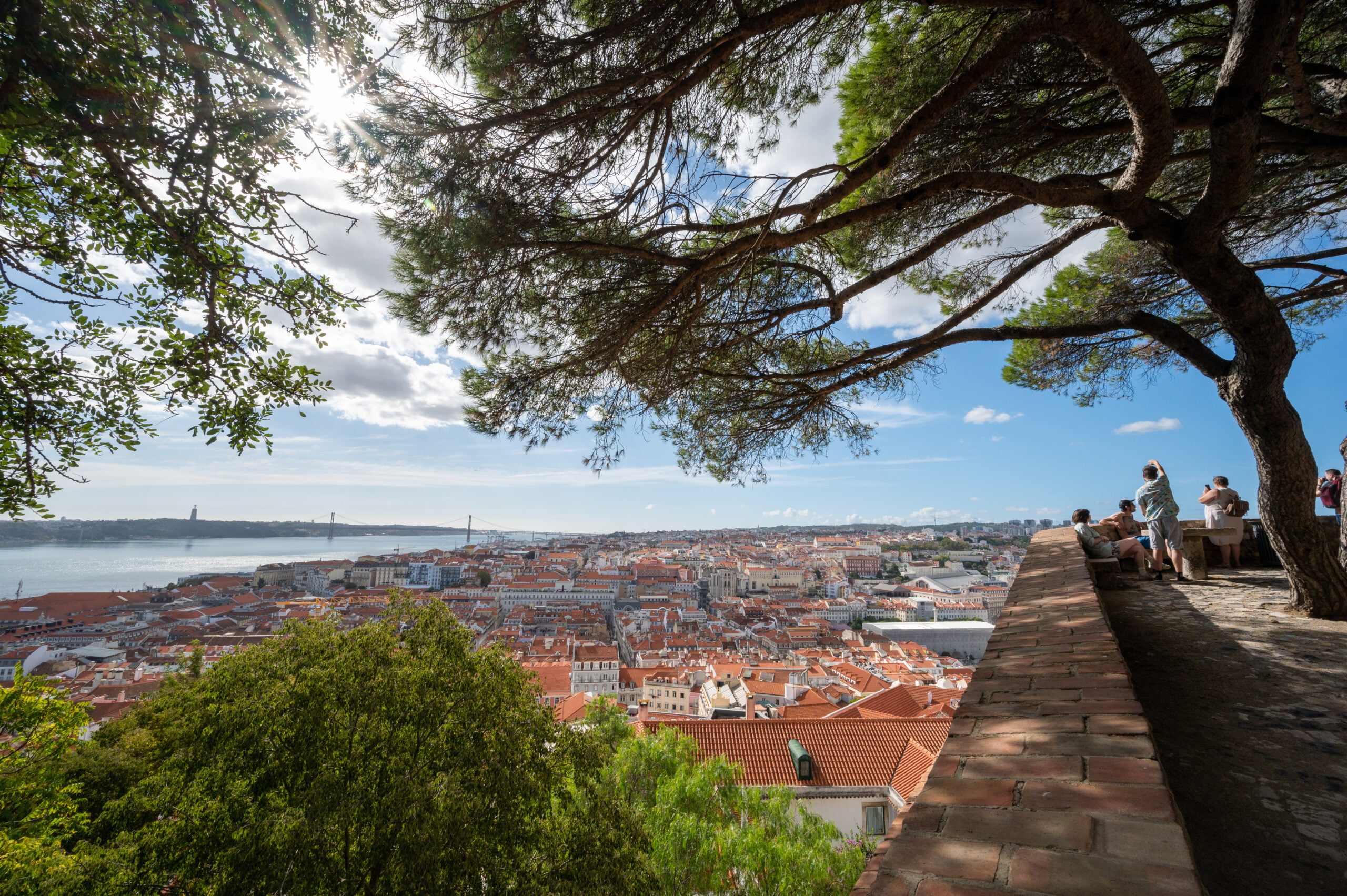
    Viewpoint at Sao Jorge Castle Lisbon

    Our Road Trip in Portugal: Final Route & Experience

    We had a connecting flight in London Heathrow before arriving at Lisbon’s Humberto Delgado Airport. I planned ahead and made sure to have all the necessary entry documents and negative-test results.  

    This is all uploaded before departure, but if you can, printing the documents out is helpful at check-in. 

    Travel requirements are constantly changing, so make sure to look at the updated requirements before you travel. This includes requirements for traveling to a new destination and also for returning home.

    Lisbon (3 nights)

    Portugal is 8 hours ahead of Washington’s Pacific Standard Time (PST). So I planned our initial arrival in Portugal to be a relaxing transition to the new time zone. We stayed in Lisbon three nights and enjoyed a leisurely pace of sleeping in, seeing the sights in Belém where our Airbnb was located, and then also spending a day exploring Lisbon on foot.

    Belém

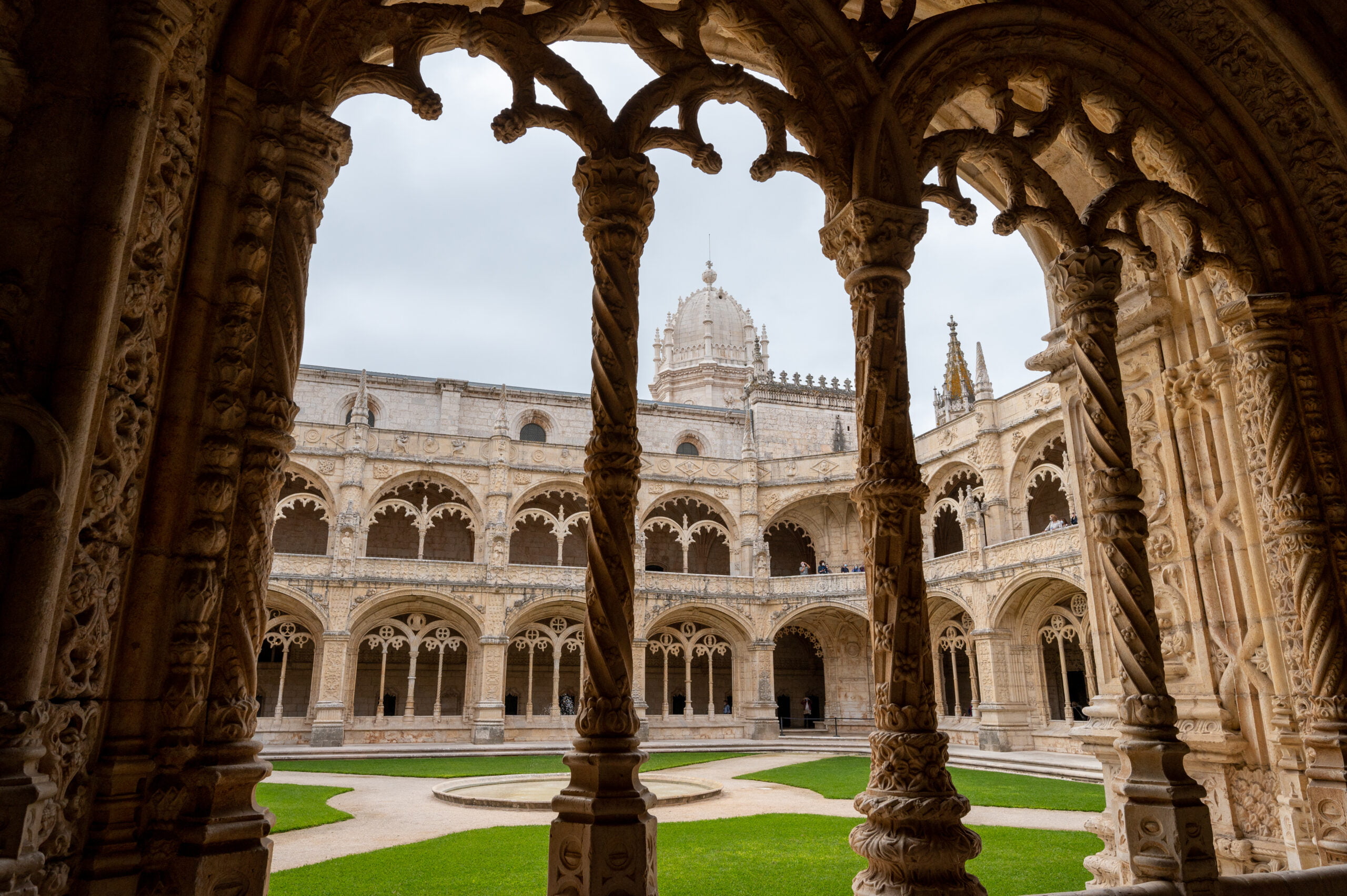
    Jerónimos Monastery in Belém was one of the few places I visited on a previous trip to Lisbon that I knew I wanted to return to with my hubby.  He wanted the trip to include new experiences for both of us, but there were a couple of things I knew he had to see and do.  

    One was visiting the Jerónimos Monastery, and the other was eating pastéis at Pasteis de Belém, then we walked to the Tower of Belém. The Tower of Belém was closed for renovations at the time of our visit, however sitting on the stairs in front and listening to the street musicians play while the waves rolled in made for wonderful travel memories.  Afterward, we visited the Museu Coleção Berardo, a modern art museum close to the Jerónimos Monastery.

    Jeronimos Monastery Belem Lisbon
    Inside the Jerónimos Monastery.

    Alfama

    We took in the views at Castelo de São Jorge, walked around the Alfama neighborhood, and ate gelato pops at Popbar. When you visit this area, make sure to try their passionfruit (maracujá) bar, it is incredible! The woman explained that they make all their gelato and sorbet in-house, and the fruit bars are made of 80% real fruit!  No wonder it tasted like eating a fresh passionfruit–so good! 

    Also, next door is Portugalidades, a store comprised of ceramics, artwork, and other handmade products, all sourced from artisans in Portugal.  If you want real made in Portugal gifts to bring home, this store is a great place to shop!

    I visited Lisbon back in 2018 and took a day trip to Sintra on that trip.  If this is your first to Lisbon, Sintra makes a wonderful day trip option, although I’d only go if the weather is nice as it’s mostly outdoor activities. 

    Speaking of weather, we had beautiful weather our entire visit, and it wasn’t until our last full day in Lisbon that we got some rain.  Thanks to my previous visit to Lisbon, I came prepared with ideas from an earlier article I wrote on How to Spend a Rainy Day in Lisbon.

    Side trip to Sines on road trip in Portugal

    Driving from Lisbon to Luz (The Algarve Region)

    We left Lisbon around 10:00 a.m. and headed for Luz in Portugal’s Algarve region.  Along the way, we decided to jump off the freeway (E1) and take the slightly slower but more scenic route along highway A-26.  

    Side Trip: Sines, Portugal

    Around lunchtime, we stopped in the town of Sines and admired our first views of the Atlantic coastline.  Beautiful teal blue water sparkled in the sun.  

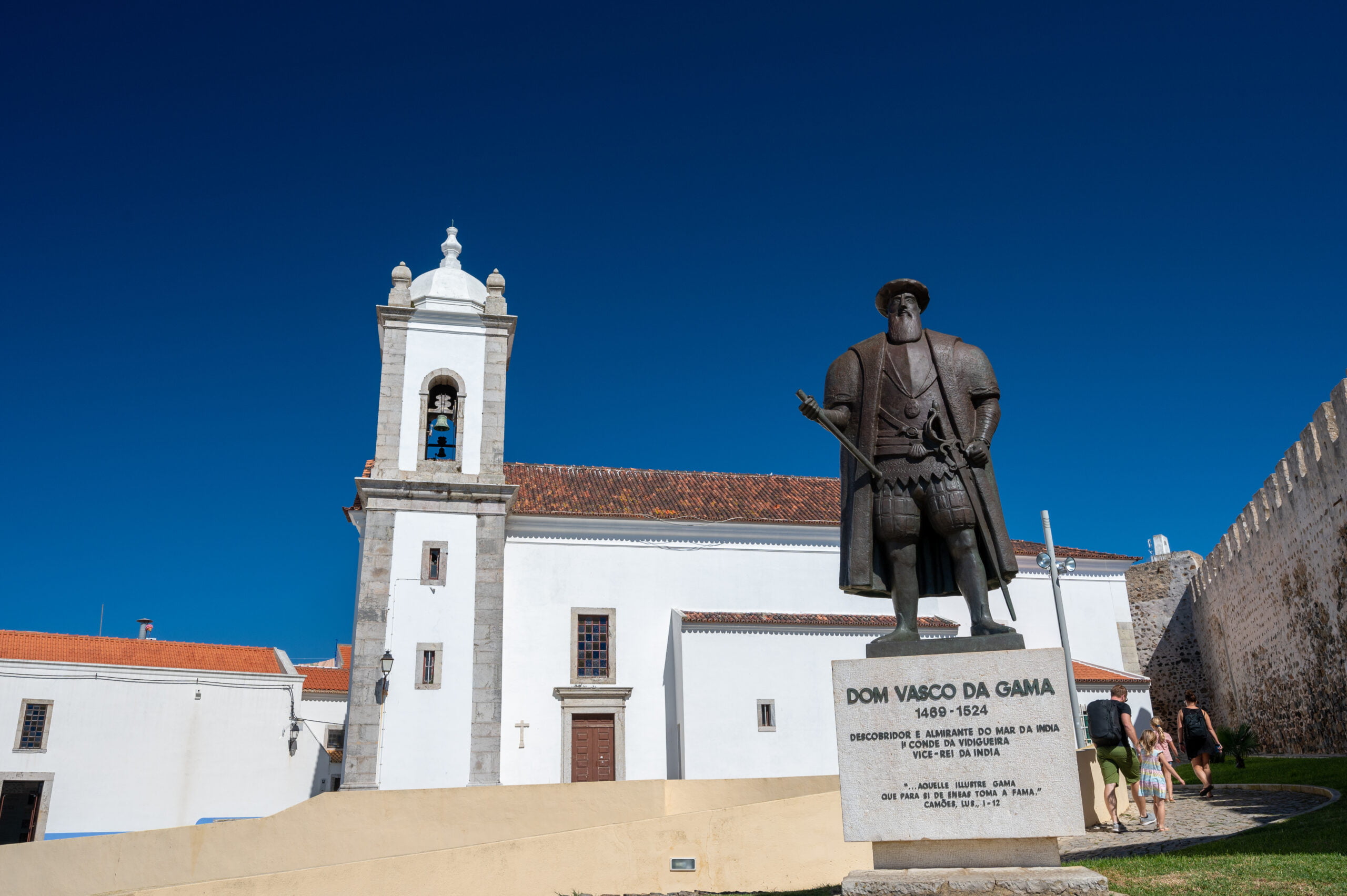
    Sines is a beautiful old town! I would love to return here and spend a night or two strolling its streets and soaking in the ambiance of this laid-back fishing town. It is also the birthplace of Vasco da Gama. You’ll find his statue near the Sines Castle overlooking the sea and the aptly named Vasco da Gama Beach.  The locals we met were so warm and welcoming.  

    The architecture and colors of this town are appealing and picturesque. It felt like a real town as opposed to a tourist destination. It’s worth a short stop on your way from Lisbon to the Algarve. 

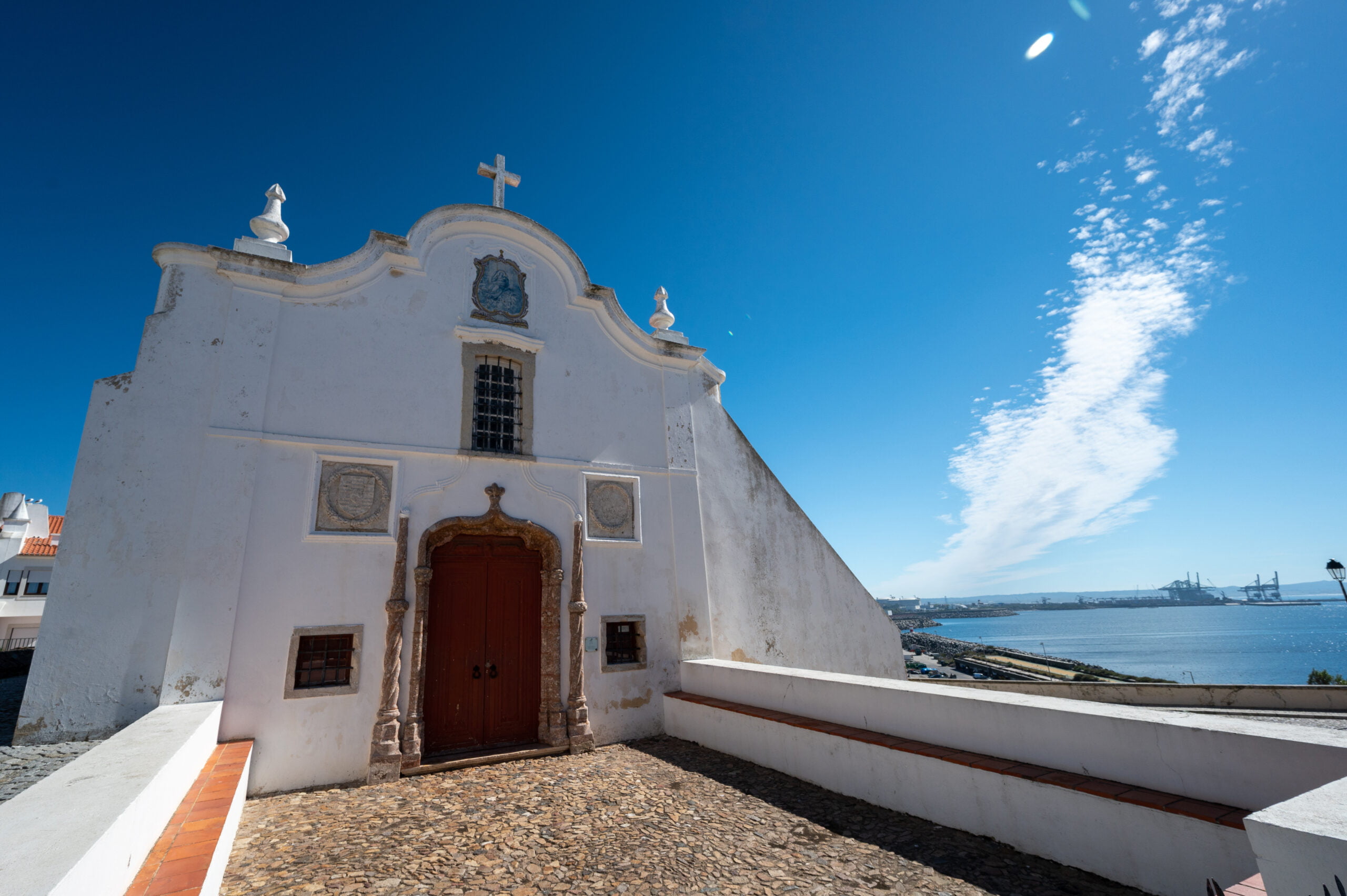
    If you’re hungry, I recommend getting a bite at Restaurante Bar Ponto de Encontro. We stopped in here for lunch during our visit, and the owner could not have been friendlier. We sampled Portuguese goat cheese and ate fried choco (cuttlefish) while enjoying views of an ancient castle and a beautiful historic church.

    With stomachs full, we left Sines and continued down the coast. We didn’t make it far before pulling off at a roadside parking area to kick off our shoes and run down the beach.  We walked in the surf and watched surfers and sunbathers enjoying the warm glow of the afternoon sun.  

    Now, with a proper amount of sand attached to our feet, we were once again ready to continue our journey to the town of Praia da Luz.  This is our base while visiting the Algarve region of Portugal.

    Vasco Da Gama Sines Portugal

    Praia da Luz (4 nights)

    We arrived at our Airbnb around 5:30 p.m. We had a self-check-in which allowed us to take as much time as we wanted to arrive. I prefer this type of Airbnb as it is one less thing to worry about when traveling.  

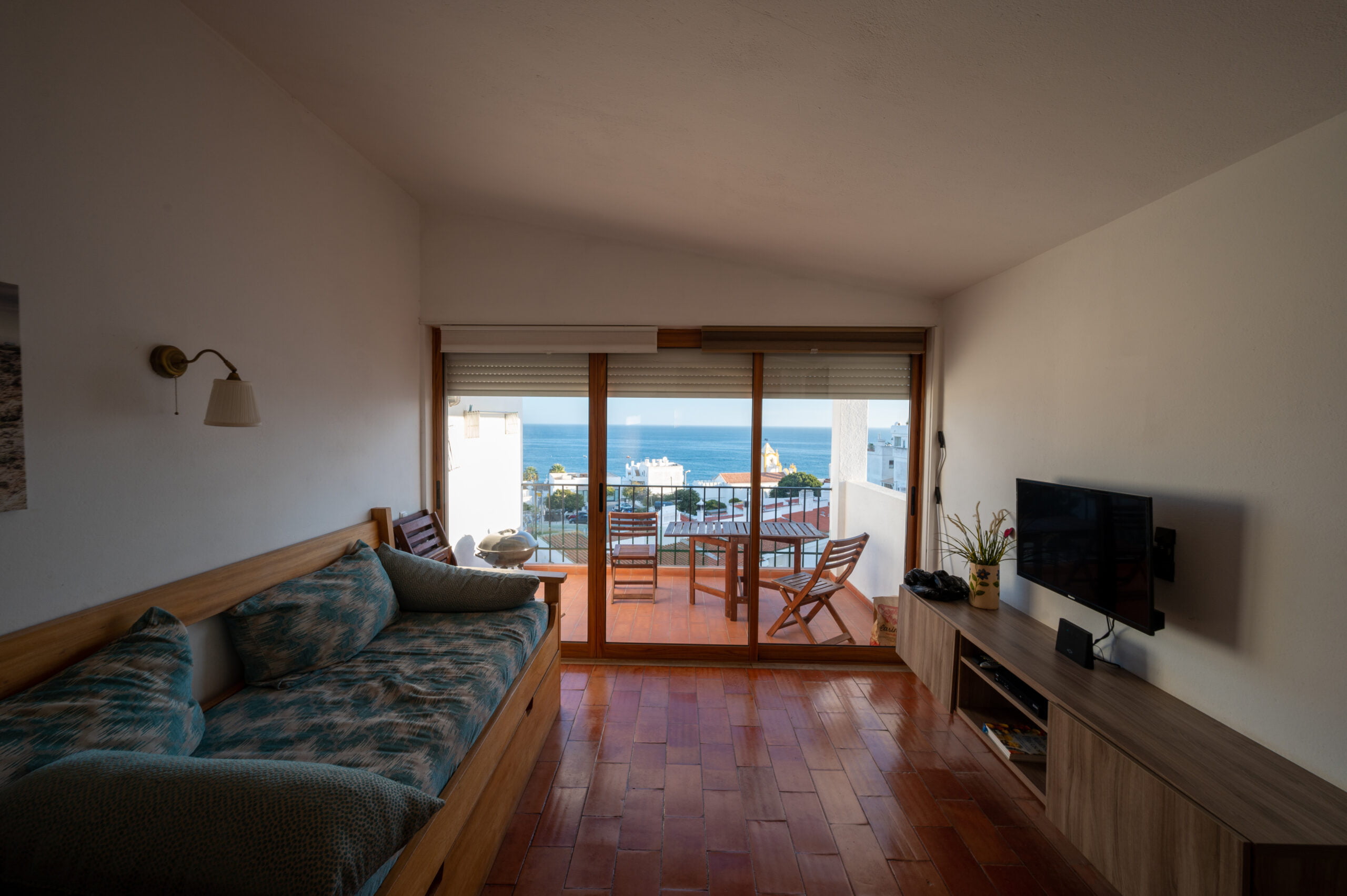
    Our Luz Airbnb was a charming two-story flat with a bedroom and bathroom on the first floor and the kitchen, living area, and balcony on the second floor.  

    As soon as we saw the view from our “lanai” (that’s what we like to call all of our vacation balconies in memory of our times in Maui), we fell in love with the place.  White buildings with red roofs and the Atlantic shimmering in the distance.  It is only a 5-minute walk from our apartment to the beach. What a beautiful base while exploring the Algarve!

    TIP: Know your check-in times and plan your route based on this. If staying at an Airbnb consider choosing self-check-in locations for greater flexibility.

    Luz Airbnb apartment
    The balcony at our Luz Airbnb was perfect for watching the sunrise and sunset.

    Algarve Day Trip: Sagres (The End of the World)

    We visited Sagres the following morning and walked around the Sagres Fortress, admiring the views of the Atlantic below us. Sagres was considered “the end of the world” or the furthest point of exploration in ancient times.  Although we know better now, it is fun looking out across the ocean and seeing only water.

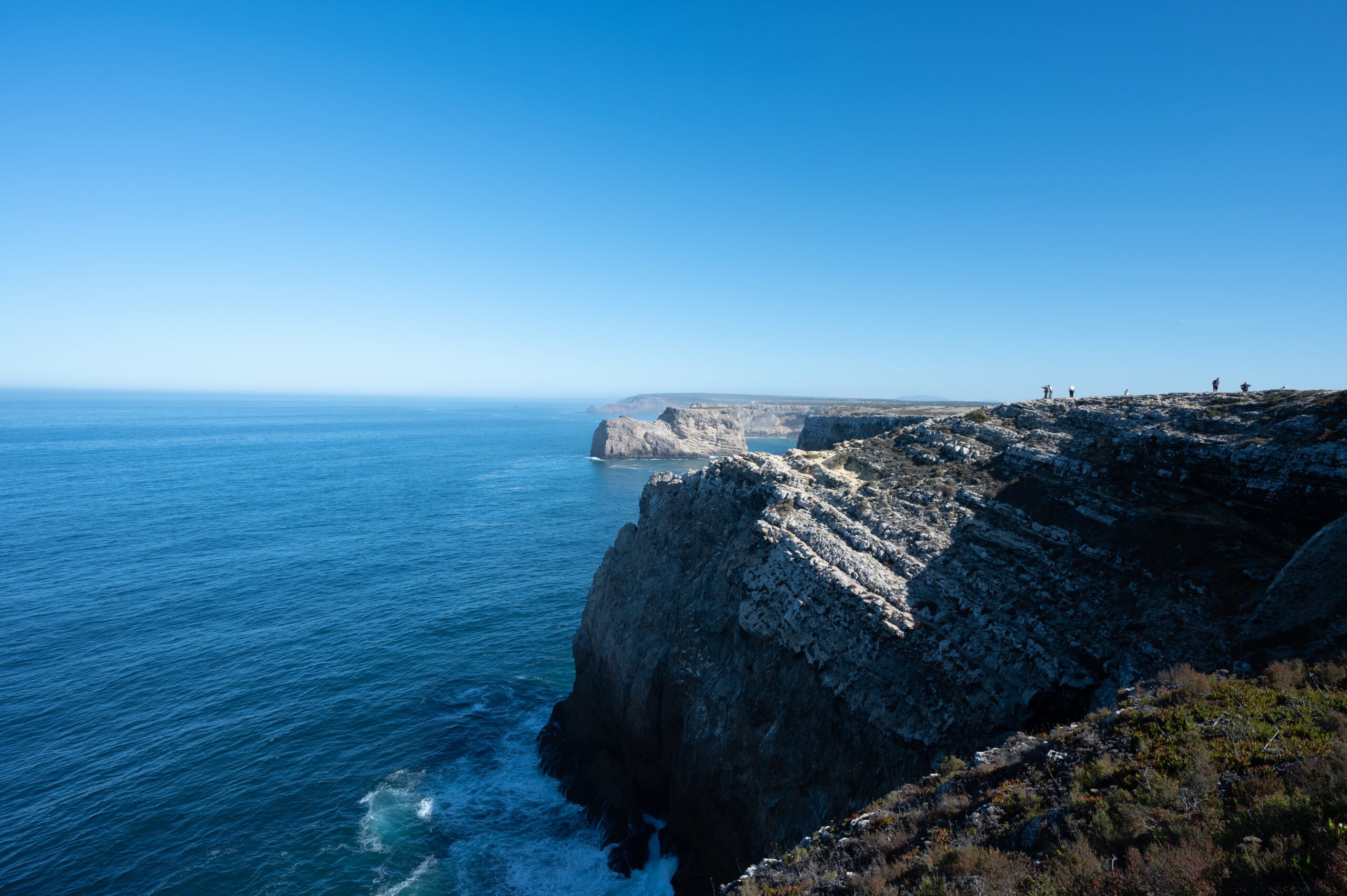
    After leaving the Sagres Fortress, we drove 3 miles to Cape St Vincent, considered the southwesternmost point of Europe. The area around the Cabo de São Vicente Lighthouse includes a couple of small gift shops, restrooms, and a small cafe. 

    Take in the views surrounding the lighthouse and imagine what it must be like on a stormy day with the waves crashing at the base of the lighthouse. It reminded me of our visit to Cape Disappointment and the pictures there of the massive waves that roll in during storm season.

    Soon, we began to feel the full force of the sun and were ready to head someplace cool, so we drove back to Luz, where we had lunch, and then headed for the beach! It was a “refreshing” swim in the Atlantic. After you are completely submerged, it feels pretty good, plus you can lay out in the hot sun, and soon enough, you’re toasty warm again. Now, this is a vacation!

    The pattern of our days in Luz was to spend the mornings exploring other parts of the Algarve and then spend the evenings in Luz.  This filled my need to explore and my hubby’s need for relaxation. When planning a trip with others, it’s always good to create a mixture of activities to suit different travel styles.

    coastline in Sagres Portugal
    The coastline views by the Cabo de São Vicente lighthouse.

    Algarve Day Trip: Lagos & Praia do Camilo

    We stopped in the town of Lagos, as I wanted to see what it was like. Many travelers to the Algarve choose to stay here, and I considered it before opting for our Airbnb in Luz. It is a much larger city with multiple beaches in the area.  Since we hadn’t eaten breakfast, we headed to Coffee and Waves, a small cafe serving locally roasted coffee. It has a surfer vibe, and we enjoyed our delicious avocado toast and peanut butter toast with bananas.

    After breakfast, we strolled through town until we ended up along the water.  It didn’t take long to realize we were out again when the sun was its hottest.  Since our beach gear was back in the car, we made a beeline for the parking garage before heading to Praia do Camilo to get a little beach time and cool off a bit.

    Praia do Camilo is a small beach that connects with another small beach through a tunnel.  You walk down a series of stairs (very common in the Algarve) to reach the first beach and then head left through the tunnel to access the adjoining beach.  We watched kayak tour groups as they explored the arches along the coastline and smiled as we watched the kids having fun digging in the sand.  Is it me, or does everyone seems happier at the beach?

    If you want more to do in the area, drive a little further down the road to Ponta da Piedade to see more beautiful rock formations, caves, arches, and a small lighthouse. Ponta da Piedade is also a popular place to photograph the sunset. 

    stairs leading to Praia do Camilo
    The stairs leading to Praia do Camilo near Lagos, Portugal.

    Algarve Day Trip: Benagil Caves & Carvoeiro

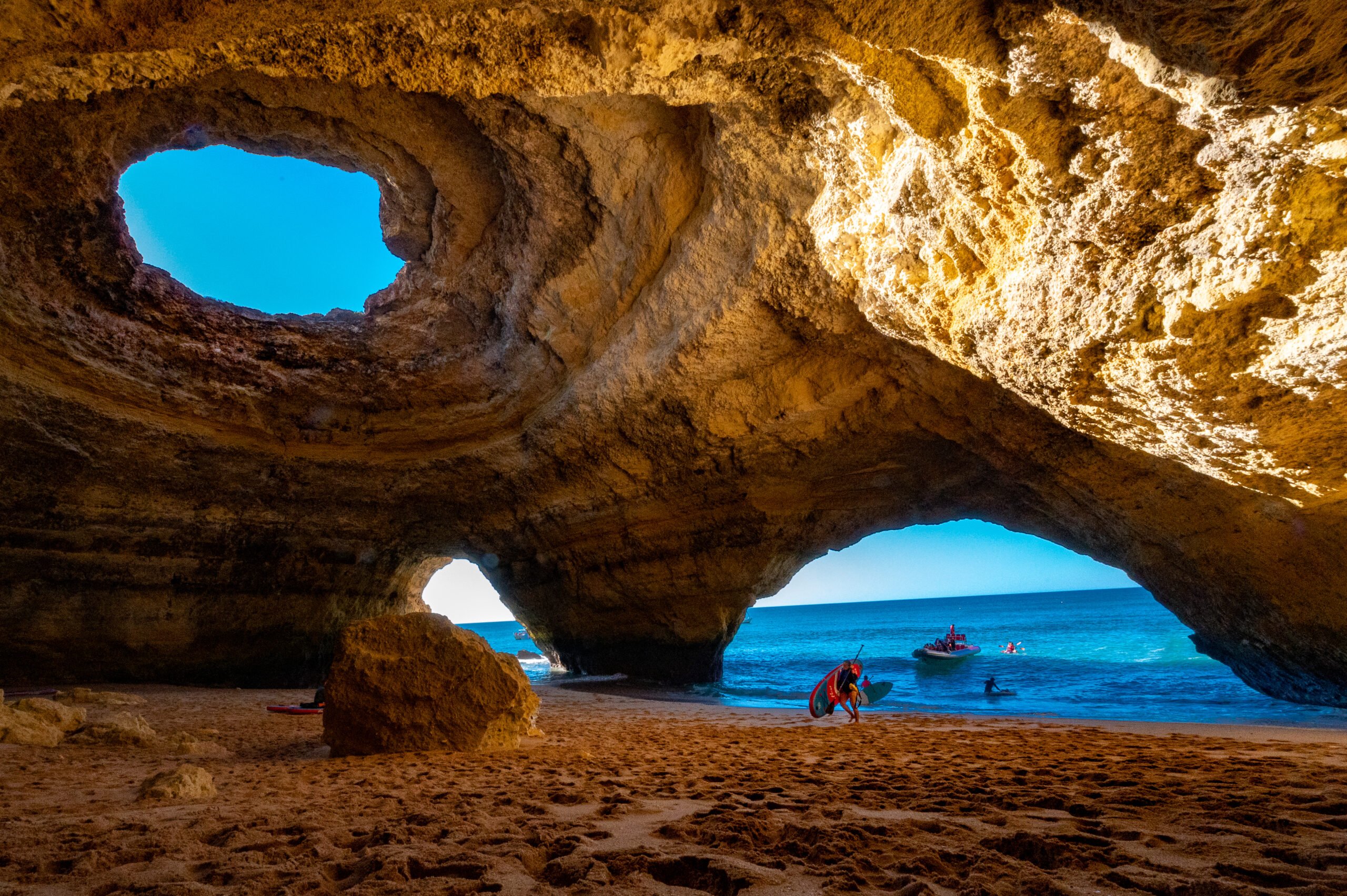
    On our last full day in the Algarve, we rented stand-up paddleboards, and SUP’d to the Benagil Caves.  We had so much fun SUP’ing to the cave. We met a woman who once lived in West Seattle, and I think she was the first American we met on our road trip in Portugal. It’s always fun to meet someone from your home area, and it reminds you how small the world really is. She gave us a few tips for things to see in Porto before she paddled back to Benagil beach.

    After taking some photos and enjoying the beauty of the cave, we paddled back to Benagil beach to return our paddleboards.  The paddleboard rental is good for 90 minutes, which is plenty of time to see the cave and even explore a little of the area around it before returning. 

    Before leaving Benagil, we walked to the far corner of the public parking area to find the trail that leads to a viewing area above the Benagil caves. The hike there was easy, and it provided beautiful views of the coastline and a unique bird’s-eye view looking down into Benagil cave. 

    “Praia” means “beach” in Portuguese, so whenever you see this on a map, you know there is a beach there.

    inside the Benagil Caves
    Inside the Benagil Caves.

    Carvoeiro

    Next, we drove to Carvoeiro to eat lunch and have more beach time. Carvoeiro is another town I considered staying at for our base while in the Algarve.  After visiting here, I want to spend a few days here on a future trip to the Algarve region.  

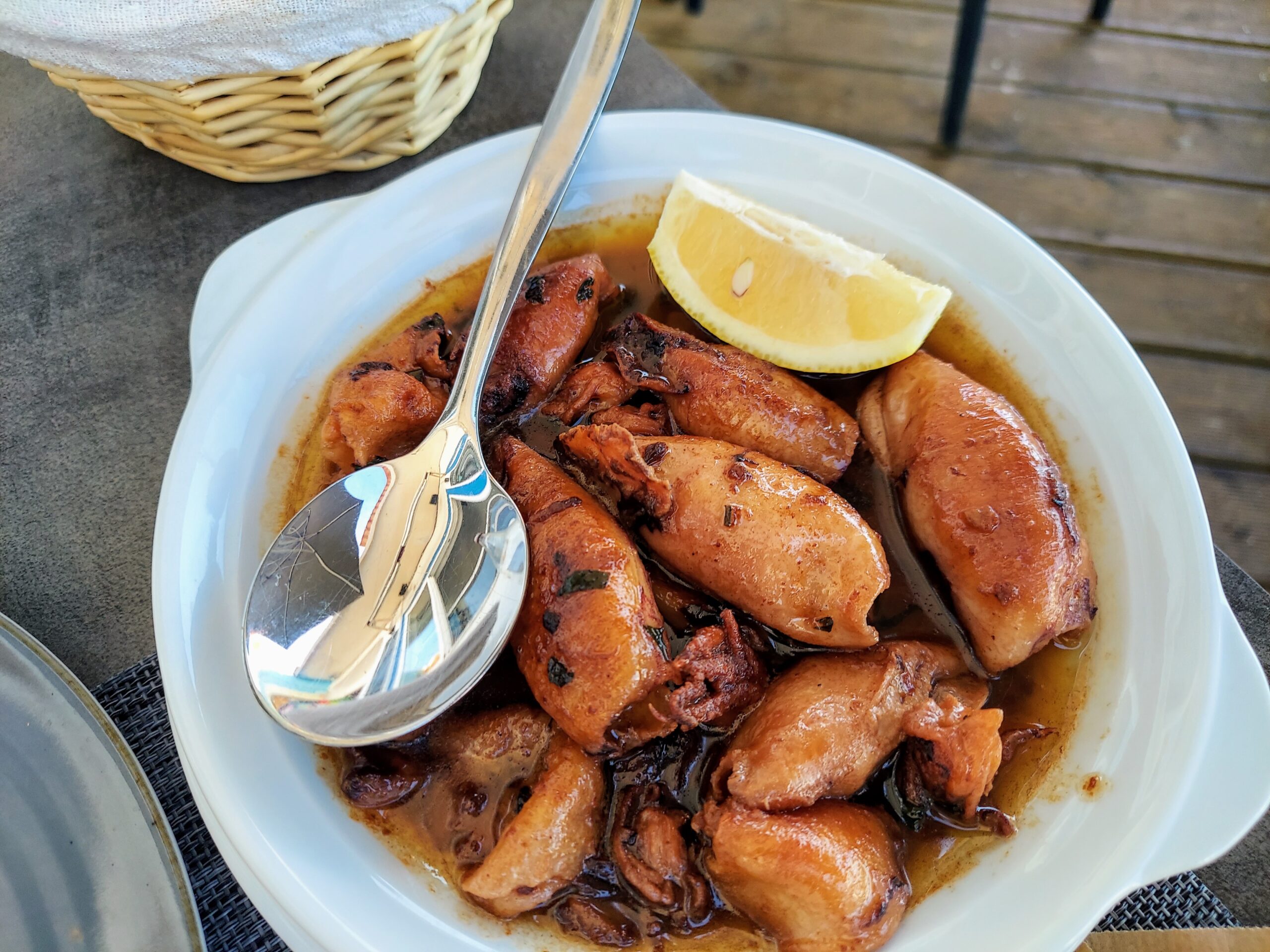
    We ate tapas at Tapas da Vila, and everything we ate was delicious! You can’t go wrong getting the oven-baked goat cheese with honey and the fried baby squid with garlic. So good! When I originally ordered them, I thought I’d get deep-fried, battered calamari rings like we find in the States. However, I got something far more delicious! I love finding new things I like while traveling. The owner and staff here were friendly and helpful; I highly recommend it!

    After lunch, we walked across the street to Praia de Carvoeiro, where we joined other sunbathers and swimmers for more time in the sun.  After a couple of quick dips in the “refreshing” water and plenty of Vitamin D, we packed up our gear and headed to the nearest gelato stand.  I got the maracuja (passionfruit) because I’m hooked on passionfruit ever since trying it for the first time in Maui last year. I was so excited to discover that the Portuguese also love passionfruit, and soon I was buying maracuja sparkling water, gelato, sorbet pops, and well, anything I could find with “maracuja.”

    Our last day in the Algarve was our favorite, but alas, it was time to move on.

    Portuguese Algarve Style Fried Squid

    Driving from the Algarve Region to Porto

    It takes about 5 hours to drive directly from Luz to Porto.  We had to meet our Airbnb host by 5 p.m., so we didn’t have as much flexibility for our drive, but we left early enough to enjoy at least one stop.  Originally I planned for us to stop in Evora, but instead, we opted to stop in Nazaré on the way to Porto.  

    A road trip in Portugal is not so different from a road trip in the States.  You have the flexibility to hop off the freeway and take the slow and scenic way if you prefer, but when you are on a time constraint, taking the highway in Portugal is a fantastic option! There is almost no traffic, and the speed limit is 120 kph/75mph. It can be a very efficient way to go while on a road trip in Portugal.

    Side Trip: Nazaré, Portugal

    There were no big waves in Nazaré during our visit, but we didn’t expect any. It’s too early in the season for the record-breaking waves, although it would have been so cool to see one!  One thing I didn’t expect was for Nazaré to be so big and crowded. It was possibly the most stressed I’d seen my hubby during our whole road trip in Portugal. The streets were narrow, and there were pedestrians to watch out for everywhere in addition to bumper-to-bumper traffic!

    We ended up driving toward the end of the Praia da Nazaré, where there was ample parking and, thankfully, a great sushi restaurant facing the beach where we could take a break from driving and eat before we both became hangry. If you stop in Nazaré, consider eating at Kabuki Sushi it was delicious!

    Afterward, you can dip your toes in the sand and walk along the pier to Farol Nazaré Pontão Norte for a view of Nazaré, the venicular, and Forte de São Miguel Arcanjo. You get a neat perspective from this side view as you imagine the legendary waves that break against it during the winter months.

    You can easily spend half a day to a full day exploring all the sites of Nazaré, but after our experience, I recommend you don’t visit on a weekend if you can help it.

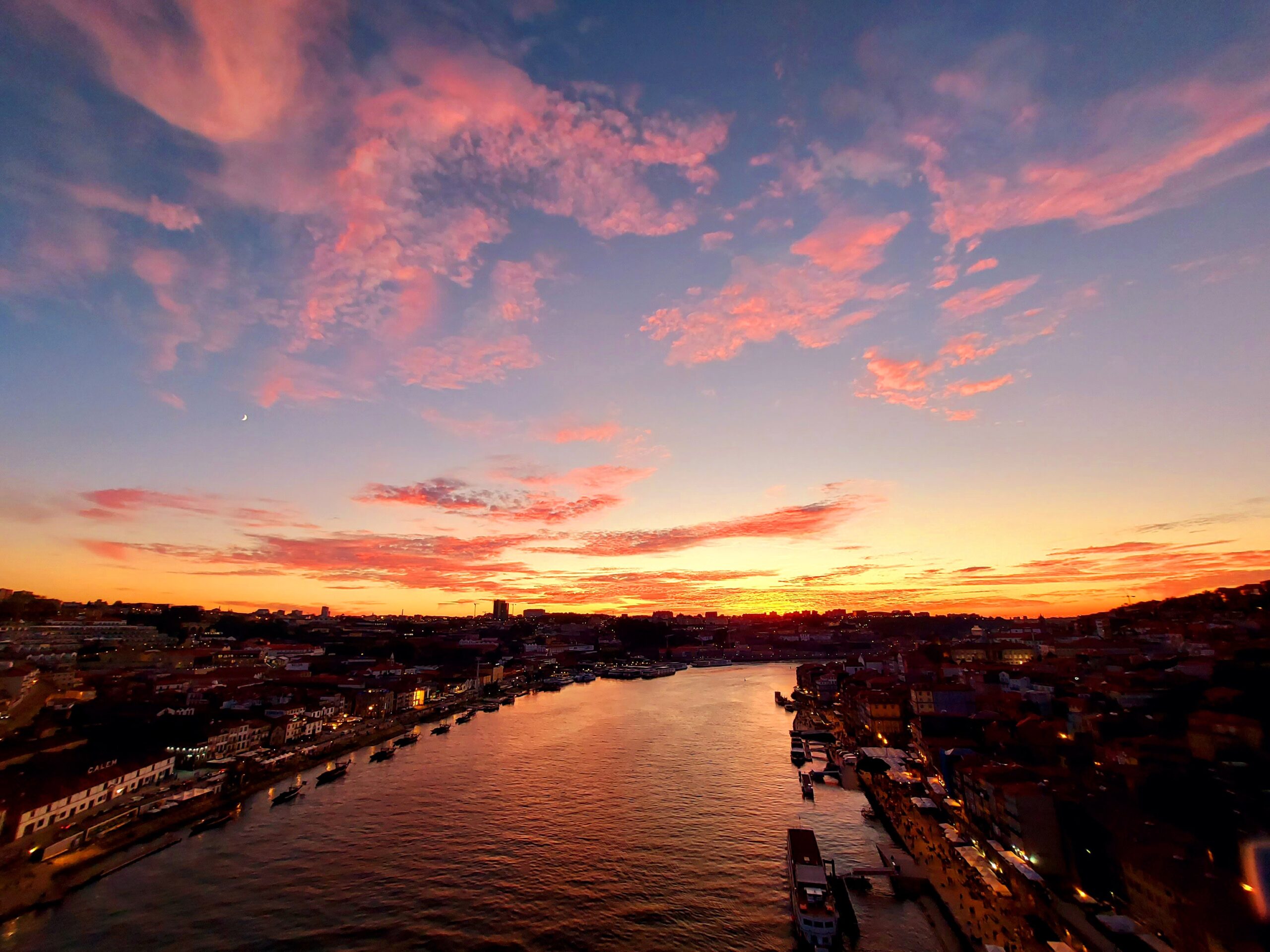
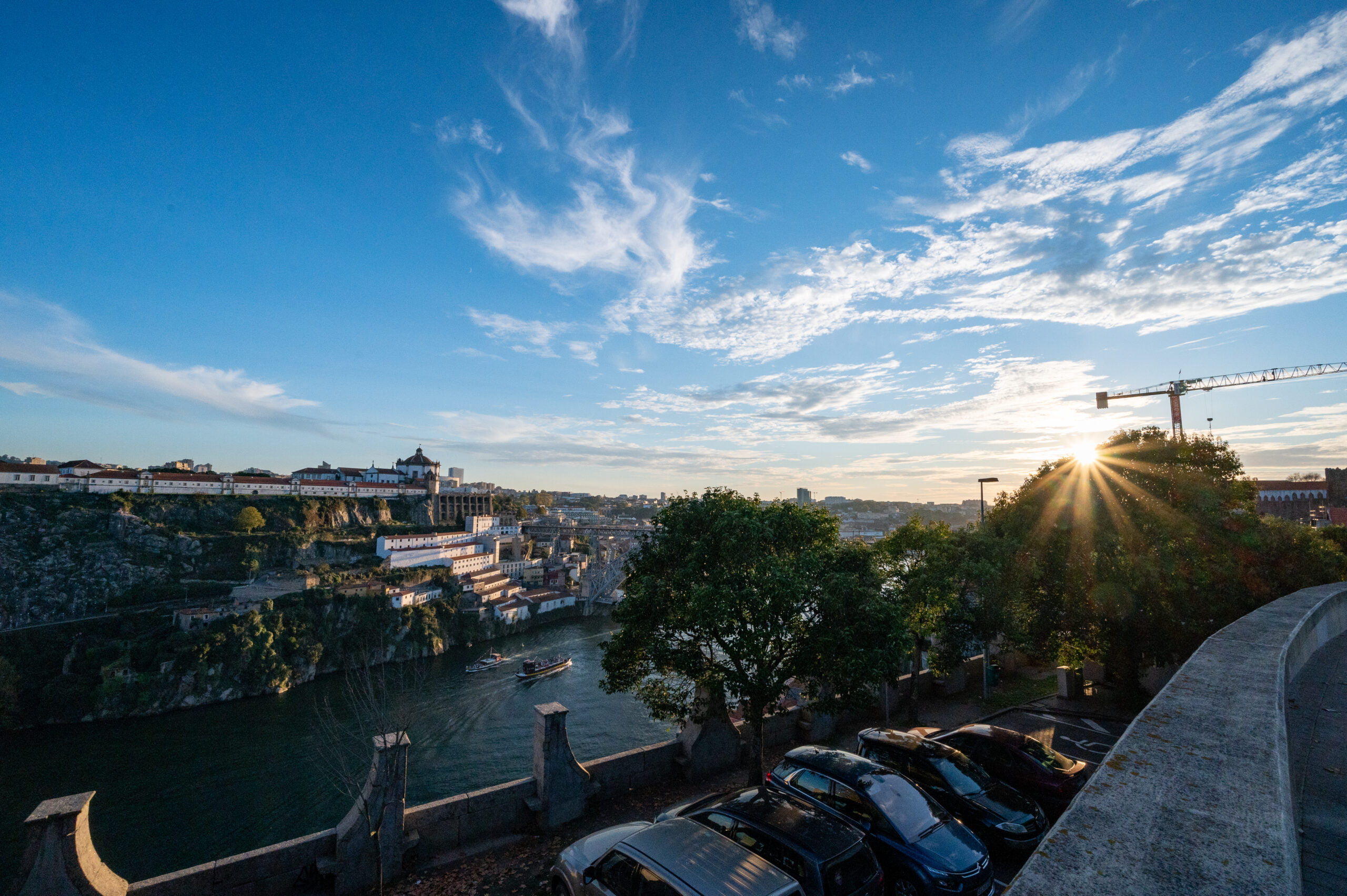
    sunset in Porto seen from Luis I Bridge

    Porto (5 nights)

    It was almost 6 p.m. by the time we checked in to our Porto AirBnb and after a long day spent in the car we were ready to explore on foot. So we walked to the Luis Bridge and joined hundreds of other pedestrians waiting expectantly for the sun to set. We heard Fado singers and sounds of music and laughter amid the hustle and bustle of the city.  I smiled as I listened to the heartbeat of this city.

    Soon the sun began to dip below the horizon.  The gorgeous oranges turned to deep reds and purples reflecting off the Douro River below.  What a perfect way to spend our first night in Porto.

    For two whole days, we walked around Porto and took in the sights and sounds of the city. We also took a short river cruise and tried our first bites of francesinha. Don’t let its appearance fool you, this is one delicious sandwich! We spent the remaining time taking day trips and enjoying evenings in Porto.

    Porto Day Trip: Peneda-Gerês National Park

    We escaped the busy city and headed toward Portugal’s only National Park, Peneda-Gerês National Park  (often referred to as Gerês). Peneda-Gerês National Park covers almost 270 sq miles and shares a border with a natural reserve in Spain.

    Side Trip: Braga’s Bom Jesus do Monte

    We made one side trip on the way and stopped to see Braga’s Bom Jesus do Monte. It was a beautiful sight to see early in the morning.  Morning runners were using the church staircase as their ultimate stair climbing machine.  Now that’s a workout!  I think this church is worth a quick stop, even if you don’t have time to explore the city of Braga.

    Braga Bom Jesus do Monte
    Standing at the base of Braga’s Bom Jesus do Monte.

    Gerês

    Shortly after entering Peneda-Gerês National Park, we had to stop our car to let a herd of goats pass on their way to graze.  They are so fun to watch!  About 15-minutes up the road from where we saw the goats, we also saw Portugal’s long-horn cachena cows. They are free-range cows allowed to graze within the national park and produce excellent beef and milk.

    The roads are narrow and winding in Peneda-Gerês National Park, and as mentioned, there are animals grazing alongside the road, so take it slow and enjoy the views. It felt like we had the park all to ourselves for most of the day!  Gerês really is a hidden gem in Portugal.

    We hiked to the Arado waterfalls and also to the Miradouro das Rocas. Miradouro means viewpoint, so whenever you see that on a map, it means it’s a viewing area, usually set high above with expansive views of the terrain below.  In this case, it is a rocky viewpoint you climb up to that provides sweeping 360º views of Peneda-Gerês National Park.

    It was nice to spend a day in nature seeing more of Portugal’s beauty.  I try to do at least one day hike whenever I’m traveling. It’s great to see the natural beauty each area of the world offers, plus I find nature to be a great way to recharge.

    Visiting Peneda-Gerês National Park on a road trip in Portugal
    I am so glad we included Peneda-Gerês National Park on our road trip in Portugal.

    Porto Day Trip: The Douro Valley

    Another day trip we took from Porto was a road trip to the Douro Valley.  This day was one of my favorites during our road trip in Portugal.  It was so beautiful to see the terraced vineyards just beginning to show their fall colors.  The terraced landscape rose from the Douro River that wound its way through the valley.

    The drive through the Douro Valley has many miradouros (viewpoints) along the way. Many of these include information boards describing the area’s history and its beginnings.

    We visited Quinta do Bomfim, a family-owned vineyard, and winery in Pinhão. We learned so much about what it took for the early farmers to carve out the terraced landscape and work the rocky land. There is so much more that goes into running a vineyard and making great port and wine than I ever realized!

    We also ate an incredible meal at Casa dos Ecos by Pedro Lemos. The restaurant sits above the Quinta do Bomfim vineyard, and it was one of the best meals we had on our entire road trip in Portugal!

    Driving from Porto to Lisbon

    Two days of day trips and two full days spent in Porto, and now it is time to return to Lisbon for our final visit before flying home. Our road trip in Portugal has come full circle.  Since we can’t check into our Airbnb before 5:00 p.m. and it only takes 3 hours to go from Porto to Lisbon, we decided to take another side trip.

    Side Trip: Aveiro and Costa Nova

    The beachside town of Costa Nova is too cute to pass up! I loved this little town with its colorfully painted houses that face the beach.  Palm trees line the promenade with a walking and cycling path that goes for miles along the waterfront. These houses, which are now primarily used as holiday getaways, were once fishing huts and storage shacks for the fisherman who lived here.  

    Just a short drive away is the town of Aveiro, where you can walk through their salt mine and learn how seawater is collected and salt harvested here each year.  I found it to be an interesting side trip.  The town is also home to the University of Aveiro, and we saw college students out walking about getting lunch and going to class. I want to come back to this town and explore it more on a future trip.

    costa nova side stop on road trip in Portugal

    Lisbon (Final 3 nights)

    We’re back in Lisbon, where we’ll spend our remaining days at an Airbnb in the Graça district of Lisbon. We returned our rental car early since we plan on staying in Lisbon for the remainder of our time. We felt even better about this decision after the taxi ride to our Airbnb. The streets in the Graca area are narrow and crowded, and it would have been a stressful drive had we chosen to keep our rental car.

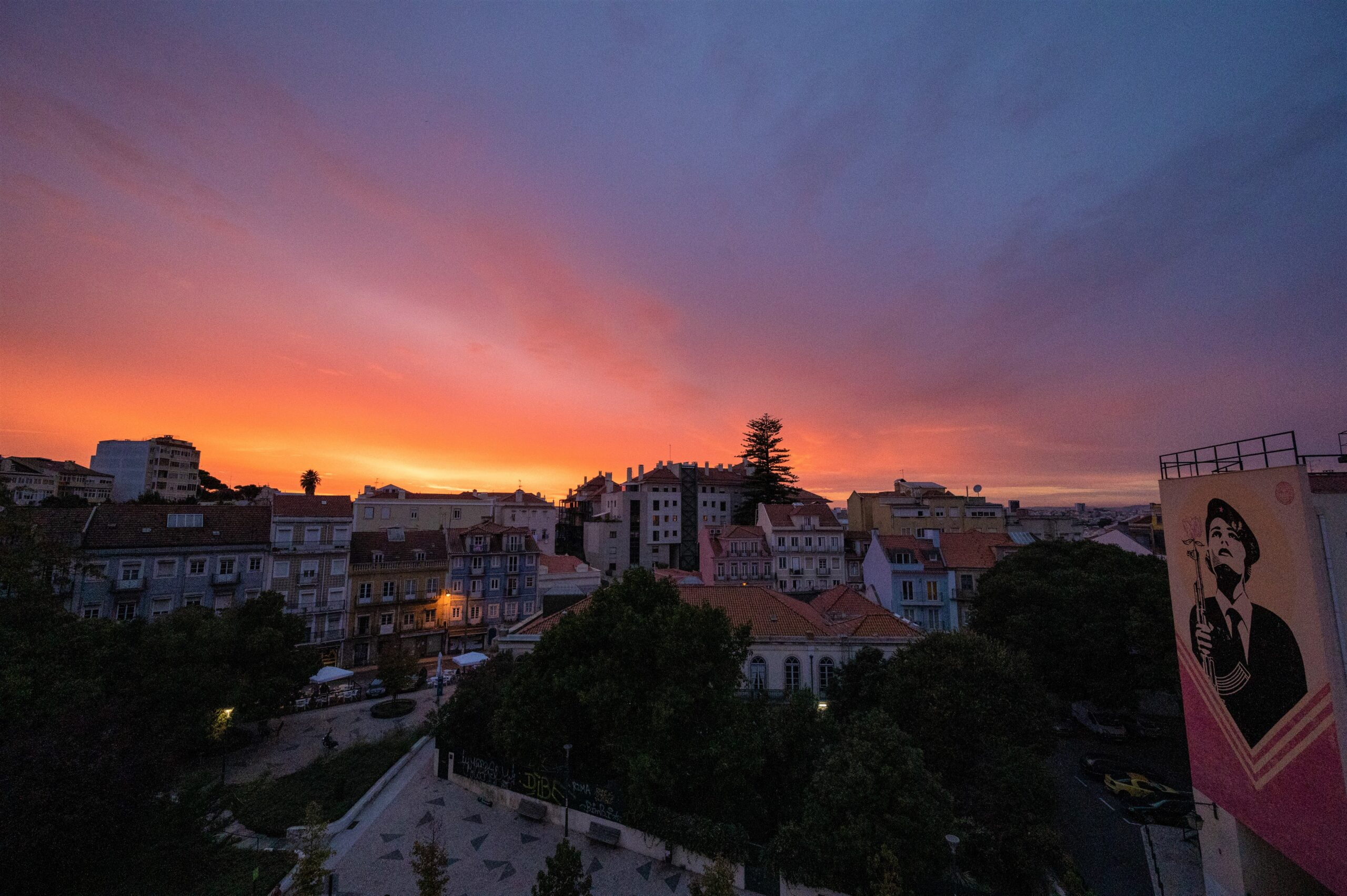
    We love the rooftop balcony at our Graça Airbnb, and we spend the evening watching the sunset, enjoying good food and good company as we listen to the city and take it all in.

    Graça is one of Lisbon’s oldest suburbs, and it sits high on a hill with many incredible viewpoints for admiring Lisbon below. The following day, we visit the Miradouro da Senhora do Monte, an excellent viewpoint with sweeping views of Lisbon and Castelo de Sao Jorge to the far left (south). 

    We explored Lisbon on foot, walking to Praça Dom Pedro IV, a popular plaza with fountains and restaurants and shops surrounding it, and wandered the streets, popping in and out of shops like this art supply store and just enjoying being out in the world again.

    That’s really what this trip is about for us. It is our first international trip in two years, and we are so grateful we could come. We stop at the Fábrica Coffee Roasters for a light lunch and coffee.  I recommend you stop here if you’re ever in Lisbon.  They have a good selection of coffee, and the staff is incredible!

    Sunset in Lisbon's Graça neighborhood

    Closing Thoughts on a Road Trip in Portugal

    With only two weeks, we didn’t hit all the stops on my “day trips” list. I would love to have walked the ancient walls around Obidos and seen the church made out of bones in Evora, but I’ll save that for another visit and instead focus on all I did get to see. 

    You rarely get to “see it all.” Chances are you’ll want to return to Portugal after your first trip. Plus, did I mention they have a whole group of islands to explore? Yep, the Azores islands look like a tropical paradise; they are next on my list to see when I return to Portugal. As another trip ends, I savor the memories made and look forward to those yet to be created.

    Boa Viagem!

    Note: Travelffeine is reader-supported. This post contains affiliate links. When you make a purchase using one of these affiliate links, we get paid a small commission at no extra cost to you. And as always, all opinions are our own. Thank you!

    More Articles That Might Interest You

    Tips for Planning a Road Trip in Portugal
    2-week road trip in Portugal
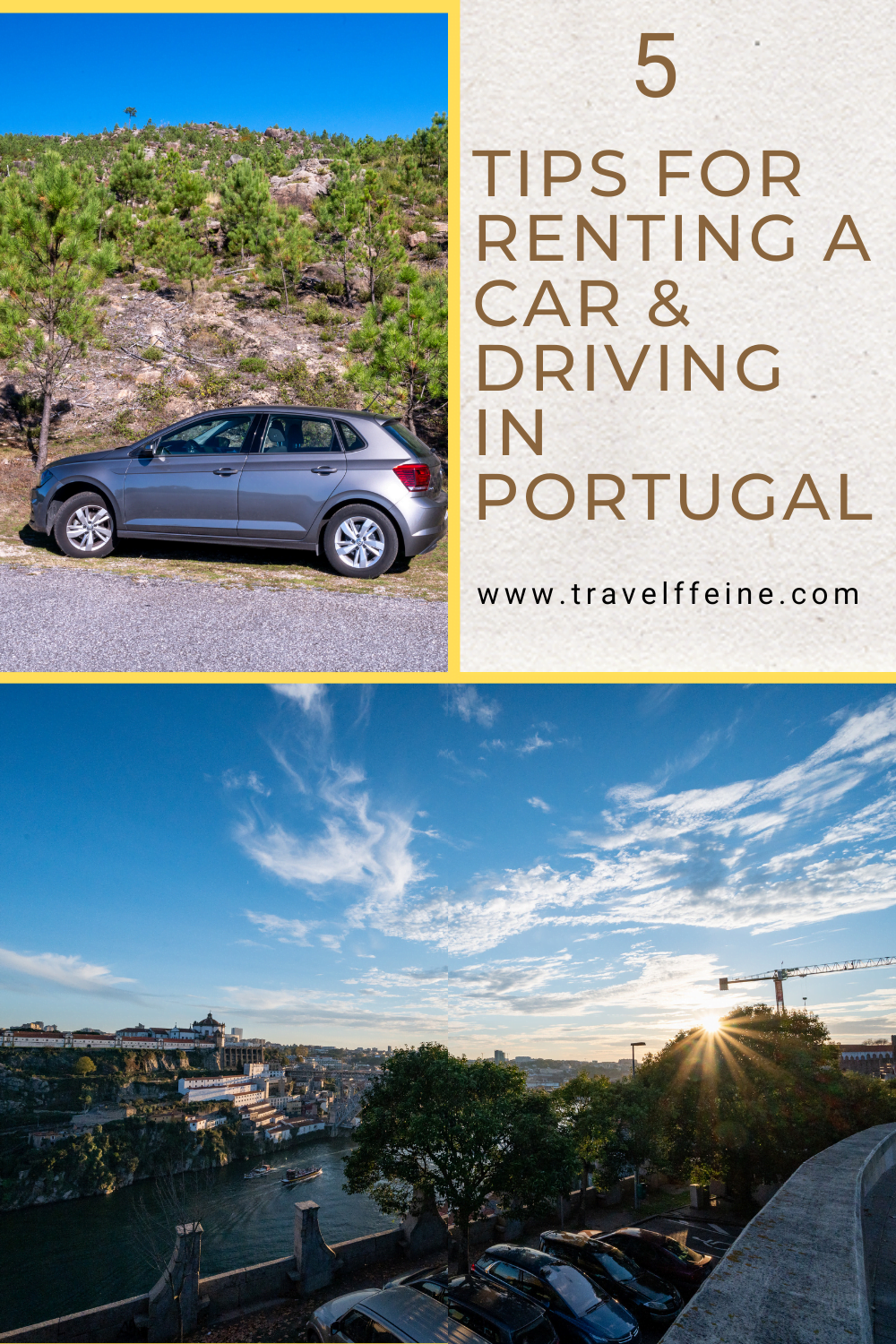
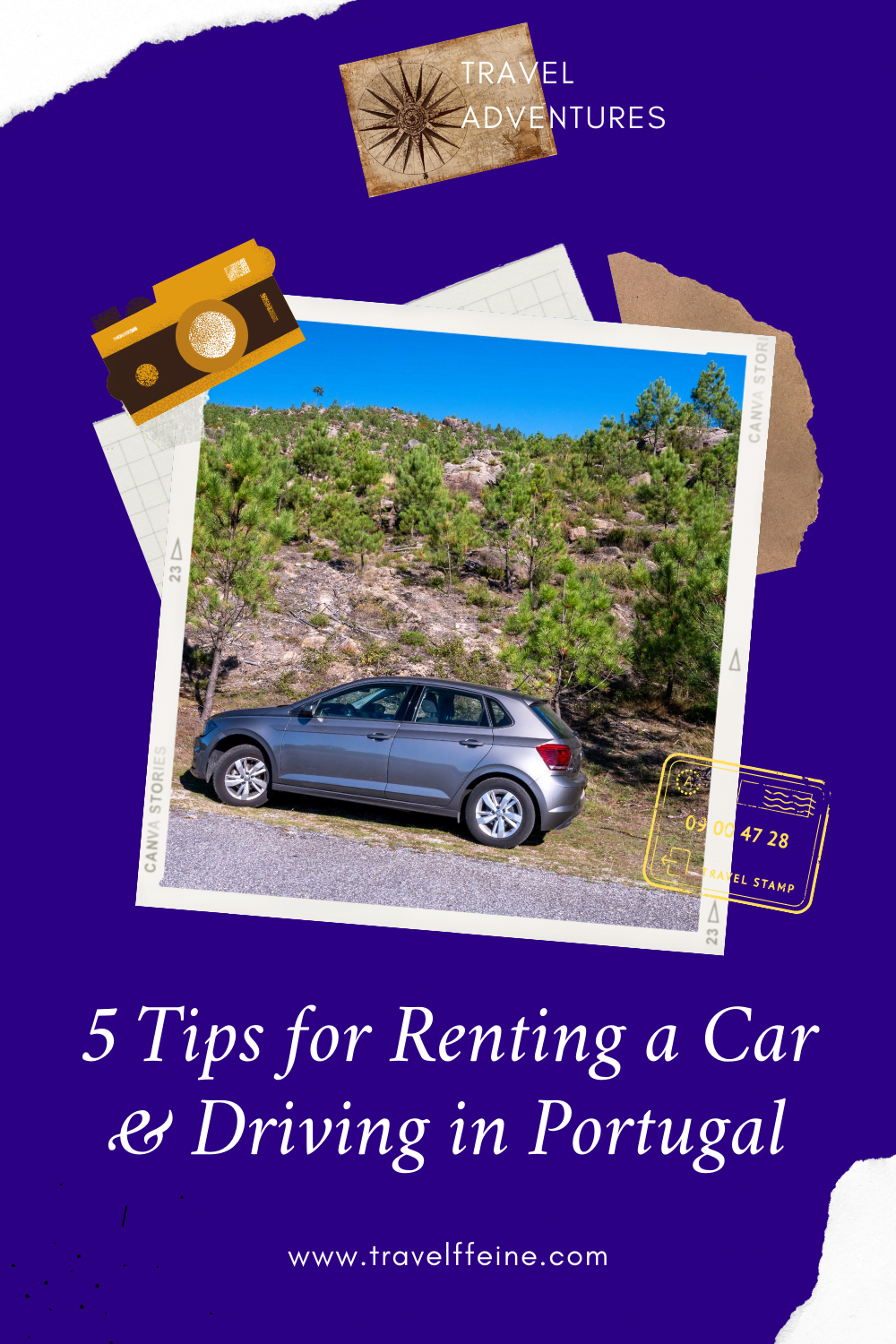
  • 5 Tips for Renting a Car and Driving in Portugal

    Below are five tips for driving in Portugal that I learned during my two-week road trip there. Renting a car in Portugal is not so different from renting a car in the U.S. However, there are a few things that are helpful to know before starting on your road trip in Portugal.

    Things to Know Before Renting a Car in Portugal

    First, let me go over a few useful things to know before you make your car rental reservation.

    • You need a valid driver’s license to rent a car in Portugal.
    • Almost all rental cars in Portugal have manual transmissions. So make sure you know how to drive a stick shift before renting one.  Larger rental car companies will have a small selection of cars with automatic transmissions, but it will cost a lot more, and you need to reserve one well in advance if you hope to get one. In general, almost all cars in Europe use manual transmissions, and it’s an excellent skill to learn!
    • Portugal has some of the highest rates of car accidents and allegedly some of the worst drivers in Europe. So, as a precaution, you want to get rental insurance. Typically this means getting CDW (collision damage waiver) insurance. You can pay for this directly with the car rental company, or you can check ahead of time with your credit card company to see if they already provide this and what you need to do to use their coverage. Whichever choice you make, it’s good to understand what it covers and what it does not cover.
    • Most car rental companies in Portugal also charge a deposit to your credit card. You need to make sure that you have sufficient credit to cover this additional deposit. If you think this could be a problem for you, call and ask the company in advance for the rental deposit amount so you can make sure to have enough credit to cover it.

    Tip: Reserve the smallest car that will accommodate your needs. Parking spaces are tight and roads are narrower so a smaller car is easier to maneuver when driving in Portugal.

    5 Tips for Renting a Car and Driving In Portugal

    night driving in Portugal

    1) Renting a Car In Portugal

    First off, you want to research a rental car company and determine where you want to pick it up. You can rent at the airport, which we did, and then drive it into the city, or you can take a taxi into the city, and rent a car there.

    Our trip to Portugal had us flying into and out of Lisbon, so we rented our car from Lisbon’s Humberto Delgado Airport.  In hindsight, I may have opted to get a rental in the city instead when we were ready to move on to our next destination.  It was stressful for my husband driving in a new country, in the dark, with a large five-lane roundabout and city traffic, to get to our first Airbnb in Lisbon.  

    Before driving off, you need to walk around your rental car and mark any damage you see. At Avis, we were given the keys to our car on the ground level but then had to walk up one level to find our car.  We walked around the car and took photos of any damage we saw (the rental agent said the images would be our evidence should any dispute arise upon return), and we also wrote it down on the rental envelope they gave us. You do this on your own with no rental agent present.  

    Before the trip, I read many reviews that said to be very thorough in your walk around and note everything. So we were a little paranoid when doing our inspection and probably worried more about small bumps and scratches than necessary. However, better safe than sorry, I guess. In the end, we didn’t have any issues at check-in. The man who checked us in walked around the car once and then gave us our receipt.

    Toll Roads: Deciding How to Pay

    Make sure you understand your options regarding Portugal’s toll roads and how you’ll pay when driving there.

    Option 1

    Most rental companies give you the option of paying to “rent” a Via Verde device which allows you to use all Verde Lanes on any toll road without stopping.  You’ll pay a fee to use this device in addition to any tolls you accumulate during your road trip in Portugal. We rented with Avis and paid $45 for the device, which we later discovered was for the rental of the device AND roadside assistance.  The rental for the device itself was around €16.

    Option 2 

    You can choose not to rent a Via Verde device and instead go into a CTT (Portugal’s post office) every 3-5 days to pay your accrued toll bill. You cannot use the Via Verde lanes with this option. The convenience of using any toll road and all Verde Express Lanes (no stopping) and not needing to find a CTT location every few days makes renting the electronic device worth it, in my opinion.

    Option 3 

    I discovered this option after returning home to the U.S. However, if you plan to make repeated trips to Portugal, or you don’t want to pay the extra fees to the rental car company, this option seems the simplest and cheapest option.  You can rent your own electronic toll device directly with Via Verde.  You pay only for the months you use it, and you can activate it for use on any subsequent trips to Portugal.  This is the option I will choose in the future.

    My recommendation

    I recommend Option 1 or Option 3 (however, as I mentioned, I have not yet tested option 3). You’re on vacation. Do you really want to mess with finding a CTT/post office every few days? I don’t think it’s worth the time or money you’ll spend finding one. 

    With a Via Verde electronic device, you slow down to 60km as you pass through the designated toll lane.  All of the Via Verde passenger lanes we encountered were on the far left side of the toll checkpoint.  

    I am still waiting to receive the toll charges from Avis. It’s been almost a month since we returned, and we still have not been charged for this. I will update this post if I learn anything more or have a bad experience with this.

    2) Research Portuguese Driving Laws

    Read up on road signs, speed limits, and driving laws before your trip.  This will ease some of the stress of driving in a new country if you are somewhat familiar with the basics of their road rules.  

    Driving in Portugal isn’t that different from driving in the States, except for a few things I’ll note below.  Another nice thing we discovered when driving in Portugal was how traffic-free the freeways are.  There is always some congestion surrounding large cities, but otherwise, we often felt like we had the highway to ourselves!

    Speed Limits 

    During my most recent visit, the freeway speeds were 75mph/120kph, although it appeared most traffic went around 140kph. Another critical thing to note is that Portugal highways have speed cameras scattered in different spots, typically near cities. If you use Google, it will make a “ding” noise and alert you about an upcoming traffic camera.

    Driving Laws

    Many of their driving laws are the same as here in the U.S. Such as driving on the right side of the road, wearing your seat belt, only using hands-free mobile devices, and so on.  I’m not going to list all of them as you can research that on your own, but here are a few that stood out to me.

    • Dash cameras are illegal in Portugal, so leave them at home as they violate their privacy laws.
    • It’s illegal to pass on the right.
    • It’s illegal to cross a solid white line and don’t even think about crossing a double one. If you need to make a turn there, don’t do it; instead, go past it until you’re able to turn around.
    • Also, this isn’t a driving law, but something we noticed driving in Portugal. Almost all of their lines are white. In the U.S., we use yellow lines to distinguish a two-lane road with traffic going in both directions, and we use white lines for roads where the traffic is all going in the same direction.  In Portugal, almost all their lines are white, which means when you’re in a city with one-way roads, it’s hard to know if you’re turning down a street with traffic coming at you or going in your direction, so pay attention to what other drivers are doing. 

    Road Signs 

    Overall, we were able to get around without knowing what all their traffic signs meant. The speed limit signs and roundabout signs, parking signs, etc., were all easy enough to figure out. However, quite a few signs had me reaching for my phone more out of curiosity than anything else, but it is a good idea to review all the traffic signs before driving in Portugal. This article on their road signs includes an extensive list with photos of each street sign.

    3) Driving in Portugal: Roundabouts

    For any of you considering renting a car from the Lisbon airport, let me go over the one area that gave my husband a little trouble.  The roundabout.

    Now, he’s no stranger to roundabouts. In fact, he’s driven in the Swindon’s magic roundabout (watch the video to see how impressive this is), and of course, here in the States, we have a few small roundabouts scattered here and there.  Since we live on the West coast, they are still few and far between, but we still have them.  

    Shortly after leaving the Lisbon airport, we came to a large roundabout with five lanes encompassing it.  Since we were new to the area and relying on Google Maps to navigate us, there was a slight delay in knowing which exit we would take. 

    This, coupled with the fact that it was dark and the seemingly odd way cars were cutting across multiple lanes to exit, made for a very stressful first encounter to the Portuguese roundabout.  After we were on the highway, my husband said, “remind me to research the driving rules for roundabouts in Portugal.”

    After we checked into our Airbnb, he did his research and discovered that in Portugal, unless you are taking the first exit out of the roundabout, you are required to take one of the inner lanes, then cross through the other lanes of traffic to exit at a later exit.

    It took a lot of practice on his part to learn how to use their roundabouts properly, but by the end of the trip, he maneuvered them like a pro, including the 5-lane roundabout at the airport.

    4) Fueling up Your Car

    To Fuel Up or Not to Fuel Up? That is the Question.

    When you’re at the car rental company, they will explain that you can pay them for a full tank of gas upon return of your rental, or you can fuel it up before returning.  

    Our rental agent explained that they charge the same amount for fuel as you pay at the gas station. He also said that we didn’t have to decide in advance but that if we wanted to return and pay them to fuel it up, it was best to return on empty. If the car still has half a tank when returning, it is better to fuel it up rather than pay for a full tank when it only needs a half tank.

    Regular Fuel or Diesel

    Make sure you know whether your car takes regular unleaded fuel (petrol) or diesel. You do not want to make the mistake of putting the wrong fuel in your engine. Your CDW will not cover that, and it will put a significant damper on your vacation. Typically, it will say what type of fuel the vehicle uses on the gas tank door or gas cap. 

    Regular unleaded gas/petrol is referred to as “gasolina sem chumbo” or “gasolina sin plomo” and has an octane rating of 95 or 98.  We looked for the “95” on the fuel pump to ensure we used the recommended fuel type.  Diesel is called “gasoleo,” and liquid propane gas (LPG) is called GPL or “gas liquido.”

    5) Parking Your Car

    Make sure each of your accommodations has on-site parking before reserving a place to stay. Most reservations sites, such as Expedia.com or AirBnb.com, offer a sort feature that allows you to select only accommodations with parking.  Use this when researching where you’ll stay.  

    Tip: Uber is easy to use when you’re staying in large metropolitan areas such as Porto and Lisbon. Dealing with traffic and trying to find a parking spot can make a vacation really stressful, so when staying in a city, consider leaving your car parked at your accommodations and instead walk, or take an Uber or a taxi.

    I research well-located Airbnbs that allow me to walk to many of the main attractions, thus eliminating the need for a car. Sometimes, they may cost a little more, but in the end, they’re worth it for the time and money I save on transiting to the sights and attractions.

    Final Thoughts on Renting a Car in Portugal

    Portugal has an excellent public transport system.  You can take trains from Lisbon to Porto and even Lisbon to the Algarve, but it is nice to have a car if you want to explore.  When you’re visiting the Algarve region of Portugal, a vehicle is a must if you’re going to drive to the different beaches along the coast.  

    When you’re in Porto or Lisbon, you can book day trips through tour groups, but then you’re on their schedule, and you no longer have the flexibility of stopping when you want.  So, although you could spend two weeks without renting a car in Portugal, I think a rental car provides flexibility and allows for spontaneous side trips.

    It is easy to navigate using Google Maps. I did bring a paper map with me but never needed to use it. Make sure to download Google offline maps for Portugal before leaving home. That way, even if you lose cell coverage, you can still navigate to your next destination.

    And last, if you have a GSM phone that uses a SIM card, you can purchase a SIM card from the Vodafone store at the Humberto Delgado Airport.  They will help you install it and activate it so you can make sure it works before heading out.  This is so easy, and the card is good throughout Portugal.

    Other Related Articles You Might Enjoy

    Happy Travels!

    5 Tips for Renting a Car & Driving in Portugal (6)
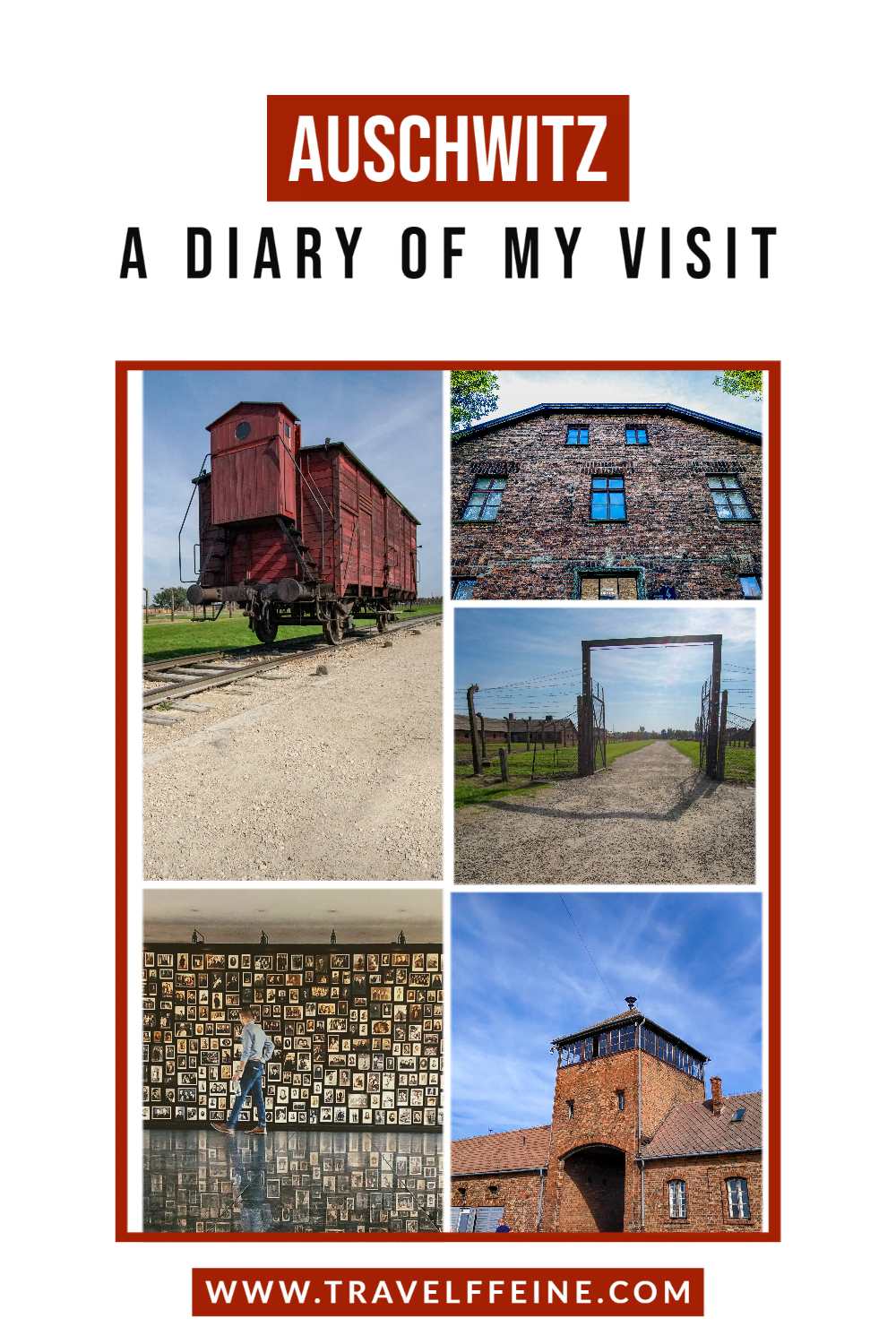
  • A Diary of My Visit to Auschwitz-Birkenau

    I tried to think of what I would write regarding my visit to Auschwitz.  I have so many thoughts regarding WWII and on the subject of The Holocaust.  There are so many studies on The Holocaust and so much history to cover that I knew I could not discuss it all or better express the facts already documented. 

    Before my trip to Europe, I listened to the full version of The Diary of Anne Frank. I also spent a few days in Amsterdam, where I visited the secret annex where Anne and her family and the others hid from the Nazis. It was very moving to read her diary and then to visit the place where she penned it. 

    After the Nazis discovered them, Anne and the other seven people in hiding were all sent to Auschwitz. Some transferred to other camps, and only Otto, Anne’s father, survived. So as I contemplated how to write about my visit to Auschwitz, it seemed fitting to write a diary of my day and the thoughts I had along the way.  

    I will also provide information on how to visit Auschwitz-Birkenau at the bottom of the page.  I recommend if you get a chance to visit here, that you’ll take it. It is a place that will leave an imprint on your heart. A place all of us should remember and never forget.

    Tuesday, September 18th, 2018

    My day begins far too early for my liking. However, I get up when my alarm goes off at 4:45 a.m.  I have somewhere to be. Today is the day I will check off another bucket list destination.  I know some may consider it a strange one, but it is a place I’ve read about since I was a child. A place that seems too awful to be true.  Today I will visit Auschwitz-Birkenau. 

    My friend Angela and I finish getting ready. We leave our Airbnb apartment in Krakow around 5:25 a.m. to meet our Uber driver. His name is Dmytro. He is nice, but nervous and keeps apologizing for every bump in the road. I assure him that we have rough roads where we come from too.

    We arrive ahead of schedule, so we wait for the bus. Angela told me earlier she’s a little apprehensive about today as she thinks it will be horrible.

    Which of course, what happened was horrible.  It was something so awful that people need to remember it happened. The horrors of Auschwitz and The Holocaust showed us the evil side of human nature. 

    Yet, it also demonstrated the resilience of the human spirit. The hope and faith that is still here. And the willingness of humans to not only sacrifice their earthly possessions to help others but to also lay down their very lives for the cause of freedom.

    Bus Ride to Auschwitz-Birkenau

    As I ride the bus to Auschwitz, sitting in my padded blue seat, I think what the journey must have been like for the victims transported there. I watch the landscape as we zip past the fields, the small towns, and forests along the way.  What was the scenery like almost 80 years ago when they brought the first prisoners to Auschwitz?  

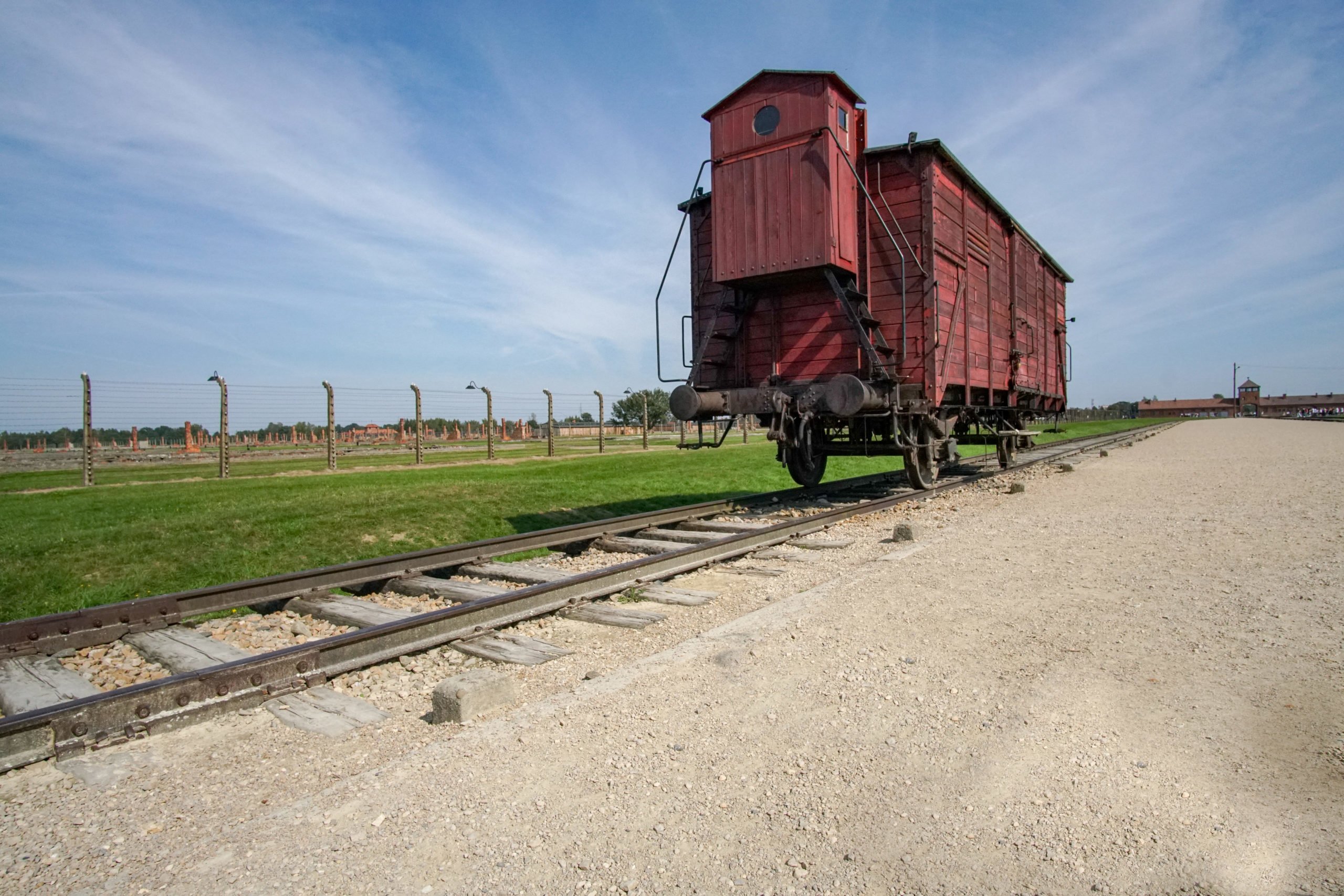
    Later, I would see the train cars that brought the captives packed so tight they could hardly breathe. They didn’t have the luxury of a padded seat or windows to view the scenery.  They were transported like cattle, worse than cattle. The Nazis packed 80-100 people to a train car with no windows, little to no food or water, and only a bucket to use as a toilet; many died during the journey. I cannot imagine it is too awful to consider.

    Eating Breakfast in Auschwitz

    The bus drops us off just outside the museum complex.  We cross the parking lot, and I think about how I haven’t had breakfast and should eat as it will be a long day. I feel almost guilty about this. Even though most would consider my breakfast here mediocre at best, it would have been a royal feast for the prisoners at Auschwitz. I try not to think about this and instead eat my egg with toast and drink a cup of coffee.

    I later learned that the prisoners at Auschwitz would work 11 hours of hard labor and receive around 1150-1400 calories per day.  The food was so awful that in the beginning, it was hard for them to eat it, and later due to their starvation, they would eat food out of the garbage.  I saw photographs of people who had lost over 50% of their body weight.  They were living skeletons.  

    Waiting for Our Museum Tour

    After eating breakfast, we walk through a security checkpoint on our way to a waiting area for our 9:00 a.m. tour group.

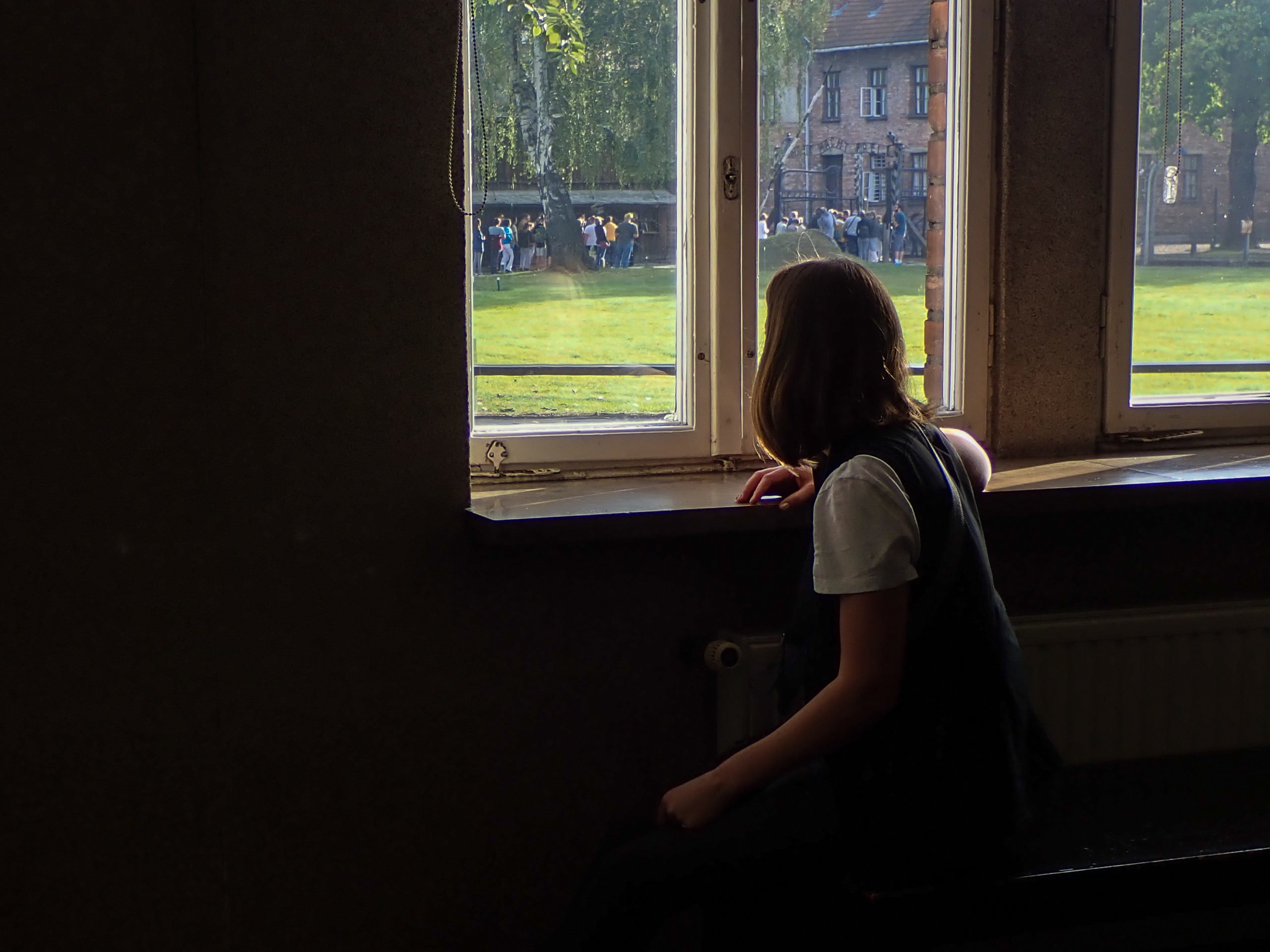
    I find a seat by a window where I look out over the courtyard. It is a bright sunny day, hardly a cloud in the sky.  It doesn’t feel dark and scary. There are hundreds of people milling around in tour groups, walking to and from the various barracks and buildings. 

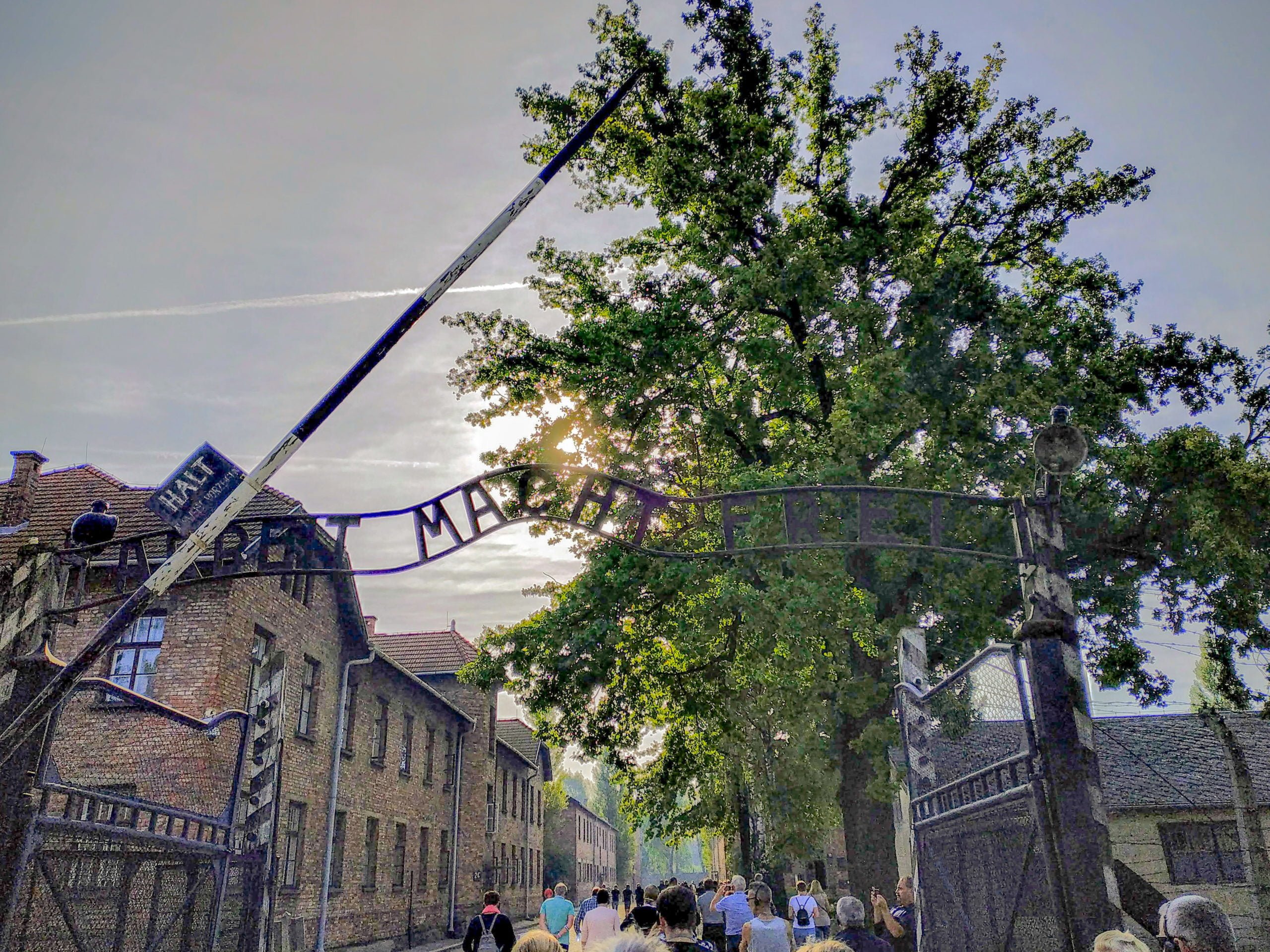
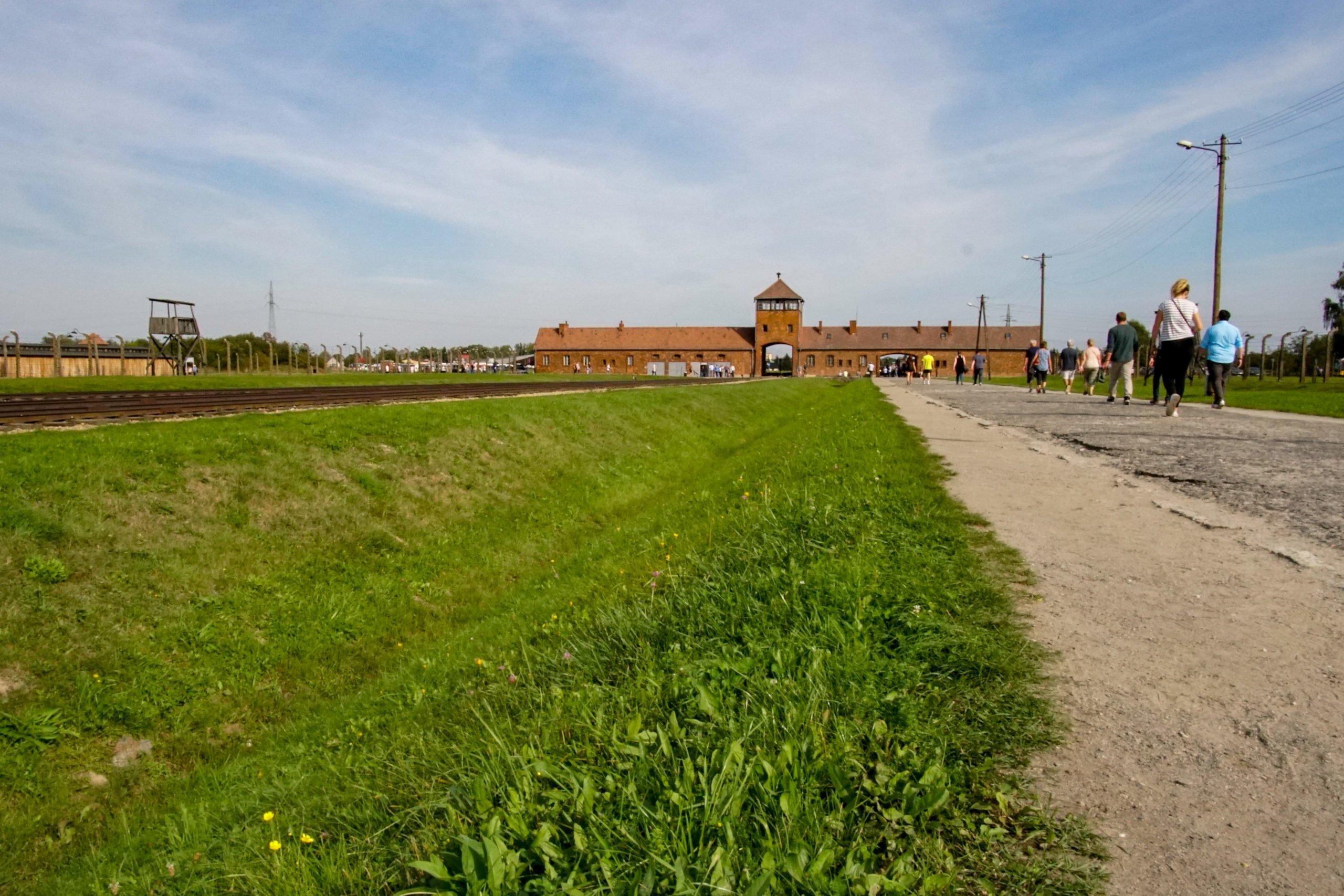
    I look out over the grassy lawn to see the iconic gates that read “Arbeit Macht Frei” (“work sets you free”), and  I think about the prisoners’ first glimpse of these gates and what they must have felt. 

    I try to imagine what it must have been like to arrive here on one of those trains. Indeed, I cannot grasp the agonizing journey that would have brought them here nor the atrocity of their fate.

    Why It’s Important to Remember

    No, try as I might, sitting there, looking out the window, as I wait safely for my tour, I could not grasp the horrors they went through.  

    However, I felt it was important to try.  It is important to remember and never to forget.  To accept what happened.  Denying it does no one any good.  It does not preserve the memory of those murdered, and it does nothing to respect the memory of those who gave their lives to stop these horrible crimes. We must remember and work to see that it is never again repeated.  

    And so I begin my tour, knowing I will hear the stories of things that are too terrible to imagine, but this isn’t fiction, this is the raw, unedited history of human depravity–and also the courage of the human spirit.

    “Remember only that I was innocent and, just like you, mortal on that day, I, too, had had a face marked by rage, by pity and joy, quite simply, a human face!”

    ~Benjamin Fondane, murdered at Auschwtiz-Birkenau, 1944

    Heroes of The Holocaust

    It was these stories of courage that our guide tells us about during our tour at Auschwitz.  She told us about Helena Plotnicka. A wife and mother of six kids.  Helena sacrificed what little food her family had to leave food in the fields where she knew Jewish prisoners worked. She left it there for them to find.  

    Helena also worked to acquire medicines for the prisoners and would also leave these in the fields. Additionally, the prisoners would give her letters and correspondence explaining the conditions in the camp so she could help spread the word. Helena was later arrested and died in Auschwitz in 1944. She was one of many heroes that tried to fight the tide of evil. 

    Other heroes like Miep Gies, Victor Kugler, Bep Voskuijl & Johannes Kleiman from the Diary of Anne Frank. Corrie Ten Boom and her family, Oskar Schindler, and countless others, including the millions who sacrificed their lives during World War II to give hope and freedom to the victims of the Holocaust and the cause of freedom for all humanity. We must remember their sacrifice.

    The Lies of the Nazis

    Our guide explains that survivors would later recount the relief they felt upon arriving at Auschwitz. They came to Auschwitz believing if they worked hard, they would continue to live. The Nazis were fine with people knowing that they had work camps, but they hid the true identity of Auschwitz-Birkenau. They hid the fact of what it really was—a death sentence.   

    So they lied. Guards forced other prisoners to write postcards from Auschwitz telling their family that the conditions were better there and that they didn’t have to work as hard.  Then these prisoners were murdered.  Later the Nazis tried to destroy the evidence of the crematoriums and other documents that would connect them with their crimes.

    We saw piles of canisters once filled with Zyklon B. This gas, a type of cyanide, was used by the Nazis to exterminate millions in the gas chambers. Later our tour group walked inside one of these gas chambers.  Fake showerheads placed on the ceiling perpetuated the lie that those entering were only taking a shower before moving to the barracks. Instead, they were sent to their deaths.

    The Death Wall

    Just before our break, we stop at the death wall. It’s an area where prisoners went through a series of steps that required them to undress and then walk naked to a wall where they were shot.  Later the Nazis decided this was too slow of a process and thus came up with the idea of using gas chambers and crematoriums.  They could only kill as many as they could burn; this turned out to be around 5,000 per day.  

    I saw the rooms with over two tons of human hair, the thousands of shoes, combs, pots, pans, and personal possessions left behind from the millions murdered. The Jews and other prisoners brought here thought they would leave someday, so they packed as many belongings as they could for the trip.  

    Upon arrival, they were told to leave their belongings in a pile and to remember where they left them as they would return to that spot.  This was another lie.  Instead, they went straight to a gas chamber, never to return.

    Our Lunch Break

    After almost 3 hours of touring Auschwitz, our guide announces that we’ll take a 40-minute break before continuing to Birkenau.  40 minutes.  Just enough time to quickly eat the pb&j sandwiches we packed.  We look for a place to sit in the shade to stay out of the burning sun.  

    It all seems surreal. One thing is for sure, I certainly won’t complain about the sun burning down on me, or how my back and feet are tired from so much standing and walking on the hard ground.  These inconveniences are so inconsequential in the grand scheme of what occurred here.  If complaining is wrong in normal circumstances, it seems almost sacrilegious now. Disrespectful, perhaps, is the sentiment I feel.

    I look around at the other visitors lounging on benches and the grassy lawn outside the museum complex.  Forty minutes doesn’t seem like a lot of time to digest what I’ve just seen and heard.  Is there any amount of time that will make processing these horrors any easier?

    Time is up, we board another bus and leave for Birkenau.

    Auschwitz II-Birkenau

    Birkenau, or Auschwitz II-Birkenau as it is also known, is a little over two miles from Auschwitz I and is shockingly massive.  It is twenty times larger than Auschwitz I and designed for one purpose.  Death.  It was the largest of the death camps.  They executed men, women, and children without regard for life.

    I cannot stop looking around in shock at how big this concentration camp is.  We ascend to the top of the central guard tower or “death gate” at the entrance to the Auschwitz II-Birkenau concentration camp.  We have an aerial view of Birkenau from here.  It stretches out further than I can see.  

    On the left, I see barracks made of brick.  I learn that the prisoners had to tear down homes and buildings in the nearby towns and then use them to build these brick barracks. They ran out of bricks, and so to the right, I see row after row of barracks made of wood.  

    There were over 300 buildings here during WWII.  The barracks used to house prisoners had been designed as horse stables.  They were not insulated and would have been awful both in the hot summer and in the freezing winters.  Prisoners often had to sleep five or more to a bed.  You can imagine the smells, the dirt and filth, and the hopelessness of the place. 

    electric barbed wire fences
    Electric barbed wire fences surrounding Auschwitz-Birkenau.

    The Family Camp

    We walked to a “family camp” where a select number of children were allowed to live.  We see drawings from these children that show their perspective.  The few that were allowed to stay in this camp were there for propaganda purposes to send out letters and postcards before meeting their fate.  

    The Gas Chambers

    Our guide takes us down the long stretch of train track that leads from the death gate to the unloading ramp where they forced prisoners into groups: women and children in one and men in another.  They immediately killed some while others walked the long way to the gas chambers.  

    There were four massive gas chambers at Birkenau, and they crammed over 2,000 people into these at a time.  Toward the end of the war, the Nazis expedited their killing and murdered anywhere from 5,000 to 6,000 people per day.

    Dr. Mengele, also known as the “angel of death,” selected some of the prisoners for his twisted human experiments. He performed medical experiments on them without anesthesia.  Twins and people with physical anomalies such as two different colored eyes were of particular interest to him.  

    We view the remains of two of the gas chambers and crematoriums.  The Nazis tried to destroy these at the end of the war to hide the evidence of their crimes. It is hard to imagine, even as I stare out over the demolished gas chamber and crematorium, that such evil exists.  

    The horrors of The Holocaust and the actions of the Nazis are so unfathomable to me.  This is not ancient history. This happened in the last 100 years.  I know, too, that holocausts have occurred in other parts of the world. It is heartbreaking to consider. 

    Individuals Not Just a Number

    Over 1 million people died at Auschwitz-Birkenau. Most of these were Jews, but there were also other prisoners of war murdered here. The death toll for Polish Jews was particularly high. Around 3 million Polish Jews were killed, that’s half of all Jews killed during The Holocaust. Only about 10 percent of Poland’s Jewish population survived.

    Our group walks to a building on the far side of the Birkenau concentration camp that has an important story to tell.  The story of the victims before they came to the concentration camps before they were hunted down, back when their lives were healthy and happy.

    In one area of the exhibit, there are enormous books on display that visitors can flip through and read name after name of those murdered during The Holocaust.  There are over 4 million Holocaust victims listed with blank pages at the end for the names not yet recorded. These books are a tribute to those murdered. They have no graves and no tombstones. However, every life mattered, and everyone one of them was an individual with a name.

    The Holocaust Book of Names

    Photographs, Memories & Moments in Time

    In another room, I see photos of some of these individuals. There are photographs with them at the beach, at the park, and hanging out with friends at dinner parties. They are photographs of kids at school, family portraits, young couples in love–people enjoying their lives.  People like you and me. 

    In another room, home movies discovered after the war play on every wall of the room.  I stood there watching people at concerts, on sailboats, with friends and family smiling and laughing.  It was as if I had a time machine to go back and see them alive again. These movies brought their memories to life, and I saw my humanity reflected in their faces.  

    I, too have home movies and photographs, I also have people I love and a life I love. However, their lives were taken from them, and I still have mine. Children never to become adults, parents never to know parenthood, and grandparents robbed of the joys of grandchildren. This exhibit had the most significant impact on me.

    wall of photographs from those murdered at Auschwitz
    A wall displaying photographs recovered from suitcases found after the war.

    It is easy, due to the mass total of victims murdered, to view them as a number.  However, it is essential to see them as individuals who loved and laughed–people like you and me. 

    As a teenager, I read the personal stories of the survivors and those that died.  Knowing these people as individuals makes it easier to empathize, to relate.  No, I can’t comprehend the horror they endured at the hands of the Nazis and others, but I know what it is to love, to laugh, to be scared, and to have dreams.  Their stores teach me about courage, about love, and to never take life for granted.

    Here is a short clip from the room displaying the home movies.

    Life and Freedom are Gifts

    That is the theme by which I try to live my life.  To live life to the fullest and be grateful for everything.  I am so blessed. I’m rich with love and family, friendship, opportunities to travel, and the ability to see the beauty in the simple.  I am thankful that I still get excited over a beautiful flower, a fall leaf, and a snowflake.

    We are not all survivors of a horrible event such as The Holocaust, but we all deal with hurt, the pain of loss, and death.  I suppose it is this terrible and painful side of humanity that can also enhance the joy we can find in life.  I think it should cause us to be more thankful for life and to embrace the joy amidst the pain.  

    Don’t stop living while you’re still alive.  There are so many others whose lives ended too soon, those that never got to graduate high school, those that never learned to ride a bike, those that never got to marry, to have kids, or to wake up to another beautiful morning.

    So be kind. Be humble. Help others and reach out to those that are hurting. Encourage. Share hope. Enjoy the simple things of life.  Be grateful. Never, ever forget that all human life is precious!

    And maybe, just maybe, in the tiniest way, by living our lives, we remember those who no longer are able to live theirs.

    Visiting Auschwitz

    Tour Options:

    You have several options when planning a visit to Auschwitz. You can go with a tour group, or you can take a self-guided tour through the concentration camps. 

    The 6-hour study tour is what I took, and I highly recommend it.  It allows for a slower pace to see both camps and provides more time for reflection.  There are tours from 2.5 hours to 6 hours in length. If you choose to go with the self-guided option, just know that you can only enter at certain hours, usually early morning or late afternoon.  You still need to reserve a self-guided tour, just as you would a guided tour. 

    The guided tours offer insightful commentary and information I feel one might miss by going on their own, but each person will have their reasons for choosing which type of tour they take.

    Booking Online: 

    Make sure to book your tour in advance of your trip to Auschwitz as the tours do book up. Learn more about the different tours offered, book your tour, and get useful information regarding your visit on the museum’s website

    Food: 

    They have a cafeteria at Auschwitz I and a hotel across the street that also has a restaurant.

    Getting There:

    I booked a shuttle through Discover Cracow from Krakow to Auschwitz.  If you are staying in Krakow, I highly recommend you consider using their service.  It is incredibly affordable and easy to book.

    The journey takes 1-1.5 hours—plan for your visit to the camps to take an entire day. Depending on which tour option you choose, it may take more or less time, however, given the solemnity of these memorial sites, it is good to give yourself time for some restful reflections rather than pack a bunch of sightseeing in afterward. 

    Additional articles for your visit to Krakow, Poland:

     
    Always remember life is a gift!
  • 16 Memorable Things to Do in Krakow Poland

    Krakow, Poland, is an incredible place to visit, and I loved my time there!  One of the things I love about travel is arriving at a completely new destination, unsure of what to expect, and then leaving with a new fondness for that place in which only days before had been unknown to me.  

    Krakow was like that for me.  There are so many memorable things to do in Krakow you cannot possibly see them all with only two or three days. This article provides an overview of Krakow’s highlights to help you create an itinerary for your adventure there.

    Brief History of Krakow, Poland

    Krakow dates back to the 11th century (possibly even earlier) and was once the capital of Poland. It was where the kings of Poland ruled from high above the city at Wawel Castle. 

    Explore the ancient fortifications dating back to the 15th century, the castle built in the 13th century, and the largest medieval square in Europe! Krakow is teeming with history and beauty. You do not want to miss visiting this extraordinary city!

    Memorable Things to Do in Krakow

    #1 Old Town (Stare Miasto)

    Wander around Old Town (Stare Miasto in Polish) and admire the gorgeous architecture and cobblestone streets. Old Town is a great place to shop for souvenirs, get a bite to eat or even better, try some gelato (I recommend Lodziarnia Donizetti)! It is also the location for many of Krakow’s main attractions.

    #2 Rynek Glowny (Main Market Square)

    Rynek Glowny is the heartbeat of Krakow. It is a beautiful place to explore, and to spend an evening admiring the architecture and taking in the hustle and bustle of the square. Watch a street musician perform, take a horse and carriage ride along the Royal Road or just sit back and people watch. 

    Rynek Glowny is probably the most iconic space in Krakow and home to several of Krakow’s top sights. You’ll find Saint Mary’s Basilica, the Cloth Hall, Rynek Underground, and more located here.

    Saint Mary's Basilica
    Saint Mary’s Basilica

    #3 Saint Mary’s Basilica

    This beautiful Gothic cathedral rises on the edge of Rynek Glowny (Main Market Square).  It is easily recognizable by its twin spires and red brick facade. You can tour the inside of the basilica and see the stunning wooden altar (at the time of this writing it is undergoing renovations). 

    You can also tour one or both of the towers. Choose from the Bugle Call Tower, the tallest of the two towers, or the Bell Tower and see the historic cathedral bells. Every hour in the square, you can hear the bells ring and a trumpeter playing St. Mary’s Bugle Call from the Bugle Tower. 

    Both towers offer you beautiful views of the square below and are my recommendation for the best bird’s eye view of the square. So grab your camera and a pair of comfy walking shoes (no elevator) and get ready to climb to the top.

    #4 Cloth Hall (Sukiennice)

    Krakow’s Cloth Hall was once the hub of international trade in Poland. It is the centerpiece of Rynek Glowny and now houses shops and an art museum. It is here you’ll find the Visitor’s Center and useful information for tours.

    You can also tour the Rynek Underground museum located beneath the Cloth Hall.  The Rynek Underground offers you a glimpse of what medieval Krakow was like — and it’s all below the historic Cloth Hall!

    Krakow's Cloth Hall
    Krakow’s Cloth Hall

    #5 Planty Park

    Take a break in the shade of one of the many trees in Planty Park, and people watch from a park bench while enjoying this green space. Planty Park resides in the area that was once the moat from the medieval walls that encircled the city.  

    The moat was filled with soil to create Planty Park, which now encompasses Old Town (Stare Miasto) in an over 2-mile loop. If you’re looking for an excellent place for a morning run, this is it! 

    #6 Wawel Castle

    Wawel Castle sits high atop Wawel Hill, and the castle complex includes a variety of attractions from which to choose.  You’ll pay to see only the tours you’re interested in, such as the treasury, cathedral, royal apartments, etc.  

    You can also stroll the castle grounds and admire the gardens and architecture for free if you don’t have any interest in the tours. 

    There is a scenic viewpoint to one side of the castle complex that provides terrific views of the Vistula river and city.  From here you can walk below and see a fire breathing dragon!

    Wawel Castle
    Wawel Castle complex

    #7 Smok Wawelski

    Don’t miss the fire-breathing dragon located alongside the Vistula river just below the Wawel castle grounds. You can even walk through the dragon’s den to reach this fire-breathing statue (the den is not stroller friendly or wheelchair accessible).  Kids will especially love seeing the dragon breathe fire and will enjoy crawling through the cave, plus it’s free!

    #8 Attend a Chopin Concert

    Fredrick Chopin is one of Poland’s most celebrated composers and pianists. I love Chopin’s music, and since my trip to Poland wouldn’t include Warsaw (planning that for next time), Fredrick’s birthplace, I knew I wanted to attend a Chopin concert while in Krakow. 

    I booked my tickets at the Chopin Concert Hall.  It is a small intimate setting and a beautiful way to spend an evening. I highly recommend it!

    Wieliczka Salt Mine Chandeliers
    Wieliczka Salt Mine St. Kinga’s Chapel

    #9 Wieliczka Salt Mines

    The Wieliczka Salt Mines are a UNESCO World Heritage Site. These mines are incredible to behold. You will see chandeliers, statues, beautiful wall carvings, and more–all made from salt! 

    I don’t know where else you’ll have a better opportunity to learn about the history and importance of salt as well as to observe some of it’s more unusual uses. 

    Read Tips on Visiting the Wieliczka Salt Mines to learn how to plan your visit and make your own memories walking on floors made of salt.

    #10 Krakow Barbican

    Explore this medieval fortress of Krakow located just outside the historical Saint Florian’s Gate.  The Krakow Barbican was built around 1499 and is an impressive example of human engineering. It was an impenetrable defense for the city and had underground passageways that led to the city gates. This fortified gateway helps display the diverse history of Krakow and the many facets of this stunning cultural city.

    Krakow Barbacan
    Krakow Barbican

    #11 St. Florian’s Gate

    This Gothic tower was the main entryway to the city of Krakow. It was one of the multiple gates along the city’s defensive walls. Where these walls and moat once stood is now home to Planty Park. The tower is about 110 feet tall and is a beautiful piece of architecture and history. I recommend you make time to explore this historic area of Krakow.
     
    Saint Florian's Gate

    #12 Oskar Schindler’s Enamel Factory

    The factory currently houses two museums, the Museum of Contemporary Art and Schindler’s Factory Museum.  The Factory Museum gives an in-depth look at the effects of WWII on  Krakow and the atrocities the Nazis committed against the Polish Jews.

    #13 Kazimierz Jewish Neighborhood

    This Jewish neighborhood once had over 3 million Jews who lived here. However, due to the extermination of the Jews during WWII, only about ten percent of them survived. 

    Plan to visit the Old Synagogue and the Galicia Jewish Museum to learn more about the lives of the Jewish community in Krakow before WWII.  Also, make sure to visit the Ghetto Heroes Square and the monument dedicated to their memory.  

    In addition to the historical sites of the Kazimierz neighborhood, it is also a great place to shop.  Explore its distinctive architecture and eclectic shops to find unique souvenirs to take back home.

    #14 Eat Polish Food

    Don’t miss trying authentic Polish food while in Krakow!  I recommend trying Polish Sour Bread Soup (Zurek). I ate this at Bar Smak and loved it! 

    Another popular street food is a Krakow bagel (Obwarzanki Krakowski). These make good on the go snacks to fuel your busy day of sightseeing.  

    Zapiekana is another delicious street food to try. They are like open-face sandwiches, long baguettes cut in half traditionally topped with mushrooms, cheese, and your choice of sauces. 

    These are just some of my recommendations, be adventurous, and try something new!

    #15 Church of Saint Peter and Paul

    Saint Peter and Paul’s Church is in Old Town. This historic baroque cathedral was built during the 16th century. Outside the church, sculptures of the 12 apostles line the gated entrance. 

    Once inside the church, you can purchase an audio guide that tells you more about the church history and also the crypt beneath the church, which is open to tour as well.

    Directly next to the Church of Saint Peter and Paul, is the 11th-century church of Saint Andrew. St. Andrew’s church is one of Krakow’s oldest.  Take time to step inside this ancient cathedral and admire its architecture before moving on.

    Church of Saints Peter and Paul
    Saint Paul and Peter’s Church

    #16 Auschwitz-Birkenau Concentration Camps

    Last, but certainly not least, is something I feel should not be missed during a visit to Krakow.  The Auschwitz-Birkenau concentration camps are not in Krakow, but rather near the city of Oswiecim. However, you can easily take a bus from Krakow to Auschwitz.  

    The journey takes 1-1.5 hours—plan for your visit to the camps to take an entire day. Depending on which tour option you choose, it may take more or less time, however, given the solemnity of these memorial sites, it is good to give yourself time for some restful reflections rather than pack a bunch of sightseeing in afterward. 

    Make sure to book your tour well in advance of your trip to Krakow as the tours do book up. You can take a self-guided tour, but only during certain hours of the day.  I chose the 6-hour study tour and I highly recommend it! The guided tours offer insightful commentary and information I feel one might miss by going on their own, but each person will have their reasons for choosing which type of tour they take.

    Suggested Itinerary for 3 days in Krakow

    Day One: Visit Auschwitz, have dinner in Krakow and enjoy Rynek Glowny (Main Square) at night. Consider attending a Chopin Concert.

    Day Two: Visit the Wieliczka Salt Mines in the morning, get some lunch and then see Saint Mary’s Basilica, visit the Cloth Hall, and then head to the Kazimierz neighborhood and have dinner there. Explore the area and do some souvenir shopping, then head to Schindler’s Factory Museum (it’s open until 8 pm most nights).

    Day Three: Explore Old Town, tour Saint Paul’s Cathedral, Wawel Castle, see the dragon, and then take a relaxing stroll through Planty Park before heading to see Saint Florian’s Gate and the Krakow Barbican. You’ll still have time for shopping in the Main Square if desired.

    Recommended Places to Eat

    Moa Burger

    Address: Mikołajska 3, 31-027 Kraków, Poland

    Moa Burger has delicious and unique burger choices.  I tried a burger with beets and pineapple on it, it was delicious, and I don’t even like beets!

    Bar Smak

    Address: Karmelicka 10, 33-332 Kraków, Poland

    This is the place I tried the traditional Polish sour bread soup, and I loved it!  Stop here if you want to try some authentic Polish food.

    India Masala

    Address: Mały Rynek 2, 31-041 Kraków, Poland

    Delicious Indian food a short walk from Rynek Glowny in the heart of Stare Miasto.

    Milkbar Tomasza

    Address: Świętego Tomasza 24, 33-332 Kraków, Poland

    This is another option when looking to try some traditional Polish food. They are a popular spot for breakfast and also serve delicious pierogis.

    Cafe Camelot 

    Address:  Świętego Tomasza 17, 33-332 Kraków, Poland

    If you’re looking for a place to get some delicious coffee and dessert, look no further than Cafe Camelot. This Cafe is close to St. Mary’s Basilica.

    Żarówka Cafe

    Address: Floriańska 20, 31-021 Kraków, Poland

    Żarówka Cafe is around the corner from Cafe Camelot and has a lovely outdoor seating area.  Enjoy coffee, a sandwich, and dessert while giving your feet a rest.

    Rynek Glowny at night
    Rynek Glowny (Krakow’s Main Square)

    Tips for Getting Around Krakow

    I was pleasantly surprised to discover how cheap it was to use Uber in Krakow. I tend to use public transportation for its cost-effectiveness and convenience. However, in Krakow, Uber was often more convenient (at least from where I was staying) and very affordable. 

    Plus, since I was traveling with a friend, we split the cost, which made it that much more cost-efficient.  Obviously, as a solo traveler, you’d need to determine what makes the most sense for your budget, but always consider the time it will take you to get to/from a destination when weighing the cost vs. benefit of a service like Uber.

    I also used the bus. Bus 304 is a good one for visiting the Wieliczka Salt Mines.

    Where to Stay

    I stayed in Old Town during my visit to Krakow. I loved being around the corner from the Main Square, Planty Park, and the various sights located in Old Town.  It was a little further from the main bus routes or the bus station, but otherwise very conveniently situated to Krakow’s main attractions.  

    Old Town can get quite noisy at night though, so be aware of that, the Airbnb that we stayed at was above an area with restaurants below and needless to say people were out enjoying themselves until two or three a.m. If you’re not a light sleeper like myself, then perhaps this won’t be an issue for you.  All in all, though, I’d stay there again for the convenience of being in Old Town.

    In addition to Old Town, you may also want to consider staying in Kazimierz, it’s close to Schindler’s Enamel factory, and has a more eclectic feel than Old Town. It is also in a touristy area, though, so expect it to be busier.  If you want to stay somewhere outside the main tourist area, but still in close walking distance to Old Town, then consider staying in Kleparz. Kleparz is just a short walk outside of Old Town, so you’re out of the touristy area, but close enough, you can easily walk there.

    Final Thoughts

    If you haven’t yet put Krakow on your list of places to visit, do it now. Once you visit, you’ll wonder what took you so long to go, and you’ll begin making plans to explore more of this unique country.

    Have Fun Exploring!
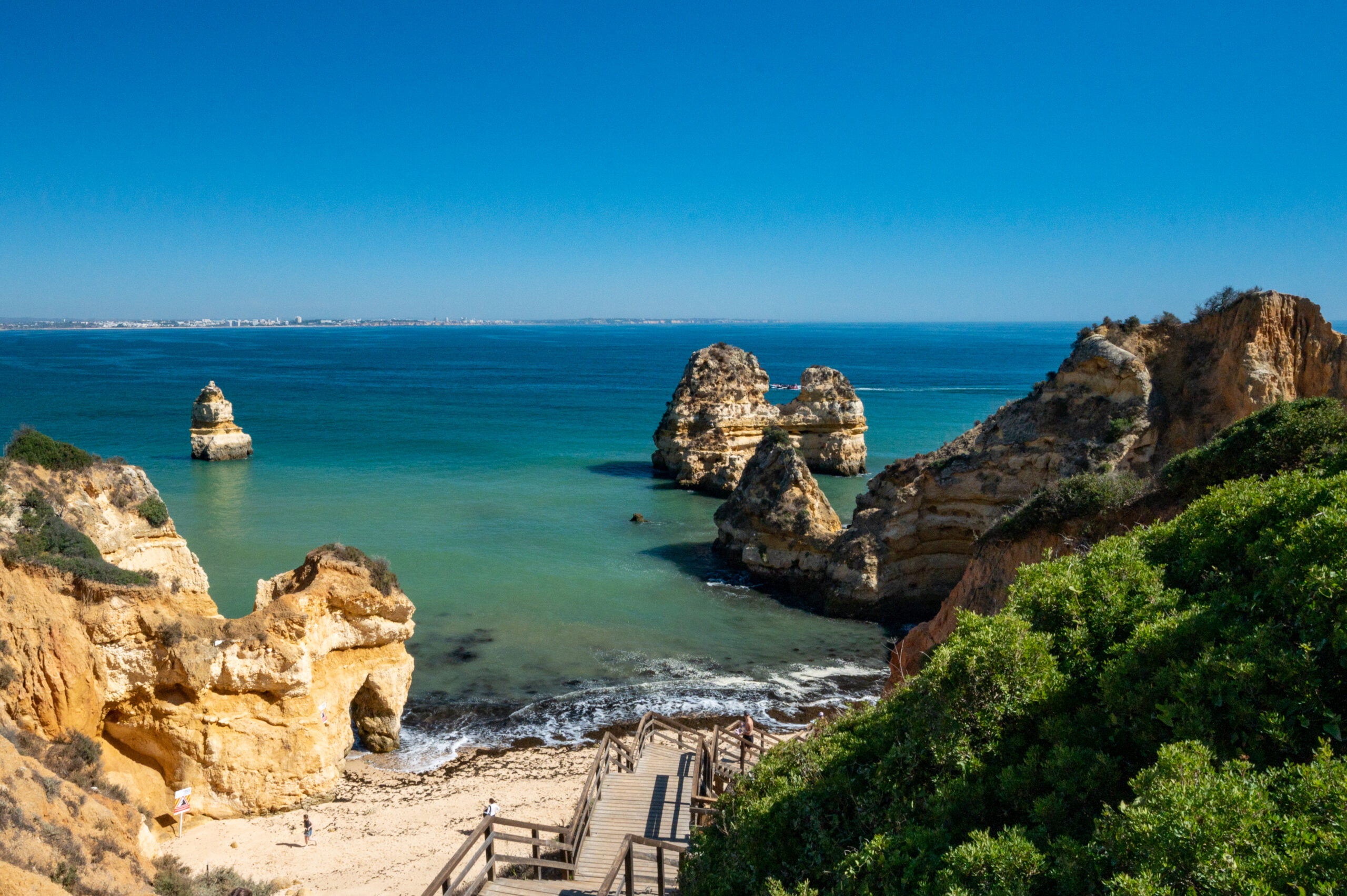
  • Tips on Visiting the Wieliczka Salt Mines in Krakow

    I first learned about the Wieliczka Salt Mines reading the book 501 Must-Visit Destinations. Upon viewing the photograph of the salt chandeliers in the book, I knew I needed to see them for myself. After touring the Wieliczka Salt Mines, I feel I gained a new appreciation for salt and miners in general. 

    Imagine a tour that combines history, salt, sculptures, miners, and royalty, all from a dark labyrinth beneath the earth. Well, that’s what you get on a tour through the Wieliczka Salt Mines. This guide will help you plan your trip to the mines so you can see the salt carved chandeliers, walk on floors made of salt, and even taste the salt for yourself.

    Brief History of Wieliczka Salt Mines

    The Wieliczka Salt Mines are over 900 years old and still in operation today. Their history spans kingdoms and world wars and various periods of technological advancement. They are an impressive example of ingenuity and creativity. There are nine levels to the mine, and they descend to a depth of 327 meters (over 1,000 feet). Your tour will allow you to see only 2% of the mine.  After you complete your visit, you will realize the significance of that and the vastness of the Wieliczka Salt Mine.  Thankfully you are always with a guide. Otherwise, it is easy to see how one could get lost amidst the labyrinths of salt carved tunnels.

    The Tour Experience

    First off, let me say, if you struggle from claustrophobia or a fear of dark places, you may want to reconsider visiting the mines.

    Although there are plenty of open spaces within the mine, you will need to travel down (and back up) in a somewhat cramped elevator and, in my case –an extremely crowded elevator. Then you’ll descend a lot of stairs to go even deeper into the mine before your guide will take you along paved pathways and into the various chamber areas.

    You’ll have your choice of two tours in the mine.  The Miner’s Tour and the Tourist Route.  Both of these tours are approximately 3 hours in length.

    The Miner’s Tour

    As the name suggests, it focuses more on the mining aspect of the Wieliczka Salt Mine. You receive working suits and miner’s gear before you’re taken on a mining adventure! You’ll get to “mine” for salt and learn firsthand about the life of a salt miner. This tour is not suited for those with disabilities, and children need to be ten years old and older and accompanied by an adult. Reservations are recommended for this route and can be made online.

    The Tourist Route

    This is the route I chose during my visit. The tour gives you an overview of the history of mining and the technological advancements over the years. There are various displays along the way to illustrate what mining would have looked like during the early years.  You’ll also tour beautiful chapels carved by miners throughout the mine’s history.  You’ll see saline lakes and admire the raw black salt used to carve the many sculptures, artwork, and chandeliers.

    Our guide was very knowledgeable and had a great sense of humor.  The pace of the tour is steady, but not too rushed.  If you want more time taking photos, then move to the back of the tour group so you can take your pictures and then catch back up. 

    Looking down into St. Kinga's Chapel.
    Looking down into St. Kinga’s Chapel.

    St. Kinga’s Chapel

    The highlight of the tourist route is a visit to St. Kinga’s Chapel. St. Kinga’s is the largest underground chapel in the world (there are 20 total chapels within the mine). You’ll descend stairs into this enormous space 350 feet underground. Everywhere you look, you see salt.  You walk on floors made of salt and admire sculptures and chandeliers carved from rock salt.  It’s stunning!

    Please note that this tour requires you to descend 800 stairs.  Children are allowed on the tourist route. If you have disabilities, please contact the mine ahead of time so they can create a specialized tour, as only certain portions are wheelchair accessible. Reservations are not required for the tourist route.

    Luggage Storage

    Plan to store your bags in the provided luggage lockers.  Small purses (35cm x 20cm x 20cm or smaller) are allowed, but no large day bags—plan to pack your camera gear and jacket and leave the rest in your locker.

    Tips on Touring Wieliczka Mine

    Photographs

    Due to the dim nature of the mine, you may find it challenging to take photographs. Try to steady yourself as best you can. A monopod or walking stick will help immensely (if you have one). The main thing is that you don’t rush taking your shots; otherwise, you will end up with blurry photographs. It is important to aim for in-focus shots, and then you can always edit later for brightness.

    Eating

    There is a cafeteria inside the mine with a variety of dishes, desserts, and beverages to choose from should you get hungry.  Plus, how often can you say you ate lunch at over 400 feet underground?

    How Much Time You Need

    Each tour takes around 3 hours, plus any extra time you may spend eating in the cafeteria, or looking at souvenirs. So I recommend you plan for about 4 hours for your visit to the Wieliczka Mines. Additionally, you’ll want to factor in at least 1-hour round trip travel time getting to/from the mine.  

    What to Wear

    Depending on which tour you choose, you will walk between 1-2 miles during your visit, so make sure to wear comfortable walking shoes. Additionally, the mines are around 57-60 degrees Fahrenheit, so you may also want to pack a light jacket.

    Restrooms

    There are two restrooms within the mine that your tour will take you past.  Your tour guide will give everyone a chance for a break about midway through the tour, and then you’ll have an opportunity again toward the end of the tour.

    Getting to Wieliczka Salt Mine

    Most people visiting the Wieliczka Salt Mine come from Krakow’s city center. Wieliczka is on the outskirts of Krakow and takes 30-40 minutes by bus from Krakow’s touristy areas. You can take bus #304 to get there, and it lets you out just a short walk from the main entrance. The same bus route will return you to Krakow’s city center.

    Another alternative to the bus is using Uber.  My friend and I did this going to the mine and then took bus #304 when returning to our Airbnb. Uber is surprisingly affordable in Krakow, especially if you can split the cost with a traveling companion.

    Hours of Operation

    Make sure to check the Wieliczka Salt Mine website in advance to see what their current hours of operation are and plan accordingly.

    Final Thoughts

    A tour of the Wieliczka Salt Mines is certainly something you’ll never forget.  It is an excursion the whole family will enjoy as long as you are prepared for it in advance.  As mentioned before, the mine is dimly lit, and for those suffering from claustrophobia, you may not find it to be an enjoyable experience. 

    Visiting the Wieliczka Salt Mine is an adventure you are unlikely to experience anywhere else and I highly recommend it for any visit to Krakow.

    For more articles that might interest you check out Ways to Save Money on Food While Traveling and Trip Planning 101.

    Happy Spelunking!

  • A Self-Guided Tour of Historic D-Day sites in Normandy

    Visiting the historic D-Day sites is an unforgettable way to spend the day.  It is one of those bucket list trips that leave you better for having made them. June 6, 1944, is one of the most historic dates in world history. The victory achieved on D-Day changed the course of the world.  

    The freedoms I have today are in large part due to the battles fought on the shores of Normandy. If you have an opportunity to travel to France, take some time to visit the D-Day sites in Normandy. You’ll never forget it.

    In this post, I share my one-day self-guided itinerary to some of the D-Day sites in Normandy, France.  You’ll get a chance to learn about my experience and also see how easy it is to plan your own trip to this historic region. Although I would have preferred a minimum of 2 days for my visit, even with only one day to see the D-Day sites, you can cover a lot of ground and still have an unforgettable trip.

    Overview of Our One-Day Itinerary to D-Day Sites in Normandy

    Where We Started Our Road Trip

    We took a direct train from Paris to Caen, where we’d booked our hotel and rental car.  In addition to spending one day seeing the D-Day sites, we also spent one day driving to Mont-Saint-Michel. For our one-day D-Day itinerary, we drove from our hotel in Caen to our first stop, the Airborne Museum in Sainte-Mere-Eglise. Then we worked our way back in the direction of Caen for the remainder of the itinerary.

    Tip: You could easily make this trip in reverse, and depending on what time of year you go, you may want to.  We discovered during our visit here in October, that places open later and close earlier in the fall and winter.  

    So in the case of our route, we arrived at the Airborne Museum, thinking it opened at 9:00 a.m. (according to Google) only to discover it did not open until 10:00. Thus, we could have started at the Normandy American Cemetery, which opened at 9:00 and closed at 5:00 and then saved the Airborne Museum for last, which closed at 6:00 p.m.  Live and learn!

    Benefits of a Self-Guided Road Trip to See D-Day Sites

    By driving yourself to the D-Day sites, you have more flexibility and choices in which places you see and how long you spend there. Driving in France was easy for me since they drive on the same side of the road as we do in the U.S. As long as you can drive a car with a manual transmission, it is pretty much the same as driving in the States. The road signs may look a little different, but all in all, it’s a very similar experience.

    However, if you’re not comfortable with driving on your own in France, there are a lot of tour companies that will drive you around to the historic D-Day sites. You can take 12-hour day trips from Paris, or local tours starting at Caen and Bayeux. So decide on whichever option works best for you and your itinerary.

    A Little Background About This Trip

    My visit to Normandy, France, was a part of a 2 1/2 month backpacking trip I took with my friend through Europe.  As I planned our route and the “must-see” stops along the way, I knew that visiting Normandy, France, and the historic D-Day sites was a must for me.  Our visit to Normandy was during the final three weeks of our trip through Europe.  

    Before arriving in Normandy, we toured the house where Anne Frank hid in the attic before being captured by the Nazis. We visited Berlin and walked over what was once Hitler’s underground bunker and wandered through the Memorial to the Murdered Jews.  Then we traveled to Krakow, Poland, where we took a day trip to the Auschwitz-Birkenau concentration camps. Finally, we went to Normandy, France, and visited some of the historic D-Day sites.  

    It was a journey through World War II history, starting with the atrocities that forced people into hiding and ultimately led to the death of millions of people. Our travels brought us full circle to Normandy, and the history surrounding D-Day, the battles leading up to it, and the battles fought afterward. 

    Although the history surrounding D-Day was one of tragedy, it was also one of triumph and hope. I saw the bleakness of death at Auschwitz, which only made my visit to the D-Day sites all the more impactful. The price was high, the sacrifice great, but freedom demands we risk everything or end up with nothing. I am so grateful for those who gave their lives so I could live in freedom.

    Site 1: Church of Sainte-Mere-Eglise

    We started our day of sightseeing in the town of Sainte-Mère-Église. We arrived a little after 9 a.m. and found that the Airborne Museum didn’t open until 10 a.m. So we wandered over to the Church of Sainte-Mère-Église, where a mannequin of a paratrooper’s body hangs from the church steeple.

    John M. Steele

    We learned more about the paratrooper represented on the church steeple during our visit to the Airborne Museum. His name was John Steele, and he was a paratrooper with the 82nd Airborne Division. During the drop into Sainte-Mère-Église, one of the houses caught fire, which unfortunately illuminated the night sky, and thus the paratroopers dropping in. 

    John Steele was hit in the foot on his way down and lost control of his parachute. His parachute caught on the church steeple. He hung there for around 2 hours, pretending to be dead before German soldiers came up and brought his body down. They took him as a prisoner, but three days later, he escaped and returned to his division. He survived WWII and returned home after the war was over. 

    stained glass window of angel and paratroopers
    A beautiful stained glass window in the Church at Sainte-Mere-Eglise.

    There is so much more to John Steele’s story and to the paratroopers that dropped that night. For any of you who have watched “The Longest Day,” you might remember seeing the scene of the paratroopers dropping in.

    The real story is full of heroism, as one of his fellow troopers on the ground gave his life to save John’s.  The chaos was compounded by the house fire, which lit up the sky and made them glowing targets.

    Go inside the church and take a look around. There is a beautiful stained glass window created in memory of the paratroopers that lost their lives here. There is also another one portraying the angel Michael surrounded by the symbols of the various Allied forces who fought to free Sainte-Mère-Église.

    Time Spent Here: (~ 30 minutes)
    Location: Church of Sainte-Mère-Église, Rue Koenig, 50480 Sainte-Mère-Église, France
    Commute Time to Next Site: ~ 1-minute walk across the parking lot.

    Site 2: The Airborne Museum at Sainte-Mere-Eglise

    The Airborne Museum is a thoughtfully designed museum made up of multiple buildings as well as an outdoor area. At the ticket desk, you receive a tablet to carry with you as you make your way through the different areas.  The tablet provides additional information about the exhibits and includes interactive features, which if you have kids, they will especially enjoy this feature. For the most part, you won’t need the tablet. However, it guides you in a particular order throughout the museum complex.

    The first building we entered after purchasing our tickets was the building designed like the inside of a big parachute.  Inside there are numerous displays of paratrooper’s gear, mementos, and stories of some of those involved in the liberation of Sainte-Mère-Église. The museum does a beautiful job portraying the details of what these paratroopers must have gone through to prepare for their mission.

    In the next building is a large display of an airplane, and on one side is a mannequin of President Eisenhower and a printed copy of his D-Day order.  Many of these guys were barely out of high school. They didn’t have much training, and yet they were going into one of the biggest and most important battles in US history. They would be some of the first boots on the ground for the US military in Normandy, France.

    “You are about to embark upon the Great Crusade, toward which we have striven these many months. The eyes of the world are upon you. The hope and prayers of liberty-loving people everywhere march with you.” ~ General Dwight D. Eisenhower

    Airplane replica at Airborne Museum D-Day Normandy
    One of the Airborne Museum’s life-sized displays.

    In another room, audio speakers play the sounds of battle along with a display of an aerial view of Sainte-Mère-Église. I also learned during my visit here, that the paratroopers had to carry packs that weighed anywhere from 90 lbs to 180 lbs!  Can you imagine jumping from a plane with a pack the size of a human strapped to your back?

    The Soldier’s Stories Helped to Connect on a Personal Level

    It was incredible to hear their stories and to take a glimpse into what those men went through. It was heroic yes, but also scary. Real courage isn’t without fear. It’s acknowledging the fear and moving forward in spite of it. Courage understands what’s at stake.

    We watched a touching film that showed the images of Holocaust survivors and also the piles of dead bodies. Tears sprang to my eyes as it put in perspective what was being fought for.  All of our future freedoms were at stake if Hitler, and the other countries fighting against democracy, had not been stopped.

    I highly recommend making the Airborne Museum a part of your itinerary when visiting D-Day sites in Normandy. They took excellent care to make it a moving and thoughtful museum and memorial to 82nd and 101st Airborne Divisions.

    Time Spent Here: (~ 1.5 hours)
    Location: Airborne Museum, 14 Rue Eisenhower, 50480 Sainte-Mère-Église, France
    Commute Time to Next Site: ~ 30-minute drive

    entryway to La Cambe D-Day German War Cemetery
    The entryway in the German war cemetery at La Cambe.

    Site 3: La Cambe German War Cemetery

    Our next stop is the La Cambe German war cemetery. It is a simple and somber graveyard, and it is also the largest war cemetery in Normandy. There are over 21,000 bodies buried here as compared with the less than 10,000 buried at the American cemetery in Colleville-Sur-Mer.

    As you walk through the entrance to the cemetery, you notice straight in front of you, a mound of raised earth (also known as a tumulus). Sitting on top is a giant dark stone cross with a man and a woman on either side. I assume this represents the mother and father of the dead. I recommend you walk to the top and get a bird’s eye view of the enormous size of this cemetery.  

    Most of the graves are marked with simple bronze-colored stones set in the ground. There are also rows of dark stone crosses spaced here and there across the cemetery. As I pass by the markers, I notice that most of the soldiers buried here were only 18 or 19 years old.  According to the cemetery, most of the soldiers buried here died between June 6, 1944, and August 20, 1944.

    The German soldiers buried here were teenagers sent off to war by the command of their country. A surviving German soldier said that some of the soldiers enlisted in WWII were only 16 years old, forced to go to war, scared to death, wanting to run, but told they’d be shot if they did.  They had families who loved them and mourned their loss. War is ugly no matter which side you’re on.

    La Cambe German War Cemetery at D-Day Normandy
    A view of the German cemetery at La Cambe from atop the tumulus.

    A Comparison of Two Cemeteries

    My visit to the German war cemetery at La Cambe provided a thoughtful comparison with my visit to the Normandy American Cemetery at Colleville-Sur-Mer. I left the La Cambe cemetery feeling sorrow at the tragic loss as a result of this war.  Although there is still certainly a sense of loss at the American cemetery, I left it feeling a sense of pride and gratefulness. It was a cemetery that celebrated and thanked those buried within, rather than only mourning their loss.

    Time Spent Here: (~ 30 minutes)
    Location: La Cambe German war cemetery, Les Noires Terres, 14230 La Cambe, France
    Commute Time to Next Site: ~ 20-minute drive

    Path to the memorial for fallen Rangers at Pointe du Hoc
    Looking down the path to the memorial for the fallen Rangers at Pointe du Hoc.

    Site 4: Pointe du Hoc

    Next, we drive to the parking area for Pointe Du Hoc. Near the parking area is a memorial to the Army Rangers who gave their lives during the bloody battle fought here.  It is a moving tribute to their courage and sacrifice. It tells the story of the Ranger’s persistence to scale the cliffs soaking wet in the middle of a storm while being gunned down by Germans from above.

    What courage and commitment it took for them to continue scaling the almost 100-foot cliffs! Their fellow soldiers were dying one after another, and yet they continued to climb until at last some of them reached the top and claimed Pointe du Hoc as an Allied stronghold.

    The cliffs at Pointe du Hoc
    The same cliffs at Pointe du Hoc the Rangers once scaled.

    This, of course, is the short version.  The entire story of what occurred at Pointe Du Hoc on June 6, 1944, is an incredible tale of heroism. It is almost unbelievable, like something out of a Hollywood movie, and yet it’s true. These men defied unbelievable odds. 

    craters formed from aerial bombings at Pointe du Hoc
    The craters from the aerial bombings dot the landscape.

    Lunar Landscape

    From the memorial near the parking lot, you continue down a trail leading to the very cliffs these Rangers climbed on that dark and stormy night. You walk past large craters from aerial bombings and get a chance to step inside the bunkers the Germans built to house their 155mm arterial guns. These guns could target ships up to 12 miles offshore! You can understand why it was so crucial for Allied forces to overtake these strongholds to win the fight on D-Day.

    The walk to the stone memorial overlooking the water is memorable in itself. It gives you a scope of the type of battle fought here.  Kids will enjoy exploring the craters and empty bunkers. The walk from the parking lot takes about 10 minutes.  Make sure to wear sturdy walking shoes and give yourself enough time to explore the grounds before heading on to your next stop.

    Time Spent Here: (~ 1 hour)
    Location: Pointe du Hoc, 14450 Cricqueville-en-Bessin, France
    Commute Time to Next Site: ~ 15-minute drive

    National Guard Association Monument
    The National Guard Association Monument built atop a former German pillbox.

    Site 5: National Guard Association Monument at Omaha Beach

    The National Guard monument located along Omaha Beach is an inspiring monument dedicated to the soldiers of the National Guard who fought not only in World War I but also in World War II.  That was one of the things written on the monument that stuck out to me. It mentioned how the sons of the National Guardsmen would fight for freedom in WWII just as their fathers had fought for freedom during WWI. What a powerful legacy.

    Take time to read the words and quotes engraved on each side of the monument. Close to the monument is another memorial of a National Guardsmen carrying his fellow soldier out of battle. This memorial is in tribute to the National Guardsmen of the 29th Division’s 116th Infantry Regimental Combat Team. 

    They were some of the first to land on the area that is now referred to as “bloody Omaha.” They came with brothers, and boyhood friends, never to return home to their families or to live out their lives.  They were so young and so courageous. The soldiers who fought in WWII are true superheroes. 

    Memorial to National Guard
    The tribute to the National Guard titled “Ever Forward.”

    Walk along the beach while you’re here and look up at the cliffs. Imagine what it was like for the soldiers who landed on these shores, wet, cold and disoriented, being gunned down in the water before they even had a chance to fight. No matter what, they wouldn’t be stopped.  They knew what they had to do, no matter the cost!

    Time Spent Here: (~ 15 minutes)
    Location: National Guard Monument (Secteur Charlie), 12 Boulevard de Cauvigny, 14710 Vierville-sur-Mer, France
    Commute Time to Next Site: ~ 5-minute drive

    Site 6: Omaha Beach Memorial

    We drove along the waterfront for another 5 minutes before reaching the parking area for the Omaha Beach Memorial.  The wind was blowing and the cold air bit into our skin. The skies were blue and clouds dotted the horizon. It made me think of the weather conditions the soldiers dealt with during the early morning hours on June 6, 1944. 

    I tried to imagine a much darker and stormier scene.  The first wave of soldiers arriving soaking wet, many drowned before they ever made it to shore. Gunfire raining down from German soldiers perched on the cliffs and the beach. This was war, ugly and chaotic with freedom on the line.  

    I live in the light of victory, but on D-Day, victory was still being fought for. It was a scene of tragedy, and decades later, many survivors would continue to have a hard time talking about it. I’ll never truly understand the full cost, but I’ll do my best to live gratefully.

    A stone memorial at Omaha beach commemorating D-Day.
    A stone memorial at Omaha beach commemorating D-Day.

    Next to the parking lot, there is a large stone marker, which is a memorial to the Allied forces landing here on Omaha Beach on June 6, 1944.  On one side of the stone memorial is the inscription: —No mission too difficult —No sacrifice too great. Duty First. Forced Omaha Beach at dawn 6 June. The other is etched with the images of soldiers and reads: Erected in memory of those —The 116th RCT 29th Infantry Division AUS landed here June 6, 1944.

    Les Braves

    Just behind it is a beautiful metal sculpture rising out of the sand just off the shore. The sculpture created by French sculptor Anilore Banon is titled “Les Braves.” According to Banon, the sculpture consists of the following three elements:

    The Wings of Hope – So that the spirit which carried these men on June 6, 1944, continues to inspire us, reminding us that together it is always possible to change the future. 

    Rise Freedom! – So that the example of those who rose against barbarity, helps us remain standing strong against all forms of inhumanity. 

    Wings of Fraternity – So that this surge of brotherhood always reminds us of our responsibility towards others as well as ourselves. On June 6th, 1944, these men were more than soldiers, they were our brothers.

    Les Braves D-Day Sculpture
    “Les Braves” sculpture on Omaha Beach.

    The people of Normandy are still very grateful to the American and Allied forces for freeing them from the Germans.

    If you have extra time and want to stop, there is the Omaha Beach Museum about a 5-minute walk from the Omaha Beach Memorial.

    Time Spent Here: (~ 1 hour)
    Location: Omaha Beach Memorial, Avenue de la Libération, 14710 Saint-Laurent-sur-Mer, France
    Commute Time to Next Site: ~ 15 minute drive

    Lunch Break

    We ate lunch at the D-Day restaurant across from the Omaha Beach Memorial parking lot. It was a choice of convenience. However, it was warm and cozy inside the restaurant. My lunch consisted of some toast topped with ham and cheese. It was a warm break from the chilly weather outside.

    I recommend packing snacks and water in your car, and possibly a picnic lunch if you’re able to. I didn’t see too many dining choices along this route.  However, that may be due in part to the time of year when we visited. In the summer, you might find more options available.

    Location: D-Day House, 1 Rue Désiré Lemière, 14710 Saint-Laurent-sur-Mer, France

    Normandy American Cemetery for WWII
    This beautiful cemetery dotted with white crosses is a serene resting place for the heroes buried here.

    Site 7: Normandy American Cemetery & Memorial

    Next, we drove to the Normandy American Cemetery and Memorial in Colleville-sur-Mer. Due to the delay at the Airborne Museum, we only had about an hour to spend at the cemetery before it closed at 5:00. So we quickly parked and headed down the long path.  We bypassed the visitor’s center, knowing what little time we had and instead continued to follow the path towards the ocean, along the infinity pool, and then curving around to the cemetery.

    mosaic at Normandy American Cemetery
    The beautiful mosaic on the chapel ceiling.

    The rows and rows of white crosses stretched out almost endlessly in front of us.  People were milling about through the rows of crosses, searching perhaps for the grave of a loved one.  As you walk throughout the Normandy American cemetery, you feel almost as though you are in a park and not a cemetery. The setting is so lush and green. It is very peaceful.

    Sculptures & Artistic Tributes to the Fallen

    Make sure to stop in the cemetery’s chapel.  It is the rotund building at the center of the cemetery. Step inside the small chapel and admire the beauty and thoughtfulness put into the gorgeous mosaic on the chapel’s ceiling. American painter Leon Kroll created this beautiful portrait symbolizing American on one side, sending out her son to battle and France on the other side, taking our fallen soldier in her arms.  It is such a beautiful image. 

    After you finish your walk around the cemetery, make your way to the large reflection pool where you’ll see a tall bronze statue rising above from the far end.  This beautiful sculpture created by Donald Harcourt De Lueis titled “Spirit of American Youth Rising from the Waves.” It bears an inscription at the bottom that reads “Mine eyes have seen the glory of the coming of the Lord.” On the walls close to it, you’ll find huge maps displaying all of the various forces along the shore and their routes.  It is awe-inspiring!
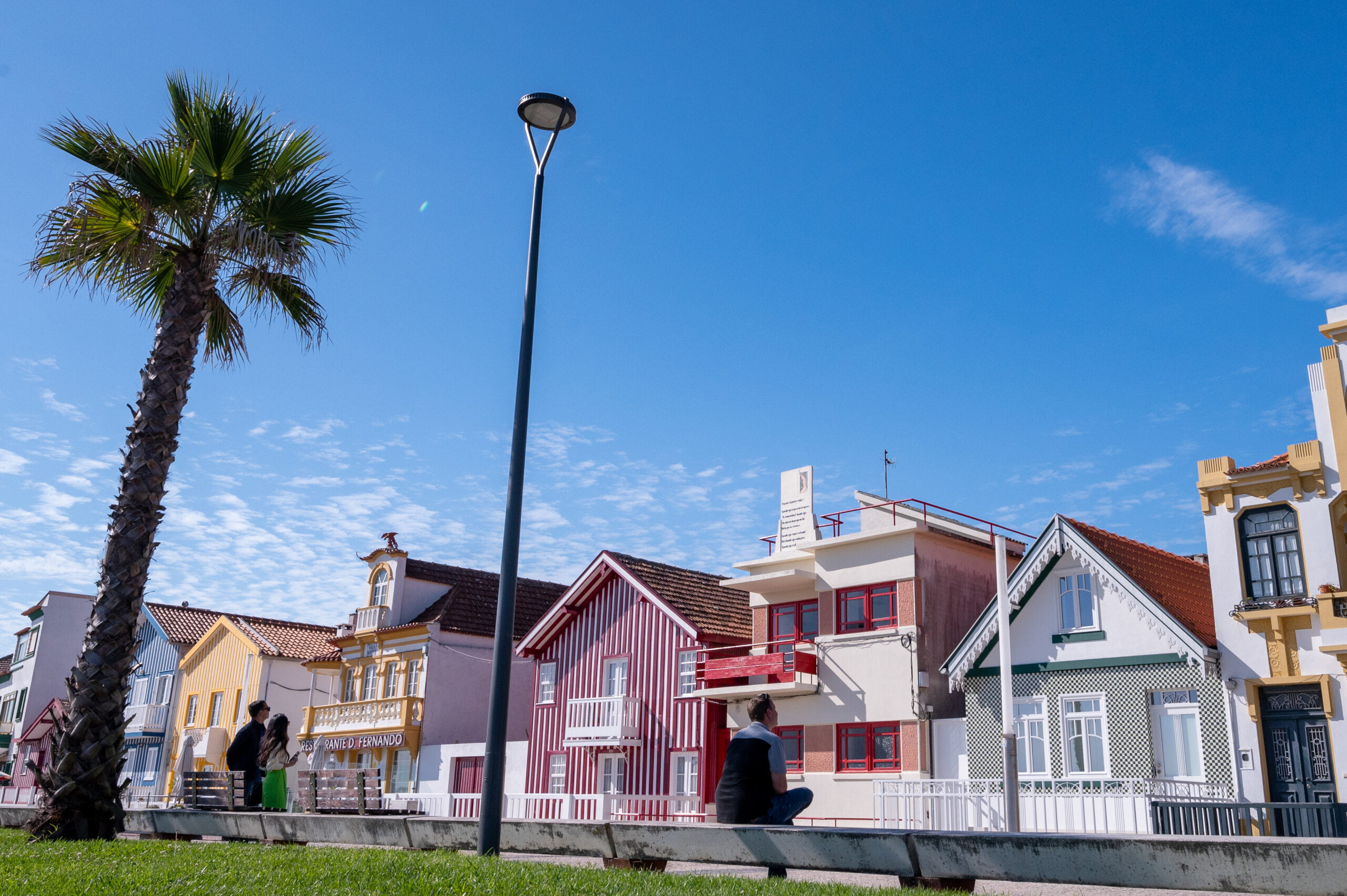
    Bronze sculpture at D-Day cemetery in Normandy France
    “The Spirit of American Youth Rising.”

    If you have time, walk along the shores of Omaha Beach below the cemetery. Make sure to stop in at the visitor’s center for more helpful information regarding those buried here and to view the beautiful infinity pool.  They have volunteers on staff who can also help you locate any loved ones who are buried here.  

    Normandy American Cemetery in Colleville-sur-Mer is a beautiful park-like setting, very peaceful.  A wonderful resting place and memorial to these soldiers.

    Time Spent Here: (~ 1 hour)
    Location: Normandy American Cemetery, 14710 Colleville-sur-Mer, France
    Commute Time to Next Site: This was the final stop, and it was about a 45-minute drive back to Caen.

    The reflection pool at Normandy American Cemetery.
    The reflection pool at Normandy American Cemetery.

    Tips & Recommendations for a Self-Guided Tour of D-Day Sites

    Planning Tips

    • Always check the hours for each museum directly on the museum’s website. Google is not always up to date on its listing for hours and operations.
    • Pack snacks and drinks in the car to keep your energy up in between stops.
    • Make sure you can drive a manual transmission before renting a car in Europe.
    • Organize your day, so you have the most time at the sites you want to see. Then if you can’t make it to all the stops on the list, you will at least have seen the ones most important to you first.
    • Wear layers and sturdy walking shoes.

    How Much Time To Spend Here

    There is so much to see that you could spend days or possibly weeks here, depending on your interests.  However, with only one day, you’ll need to pick the top sights you want to see and save the rest for your next trip. One site I would have liked to have fit into our day was Utah Beach. I guess I’ll save that for my next trip!
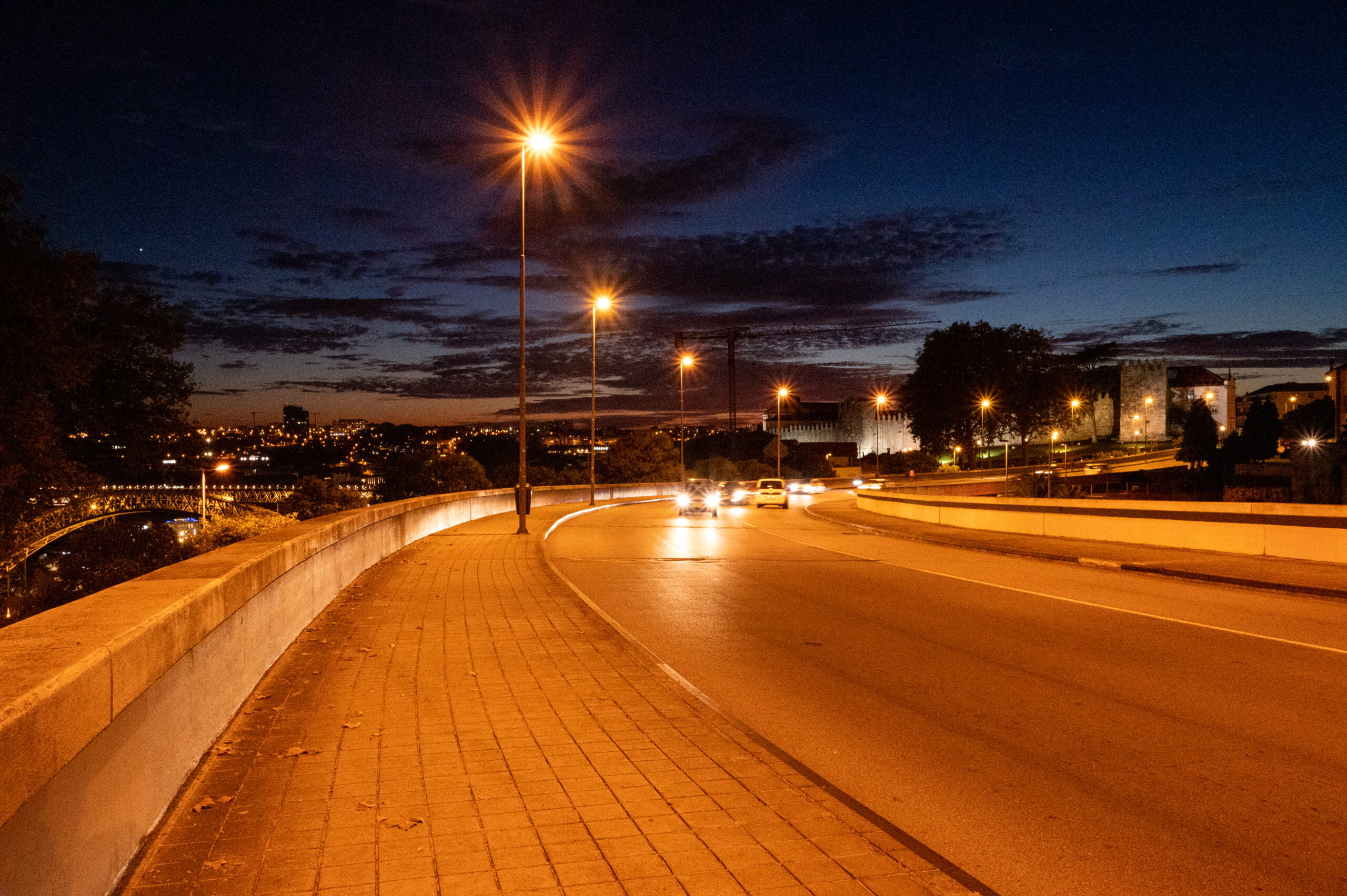
    Getting Here:

    You can take a direct train from Paris’ Saint-Lazare station to Caen. This takes approximately 2 hours, 15 minutes. You can also take a train from Caen to Bayeux if you prefer to stay there.  In Bayeux, bus #70 takes you to many of the D-Day sites if you prefer not to drive.  You can also, of course, book a tour of the sites. Caen also has an airport so if you’re coming from somewhere other than Paris, you might check to see if they have flights that go through it.

    Recommended Apps to Download Before Your Trip

    Google Maps: This invaluable tool will help you get to each destination along your journey. If you plan to do a self-guided driving itinerary, then you will want to install Google Maps on your phone ahead of time and also download it for offline use.

    Normandy D-Day 1944 (by Spot on Locations Ltd): This Normandy D-Day app provides the names and locations for all the various D-Day sites in Normandy. It gives historical details associated with each area and includes over 500 photos and 100 locations. If you like learning more about the history, then consider downloading this app before your trip and looking through the areas you’ll visit and read up on the history associated with each.

    Rick Steves Audio Europe: Consider downloading this app before any trip you take to Europe.  If you enjoy self-guided tours, then you will appreciate this app. Just put your earbuds in, and Rick Steves will guide you on your walking tour to whichever destination you’ve chosen on the app. 

     So say you choose France, you will then see a list of all the audio guides the app has for France.  Look for the one titled “Normandy: D-Day Sites” and listen to this before your trip to D-Day to get an idea about what there is to see and learn more about the history of the region. The app has not only audio walking guides, but also interviews with local experts on a variety of subjects relating to each location.

    crosses at American Cemetery in Normandy.
    Roses and flowers left by crosses. Reminders that they are not forgotten.

    Closing Thoughts on D-Day

    Visiting the D-Day sites in Normandy was like walking through the history books. It is one thing to read about this incredible date in history, but it is something else to see the area firsthand. To see the graves of the thousands of soldiers who lost their lives here, and to read about their individual stories is an incredible and moving way to spend the day.  

    Visiting sites like D-Day or even Auschwitz remind me of the beauty of the human spirit. Yes, there is an ugly side to humanity. However, there is also resilience and a determination to overcome even the worst odds for the good of mankind.

    I hope you plan a trip to visit Normandy, France, and the historic D-Day sites. However, if you can’t do that right now, why not visit a local Veteran’s Cemetery or museum near you, dedicated to those who gave so we could have freedom.  Say thank you the next time you see a veteran, and let’s use our freedom to show compassion and grace to everyone we meet.

    Thank You to All Who Served and Continue to Serve

  • Spend an Unforgettable Day At Mont-Saint-Michel

    On the border of Normandy and Brittany, Mont-Saint-Michel rises above the bay like a bastion. This medieval fortress is chiseled into the granite that formed this small island. One look at it and you can understand its allure. There is something so unique about this little island. Mont-Saint-Michel is just one of the many historical treasures found in Normandy. It may take a little extra work getting here, but the historical significance and beauty of this region are well worth your time and effort!

    Discover for yourself why over 2 million people visit this island every year. This article includes everything you need to plan your visit to Mont-Saint-Michel, whether you’re visiting from Paris or another area of France.  Don’t be put off by the extra effort to visit this remarkable destination. It’s easier than you think!

    What You’ll Find in this Article

    About Mont-Saint-Michel

    Mont-Saint-Michel is a UNESCO Heritage Site. It reportedly dates back to 708. The story is that the Bishop of Avranches had a vision from the Archangel Michael telling him to build a sanctuary here. So one of the first things you might notice when looking up at Mont-Saint-Michel is the golden spire with the Archangel Michael rising high above everything else.

    Benedictines settled in the abbey in the 10th century, where the town began to grow outward on the rocky island, and by the 14th century, it reached the foot of the rock.  It was used as a stronghold during the Hundred Years War and became a symbol of national identity. The Germans also occupied Mont-Saint-Michel during World War II, bringing with them thousands of German tourists seeking to visit this incredible place. So, as you can see, this small island is rich with history!

    mont-saint-michel bay at low tide
    Explore the area around Mont-Saint-Michel at low tide.


    As you explore the village of Mont-Saint-Michel, you will discover what a feat of engineering it is.   The walls are built into the granite rock that makes up the island. This was certainly not the most natural choice of terrain for construction, and that is what makes it so extraordinary!

    The tides at Mont-Saint-Michel are another aspect that makes this island fortress so remarkable. The highest tides in all of Continental Europe are observed here!  Access to the island is restricted during “spring tides.” This is when the tide is the highest. You can view the tide charts for the whole year and also check Mont-Saint-Michel’s website for dates when they are closed

    Arriving at Mont-Saint-Michel

    Whether you arrive via bus or car, you will still need to either walk the remaining 1.5 miles across the causeway to the island from the car park or take the complimentary shuttle.

    Mont-Saint-Michel at low tide
    This is the most water we saw surrounding Mont-Saint-Michel during our low-tide visit.

    Parking at Mont Saint Michel: It costs around 9€ to 15€ to park for 24 hours at Mont-Saint-Michel. Prices vary depending on what time of year you visit. 

    Walking to Mont-Saint-Michel: It is approximately a 40-minute walk (~1.5 miles) from the parking lot at Mont-Saint-Michel to the main entrance into the walled city. There are signs posted along the trail telling you how long from “this” point the walk will be.

    Complimentary Shuttle: You can walk over to the complimentary shuttle area following the signs from the parking lot or bus stop (if arriving via bus) and wait for the next free shuttle to transport you across the causeway. 

    My Recommendation: 

    If the weather is nice and you’re able to do it, I recommend walking. You have beautiful views all along the way to Mont Saint Michel. It gives you time to soak in the size and location of this walled island and the abbey rising from the top. You can always choose to ride the shuttle back at the end of your visit.

    My friend Angela and I chose to walk the 1.5 miles, and although it was a cold day, the walk was beautiful. It helps that it is a flat, easy walk.  There were lots of people out walking with us too.  Oh, and of course, we chose to walk it before realizing that it would be a 40-minute walk in the cold.  However, in the end, I’m glad we didn’t know how long it was, otherwise we would have missed out on admiring and photographing the views as we walked. So skip the shuttle and walk to the island, then take it back when you’re ready to leave. 

    Things to Do at Mont-Saint-Michel

    La Grande Rue

     
    La Grand Rue Mont Saint Michel
    Enjoy exploring the narrow streets of Mont-Saint-Michel.

    Upon arriving at Mont-Saint-Michel, you’ll pass by public restrooms and enter the archway on to La Grand Rue. This narrow street is the main street in the village.  This is where you’ll find souvenir shops, hotels, cafes, and restaurants.  Continue up this street to visit the abbey. I recommend you do that first, then take your time stopping at the shops and sites along La Grand Rue on your way back down.

    Mont-Saint-Michel Abbey

    This is the one attraction you must see while visiting Mont-Saint-Michel.  If you only pay for one, make this it. The historic Mont-Saint-Michel Abbey crowns the top of this rocky fortress. The Benedictine abbey was built around the 10th century and was used as an abbey until the French Revolution when it later became a prison; this lasted until 1863. Then in 1874, it became a historical monument. It took over 1300 years to build the abbey!

    The climb up to the abbey is a steep one. However, it is fascinating to look up at this magnificent medieval structure rising and towering over everything surrounding it.  It also makes your neck hurt!

    looking up at the abbey towering above
    Looking up at the Abbey can be a real pain in the neck!


    Hours & Ticket Information:
     Mont-Saint-Michel Abbey Ticket Prices and Opening Hours

    The price of your ticket includes a guided tour (during certain hours). You can also purchase an audio guide for an additional 3€ and take a self-guided tour. There are a lot of stairs to climb as you make your way to see the abbey. However, the view from the top is worth it.

    Skip the ticket line at the abbey and purchase your abbey tickets in advance

    Mont-Saint-Michel Abbey Church
    The Mont-Saint-Michel Abbey Church as seen from the terrace.

    Terrasse de l’Ouest

    Don’t miss this stop on your visit to the abbey.  The terrace is located outside the abbey church and has incredible views! You can walk down the backside of the abbey from the terrace to return to the main town. I highly recommend you do this! There are also restrooms at the terrace.  Soak in the views before exploring more of this unique island.

    My friend, Angela, met the woman she was studying French with online before our trip, at Mont-Saint-Michel and we toured it together.  It was fun to meet a local and get a chance to learn more about French culture.  The French people I know are warm and funny, and yes, they love food! I love getting to learn about a country from the locals. 

    Travel, and be prepared to have your preconceived ideas forever transformed in the light of reality.

    My friend Angela and her French friend Bernadette
    One of the gifts of travel is friendships made around the world!

    Église Saint-Pierre

    Step inside this small chapel just off the La Grand Rue and enjoy a quiet break.  Make sure to also stop at the cemetery just up from the church.  It is a unique setting with views of the bay below.  This local parishioner’s church provides a more simplistic and less touristy space in which to have a quiet moment. Admire the beautiful stained glass windows as well as an impressive statue of the Archangel Michael slaying a dragon.  You are welcome to join them in mass during its observed hours.

    La Chapelle-Saint-Aubert

    This small chapel was built towards the foot of Mont-Saint-Michel, you can access it via a path near the front entrance to La Grand Rue.  It is best seen during low tide, though, due to its low position. Although you may not be able to go inside, you can look around the outside and take a peek in the windows.

    Explore the Sandy Bay at Low Tide

    Check with the Tourist Information Center to see whether or not there are any guided tours of the mudflats surrounding the island. Also, make sure to check the tide charts and ask the tourist information center about when it is safest to explore.  Even if you can’t take a tour, you will have fun walking around the outside perimeter of the island, examining it from the ground level.

    Views of Mont-Saint-Michel Bay at low tide
    A view of the bay at low tide and the causeway leading up to Mont-Saint-Michel.

    Getting to Mont-Saint-Michel

    You have a lot of options when traveling to Mont-Saint-Michel. I will focus on the two most common options.

    Fastest Route to Mont-Saint-Michel from Paris by Train:

    If you’re coming from Paris to Mont-Saint-Michel on the train, the quickest route will take you about 3.5 hours to get to Mont-Saint-Michel.  Take the train from Paris’ Montparnasse Station to Rennes and then a shuttle bus from Rennes to Mont-Saint-Michel. You can book the entire trip ahead of time online. Prices start around 50€ to travel from Paris to Mont-Saint-Michel (one-way). 

    In addition to passing through Rennes, there is also an option that takes you to Dol de Bretagne. Then it’s just a 20-minute shuttle from there to Mont-Saint-Michel. The travel times are similar for both options leaving Montparnasse Station. Visit SNCF’s website to view a timetable for the day you wish to travel. 

    You don’t have to book your shuttle bus from Rennes Station to Mont-Saint-Michel ahead of time either. You can always purchase your ticket at the Rennes train station.  They schedule shuttle buses in conjunction with the arriving trains from Paris. Upon arrival at the station, you can purchase your ticket for the next departing shuttle (or purchase ahead of time online at SNCF). The ticket price from Rennes station to Mont-Saint-Michel is 30€ for a round trip ticket.

    Here are some additional train options, as well as shuttle bus information if you’re arriving from Pontorson.

    Car Rental Option from Caen:

    Another option when traveling from Paris to Mont-Saint-Michel is to take a train from Saint-Lazare Station to Caen. If you plan to visit other sites in the Normandy region of France, such as historic D-Day sites, then Caen makes an excellent starting destination for your trip to Mont-Saint-Michel.

    This is the option I chose for my trip.  My friend Angela and I planned to see D-Day sites the following day, and we also had a flight scheduled from Caen to Toulouse, so it made the most sense for our trip. Our car rental experience turned out to be far more of an adventure than we had planned! However, renting a car in France is pretty much the same process as renting one in the States. 

    They drive on the right side of the road, so there’s no learning curve for American drivers.  You do, however, need to know that when you rent a car in Europe, you will get a car with a standard transmission, unless you specifically request an automatic (subject to availability). So if you don’t know how to drive a clutch, learn before you go, or plan for another option.

    With Google Maps, it is easy to navigate from Caen to Mont-Saint-Michel via their freeway systems.  We had no issues getting lost, and there are lots of signs along the freeway for the major tourist sites too. We used our rental car to drive to all the D-Day sites, and the flexibility it provided is worth any extra hassle, in my opinion.

    Side Note: If driving from Paris, make sure to choose the “avoid tolls” option with Google Maps, so you aren’t surprised by any huge toll fees. I’ve read they can be surprisingly high.

    Thoughts on Driving vs. Public Transportation:

    It depends where you are driving from, but for the Normandy region of France, unless you’re booking through a tour company, I think renting a car makes the most sense.  A car gives you the most flexibility, and it is an easy area to navigate using Google Maps.  

    It will depend on your trip plans.  If you’re going to be in the area for 2-3 days at a minimum, then renting a car probably makes the most sense, however, if you are planning this for a day trip only, then you may want to take the train and shuttle option or book through a tour company. If you’re traveling solo, this will most likely save you money. However, if you’re in a group, then a car rental might save you some money.

    Approximate Travel Times: 

    • Train from Paris to Rennes leaving from Montparnasse Station: Approximately 2 hours
    • A shuttle from Rennes to Mont-Saint-Michel: Approximately 1 hour 10 minutes
    • Train from Paris to Caen leaving from Saint-Lazare Station: Approximately 2 hours and 15 minutes
    • Drive time from Caen to Mont-Saint-Michel: Approximately 1 hour 40 minutes
    The cloister at Mont-Saint-Michel Abbey
    The cloister at Mont-Saint-Michel Abbey.

    Tips for Your Visit to Mont-Saint-Michel

    Best Times to Avoid the Crowds:

    Spring to Fall is the busiest time to visit Mont-Saint-Michel, with summer being the absolute peak.  If you can visit in the off-season (mid-October to February), you will be rewarded with fewer crowds.  However, as I discovered during my visit there at the end of October, it can be frigid, so plan ahead and wear layers. Pack a scarf and gloves if you plan to visit during the colder months of the year.

    Plan to arrive between 9 a.m. and 10 a.m. to avoid the crowds brought in on the tour buses.  This is especially important during the peak season.  When I visited in October, I didn’t arrive until around noon, and although crowded, it wasn’t unbearable.

    Weather is typically the best April thru September. If you plan to explore outside and photography is one of your primary reasons for visiting, then I’d research weather patterns ahead of time to give yourself the best chance of good weather.

    Where to Eat:

    If you don’t plan ahead and pack a lunch or don’t plan to wait until you are off the island to eat, here are a couple of options for dining while at Mont-Saint-Michel. Just know that the prices and quality at most establishments here reflect the tourist-generated economy. In plain English: Prices are high, and food quality tends to be lower.

    Au Pelerin: This is one of the more reasonably priced options off the Grand Rue at Mont-Saint-Michele.  They serve baguettes and pizza and are a casual family-friendly establishment.

    La Sirene: If you wish to try the local dish of galette bretonne (which I recommend you do while in the area), then this is a good choice. The galette bretonne is a savory style crepe filled with ham and served with an egg. It is a simple but delicious meal!

    a galette bretonne
    Make sure to eat a galette bretonne while in the area.

    What to Wear:

    Wear comfortable walking shoes as the climb up to the abbey is a steep one with lots of stairs.  Additionally, if you plan to explore the area surrounding the island during low tide, you’ll want shoes that you’re okay with getting a little muddy.  

    If coming during the spring or fall, you’ll want to pack a light jacket, at least, plus a scarf.  Even in summer, I’d pack a rain jacket.  In the late fall and winter, you’ll want to dress in layers and wrap a scarf and gloves and perhaps a hat too.

    How Much Time Should You Plan to Spend Here:

    Plan to spend around 4 hours here.  That allows you time to explore the village, tour the Abbey, and grab a bite to eat if you wish.  You can also take time to explore the mudflats if the tide is out.  However, make sure to check with the tourist office and tide charts first!

    Consider spending the night if you want to see the tide at different levels and experience what it would be like to live on a small fortified island.  You will also get a chance to explore the village at night and early in the morning without the crowds.

    Mont-Saint-Michel at Night:

    You may want to consider visiting here in the late afternoon and then plan to stay for the sunset and views of Mont-Saint-Michel lit up at night. Seeing the island’s lights reflecting off the surrounding sand and water makes for beautiful photographs and treasured memories.

    Final Thoughts and Tips

    This small island is built out of a large mound of granite. This means that they only had one way to go–up!  This is the way you will go too. The streets are narrow because once again, this is a small town built on a small island chiseled from rock.  So expect it to get crowded and to take things slow. 

    Your climb up to the Abbey is a rather steep one, especially towards the top, but take it slow and stop for breaks as you need to.

    The goal is not to speed through this medieval village, but instead to take it all in, slowly meandering through the streets, stopping at whatever strikes your interest.  Mont-Saint-Michel is a unique destination. I have not visited any other place like it. So give it some time and try to imagine what it was like 500 years ago.

    If you’d like to read about Angela and my surprising discovery in the parking lot at Mont-Saint-Michel, then read Misadventures in Normandy France. If you have any questions about the trip that aren’t covered here, please don’t hesitate to ask!

    Bon Voyage!