author.travelffeine.com

Category: Oregon

Oregon State is a beautiful state with unique volcanic features, coastal towns, and incredible outdoor spaces. Come see all there is to discover within this Pacific Northwest state.

  • An Incredible One Week Oregon Road Trip

    This one-week Oregon road trip explores some of the unique and lesser-known places to see in Oregon State. I wrote this itinerary based on my own road trip leaving from Seattle.  Customize as needed to guide you from your home to each of these places to see in Oregon.  I think one week is enough time to see each of the features listed on this Oregon road trip itinerary. However, some might complete it in less time, and others might prefer a slower pace.  For example, my hubby and I did all of the things listed on this itinerary, except the side trip to Crater Lake, in 4 nights and 5 days of driving.

    Oregon Road Trip Summary

    • Time Needed to Complete: About 1 week
    • Leaving From: Seattle, WA
    • Type of Activities: Hiking, Camping, Photography, Drone Photography, Exploring Oregon’s Natural Wonders
    • Approximate Total Miles (if leaving from Seattle): ~1400 miles

    Map of This Oregon Road Trip

    Click on the map to get driving directions to each location, feel free to customize according to your start/end points. 
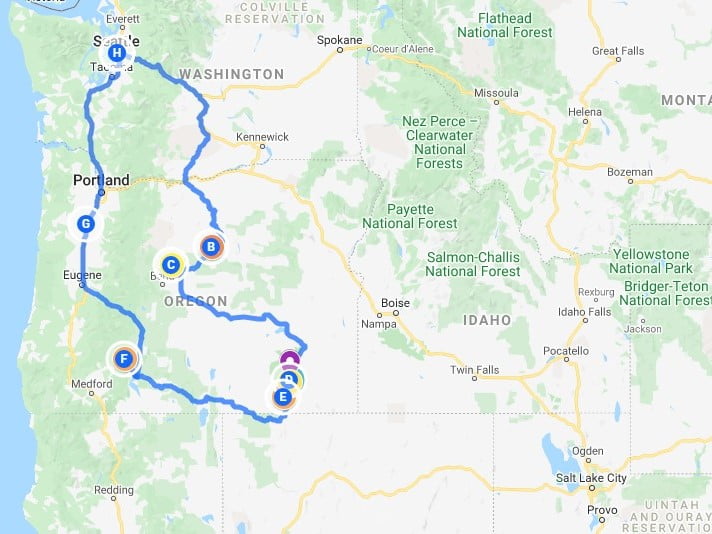
    Overview of Stops on this Oregon Road Trip

    • The Alvord Desert

    • Oregon’s Painted Hills

    • Smith Rock State Park

    • Crater Lake

    • In-N-Out Burger (Yes, this is considered to be an important stop on this road trip.)

    The Alvord Desert
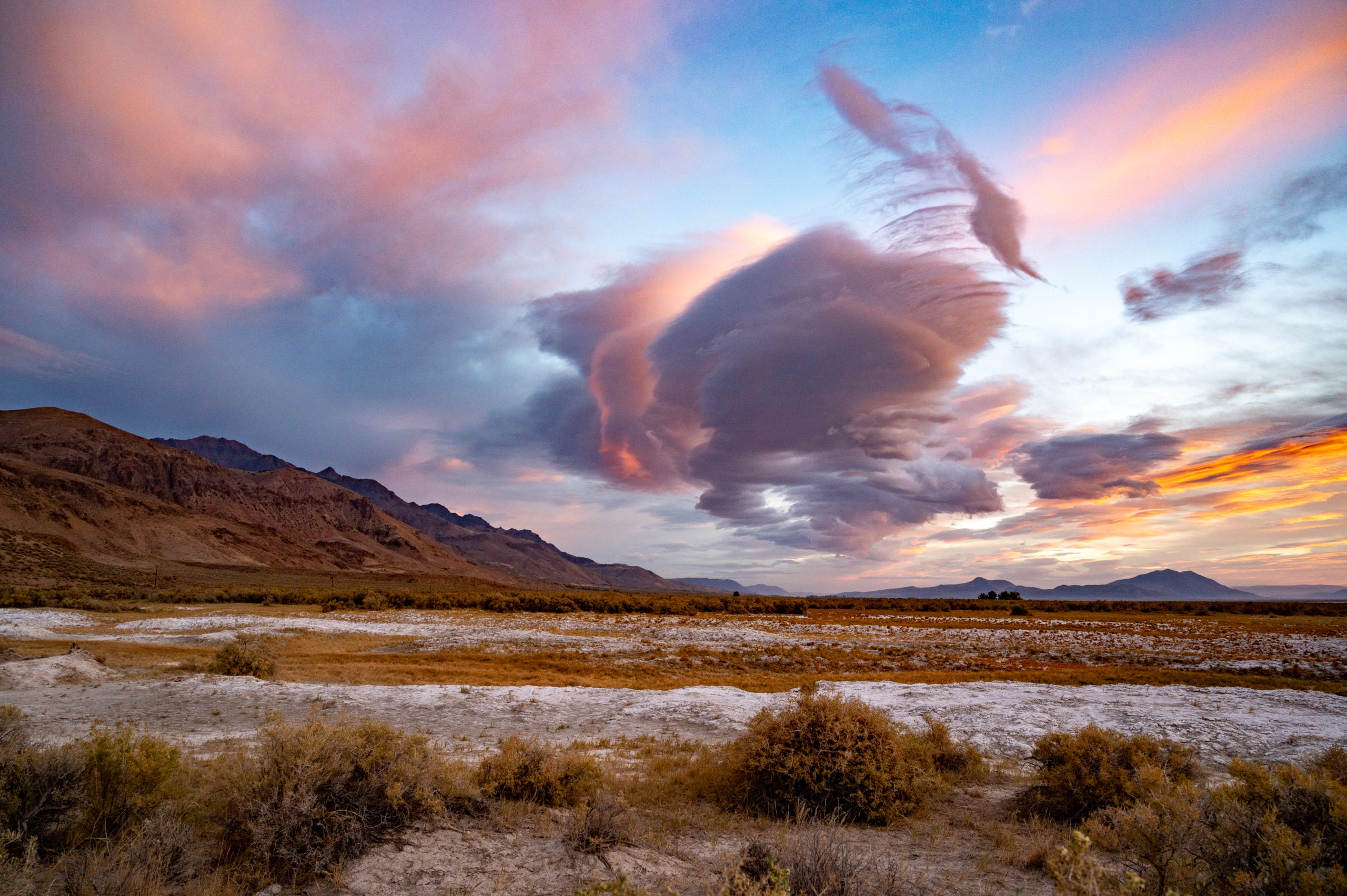
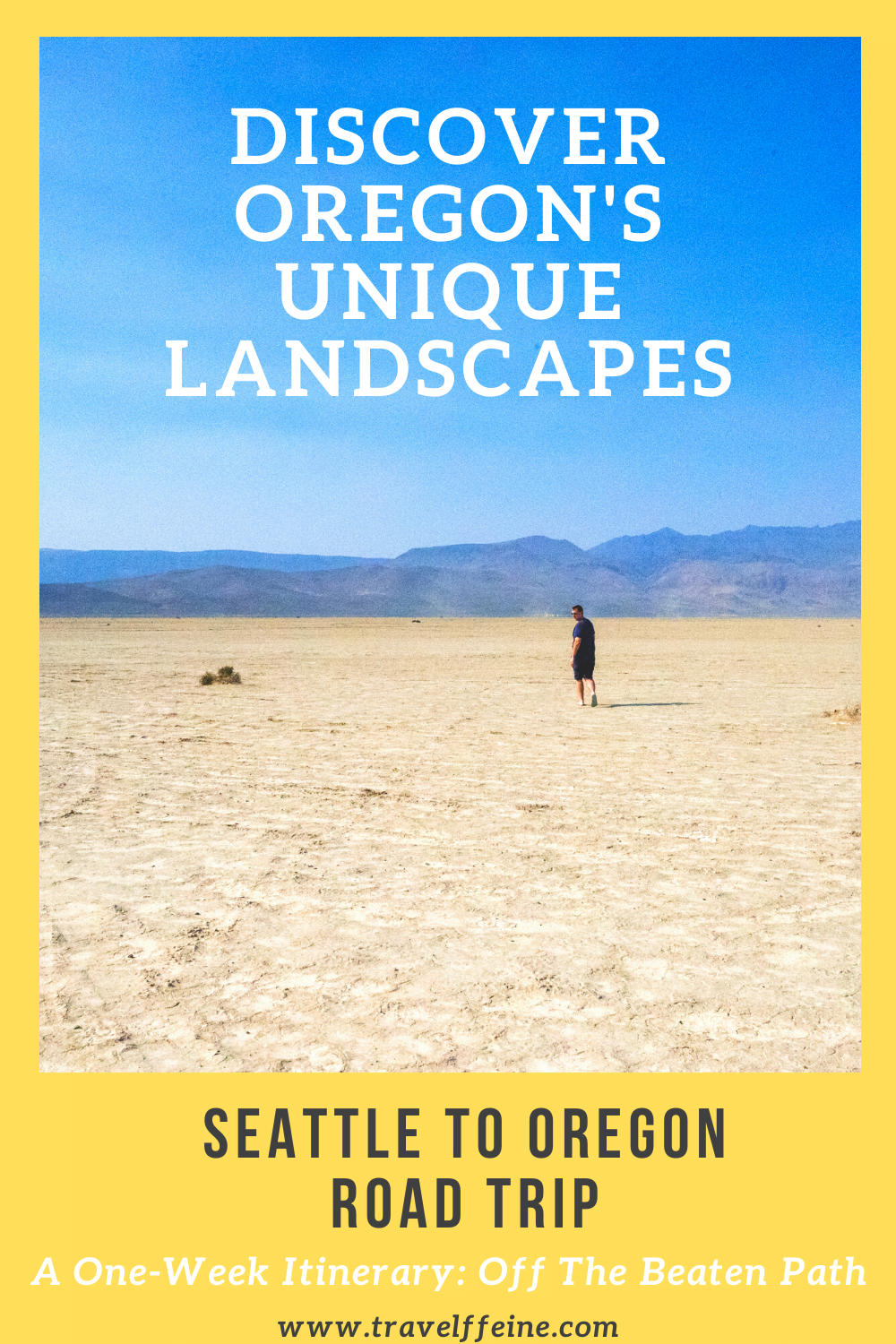
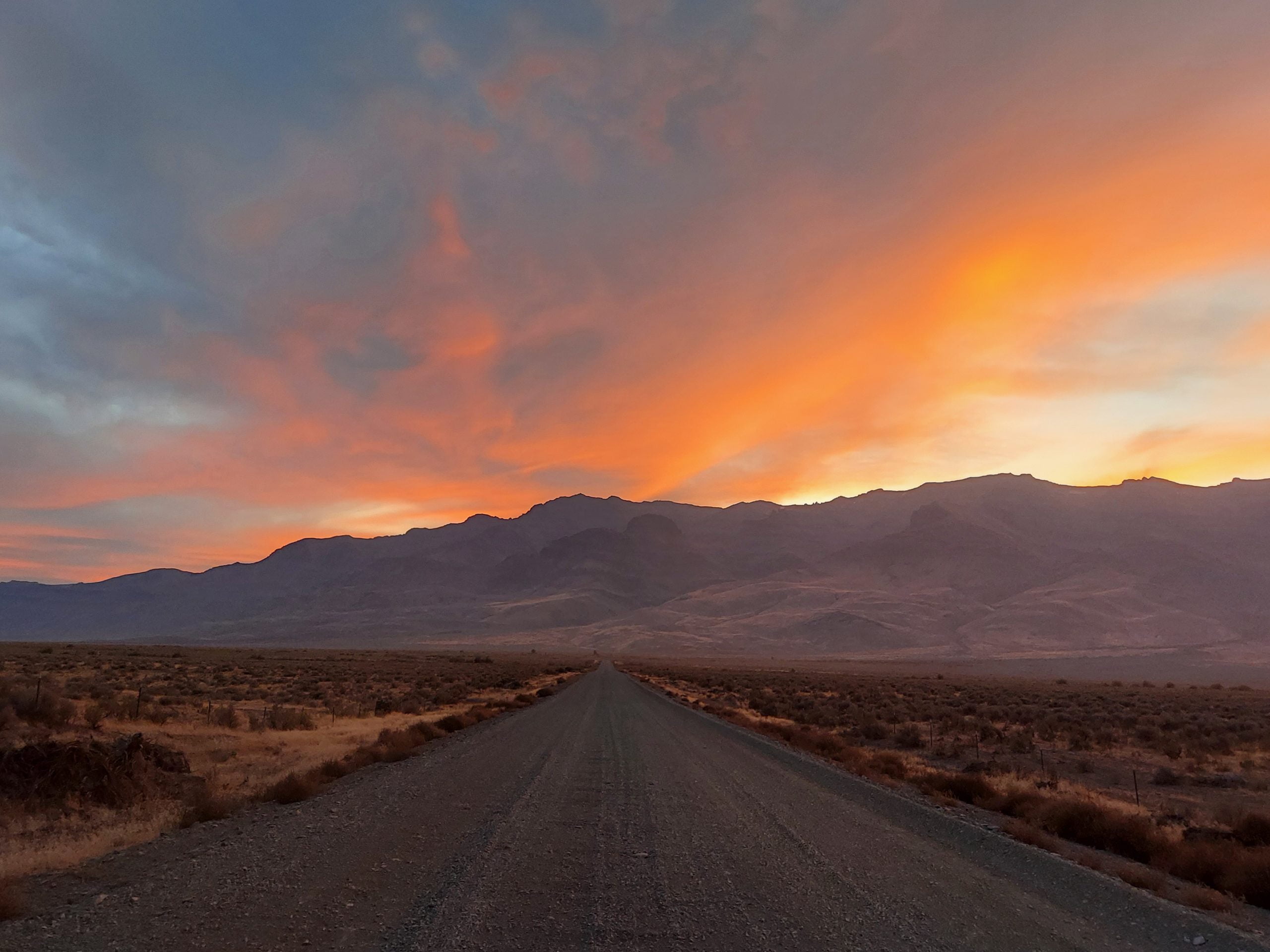
    This remote section of Oregon State is rugged and beautiful! Enjoy the drive through sagebrush dotted hills, deep canyons, mountain views, and gravel roads leading to the middle of nowhere.  Relax in the Alvord Hot Springs, embrace your inner race car driver, and soak in the desert sun. This is a destination for the adventurous! It is a highlight on this Oregon road trip itinerary and is a stop you won’t soon forget! Read my post Exploring Alvord Desert and Hot Springs in Oregon for more tips on planning your adventure here.

    The easiest way to navigate to the Alvord Desert is using the Alvord Desert Hot Springs address and then going into the desert from there.

    Alvord Desert Hot Springs
    36095 E Steens Rd
    Princeton, OR 97721

    *Optional Add-On: A day spent exploring Steens Mountain. There are beautiful hikes and viewpoints at Steens Mountain which borders the Alvord Desert. If the weather is good, consider spending the day exploring the scenic Steens Mountain Loop Road.  However, as with the Alvord Desert, prepare for driving on unpaved gravel roads with rugged terrain and little cell service.  

    Oregon’s Painted Hills
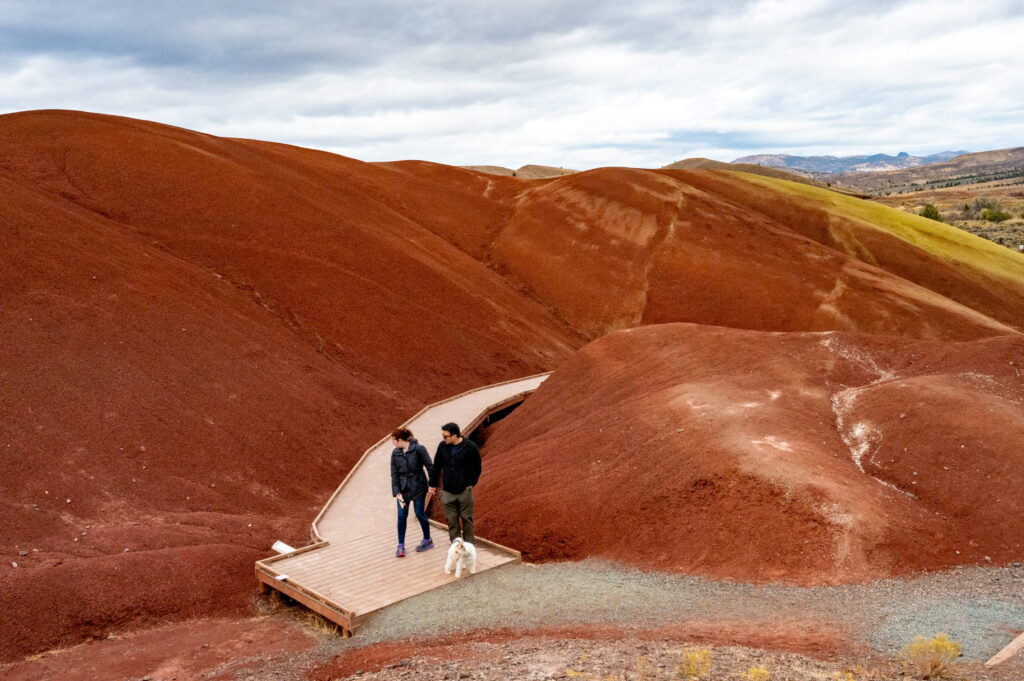
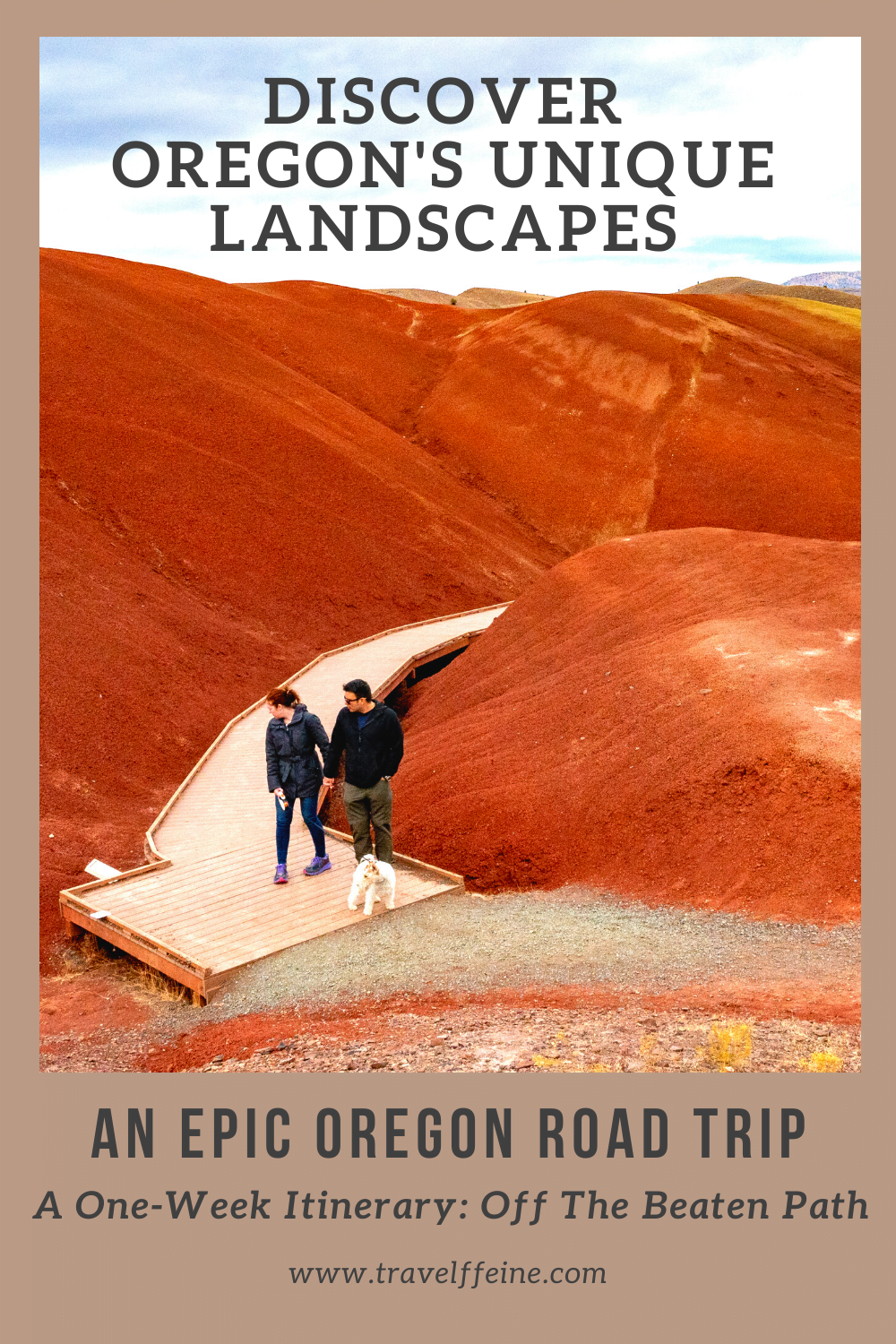
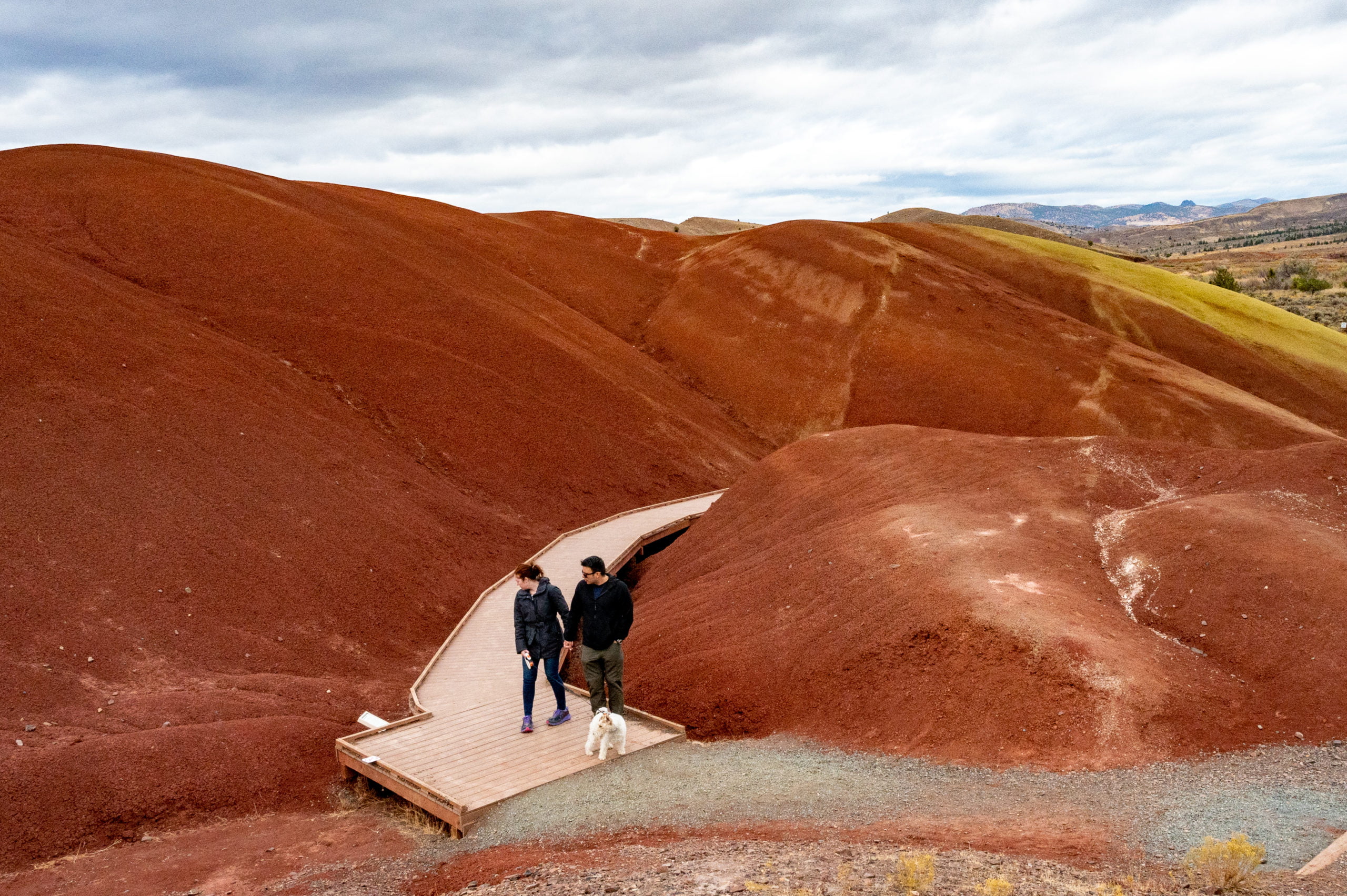
    couple with dog at painted cove

    Oregon’s Painted Hills is just another in this state’s selection of unique destinations. These brightly colored hills located in the John Day Fossil Beds National Monument are the result of ancient volcanic activity.  You’ll journey past rolling farmlands and suddenly find yourself surrounded by hills painted in bright reds and yellows. They really are an unusual find amongst the ranches and green pastures. This Oregon road trip stop surprised me as I never realized Oregon had so many fascinating natural features. I was left with a greater appreciation for this beautiful state.  Read Visiting Oregon’s Unique Painted Hills for more information on how to get there.

    John Day Fossil Beds National Monument- Painted Hills Unit
    37375 Bear Creek Rd
    Mitchell, OR 97750

    Smith Rock State Park
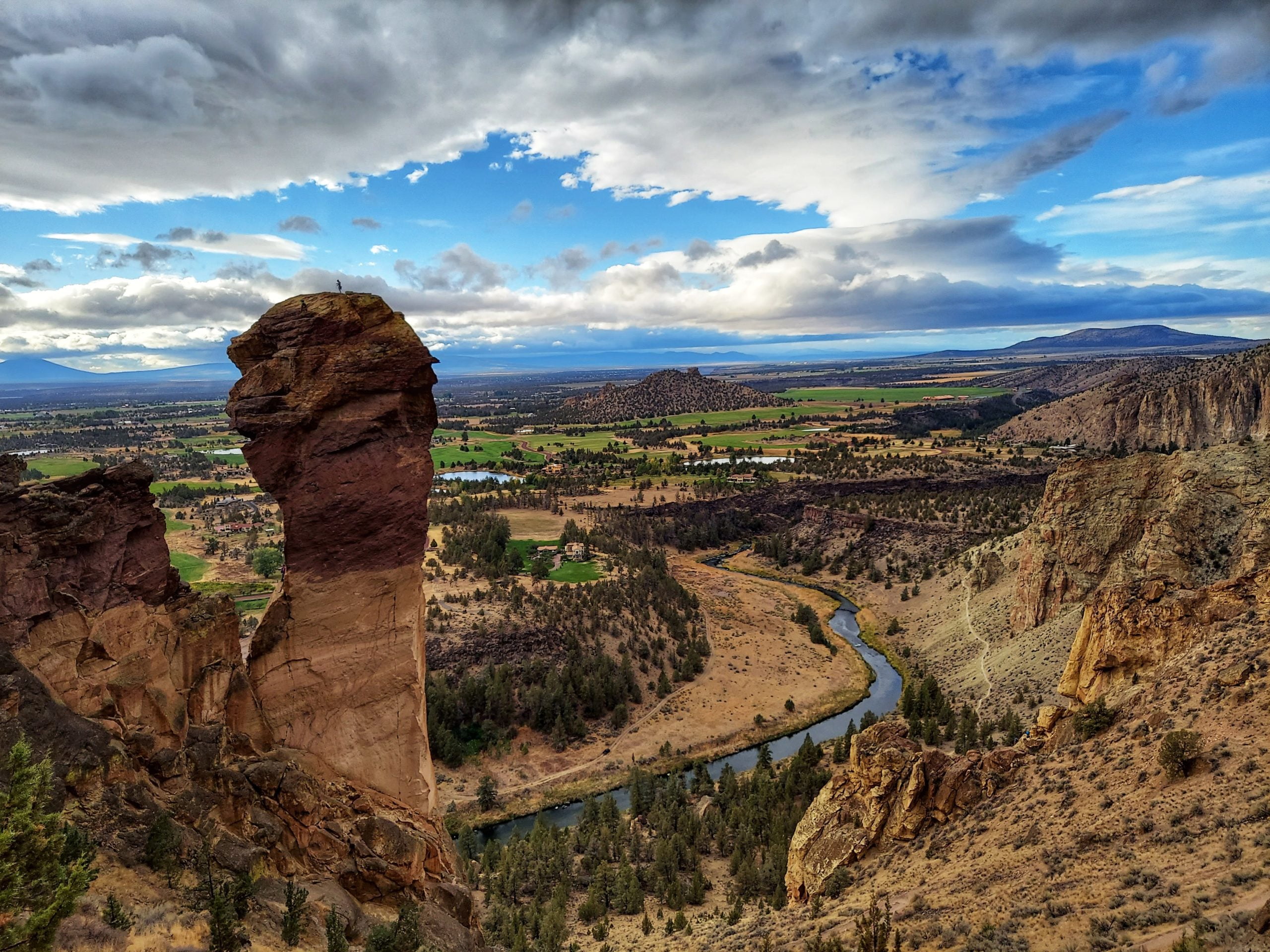
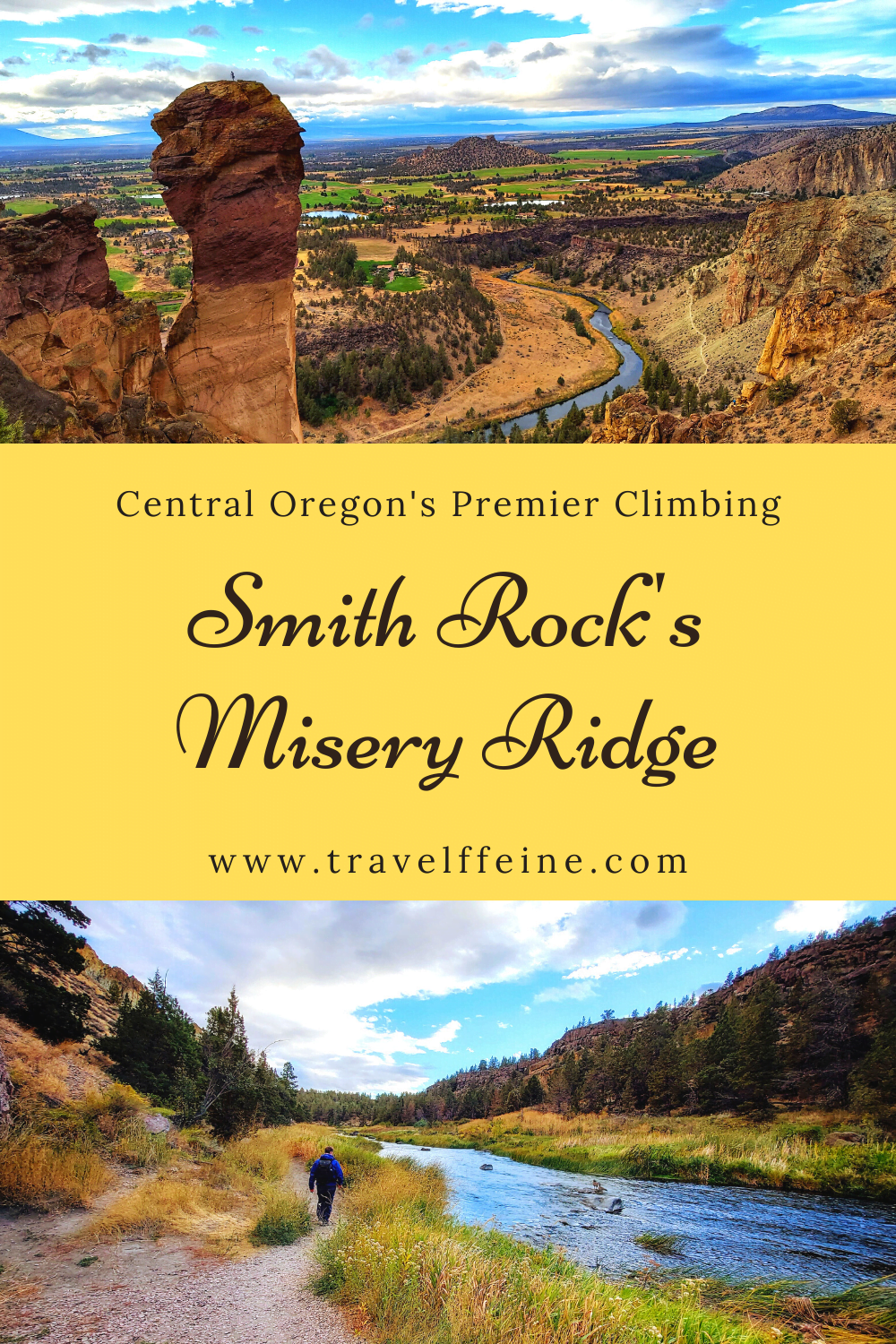
    You will love the rugged beauty of Smith Rock State Park. It’s craggy rock cliffs, sweeping vistas, and beautiful river walks winding through the park. If you’re into rock climbing, hiking, or mountain biking, this is the park for you! Smith Rock State Park was a favorite stop of mine along this Oregon road trip. We only spent a few hours here, but I could have spent days photographing its beauty and exploring all the trails. Read more about our hike at Smith Rock State Park: Misery Ridge Loop Trail.

    Smith Rock State Park
    Terrebone, Oregon 97760

    Crater Lake
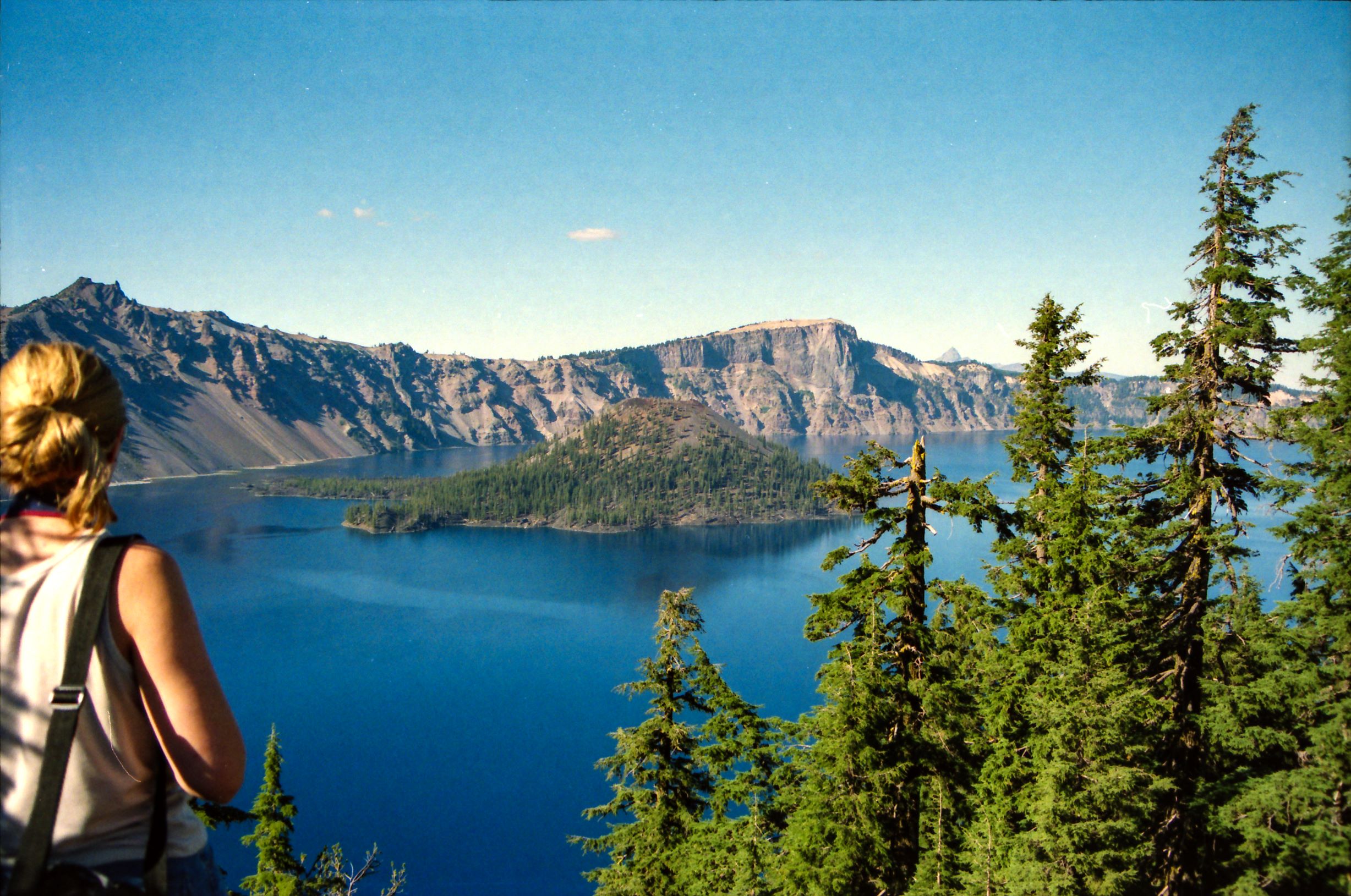
    My hubby and I did not stop at Crater Lake on this latest Oregon road trip due to our time constraints. However, if you’ve got a week to make this road trip and you’ve never visited, then I recommend you include it in your route.  

    Just a word of warning before you go, the journey to Crater Lake is not for the faint of heart. You drive up the mountain with nail-biting drop-offs. Keep your eyes on the road, and soon you’re rewarded with gorgeous views of this volcanic lake.  It is such a unique natural setting that everyone should see it at least once.  I visited years ago on another road trip with a friend, and its gorgeous blue waters are a beautiful sight to behold. 

    Read the Department of Interior’s blog on 12 Things You Didn’t Know About Crater Lake for further inspiration. You can also visit the Crater Lake National Park website for information on road conditions, where to stay, and what’s open.

    Crater Lake Observation Station
    Rim Drive
    Crater Lake, OR 97604

    In-N-Out Burger
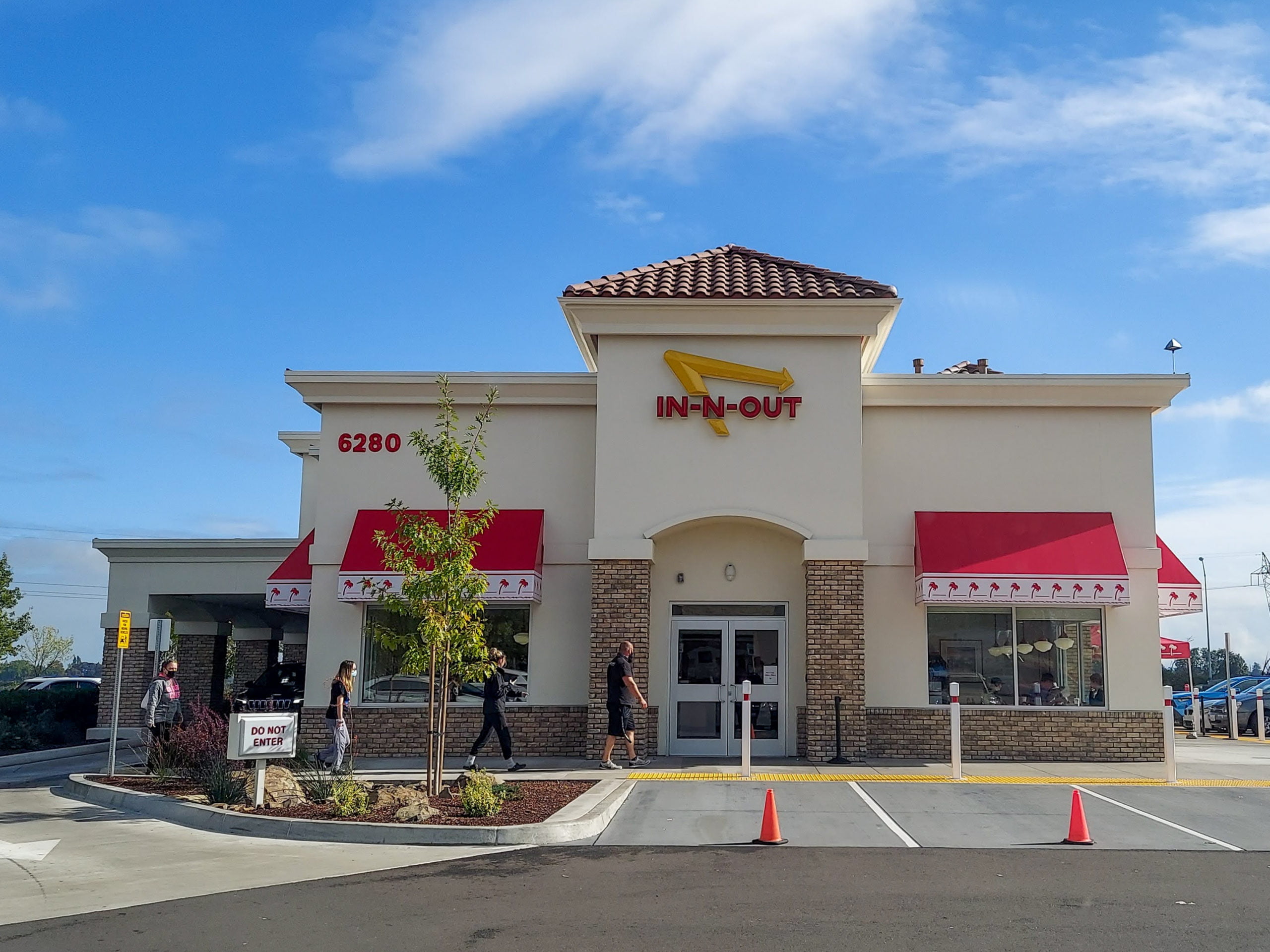
    If you’re from California, you might not understand why an In-N-Out Burger is highlighted as a stop along this Oregon road trip.  However, if you’re a Washingtonian like me, who loves In-N-Out, you’ll get it.  There are no In-N-Out Burgers in Washington State and it was only recently that we had the option in our neighbor state of Oregon.  So, I knew that no road trip to Oregon would be complete without including at least one stop at In-N-Out!  If you’ve never had In-N-Out then you’re missing out! 

    I love their cheeseburger with a strawberry milkshake.  Sometimes I ask for it animal style which means they give me a yummy grilled onion relish in place of the raw onion on the regular cheeseburger.  One of the things I love about In-N-Out Burger is their consistency.  I know no matter which location I stop at I will get a consistently good burger at consistently low prices.  Just trust me on this, and give them a try.  I’m starting to salivate just thinking about them, so I’d best move on.

    This is the address for the location we stopped at on this road trip.

    In-N-Out Burger
    6280 Keizer Station Blvd
    Keizer, OR 97303

    Final Thoughts & Tips

    Download an offline map of Oregon before your road trip. Since a lot of this road trip passes through Oregon’s remote areas, there is little to no cell service near many of these destinations.  Having an offline map is a huge help, especially when navigating places like the Alvord Desert.  Also, a printed road atlas is never a bad idea either, but at a minimum, have the offline map.

    Pack road trip essentials like extra water, road tunes, snacks, a good spare tire, jumper cables, an emergency kit, and a portable charger for electronic devices.  Also, make sure to keep your car fueled up as gas can be few and far between in some of these areas.  The Alvord Desert is the most remote of the destinations, so make sure to read my guide for visiting there and my tips for preparing for the trip. You may also want to read AAA’s guide to road trip car maintenance to make sure your car is ready for your trip.

    Places to Stay
    We camped at Alvord Desert, and then stayed in a hotel in Princeton for our visit to Oregon’s Painted Hills, and also stayed in a hotel in Redmond, Oregon for our visit to Smith Rock State Park.  There are two campgrounds at Crater Lake National Park open only in the summer. Check 
    the park’s website ahead of time for the latest information and how to reserve a spot.

    Talk to locals if you are unsure about areas that are okay to drive in, or for information about weather conditions, and places to see.  Locals know their area and are usually more than happy to share their first-hand knowledge.

    This Oregon road trip itinerary really highlights the variety found in this state. Prior to this road trip, most of my visits to Oregon were relegated to the coast, which is beautiful. However, there is so much more to Oregon than just its coastline.  I think you will be surprised to discover the natural beauty and unique volcanic features along this Oregon road trip.  

    Happy Exploring!
  • Exploring Alvord Desert and Hot Springs in Oregon

    On a recent road trip to Oregon State, I mapped out a route to explore areas of Oregon I’d never traveled to before.  The first destination was the Alvord Desert and Alvord Hot Springs.  The drive out to the Alvord Desert felt like I was driving to the middle of nowhere (I guess I kind of was).  It was unexpected to discover this playa with its natural hot springs bubbling up in the far southeast corner of Oregon State. 

    This area of Oregon is remote and rugged. It was beautiful to camp out under the desert sky and see the billions of stars above, to watch the sunrise across the desert landscape, and to pretend I was a rally racer as I zigzagged my way across the desert.  It was a unique experience and one I recommend you try for yourself!

    About the Alvord Desert

    The Alvord Desert is a 12-mile long by 7-mile wide playa.  A playa is a dried-up lake bed. So at one time, there used to be an almost 100-mile wide lake here!  That’s pretty cool! This dried up desert basin is now covered with cracked earth, and the occasional rain the region gets is moved across the playa by the wind. This creates small pools and also a muddy sticky surface you don’t want to drive across.

    Additionally, the Alvord Desert is rich in geothermal resources and has several hot springs surrounding it.  The Alvord Hot Springs is the most developed and easiest to access.  Also, it’s important to note that not all hot springs are safe for humans.  The Alvord Hot Springs is funneled into the soaking pools with a temperature regulator to ensure it never gets too hot.

    Getting to the Alvord Desert

    You can drive to the Alvord Desert either from the north, coming from Burns and New Princeton via Hwy 76, or coming from Fields when arriving from the south end. 

    If coming from Hwy 76, you’ll turn onto the Folly Farm Rd/Fields-Denio Road and drive about  40 miles on an unpaved, rough gravel road. Plan to take this portion of the journey slowly as there are a lot of washboard areas along the road. It takes about an hour to get there from the turnoff on Hwy 76.

    If coming from the town of Fields, it is about 22 miles on the Fields-Denio Road, about 10 of which is unpaved. This is definitely the easier of the entrances due to having less unpaved road to travel on.

    Alvord Desert Access:

    The two easiest places to enter the desert floor are either via Frog Springs (there are pit toilets here), or you can pay the Alvord Hot Springs to use their private access road.  It was $10/vehicle at the time of my visit. Contact them ahead of time for current costs. 

    *Please note that the Frog Springs access is probably best suited for an SUV or other high-clearance vehicle. It really depends on how much traffic or rain the area has received. It seemed fine when we went, even for a car, but this isn’t always the case. Check conditions for yourself and then decide based on your vehicle and comfort level.

    Alvord Hot Springs: 36095 E Steens Rd, Princeton, OR 97721

    Camping Options

    Camping in the Alvord Desert Playa

    You can camp in the Alvord Desert for free using public access roads such as Frog Springs.  However, if you choose to access the desert via the Alvord Hot Springs property, you pay a fee to use their access road. Camping in the desert is still free, but you pay them to use their road. 

    Frog Springs has pit toilets and a desert map with other information on rules and restrictions in the Alvord Desert Playa.  If you’re in a car and are concerned about low-clearance levels when driving, you may want to pay the access fee and use the Alvord Hot Springs road instead.  The Frog Springs road can get a little rougher for entry.

    If camping in the Alvord Desert, “pack it in, pack it out” is the motto of the desert. Leave it the way you found it. Make sure to bury human waste in a small hole 6-8 inches deep and at least 200 feet from the water. That is the policy according to the Bureau of Land Management.

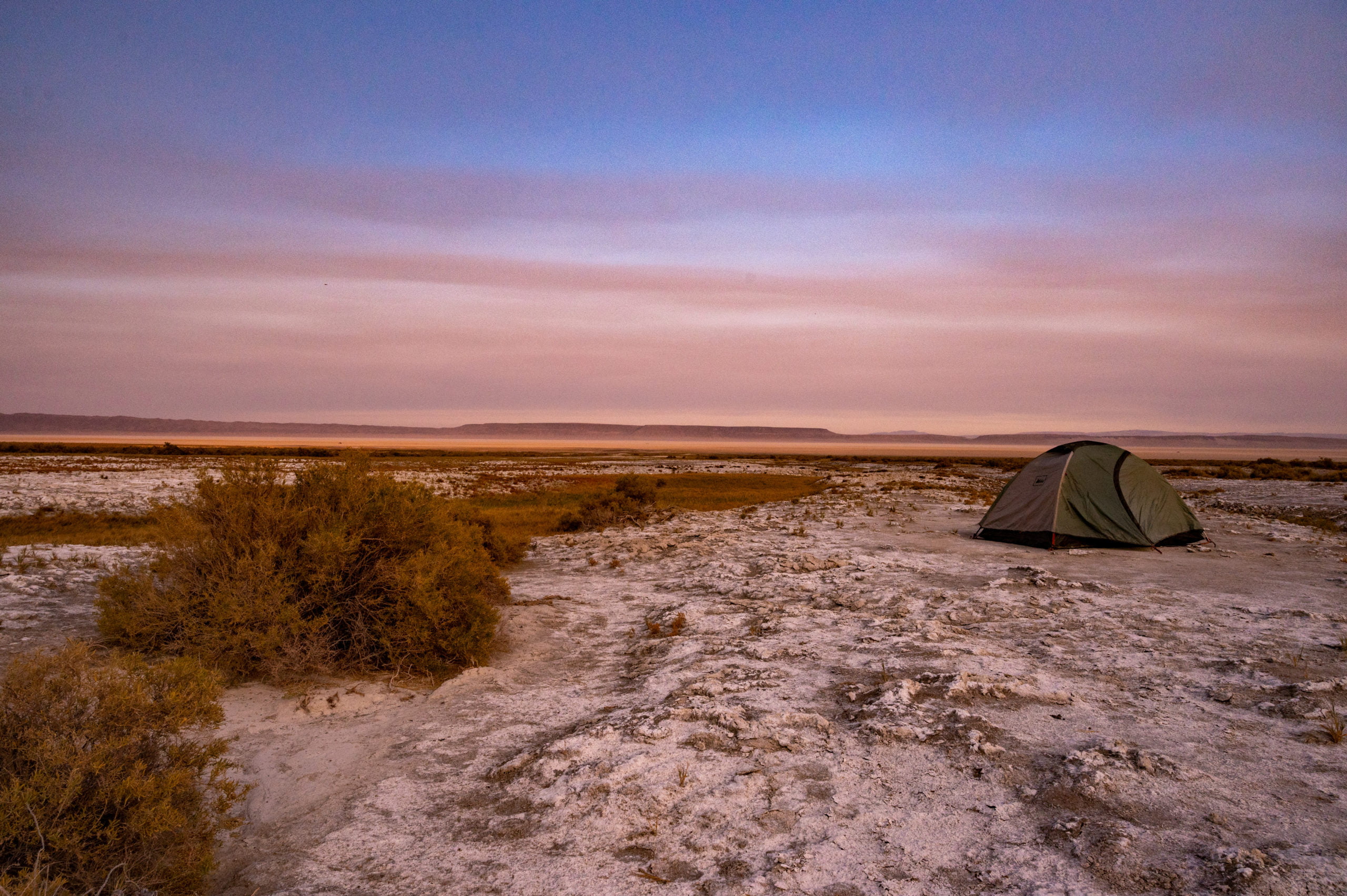
    tent in desert at sunset
    The ground is white from the mineral deposits due to geothermal activity.

    Camping Tips for the Alvord Desert:

    Camp toward the outer perimeter, be aware during the day of where you park too. You don’t want someone speeding across the desert to hit you.  Due to the dust kicked up when driving, it can obscure visibility, and that, combined with the highspeed of those racing in the desert, can make it hard to see. We parked off to the side away from the areas we could clearly see people racing.

    If you know it’s going to rain, I recommend forgoing camping in the Alvord Desert.  Since the playa is flat, water can move from one side of the desert to the other very quickly. I read reports of people who went to sleep on dry ground, and in the night, the winds blew water from the opposite side of the desert to their campsite, and they woke up to find themselves stuck in the mud.  Be aware of weather conditions.
     
    It also gets very windy in the Alvord Desert, and there is very little to shield you from the wind. You may want to position your tent next to your car and use it as a shield from the wind if possible.  
    sleeping in car sunrise in the desert
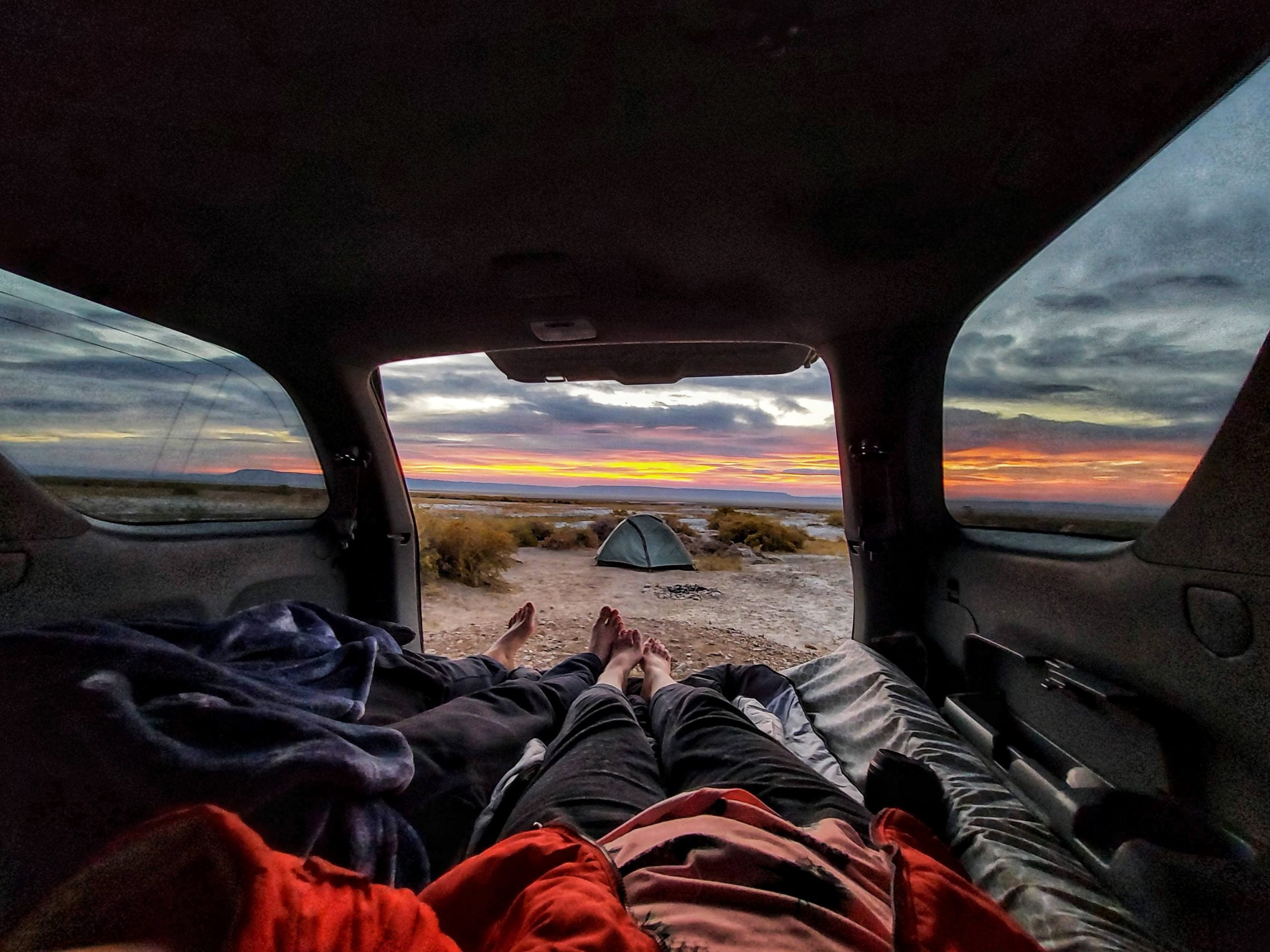
    You can also plan to sleep in your car if it’s too windy or cold.

    Camping at Alvord Hot Springs

    If you pay to camp at the Alvord Hot Springs, you can access the desert via their road at no extra cost. You also have unlimited access to the hot springs for the duration of your stay.  Additionally, they have garbage and recycling options as well as a heated restroom. There is no potable water or showers, though. They do sell some supplies in the reservations office during business hours. 

    Campsites: 

    There is a gravel parking lot on your left after you drive through the Alvord Hot Springs entrance.  You can park here and camp in your vehicle or pitch a tent directly in front of the rocky parking area in the dirt.  However, they also have numbered campsites you can find on a road that goes past the office building.  

    These are the best choice for tent camping and trailer camping as it feels less like a parking lot and more like actually camping in the desert.  Book these ahead of time, as they fill up, and then you’re left with the parking lot option. At the time of our visit, it was $20 for a one-person campsite and $40 for 2-8 people.

    Bunkhouses:

    Besides campsites, Alvord Hot Springs also offers bunkhouses with beds to rent on a nightly basis. Bring your own linens and pillows as these are not provided.  Think of it as camping, but without the tent and you get a bed too. You still need to provide everything else.

    Visiting the Alvord Hot Springs

    Whether you choose to camp at the Alvord Hot Springs campground or not, consider visiting the hot springs for a warm soak in a rustic but beautiful setting.  Since we camped at Alvord Hot Springs, we had access to the hot springs for a full 24 hours. We chose to visit the hot springs in the morning before our trek into the desert, and it was a beautiful time of the day for a soak. We also had the hot springs to ourselves, which made it feel more remote and special.

    There are no showers at the Alvord Hot Springs, so keep that in mind when planning your trip.  There is a restroom by the reservation office, and there is a small changing area on the backside of the hot springs where you can hang your towels. This is not a luxury spa. It is very bare-bones.  Rustic. However, it is a unique experience that I felt added to our day spent in the desert.

    Also, it’s important to note, towels are not provided, and clothing is optional.  So, if you are visiting the hot springs with your family, you may want to check at the hot springs first to make sure it’s empty or that people are wearing clothing. 

    During my visit, it seemed easy enough to use the hot springs when others weren’t around. The evening was the busiest time as visitors who paid only for road access, and hot springs access came in off the desert for a soak and then left again later that night.

    Spending the Day in the Alvord Desert Playa

    After our soak in the hot springs, we packed up our stuff and headed down the access road to the Alvord Desert. We spoke with the woman in the office before leaving, who advised us to drive straight a way out before turning to the left or right as there is an area mainly to the left when facing the desert that is a runoff for the hot springs and your car can easily become stuck.

    Quick side note: You’ll get an access code when you pay at the reservation office to open a lock on the chain blocking access to the private desert road.  

    We made sure to drive only where the ground appeared dry and where there were clear signs that others had driven there as well.

    You do not want to get stuck in the desert.  I read of people doing that, and it sounds like an awful experience. It is expensive to get a tow in this remote area, and you don’t have many options.  So play it safe, don’t drive where it’s muddy, and stick to the areas toward the inner part of the desert rather than the outer corners.

    Things to Do in the Alvord Desert

    Race Across the Desert

    This is why many people come here.  It’s an open area that is ideal for racing. Landspeed records have been made here.  However, I don’t recommend you come here and drive as fast as you can. It is dangerous, and people have died in the Alvord Desert from racing accidents.

    You don’t really have to drive that fast for it to feel fast.  I was cruising across at 35 mph, and it felt way faster!  It’s a strange experience to have no frame of reference, no lines, and no road.  It feels a little unsettling and also oddly fun.

    cloud of smoke from desert racer
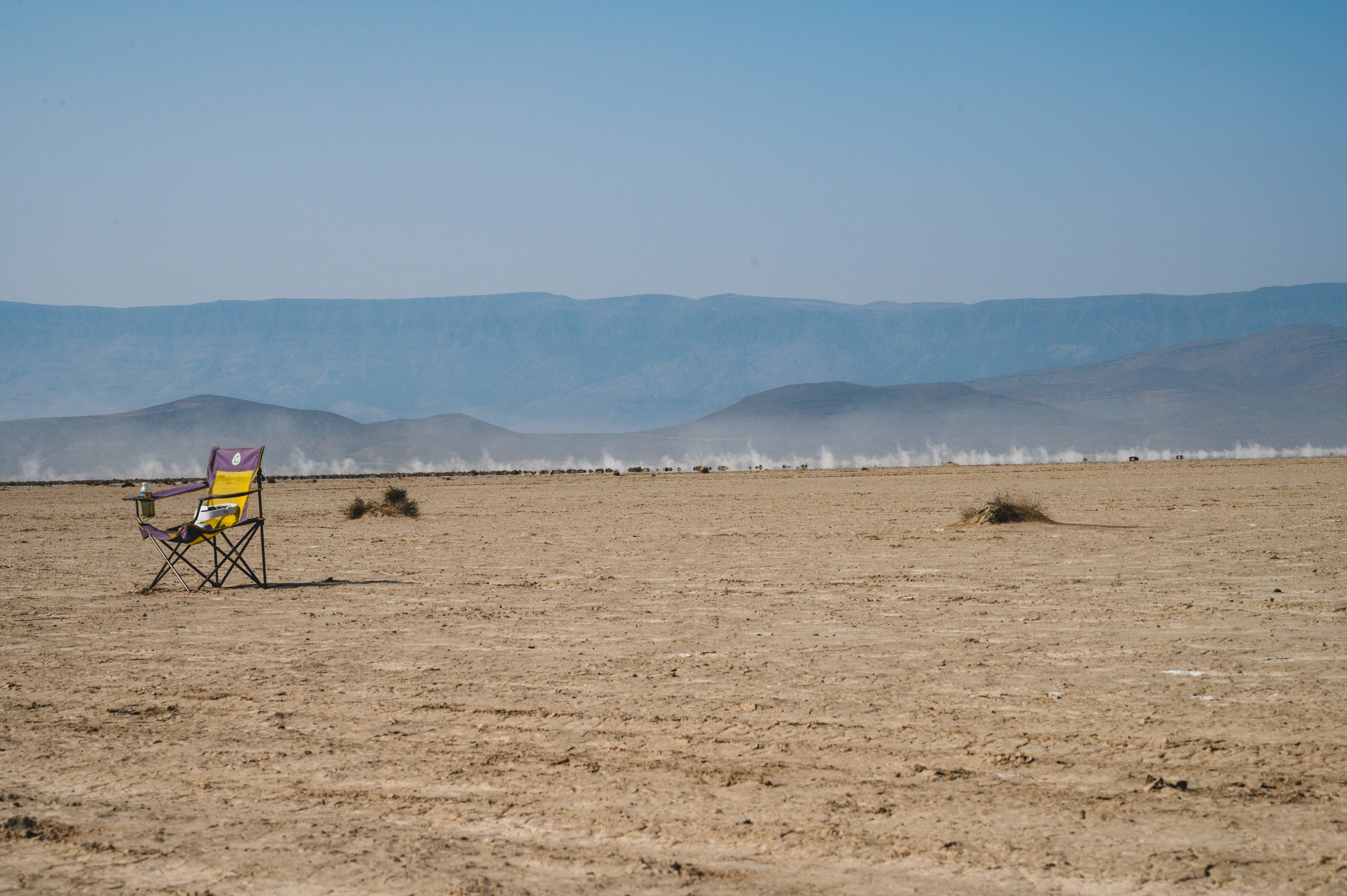
    The dust cloud from a distant car racing across the desert.

    Fly Drones

    This is a great area where you can safely fly your drone. If you want to practice with your drone in an area with no power lines or buildings, or obstructions, you’ve come to the right place. Obviously, maintaining the same safety, you would flying a drone anywhere else.  Don’t fly over crowds, don’t fly higher than the FAA guidelines, always keep it within line of sight, and so on.

    Camp

    As mentioned above, camping in the desert is a fun experience. You have incredible stargazing at night as well as the unique experience of camping in an open playa. 

    Remote Control Toys

    Another fun thing to bring with you is remote-controlled vehicles. If you have kids, they will enjoy racing these without any obstructions.

    Bicycling

    Yep, I know it seems strange, but people actually come here and cycle in the desert.  I’m not sure I want to do it, but others seem to enjoy it.

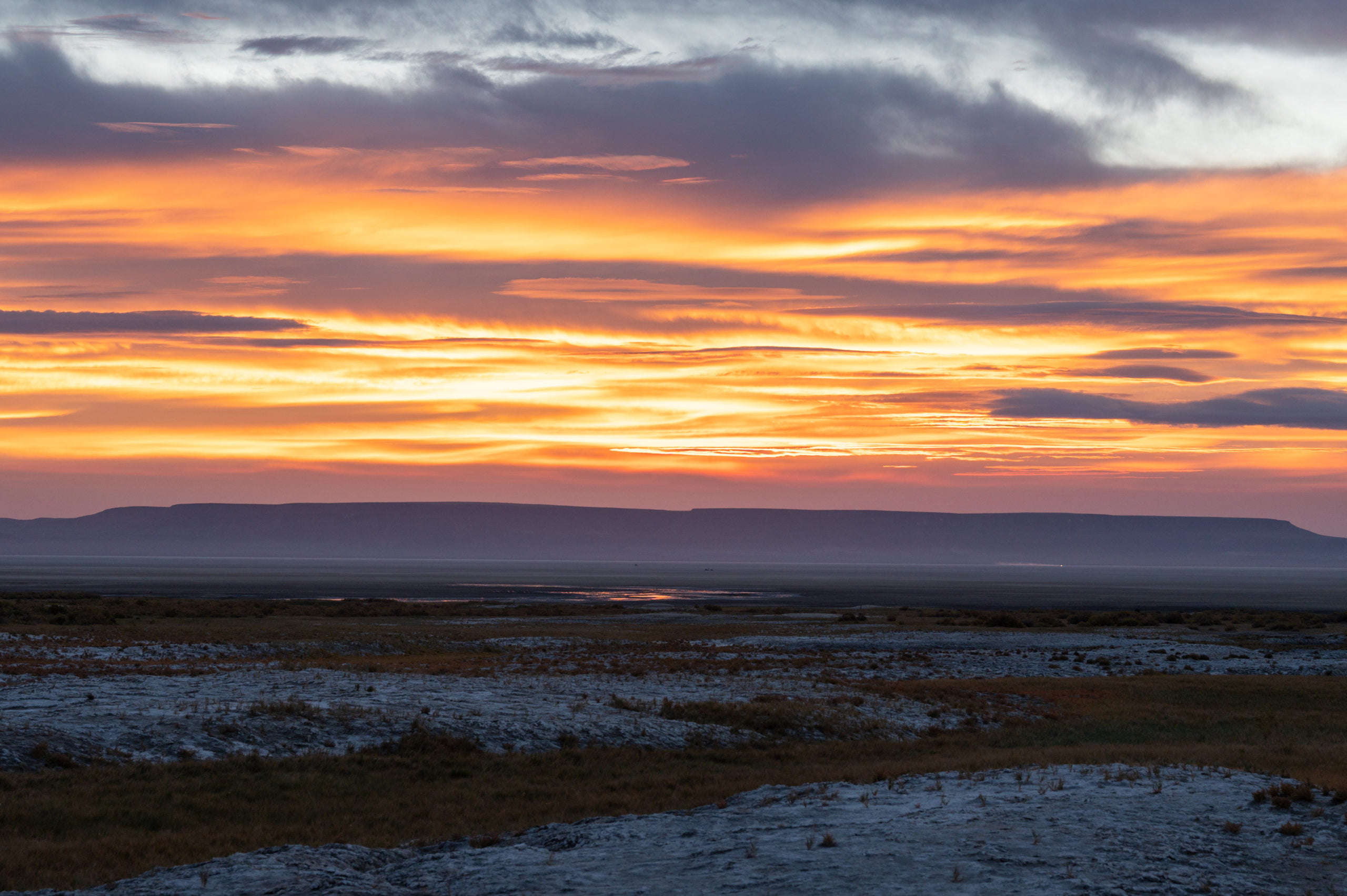
    sunrise Alvord Desert
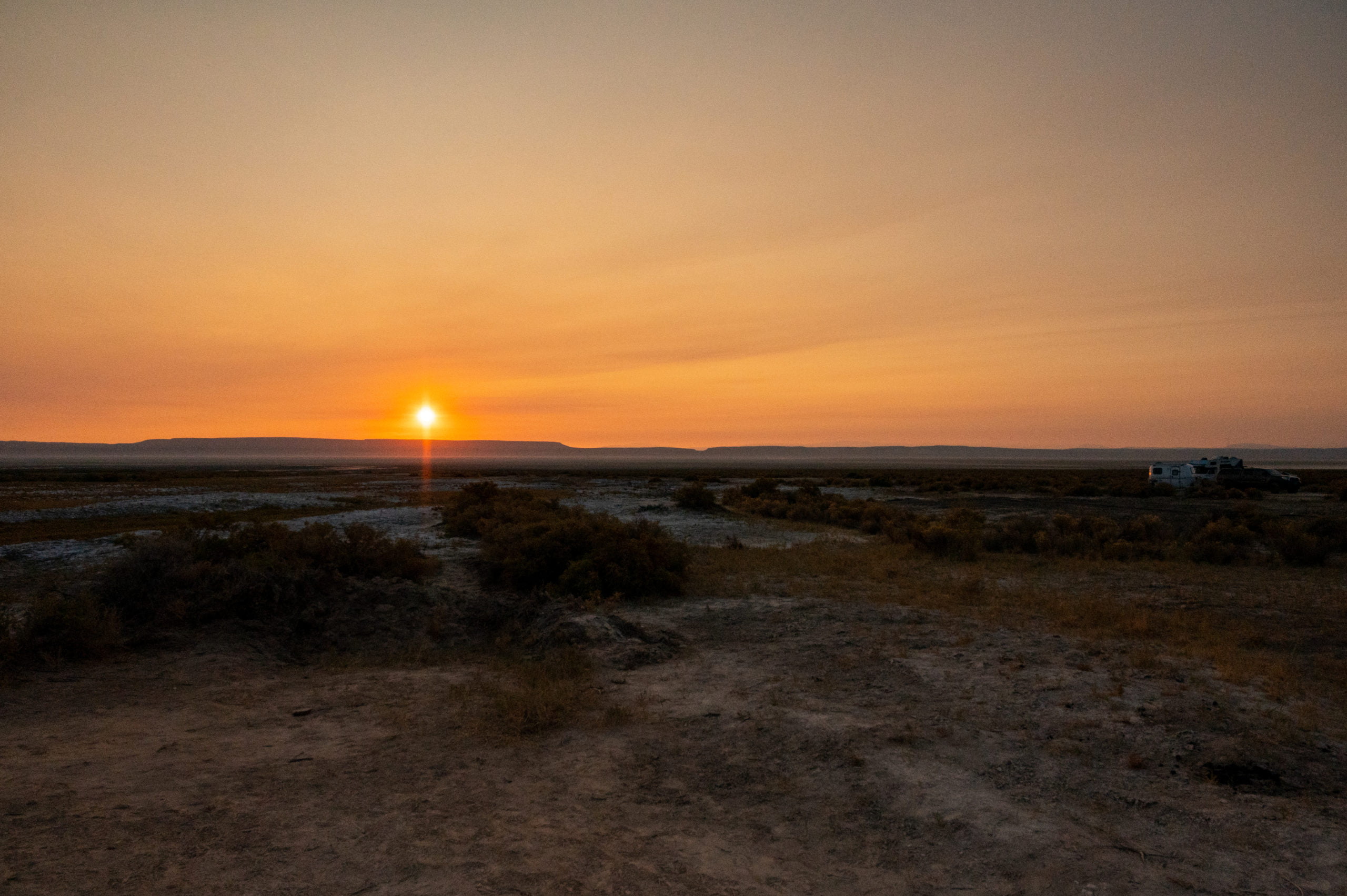
    Sunrise over the Alvord Desert.

    Watch the Sunrise

    This was probably my favorite experience, to watch the sunrise over the desert. Well, sunsets are pretty gorgeous here too, but I guess there’s something about seeing the sun as it rises and covers the playa floor with color. The crisp morning air and a cup of fresh coffee combined with the sunrise is a pretty perfect way to start the day!

    Watch Kite Boarding and Kite Buggies

    One of the unique things I saw here were people on kite buggies. They’re little go-karts attached to a sail, which the rider controls to harness the wind and propel them across the desert. Land sailing and kiteboarding are similar activities people also enjoy here. If you have the opportunity to try it, you should.

    Stargazing

    Bring a telescope or binoculars for stargazing. Even if you don’t have these tools, you’ll still enjoy outstanding views of the stars. The Alvord Desert has very low light pollution, so the stars seem to jump out everywhere as far as you can see.

    Where Can you Drive

    There are some areas of the Alvord Desert that are privately owned. I worried about going where we weren’t supposed to, but it wasn’t an issue for us. We had plenty of room to explore and never came across an area that seemed off-limits. When I asked the woman at the Alvord Hot Springs reservation office, she indicated I didn’t need to worry about it, that their family-owned most of the land not managed by the government.

    Most of the private land is in the western section of the desert, so if you’re concerned about driving into the private land areas, try to stay on the east side of the desert.  You can read more on BLM’s website as well as see their maps for the boundaries. However, I wouldn’t overthink it too much. You can clearly see where other people are congregating and driving.

    Tips for Enjoying Your Visit

    Food

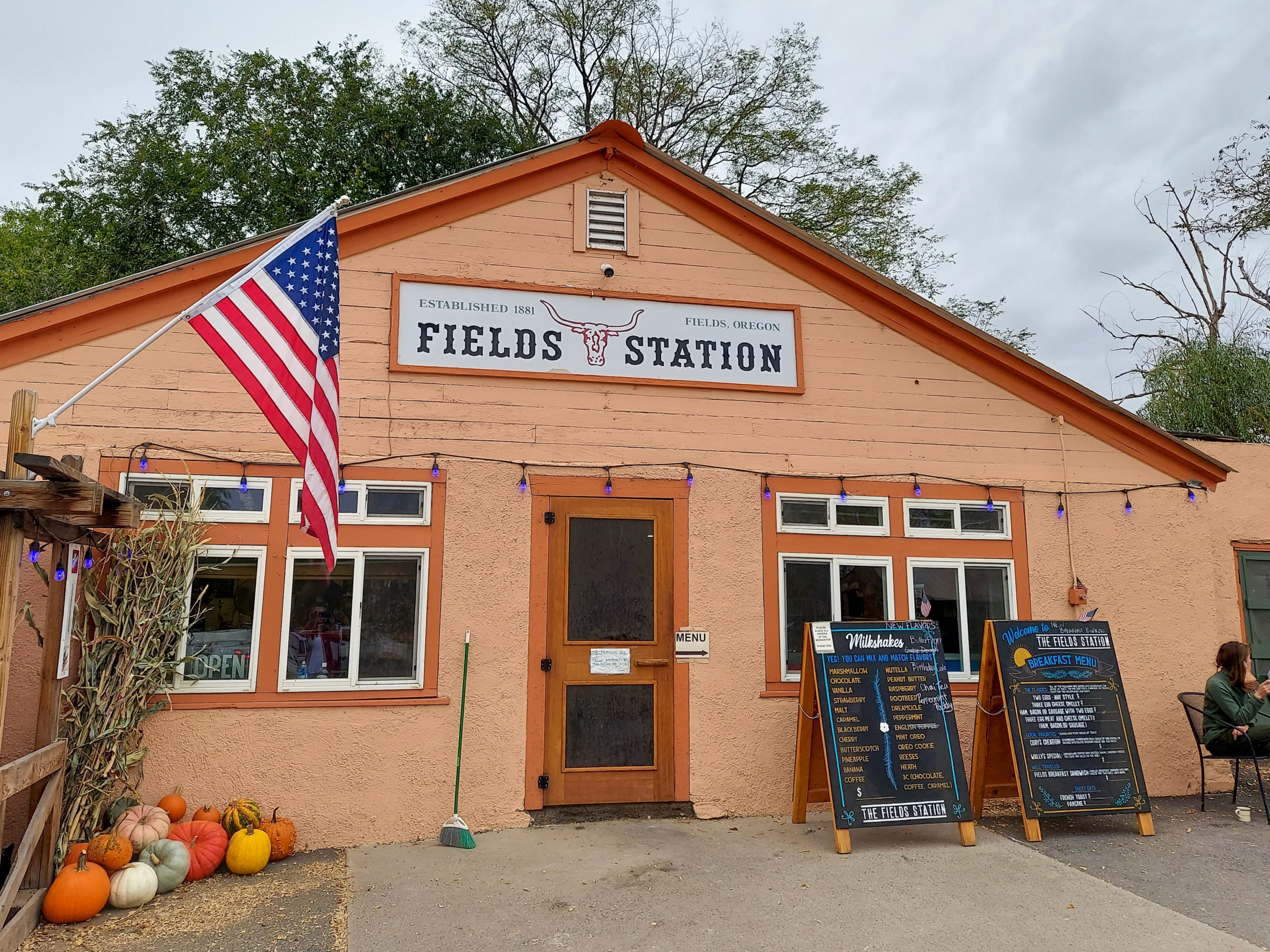
    Make sure to stop at The Fields Station for an amazing milkshake, and if you’re hungry, they serve up some pretty great burgers and breakfast too!  They are the closest gas station and convenience store to the Alvord Desert.  It takes about 30 minutes to drive from the Alvord Desert to the Fields Station.

    Bring food, plenty of water, and a camping stove if you plan to camp. Bring your usual camping gear and supplies, and if you need anything extra, make sure to stop in Burns or Fields first.

    Fuel

    Make sure you fuel up before you make the last stretch out. For most travelers, this probably means fueling up in Burns.  Other than the Fields Station, there are no other gas stations close by, and the station in Fields closes early. 

    The Fields Station near the Alvord Desert
    Stop at the Fields Station for a delicious milkshake! I had one for breakfast!

    Check Tires

    The gravel road leading to the Alvord Desert is rough with a lot of washboard areas.  It was a really rough ride coming from the North off Hwy 78.  Make sure your tires are in good condition and properly aired up.  Take it slow and watch out for traffic. 

    Finding Your Way

    Drop a pin on Google Maps for whichever access road you use so you can point your car in that direction when returning from a day spent driving in the desert.  The desert is wide open and can be a little disorienting, so having a pin to help point you in the direction you need to go to leave can be useful.  

    The cell service is intermittent in this remote part of Oregon, so download an offline map of Oregon before your road trip to the Alvord Desert.  

    Weather

    Make sure to check the weather ahead of time. Do not camp in the playa if it is raining, or even if it has recently rained before your arrival.  You don’t want to risk getting stuck in the mud! Also, make sure to pack warm layers for the evenings and sleeping at night as it is cold in the desert at night and in the morning. It is also very windy at times, and other than during the day when it was sunny, I was thankful to have warm layers for walking around.  The best time of year to visit is from May to October during the dryer and warmer months.

    What to Pack

    Bring a swimsuit and towel if you plan to visit the Alvord Hot Springs.  You’ll also want sunglasses, sunscreen, and lots of water!  As mentioned above, you’ll need to bring y our own food, although, if you get a chance either on the way to the desert or on your way home, make sure to stop in at The Fields Station for a milkshake and some food!

    Final Thoughts On Visiting the Alvord Desert

    Unless you’re coming with a group and bringing cars for racing, or motorcycles, etc., I don’t think you’ll necessarily want to spend more than a day here.  I began to get a little bored after a while. We drove in the desert, we flew the drone, we sunbathed for a while, and then it felt like we’d pretty much done the desert thing.  I guess it really depends on what you’re planning to do while you’re here.

    Visiting the Alvord Desert was truly an interesting experience and one I recommend. However, it is a bit of a journey getting here, so plan ahead, make sure to bring good road trip music, and plan to play a few road trip games to pass the time getting there.

    Related Articles You Might Enjoy


    Have fun, playa! (sorry, couldn’t resist)

  • Smith Rock State Park: Misery Ridge Loop Trail

    On a road trip to Central Oregon, hubby and I spontaneously decided to stop at Smith Rock State Park near Bend, Oregon.  I am so glad we did!  This 600+ acre park is beautiful!  The river winds its way through the park, with volcanic rock formations towering alongside it.  It’s no wonder it’s considered Oregon’s top rock climbing destination.  For those looking for exceptional views and a gorgeous natural setting, you’ve come to the right place!

    We arrived mid-afternoon as we’d visited Oregon’s Painted Hills that morning. Since we didn’t have much time to spend at Smith Rock, we wanted a hike that would give us the best feel for this massive park.  So we chose the Misery Ridge Loop Trail.  It was the best decision we made, and I highly recommend you hike it when you visit Smith Rock State Park!

    About Misery Ridge Loop Trail

    Trail Length: ~ 4.0 miles (loop from Welcome Center)

    Elevation Gain: ~ 1000 feet

    Trail Difficulty Rating: Moderate

    Features: Towering volcanic rock formations, sweeping landscapes, river walk, scenic views, wildlife

    Entrance Fee: There is a $5 day-use parking fee. 

    Restrooms: There are restrooms near the Welcome Center as well as portable toilets at the bottom of the Chute Trail near the Crooked River Bridge.

    Open Hours: Dawn to Dusk

    Getting to Smith Rock State Park

    Smith Rock Welcome Center: 10087 NE Crooked River Drive, Terrebonne, OR 97760

    Smith Rock State Park is located just outside the small town of Terrebonne in Central Oregon.

    Approximate Drive Times:

    • 6 hours from Seattle, Washington
    • 3 hours from Portland, Oregon
    • 40 minutes from Bend, Oregon

    Smith Rock’s Misery Ridge Loop Trail

    Overview of Hiking the Misery Ridge Loop

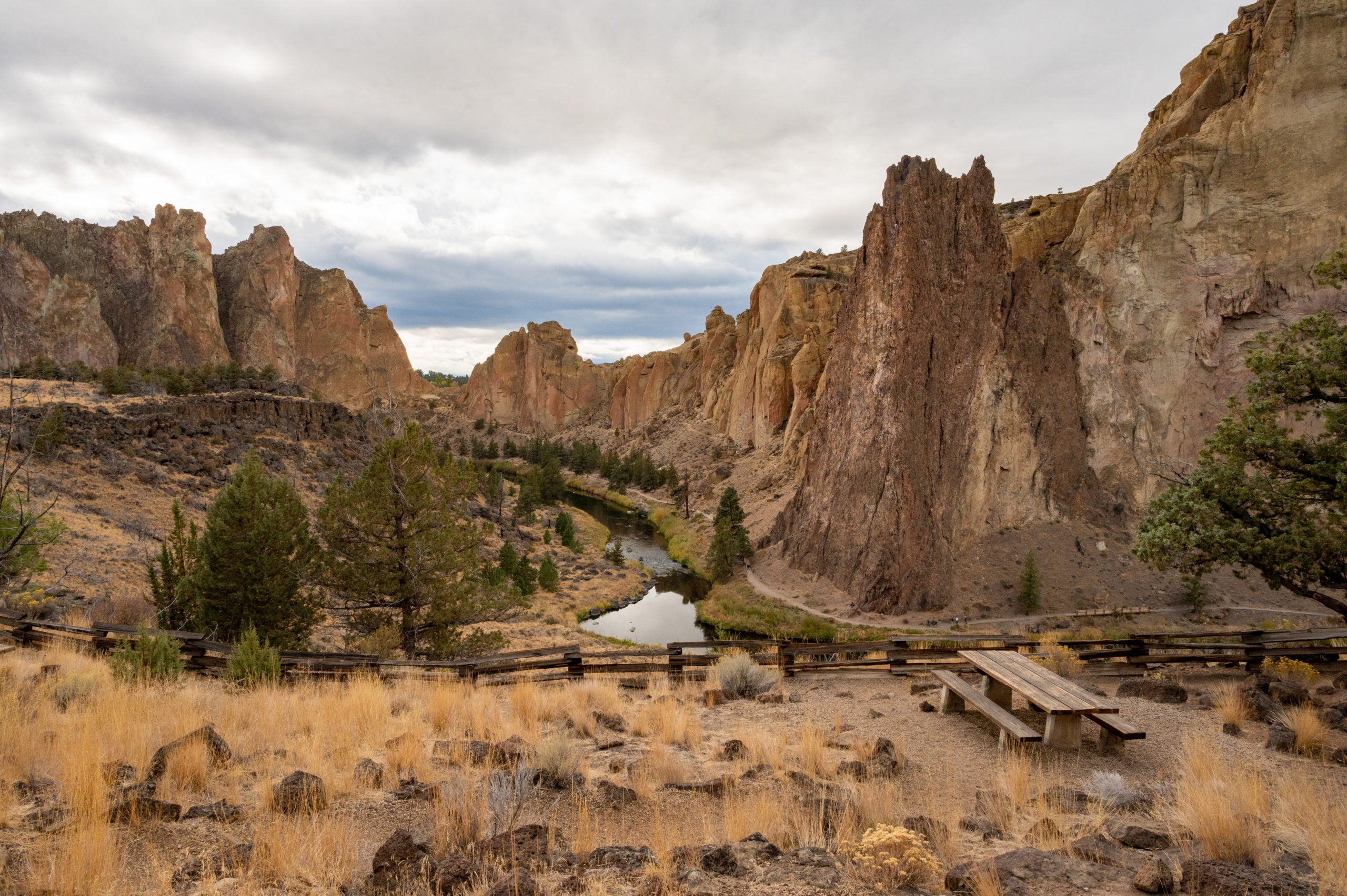
    I love a hike with variety, and I absolutely love loop trails.  I get to see something new for the whole hike without needing to retrace my steps!  The Misery Ridge Loop Trail knocked it out of the park!   I had multiple viewpoints of Crooked River on my way up the steep switchbacks along Misery Ridge and incredible views of the entire valley at the summit. 

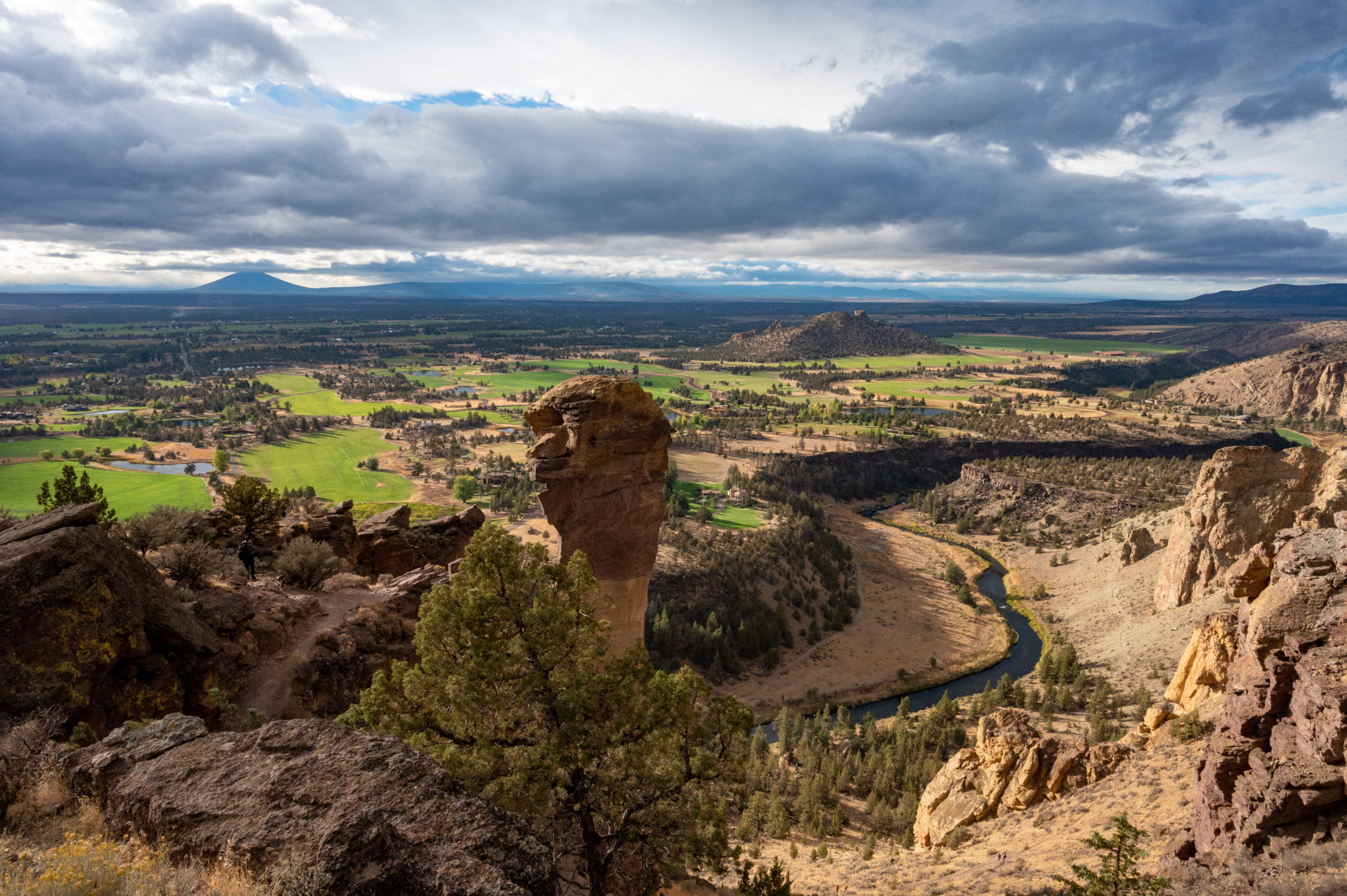
    A little further down the trail, still at the top, I got new views of the valley in addition to the infamous “Monkey Face.”  I enjoyed coming down the backside of Misery Ridge with up-close views of Monkey Face and Crooked River.  I saw rock climbers up close and enjoyed seeing geese, ducks, and cranes along the river.  It was the perfect way to spend an afternoon!

    Parking was full near the Welcome Center, so we parked in the overflow parking lot just inside the park gates. We paid the $5 day-use fee, grabbed our gear, and headed out!  We found a trail that made its way along the ridgeline in the direction of the Welcome Center.  There are excellent viewpoints here as well as picnic areas and a kid’s play area. So, if you find yourself short on time or unable to do a hike, consider stopping here and walking along the ridge for some great photo opportunities and spaces to soak it all in.

    Beginning Our Hike: The Chute Trail

    The path along the upper ridge takes you past the Welcome Center to an Overlook area where you make a left onto a wide path to begin your descent into the canyon. Stay right to take the steeper but shorter Chute Trail. This dirt trail brings you to the bottom, where you’ll cross the Crooked River Bridge. There are porta-potties near the bridge which are your last chance to use a restroom for this hike.

    Misery Ridge Trail

    After crossing the Crooked River Bridge, you’ll head to the right, where you’ll see a trail sign for the Misery Ridge Trail.  I know, with a name like that, you’re beginning to wonder what you’ve got yourself into!

    This is where you begin a series of switchbacks as you make your ascent to the summit. It’s less than a mile to the top, and there’s no rush, so hike at your own pace and take as many breaks as needed.

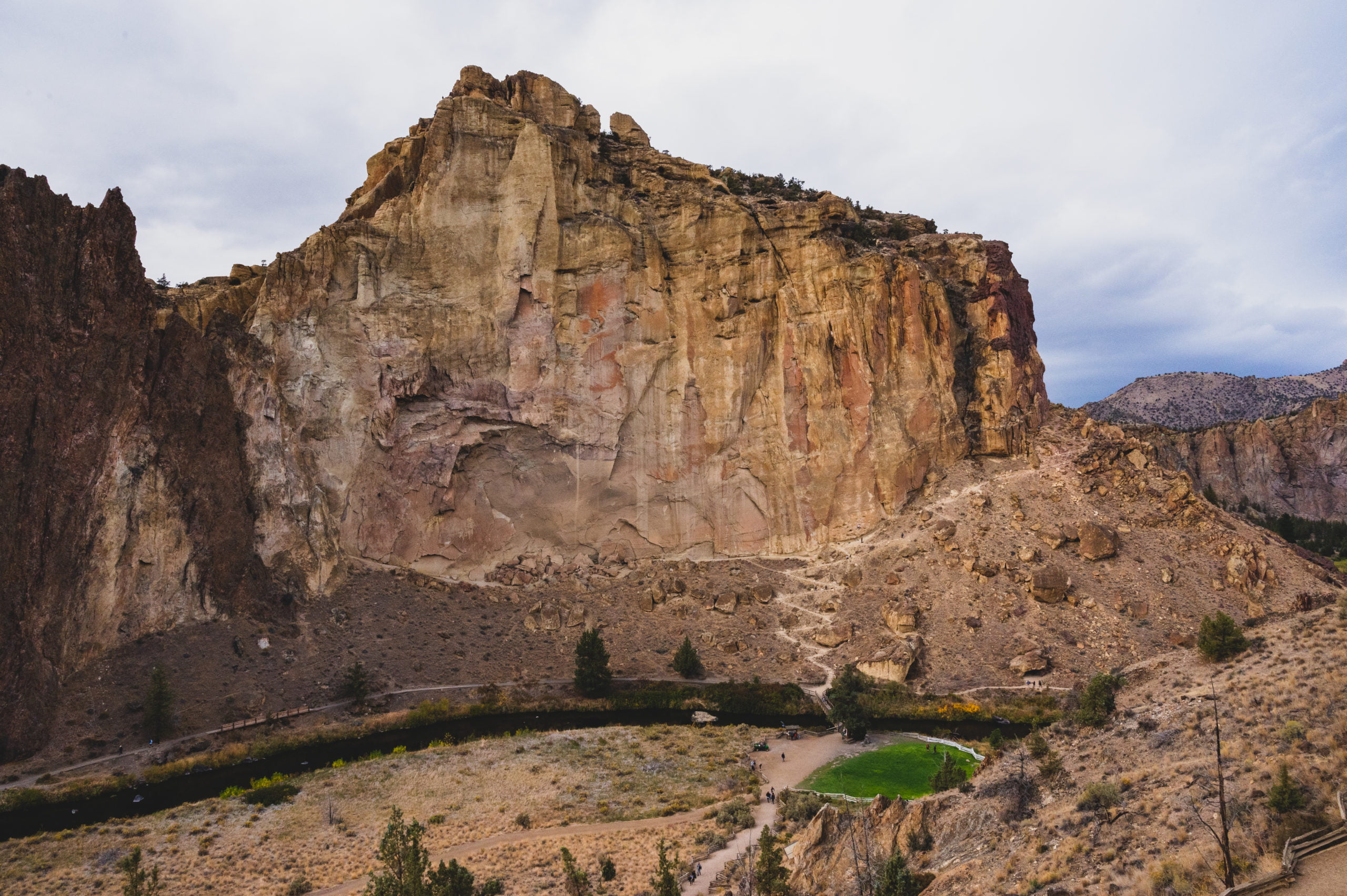
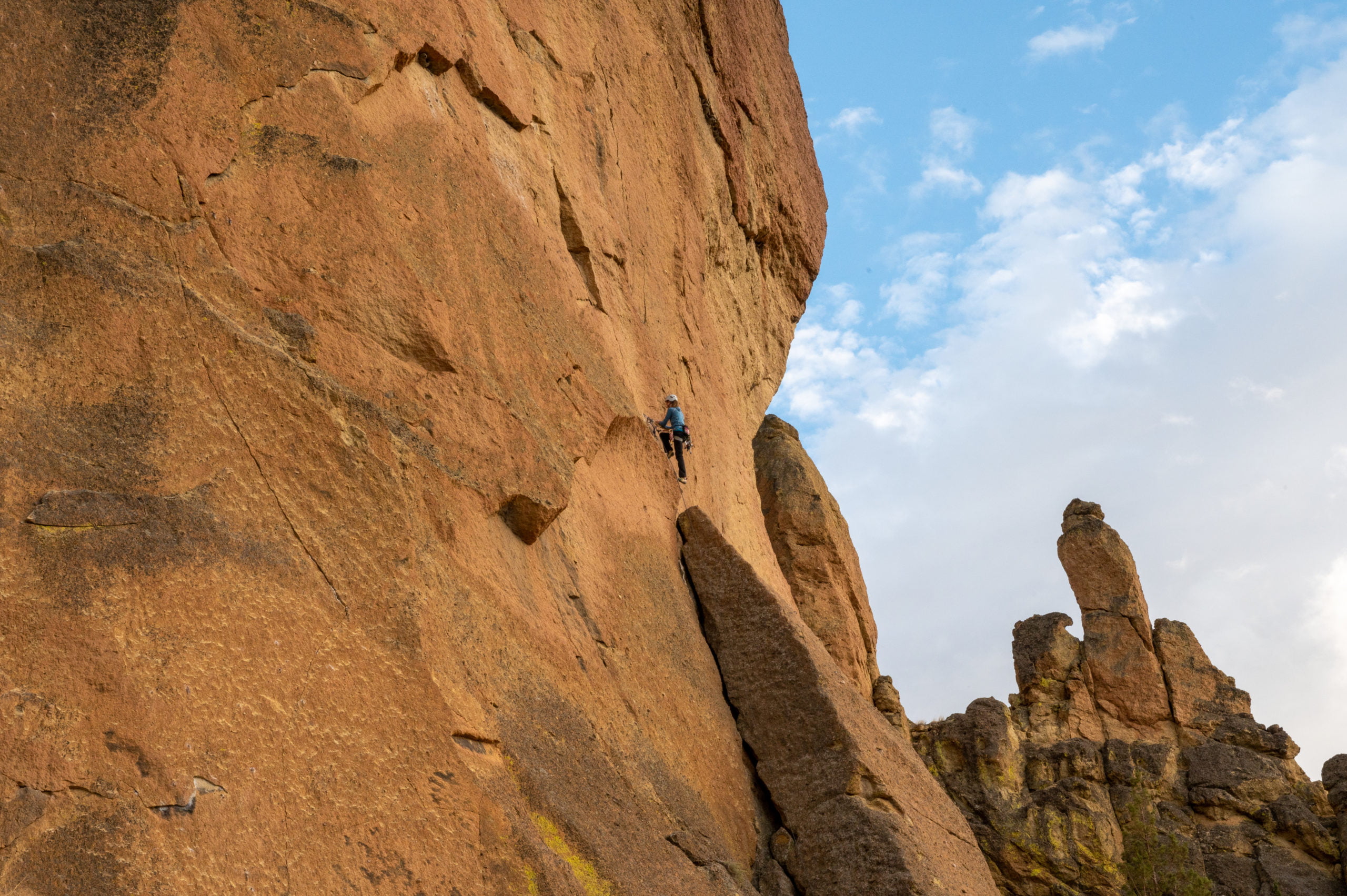
    You’ll see a few climbers at Red Wall about midway to the summit. Make sure to stop, turn around once in a while, and enjoy the sweeping views of the river as it winds its way through the canyon. These views are going to make you smile, and soon you’ll be done with your steep ascent and can rest and take it all in!

    Misery Ridge Summit

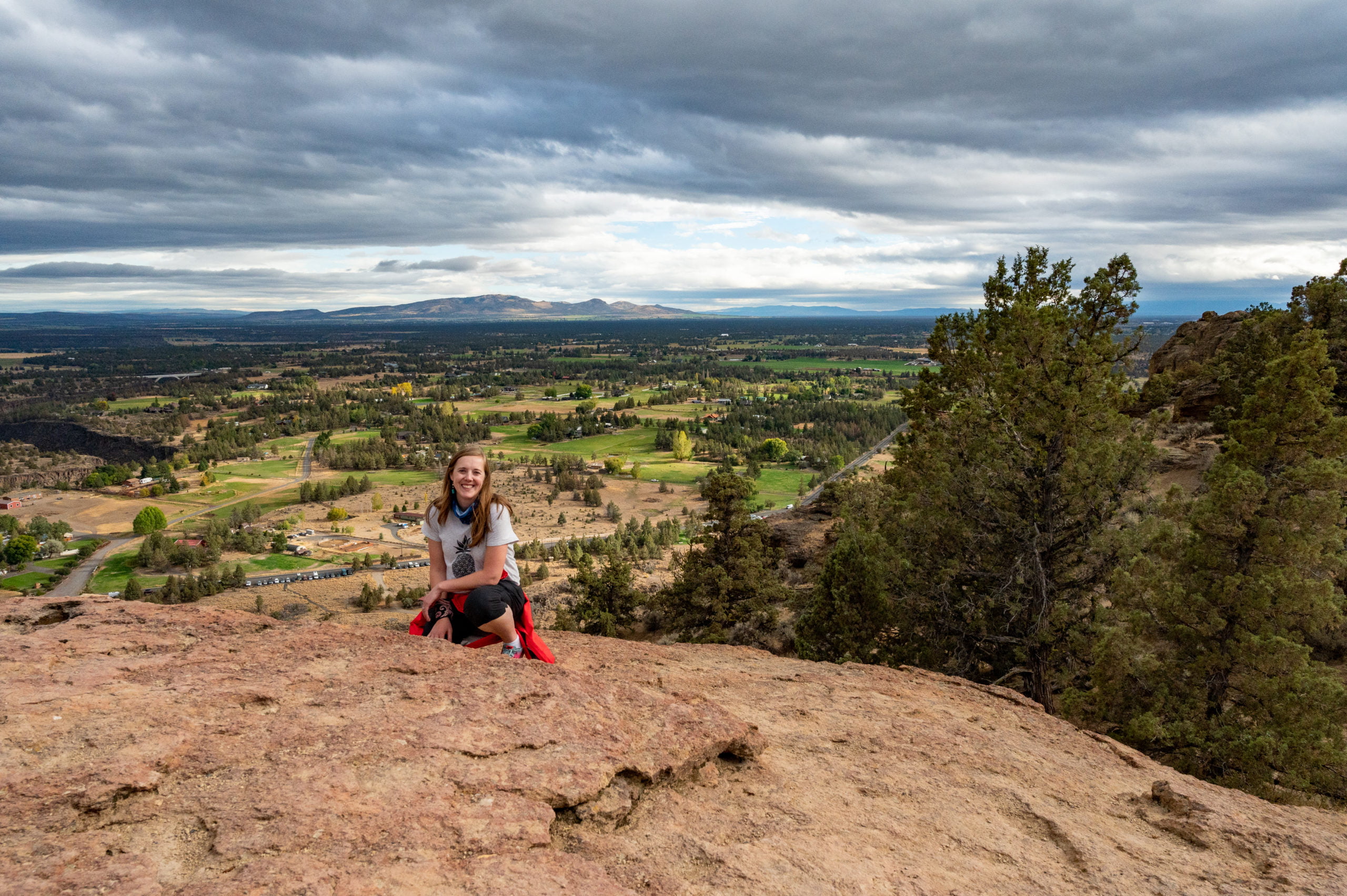
    We made it! That steady climb the entire way up Misery Ridge was worth it!  After getting to the top, head a little to the left for a wide rocky area with outstanding views of the valley below! Look down victoriously at the switchbacks you climbed and enjoy a little break as you soak it all in. When I arrived at the summit, I couldn’t help smile as I saw the reward for my efforts. It felt like I could see all of Smith Rock State Park and all of Central Oregon!

    Monkey Face

    After enjoying the views, make your way to the trail at the summit, and you’ll soon see a sign for Misery Ridge Trail. Follow this trail west for about 5 minutes and soon you’ll see glimpses of Monkey Face. You’ll also be rewarded with more sweeping views of Crooked River snaking its way through the valley. Feel free to walk closer to Monkey Face for some great photos and also to catch a glimpse of climbers on their way to the top of this iconic rock formation. They’ve sure earned that view!

    *Even if you decide not to make the Misery Ridge Loop and instead go back the way you came, don’t miss the extra little bit of hiking to see Monkey Face before you do.

    Misery Ridge Trail to Mesa Verde Trail

    After your break near Monkey Face, you’ll find your way back to the main Misery Ridge Trail and see where it begins to descend back down toward the river on the west side. Hike down a series of switchbacks and you’ll pass a small rock cave, which I, of course, couldn’t help crawling into. As you get close to the base of Monkey Face, you’ll connect with the Mesa Verde Trail, where you’ll head left. Make sure to glance toward the rocks along the left and look for climbers. You’ll see them scattered everywhere! Also, keep an eye out for trail runners. We were passed twice on the loop by the same runner!

    The River Trail

    After about a half-mile along the Mesa Verde Trail, you’ll come to the River Trail. You’ll continue straight (to the left) to stay on the River Trail.  The trail stays close to the river as you follow its winding path back around the towering rock formations. You’ll continue on this trail admiring the scenery from the ground level that you once gazed on from above. In about a mile, you’ll find yourself back at the Crooked River bridge. From here, you’ll retrace your steps back up the Chute Trail and to the top. 

    Tips & Important to Know

    Weather

    Smith Rock State Park is open year-round.  We visited in October, and the weather was perfect! Light jackets were great to have where it was windy at the top, but overall, I didn’t find I really needed mine. However, if you come in the summer, expect it to be hot, so start early if possible as temperatures can get as high as 100°F. In the winter, temperatures will often reach below freezing, and you’ll might see snow. So wear the appropriate clothing.

    Water

    Make sure to pack plenty of water. You work up quite a thirst hiking that first mile. This is even more important if you hike during the hotter months. I always say you’ll never regret bringing too much water, but you’ll certainly regret not having enough!

    Snacks

    It’s always a good idea to bring snacks to help fuel your body through a hike. Plus, there are some great resting areas within Smith Rock. You might even want to plan a picnic for after your hike.

    Snakes

    Yep, you read that right. There are snakes in Smith Rock State Park. Thankfully, we did not see any during our hike! There are rattlesnakes as well as bull snakes, garter snakes, and other non-venomous varieties.  Obviously, it’s the rattlers you really want to watch out for.  They are often found in tall grass, rocky caves, under rocks, and so on. If you encounter one, do your best to slowly walk away from it, giving it plenty of space. They aren’t typically aggressive and want to get away from you as much as you do them (well, pretty close to as much).

    Miscellaneous

    Bring trekking poles if you have them, as these are useful when you begin your steep descent down the backside of Misery Ridge. The dirt and loose rocks can make this a slippery trail to descend, and poles are nice to have.  The River Trail also allows for mountain bikers, so make sure to watch out and give them the right of way.

    Maps

    If the Welcome Center is open, you can pop in and ask for a trail map for the entire Smith Rock State Park.  However, if they’re not open, or you’d rather use your mobile device, you can use this online brochure and map of Smith Rock State Park.

    Final Thoughts About Smith Rock

    My hubby and I are moderately healthy. Truth be told, we’ve got some extra pounds from all our recent 2020 sedentary living, but we had no issues hiking this trail. We both took breaks as needed and made sure to hydrate often. We did not rush at all, and I stopped and took a TON of photos! 

    That being said, it took us 3 hours to hike from the trail near the Welcome Center and back.  If we had hiked this straight through without any breaks and zillions of photo stops, it most likely would have only taken 2 hours.  The ascent up the Chute Trail is the most strenuous (IMHO), and it’s only about 3/4 of a mile. If you are in reasonable physical shape, you should be able to do this hike, and I think you’ll be glad you did!

    In closing, if you ever find yourself in Central Oregon near Bend, then you need to visit Smith Rock State Park!  With over 600 acres, there is a lot to see and do.  There is rock climbing, mountain biking, horseback riding, and hiking all within this one park!  If I were a local, I can tell you this would be one of my go-to parks.  I loved my visit here!

    Happy Hiking!

  • Visiting Oregon’s Unique Painted Hills

    Visiting Oregon’s Unique Painted Hills

    On a recent road trip to Central Oregon, we took a small detour to see Oregon’s Painted Hills.  I’d read about them, and they reminded me a little of the South Dakota Badlands.  I didn’t realize I had anything like that so close to home, so I wanted to check them out. After taking this short road trip to Oregon, I will say that I have a newfound appreciation for Washington’s neighbor state. It has more natural variety than I previously realized, and it left me wanting to explore more of it in the future.

    Prineville, Oregon: Our gateway to Oregon’s Painted Hills

    We left the Alvord Desert and drove about 4.5 hours to the town of Prineville, Oregon.  Our first glimpse of the town of Prineville was from up above the town. It appeared like an oasis in the desert, green and lush.  I wondered what the first settlers along the Oregon Trail must have felt when they first saw this area. 

    Only an hour away, Prineville is a great choice for travelers needing to spend the night before heading on to the Painted Hills.

    After checking into our hotel, we decided to grab some dinner as we had skipped lunch, and were on the verge of getting hangry, so food was a priority!  We read reviews about an authentic Mexican restaurant with great food, so we headed to Tacos Toledo Mi Tiendita. It is a tiny little restaurant mainly used for takeout, but there are two tables for indoor seating.  

    I was ready to order everything on the menu!  Instead, I ordered a tamale (I love tamales!), 5 authentic tacos (no Tex-Mex stuff), a Chile Relleno, and hubby ordered a pambazo with chips and salsa.  I loved everything I ordered!  The pambazo is like a breakfast sandwich. It has potatoes, cheese, and chorizo inside.  

    After dinner, we drove around Prineville and liked what we saw.  They have beautiful historic buildings and the Bowman Museum, which tells the history of the area from the time of the first settlers. The town felt like a nice blend of history and progress.

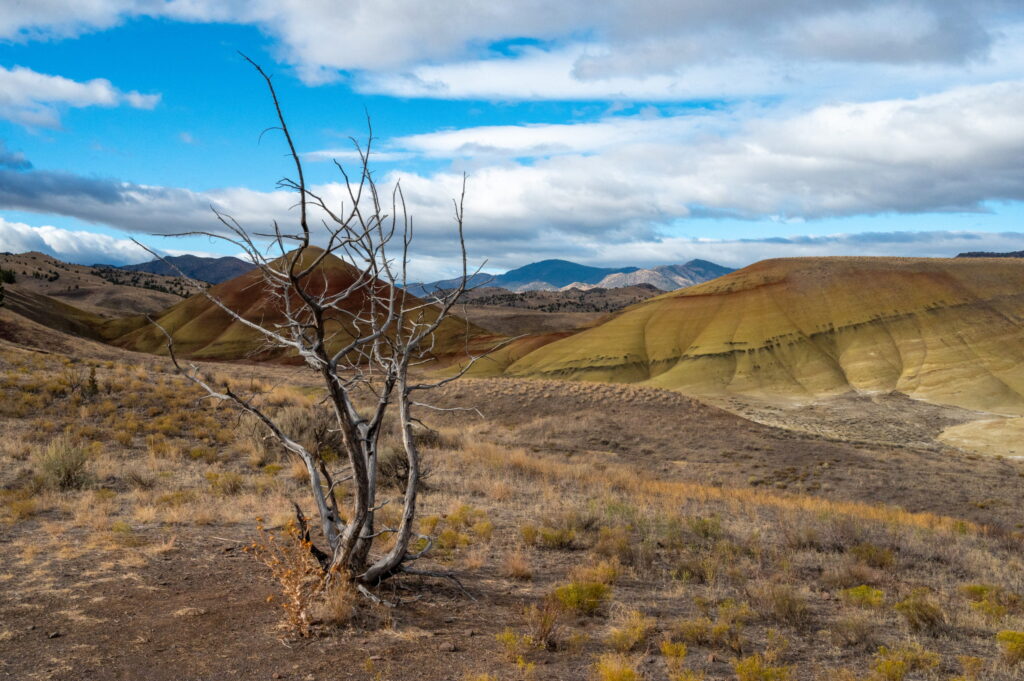
    old tree at Painted Hills

    Driving From Prineville to Oregon’s Painted Hills

    The next morning we got up early, ate breakfast at the hotel before checking out, and then headed for the Painted Hills.  It is about a 1-hour drive from Prineville to reach the Painted Hills in the John Day Fossil Beds National Monument.

    I enjoyed the drive as it was a mixture of farmland, lakes, and trees.  The drive passed quickly, and soon we were turning off on a small narrow road that passed by more farms while also catching our first glimpses of the Painted Hills. 

     After about a 10-minute drive on this road, we came to the John Day Fossil Beds National Monument entrance.  This is where the road turns to gravel.  It’s nothing too bumpy, though, not at all like our drive to Alvord Desert, where the road was much rougher.  Any car should handle the gravel roads at the Painted Hills. Just take it slow.

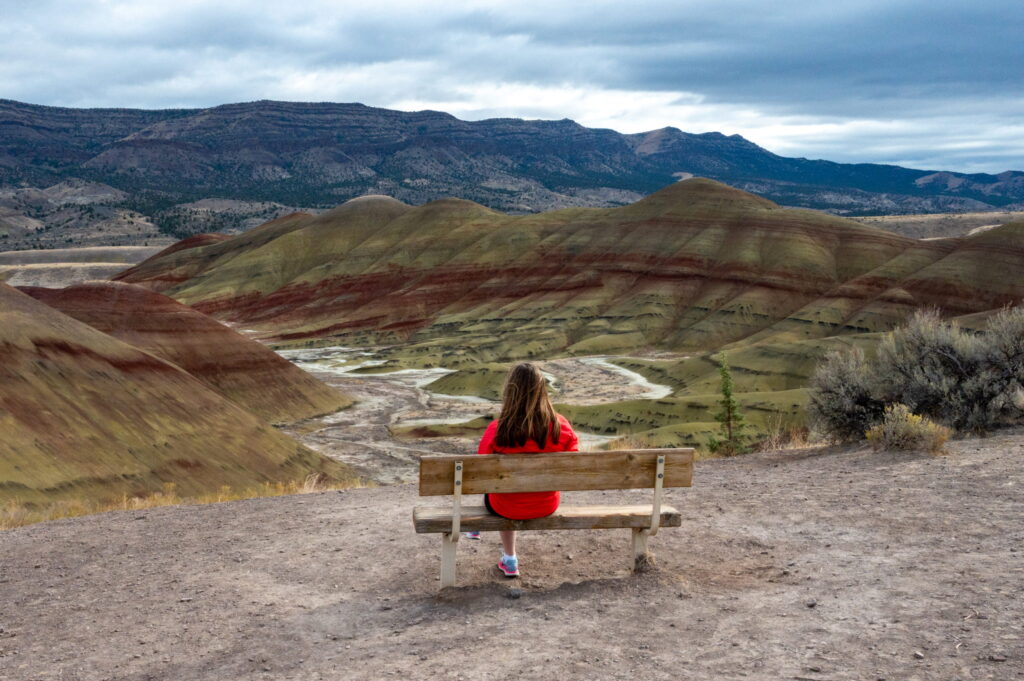
    painted overlook closer bench view
    Enjoying the view at the Painted Overlook trail.

    The Painted Hills at John Day Fossil Beds National Monument

    Shortly after entering the National Monument boundary via the gravel road, you’ll come to a fork in the road where you can go left to the Visitor Center or right to continue to the trails and to see the Painted Hills.  If you need to use the restroom, then head to the Visitor Center as that is the only restroom facility at the Painted Hills.

    Trails at the Painted Hills

    Continuing up the dirt road past the turnoff for the Visitor Center, you’ll come to the Painted Overlook. This is the first trail in a series of trails within the Painted Hills park area. You’ll also pass the Carroll Rim Trail parking area on your way to the Painted Overlook parking lot.

    • The Painted Overlook (0.5-mile roundtrip) 
    • Carroll Rim Trail (1.6 miles roundtrip)
    • The Painted Cove Trail (0.25-mile boardwalk trail + overlook)
    • The Red Scar Knoll Trail (0.25-mile trail)
    • The Leaf Hill Trail (0.25-miles roundtrip)
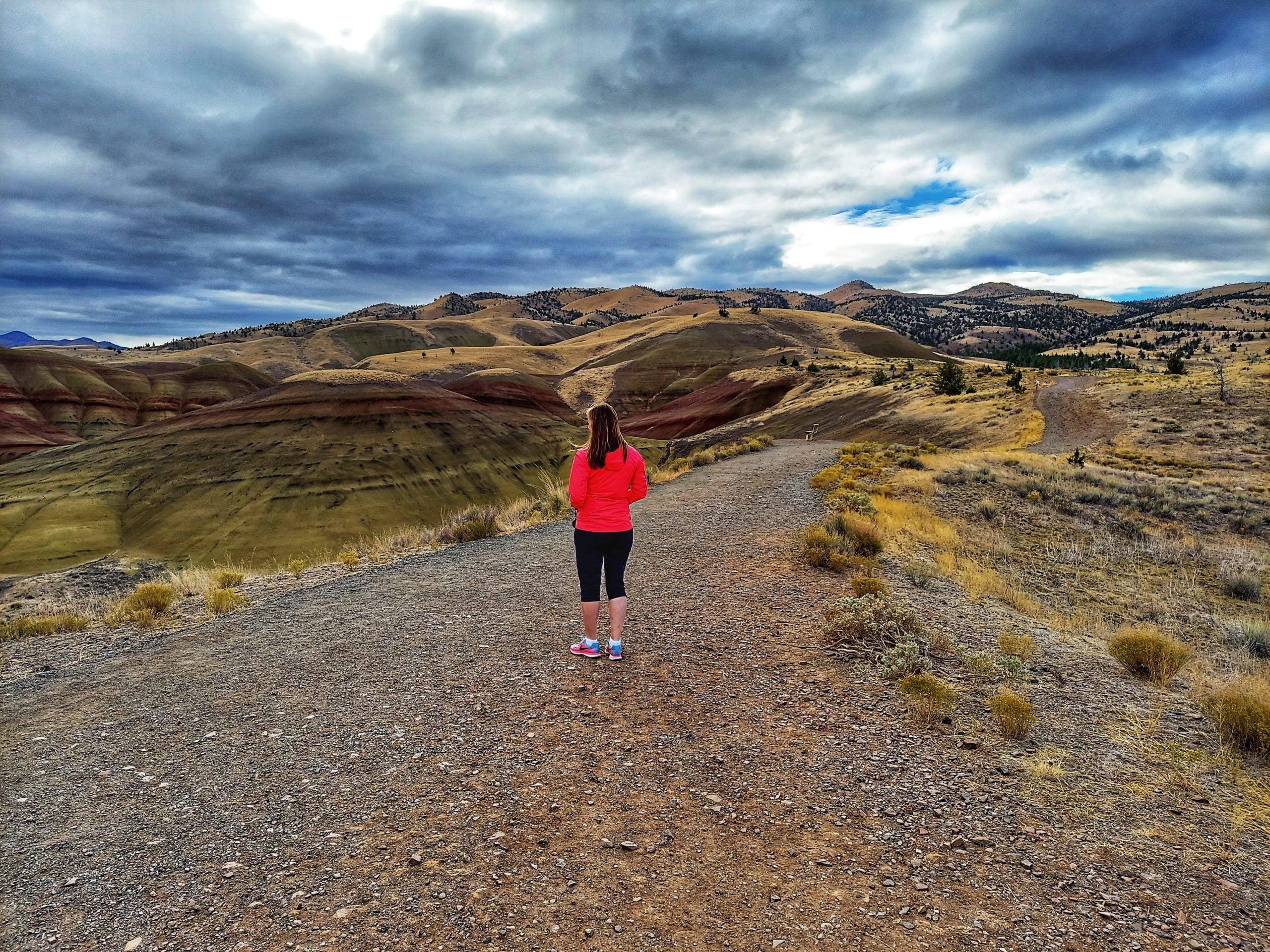
    The Painted Overlook is a 0.5-mile roundtrip gravel path to an viewpoint.  There is a bench on one section of the trail with sweeping views of the painted hills below.  At the beginning of the trail, there are some signs with information regarding the area’s volcanic formation.
    painted hills overlook trail
    The wide gravel path at the Painted Overlook trail.

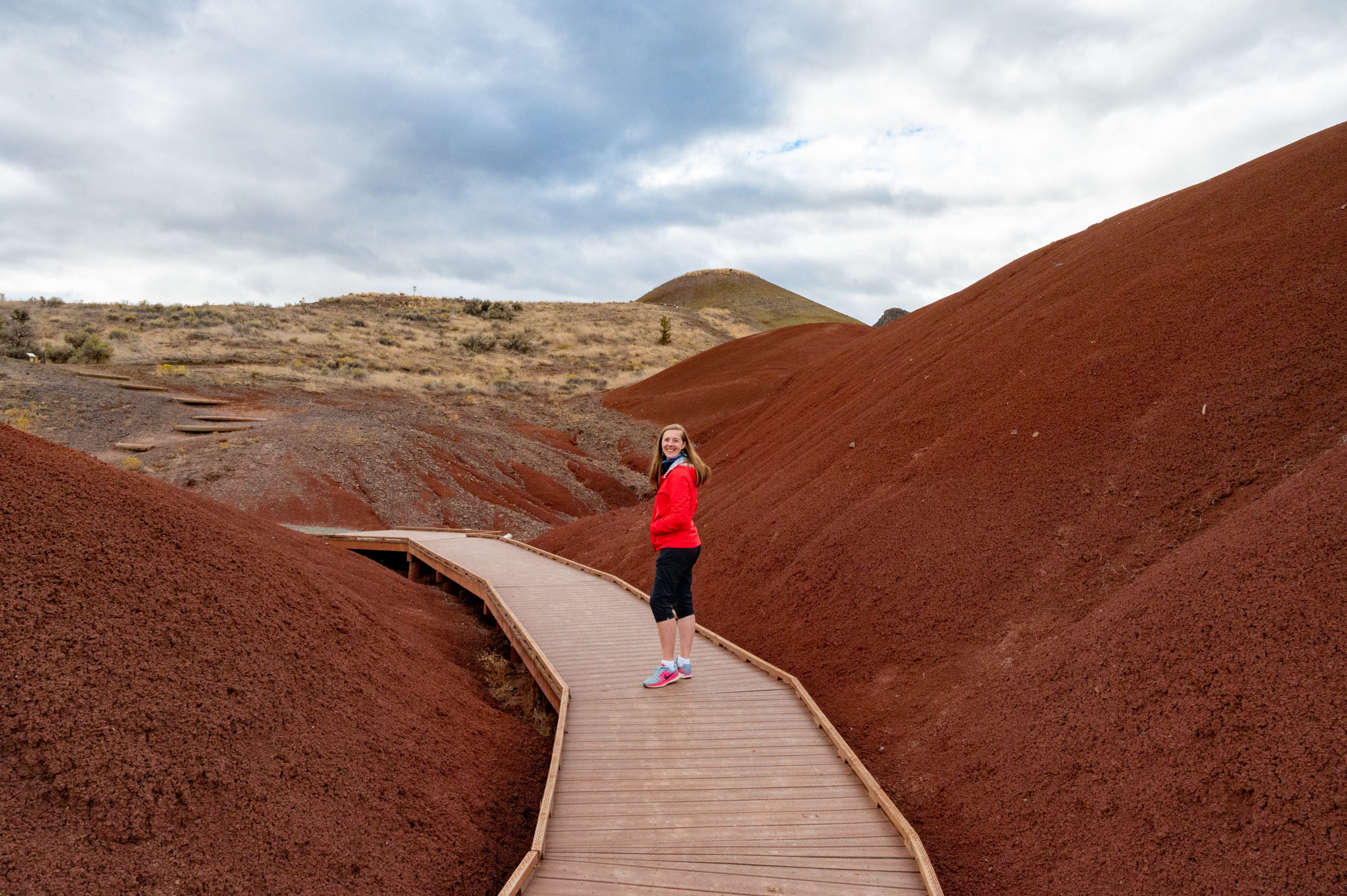
    The 0.25-mile roundtrip Painted Cove Trail follows a wooden boardwalk before connecting to a dirt path.  Make sure to read the signs along the trail that explain how these unique painted hills came to be. 

    person walking on boardwalk at painted cove in the painted hills
    The wooden boardwalk at the Painted Cove trail.

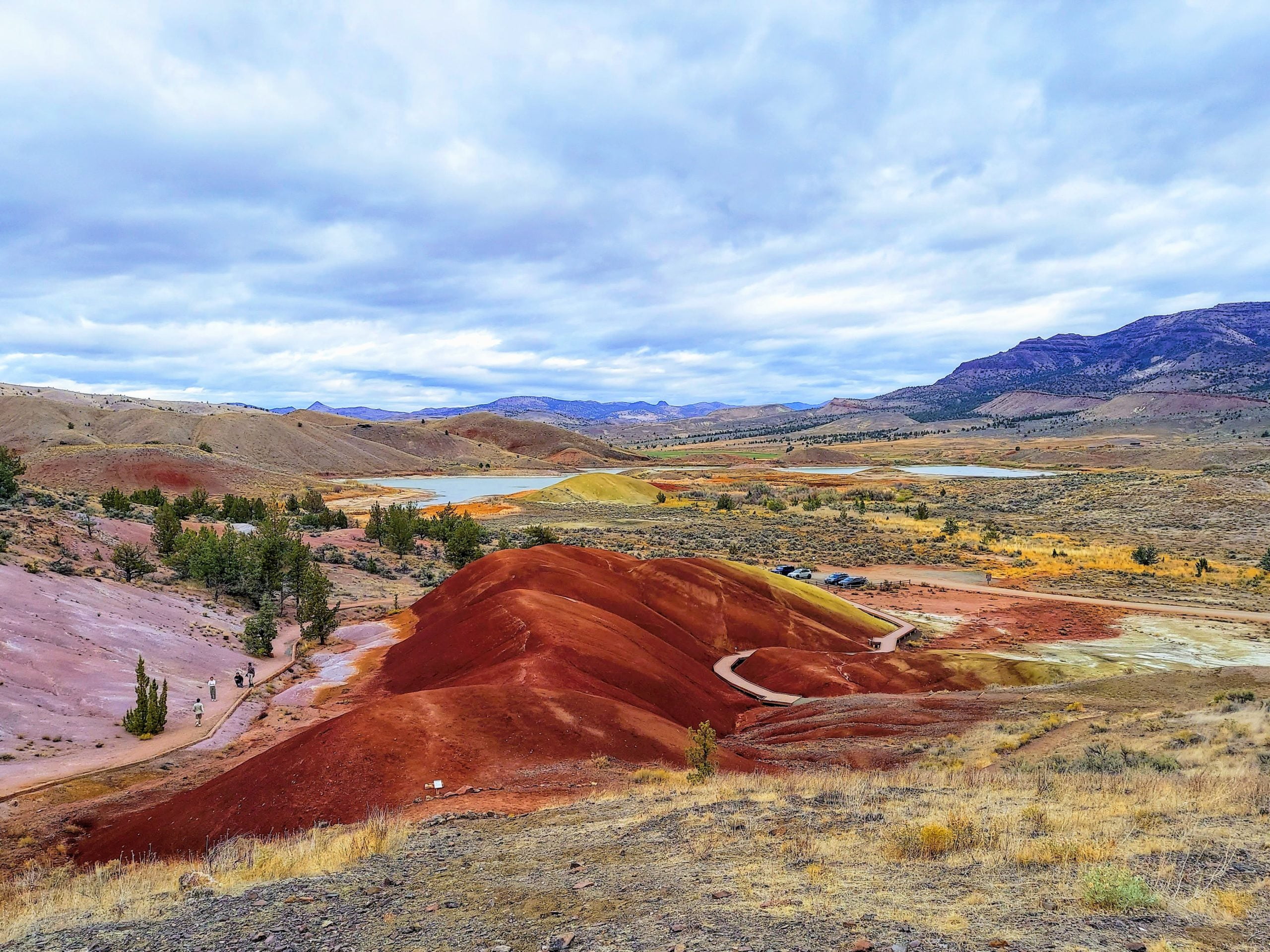
    At the end of the boardwalk (when starting counterclockwise) leads to a fork in the trail.  You can go left to walk up to an overlook or right to continue the loop.  I recommend walking up to the overlook as it provides great views of the painted hills below and a really neat icy blue lake.

    the painted cove trail overlook
    The view from the Painted Cove trail overlook.

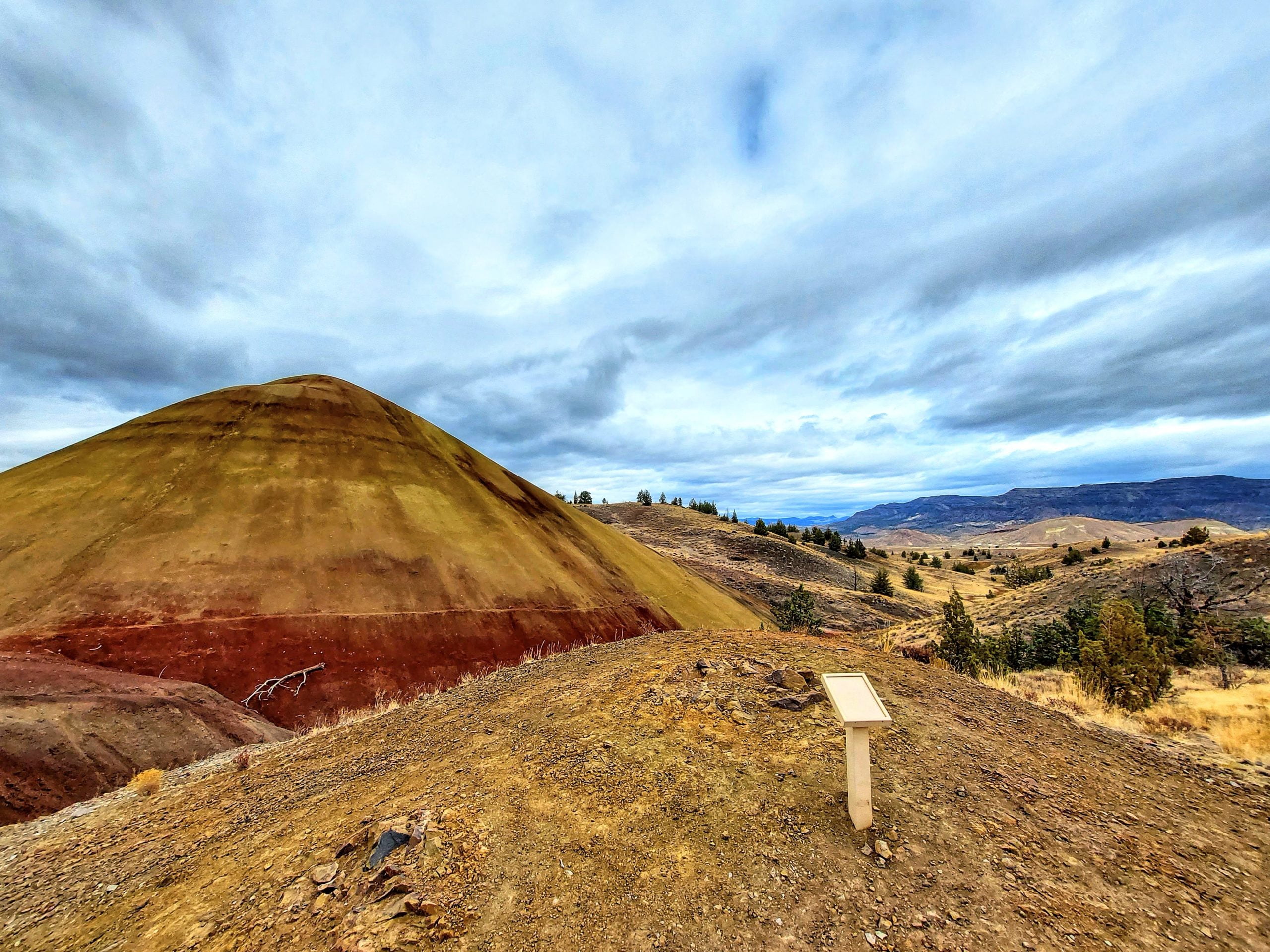
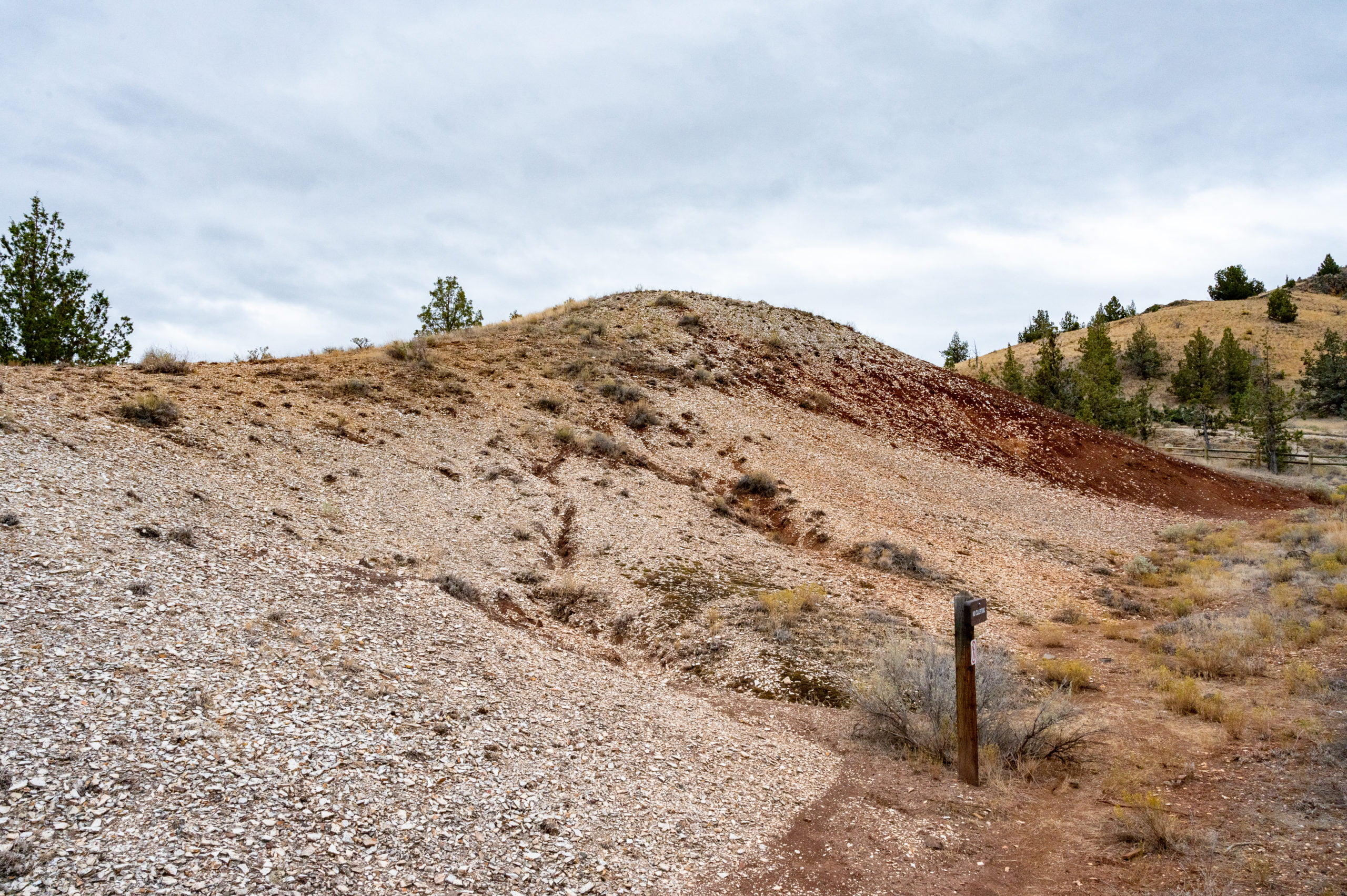
    The Red Scar Knoll Trail (also known as Red Hill trail) is another short trail (.25 mile roundtrip) that leads to a dark red hill on one side and yellow on the other. The trail takes you over a small bridge where it forks straight and to the left where you can view the red side first. 

    Then, retrace your steps back to the main trail and continue as it goes around the hill and brings you to a viewing area of the yellow side of the hill. The red and yellow colors found in the painted hills is due to the blend of iron and magnesium.  The hills are rusting!

    red scar knoll trail viewpoint
    The yellow side of the red scar knoll.

    The Leaf Hill Trail (Leaf Fossil Trail) leads you to a hill where fossilized leaves of genus Metasequoia, the Dawn Redwood, were found. Although it is fascinating that these great trees once lived here, the actual hill and trail were a bit underwhelming.

    Leaf Fossil Hill
    Scattered fossils at the Leaf Fossil Hill trail.

    Time Spent Visiting the Painted Hills

    We spent approximately 2 hours exploring the Painted Hills.  Visiting all of the trails, except the Carroll Rim Trail. We planned to do it last, but the parking lot was full upon our return. Deciding we’d probably seen what there was to see anyway; we left without hiking that trail.

    My recommended trails:

    • The Painted Overlook: This had nice views of the hills we passed while driving up to the Overlook.
    • The Painted Cove Trail: I liked being so close to the Painted Hills as well as the small overlook that let me see the pretty lake and painted hills below.
    Just Okay: The Red Scar Knoll trail was just okay, in my opinion. I did think it was interesting that it is red on one side and yellow on the other, and it is short enough that it won’t take you very long to complete.
    Could have skipped: The Leaf Hills trail was the most boring one of them all.  You could see a bunch of scattered pieces of rock, which may have been fossils, but really, if you are looking for a trail to skip, this is one I felt sort of like “meh” afterward.
    tree and bridge at red scar knoll trail
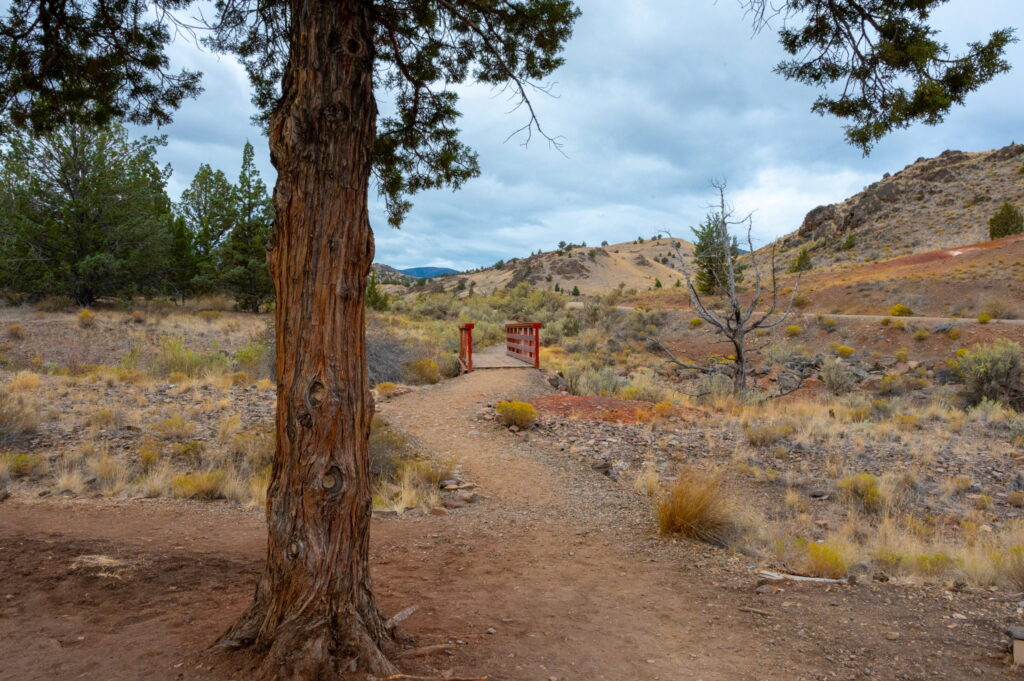
    One of the beautiful trees dotting the landscape. It made me think of how the redwoods once grew here.

    Getting to Oregon’s Painted Hills

    From Prineville, Oregon
    Take US-26 E for about 43 miles before turning left onto Bridge Creek Rd/Burnt Ranch Rd. Follow Bridge Creek Rd for another 5.5 miles before turning left onto Bear Creek Rd. Bear Creek Rd is a gravel road. Follow signs in the park to either the trails or the Visitor Center.

    From Mitchell, Oregon

    Take US-26 W for 3.6 miles, then turn right onto Bridge Creek Rd/Burnt Ranch Rd. Follow Bridge Creek Rd for another 5.5 miles before turning left onto Bear Creek Rd. Bear Creek Rd is a gravel road. Follow signs in the park to either the trails or the Visitor Center.

    Tips for Your Trip

    Fuel up in Prineville or Mitchell, depending on which direction you’re coming from. The only restroom is at the Visitor Center and picnic area near the Painted Hills entrance. Go left at the fork in the gravel road and follow the signs to the Visitor Center. I did not see any other restrooms in the park.

    Bring a jacket, depending on what time of year you visit (we came in the fall), it can get windy and cold.  We were happy we had our rain jackets with us as well as sweatshirts. I also recommend bringing snacks and drinks as there is nothing inside the National Monument area.

    Happy Trails!