author.travelffeine.com

Category: France

There is so much to see in France! Here are some travel guides, stories, and inspiration for planning your trip to France.

  • A Self-Guided Tour of Historic D-Day sites in Normandy

    Visiting the historic D-Day sites is an unforgettable way to spend the day.  It is one of those bucket list trips that leave you better for having made them. June 6, 1944, is one of the most historic dates in world history. The victory achieved on D-Day changed the course of the world.  

    The freedoms I have today are in large part due to the battles fought on the shores of Normandy. If you have an opportunity to travel to France, take some time to visit the D-Day sites in Normandy. You’ll never forget it.

    In this post, I share my one-day self-guided itinerary to some of the D-Day sites in Normandy, France.  You’ll get a chance to learn about my experience and also see how easy it is to plan your own trip to this historic region. Although I would have preferred a minimum of 2 days for my visit, even with only one day to see the D-Day sites, you can cover a lot of ground and still have an unforgettable trip.

    Overview of Our One-Day Itinerary to D-Day Sites in Normandy

    Where We Started Our Road Trip

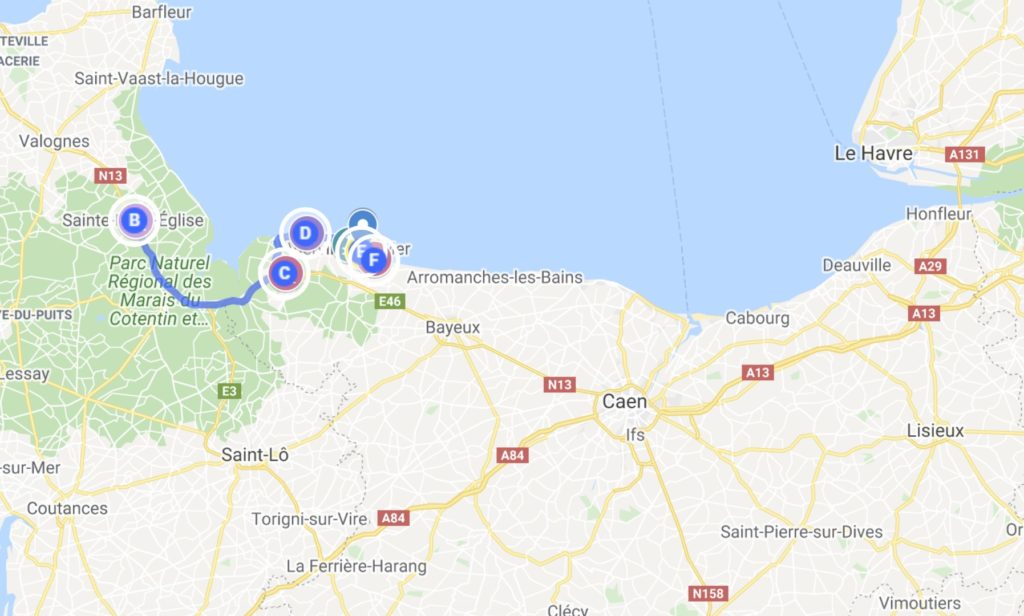
    We took a direct train from Paris to Caen, where we’d booked our hotel and rental car.  In addition to spending one day seeing the D-Day sites, we also spent one day driving to Mont-Saint-Michel. For our one-day D-Day itinerary, we drove from our hotel in Caen to our first stop, the Airborne Museum in Sainte-Mere-Eglise. Then we worked our way back in the direction of Caen for the remainder of the itinerary.

    Tip: You could easily make this trip in reverse, and depending on what time of year you go, you may want to.  We discovered during our visit here in October, that places open later and close earlier in the fall and winter.  

    So in the case of our route, we arrived at the Airborne Museum, thinking it opened at 9:00 a.m. (according to Google) only to discover it did not open until 10:00. Thus, we could have started at the Normandy American Cemetery, which opened at 9:00 and closed at 5:00 and then saved the Airborne Museum for last, which closed at 6:00 p.m.  Live and learn!

    Benefits of a Self-Guided Road Trip to See D-Day Sites

    By driving yourself to the D-Day sites, you have more flexibility and choices in which places you see and how long you spend there. Driving in France was easy for me since they drive on the same side of the road as we do in the U.S. As long as you can drive a car with a manual transmission, it is pretty much the same as driving in the States. The road signs may look a little different, but all in all, it’s a very similar experience.

    However, if you’re not comfortable with driving on your own in France, there are a lot of tour companies that will drive you around to the historic D-Day sites. You can take 12-hour day trips from Paris, or local tours starting at Caen and Bayeux. So decide on whichever option works best for you and your itinerary.

    A Little Background About This Trip

    My visit to Normandy, France, was a part of a 2 1/2 month backpacking trip I took with my friend through Europe.  As I planned our route and the “must-see” stops along the way, I knew that visiting Normandy, France, and the historic D-Day sites was a must for me.  Our visit to Normandy was during the final three weeks of our trip through Europe.  

    Before arriving in Normandy, we toured the house where Anne Frank hid in the attic before being captured by the Nazis. We visited Berlin and walked over what was once Hitler’s underground bunker and wandered through the Memorial to the Murdered Jews.  Then we traveled to Krakow, Poland, where we took a day trip to the Auschwitz-Birkenau concentration camps. Finally, we went to Normandy, France, and visited some of the historic D-Day sites.  

    It was a journey through World War II history, starting with the atrocities that forced people into hiding and ultimately led to the death of millions of people. Our travels brought us full circle to Normandy, and the history surrounding D-Day, the battles leading up to it, and the battles fought afterward. 

    Although the history surrounding D-Day was one of tragedy, it was also one of triumph and hope. I saw the bleakness of death at Auschwitz, which only made my visit to the D-Day sites all the more impactful. The price was high, the sacrifice great, but freedom demands we risk everything or end up with nothing. I am so grateful for those who gave their lives so I could live in freedom.

    Site 1: Church of Sainte-Mere-Eglise

    We started our day of sightseeing in the town of Sainte-Mère-Église. We arrived a little after 9 a.m. and found that the Airborne Museum didn’t open until 10 a.m. So we wandered over to the Church of Sainte-Mère-Église, where a mannequin of a paratrooper’s body hangs from the church steeple.

    John M. Steele

    We learned more about the paratrooper represented on the church steeple during our visit to the Airborne Museum. His name was John Steele, and he was a paratrooper with the 82nd Airborne Division. During the drop into Sainte-Mère-Église, one of the houses caught fire, which unfortunately illuminated the night sky, and thus the paratroopers dropping in. 

    John Steele was hit in the foot on his way down and lost control of his parachute. His parachute caught on the church steeple. He hung there for around 2 hours, pretending to be dead before German soldiers came up and brought his body down. They took him as a prisoner, but three days later, he escaped and returned to his division. He survived WWII and returned home after the war was over. 
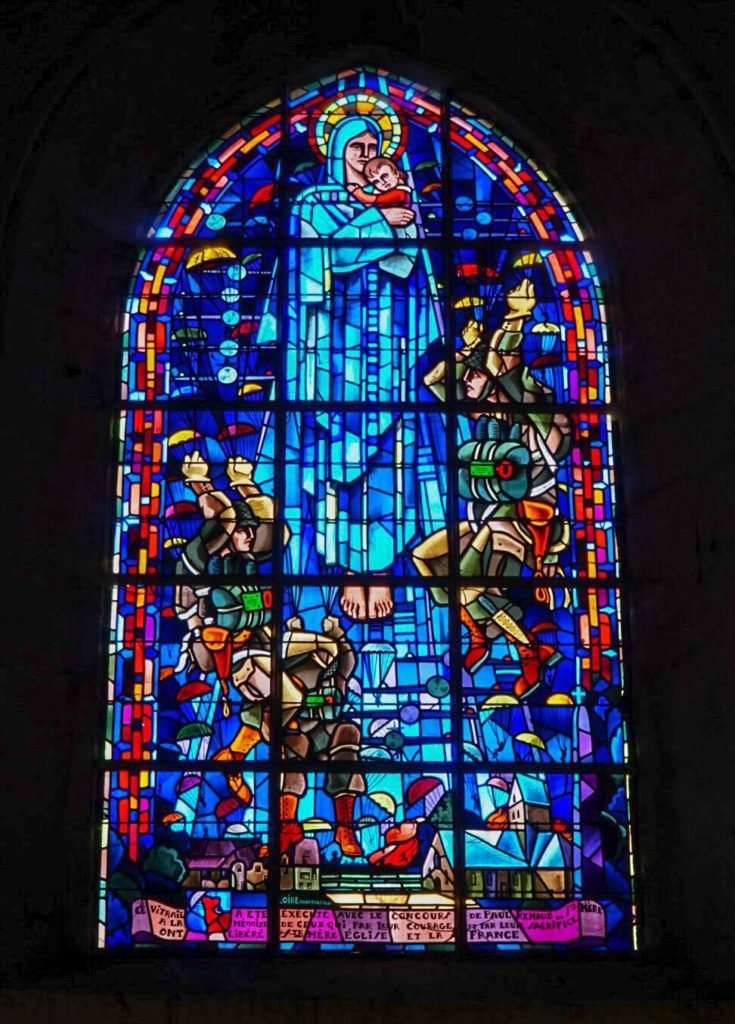
    stained glass window of angel and paratroopers
    A beautiful stained glass window in the Church at Sainte-Mere-Eglise.

    There is so much more to John Steele’s story and to the paratroopers that dropped that night. For any of you who have watched “The Longest Day,” you might remember seeing the scene of the paratroopers dropping in.

    The real story is full of heroism, as one of his fellow troopers on the ground gave his life to save John’s.  The chaos was compounded by the house fire, which lit up the sky and made them glowing targets.

    Go inside the church and take a look around. There is a beautiful stained glass window created in memory of the paratroopers that lost their lives here. There is also another one portraying the angel Michael surrounded by the symbols of the various Allied forces who fought to free Sainte-Mère-Église.

    Time Spent Here: (~ 30 minutes)
    Location: Church of Sainte-Mère-Église, Rue Koenig, 50480 Sainte-Mère-Église, France
    Commute Time to Next Site: ~ 1-minute walk across the parking lot.
    Site 2: The Airborne Museum at Sainte-Mere-Eglise

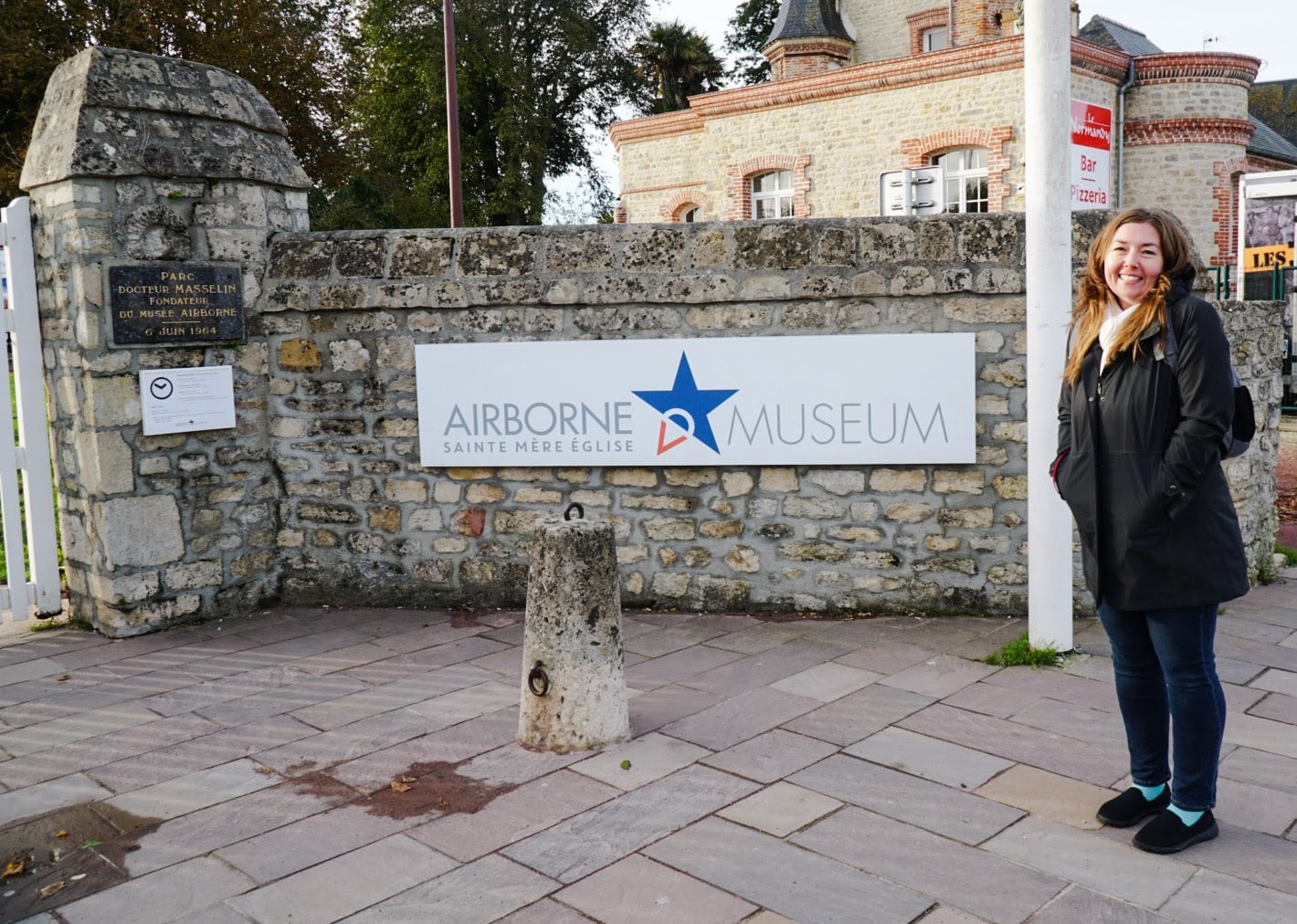
    The Airborne Museum is a thoughtfully designed museum made up of multiple buildings as well as an outdoor area. At the ticket desk, you receive a tablet to carry with you as you make your way through the different areas.  The tablet provides additional information about the exhibits and includes interactive features, which if you have kids, they will especially enjoy this feature. For the most part, you won’t need the tablet. However, it guides you in a particular order throughout the museum complex.

    The first building we entered after purchasing our tickets was the building designed like the inside of a big parachute.  Inside there are numerous displays of paratrooper’s gear, mementos, and stories of some of those involved in the liberation of Sainte-Mère-Église. The museum does a beautiful job portraying the details of what these paratroopers must have gone through to prepare for their mission.

    In the next building is a large display of an airplane, and on one side is a mannequin of President Eisenhower and a printed copy of his D-Day order.  Many of these guys were barely out of high school. They didn’t have much training, and yet they were going into one of the biggest and most important battles in US history. They would be some of the first boots on the ground for the US military in Normandy, France.

    “You are about to embark upon the Great Crusade, toward which we have striven these many months. The eyes of the world are upon you. The hope and prayers of liberty-loving people everywhere march with you.” ~ General Dwight D. Eisenhower
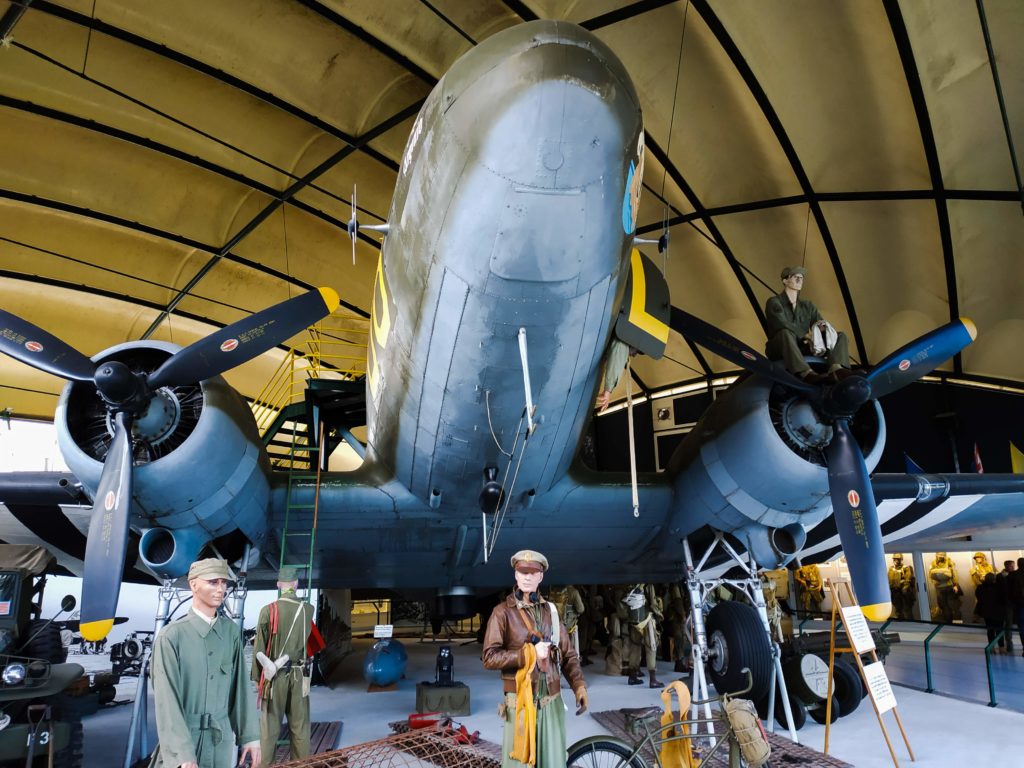
    Airplane replica at Airborne Museum D-Day Normandy
    One of the Airborne Museum’s life-sized displays.

    In another room, audio speakers play the sounds of battle along with a display of an aerial view of Sainte-Mère-Église. I also learned during my visit here, that the paratroopers had to carry packs that weighed anywhere from 90 lbs to 180 lbs!  Can you imagine jumping from a plane with a pack the size of a human strapped to your back?

    The Soldier’s Stories Helped to Connect on a Personal Level

    It was incredible to hear their stories and to take a glimpse into what those men went through. It was heroic yes, but also scary. Real courage isn’t without fear. It’s acknowledging the fear and moving forward in spite of it. Courage understands what’s at stake.

    We watched a touching film that showed the images of Holocaust survivors and also the piles of dead bodies. Tears sprang to my eyes as it put in perspective what was being fought for.  All of our future freedoms were at stake if Hitler, and the other countries fighting against democracy, had not been stopped.

    I highly recommend making the Airborne Museum a part of your itinerary when visiting D-Day sites in Normandy. They took excellent care to make it a moving and thoughtful museum and memorial to 82nd and 101st Airborne Divisions.

    Time Spent Here: (~ 1.5 hours)
    Location: Airborne Museum, 14 Rue Eisenhower, 50480 Sainte-Mère-Église, France
    Commute Time to Next Site: ~ 30-minute drive
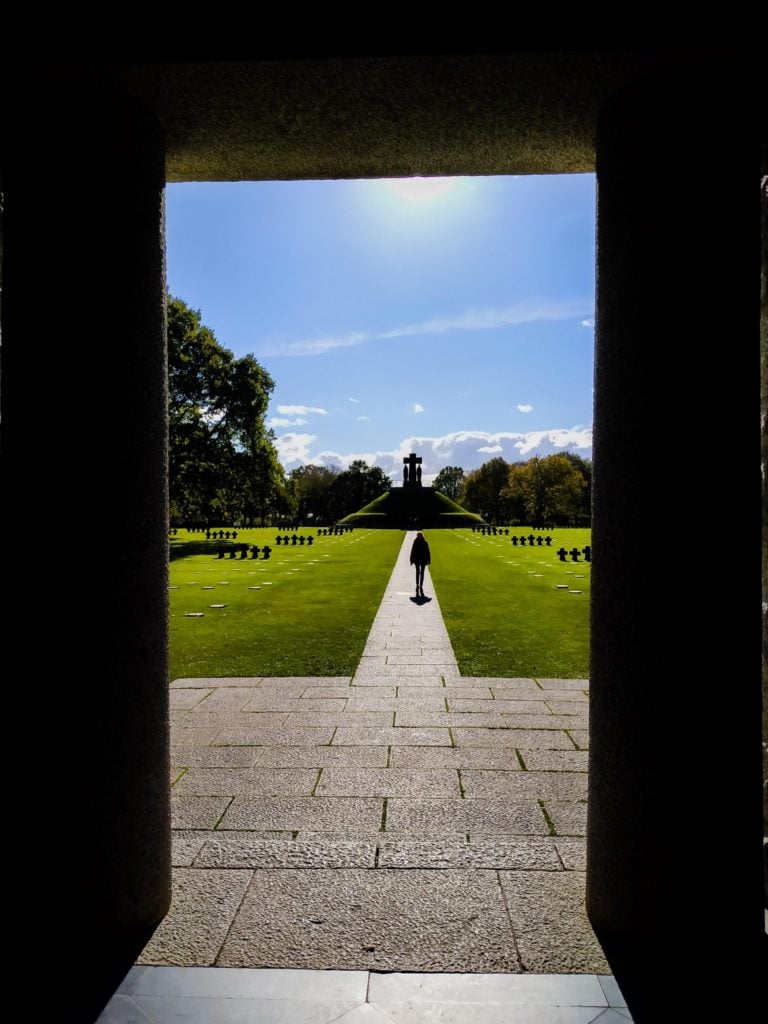
    entryway to La Cambe D-Day German War Cemetery
    The entryway in the German war cemetery at La Cambe.

    Site 3: La Cambe German War Cemetery

    Our next stop is the La Cambe German war cemetery. It is a simple and somber graveyard, and it is also the largest war cemetery in Normandy. There are over 21,000 bodies buried here as compared with the less than 10,000 buried at the American cemetery in Colleville-Sur-Mer.

    As you walk through the entrance to the cemetery, you notice straight in front of you, a mound of raised earth (also known as a tumulus). Sitting on top is a giant dark stone cross with a man and a woman on either side. I assume this represents the mother and father of the dead. I recommend you walk to the top and get a bird’s eye view of the enormous size of this cemetery.  

    Most of the graves are marked with simple bronze-colored stones set in the ground. There are also rows of dark stone crosses spaced here and there across the cemetery. As I pass by the markers, I notice that most of the soldiers buried here were only 18 or 19 years old.  According to the cemetery, most of the soldiers buried here died between June 6, 1944, and August 20, 1944.

    The German soldiers buried here were teenagers sent off to war by the command of their country. A surviving German soldier said that some of the soldiers enlisted in WWII were only 16 years old, forced to go to war, scared to death, wanting to run, but told they’d be shot if they did.  They had families who loved them and mourned their loss. War is ugly no matter which side you’re on.
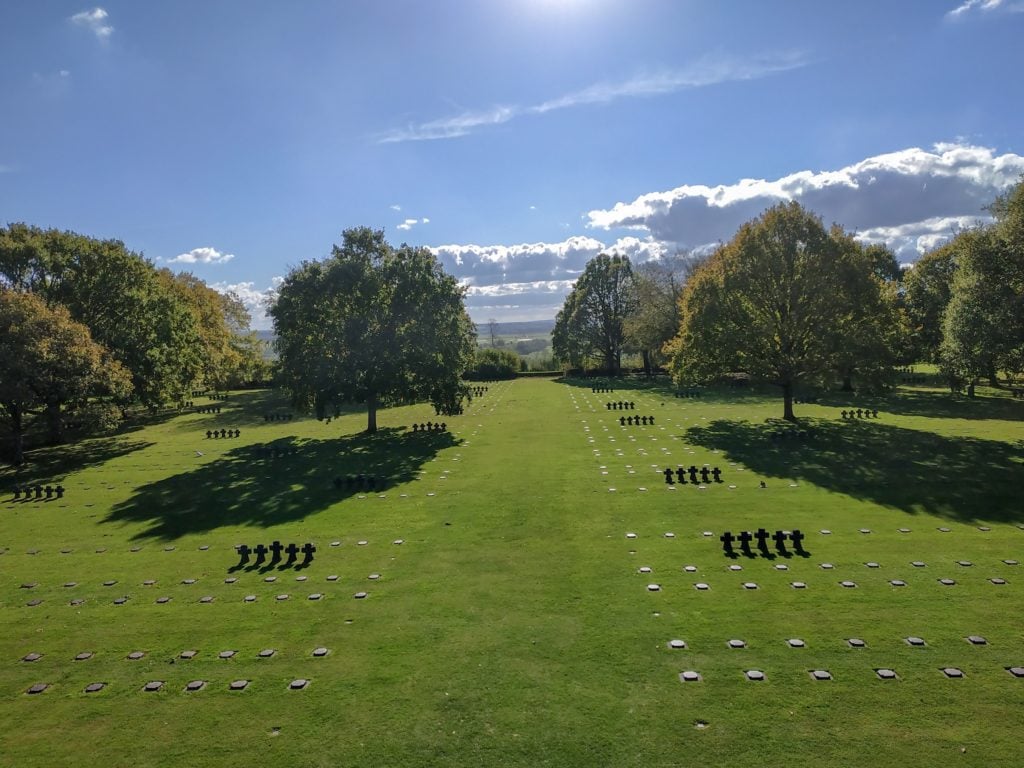
    La Cambe German War Cemetery at D-Day Normandy
    A view of the German cemetery at La Cambe from atop the tumulus.

    A Comparison of Two Cemeteries

    My visit to the German war cemetery at La Cambe provided a thoughtful comparison with my visit to the Normandy American Cemetery at Colleville-Sur-Mer. I left the La Cambe cemetery feeling sorrow at the tragic loss as a result of this war.  Although there is still certainly a sense of loss at the American cemetery, I left it feeling a sense of pride and gratefulness. It was a cemetery that celebrated and thanked those buried within, rather than only mourning their loss.

    Time Spent Here: (~ 30 minutes)
    Location: La Cambe German war cemetery, Les Noires Terres, 14230 La Cambe, France
    Commute Time to Next Site: ~ 20-minute drive
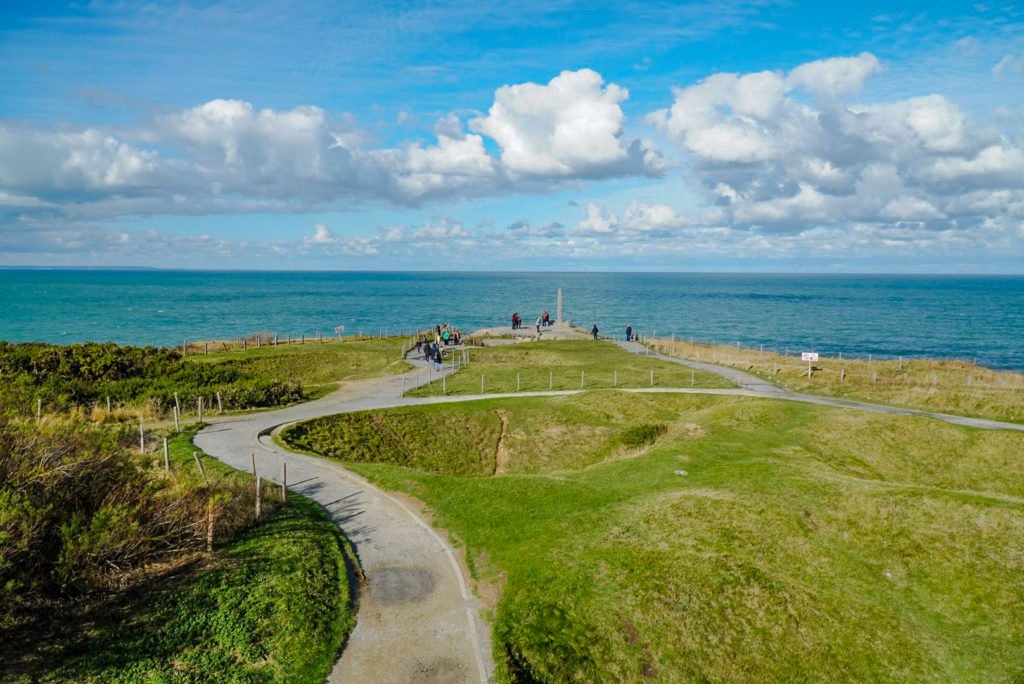
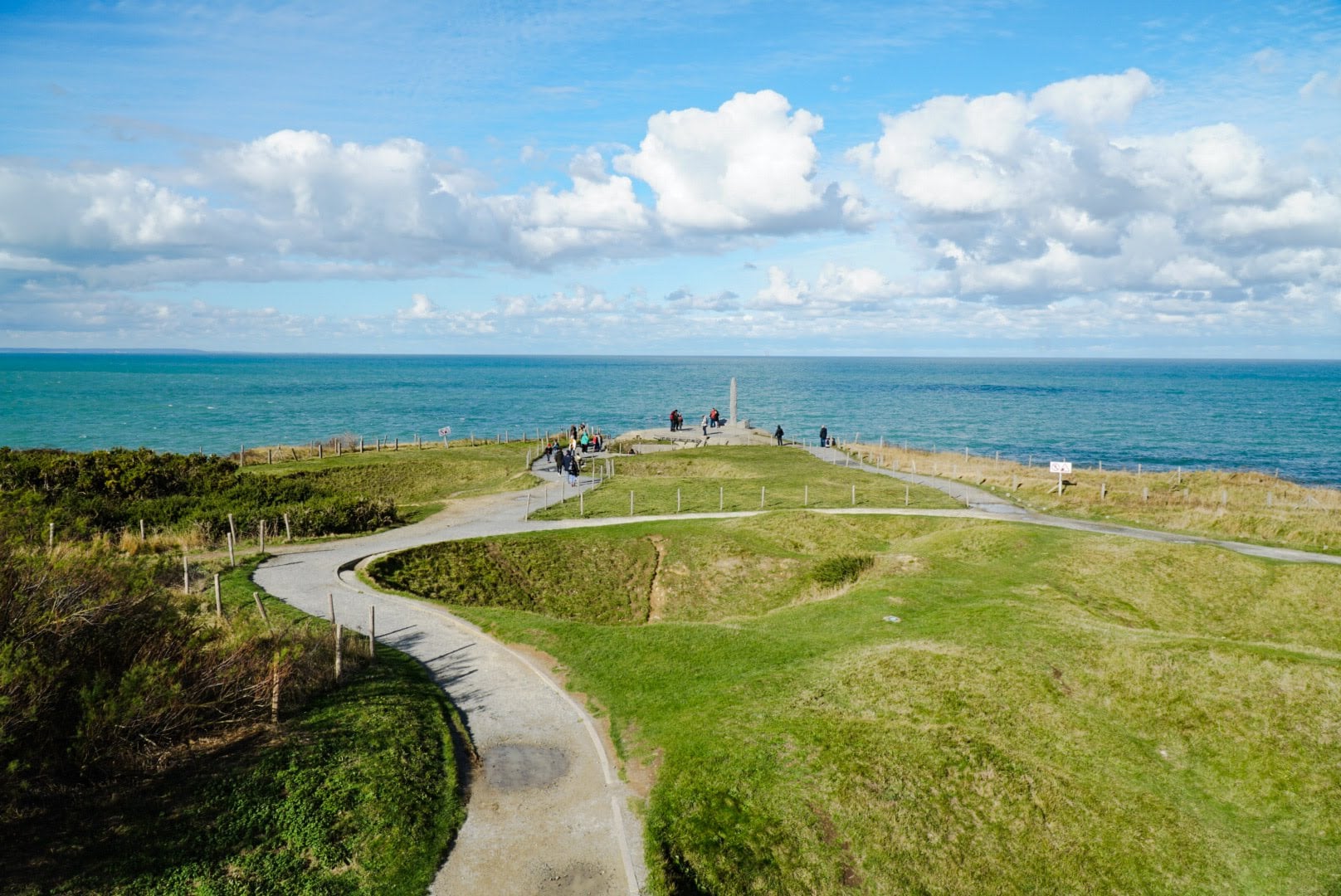
    Path to the memorial for fallen Rangers at Pointe du Hoc
    Looking down the path to the memorial for the fallen Rangers at Pointe du Hoc.

    Site 4: Pointe du Hoc

    Next, we drive to the parking area for Pointe Du Hoc. Near the parking area is a memorial to the Army Rangers who gave their lives during the bloody battle fought here.  It is a moving tribute to their courage and sacrifice. It tells the story of the Ranger’s persistence to scale the cliffs soaking wet in the middle of a storm while being gunned down by Germans from above.

    What courage and commitment it took for them to continue scaling the almost 100-foot cliffs! Their fellow soldiers were dying one after another, and yet they continued to climb until at last some of them reached the top and claimed Pointe du Hoc as an Allied stronghold.
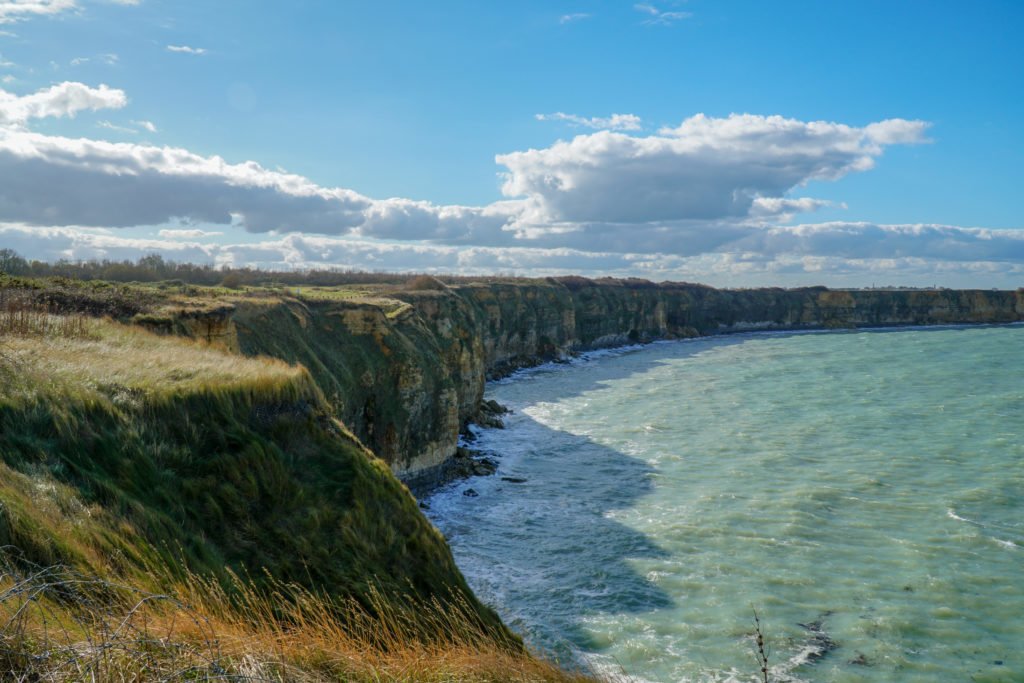
    The cliffs at Pointe du Hoc
    The same cliffs at Pointe du Hoc the Rangers once scaled.

    This, of course, is the short version.  The entire story of what occurred at Pointe Du Hoc on June 6, 1944, is an incredible tale of heroism. It is almost unbelievable, like something out of a Hollywood movie, and yet it’s true. These men defied unbelievable odds. 
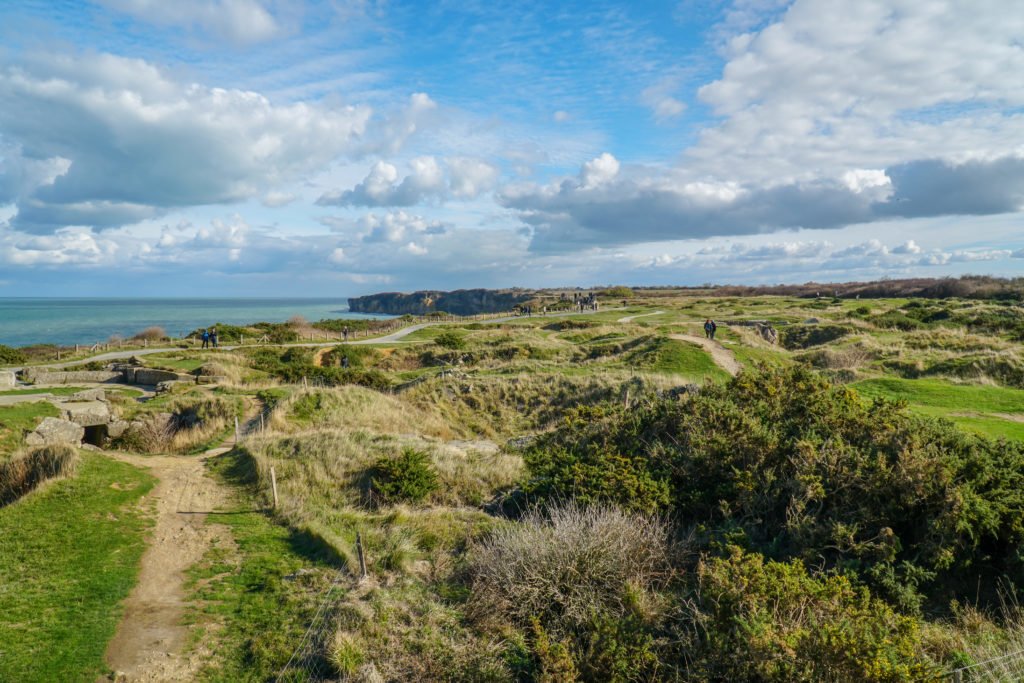
    craters formed from aerial bombings at Pointe du Hoc
    The craters from the aerial bombings dot the landscape.

    Lunar Landscape

    From the memorial near the parking lot, you continue down a trail leading to the very cliffs these Rangers climbed on that dark and stormy night. You walk past large craters from aerial bombings and get a chance to step inside the bunkers the Germans built to house their 155mm arterial guns. These guns could target ships up to 12 miles offshore! You can understand why it was so crucial for Allied forces to overtake these strongholds to win the fight on D-Day.

    The walk to the stone memorial overlooking the water is memorable in itself. It gives you a scope of the type of battle fought here.  Kids will enjoy exploring the craters and empty bunkers. The walk from the parking lot takes about 10 minutes.  Make sure to wear sturdy walking shoes and give yourself enough time to explore the grounds before heading on to your next stop.

    Time Spent Here: (~ 1 hour)
    Location: Pointe du Hoc, 14450 Cricqueville-en-Bessin, France
    Commute Time to Next Site: ~ 15-minute drive
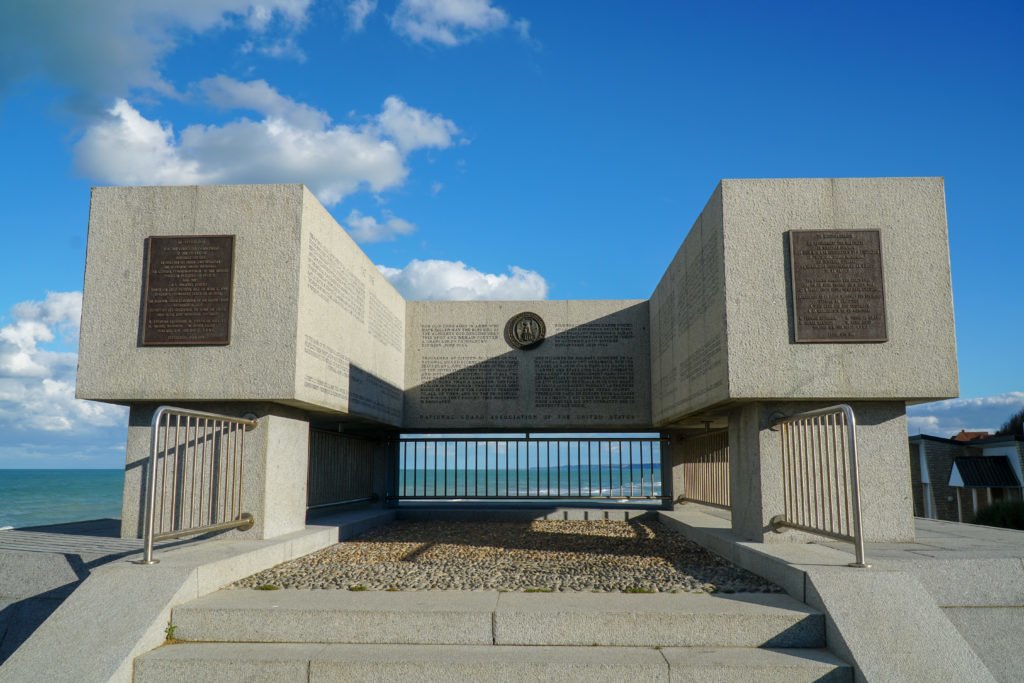
    National Guard Association Monument
    The National Guard Association Monument built atop a former German pillbox.

    Site 5: National Guard Association Monument at Omaha Beach

    The National Guard monument located along Omaha Beach is an inspiring monument dedicated to the soldiers of the National Guard who fought not only in World War I but also in World War II.  That was one of the things written on the monument that stuck out to me. It mentioned how the sons of the National Guardsmen would fight for freedom in WWII just as their fathers had fought for freedom during WWI. What a powerful legacy.

    Take time to read the words and quotes engraved on each side of the monument. Close to the monument is another memorial of a National Guardsmen carrying his fellow soldier out of battle. This memorial is in tribute to the National Guardsmen of the 29th Division’s 116th Infantry Regimental Combat Team. 

    They were some of the first to land on the area that is now referred to as “bloody Omaha.” They came with brothers, and boyhood friends, never to return home to their families or to live out their lives.  They were so young and so courageous. The soldiers who fought in WWII are true superheroes. 
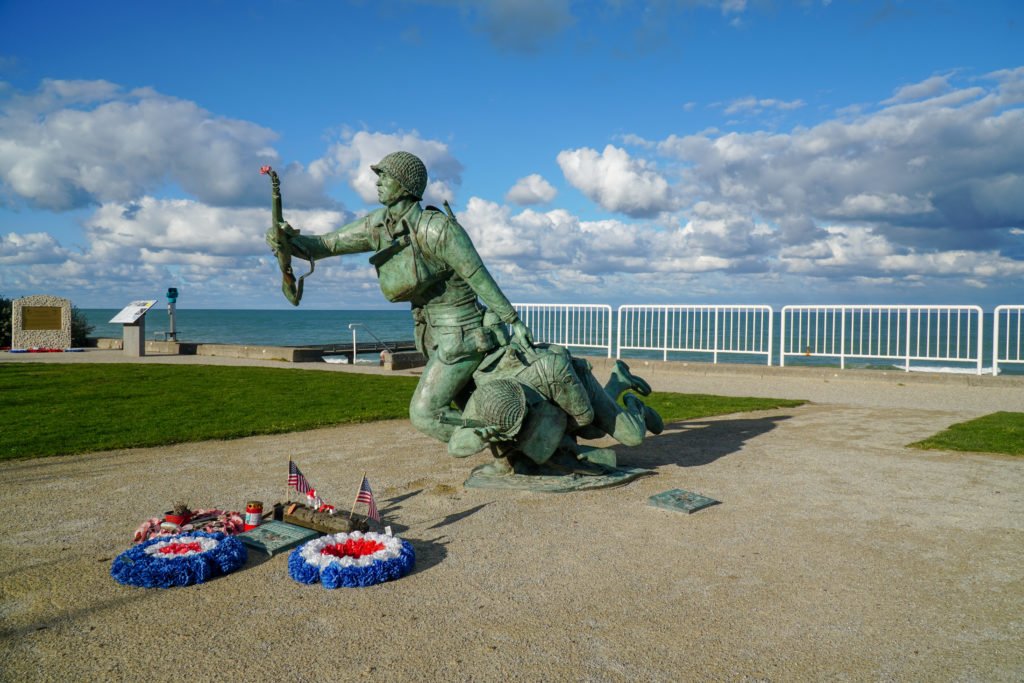
    Memorial to National Guard
    The tribute to the National Guard titled “Ever Forward.”

    Walk along the beach while you’re here and look up at the cliffs. Imagine what it was like for the soldiers who landed on these shores, wet, cold and disoriented, being gunned down in the water before they even had a chance to fight. No matter what, they wouldn’t be stopped.  They knew what they had to do, no matter the cost!

    Time Spent Here: (~ 15 minutes)
    Location: National Guard Monument (Secteur Charlie), 12 Boulevard de Cauvigny, 14710 Vierville-sur-Mer, France
    Commute Time to Next Site: ~ 5-minute drive

    Site 6: Omaha Beach Memorial

    We drove along the waterfront for another 5 minutes before reaching the parking area for the Omaha Beach Memorial.  The wind was blowing and the cold air bit into our skin. The skies were blue and clouds dotted the horizon. It made me think of the weather conditions the soldiers dealt with during the early morning hours on June 6, 1944. 

    I tried to imagine a much darker and stormier scene.  The first wave of soldiers arriving soaking wet, many drowned before they ever made it to shore. Gunfire raining down from German soldiers perched on the cliffs and the beach. This was war, ugly and chaotic with freedom on the line.  

    I live in the light of victory, but on D-Day, victory was still being fought for. It was a scene of tragedy, and decades later, many survivors would continue to have a hard time talking about it. I’ll never truly understand the full cost, but I’ll do my best to live gratefully.
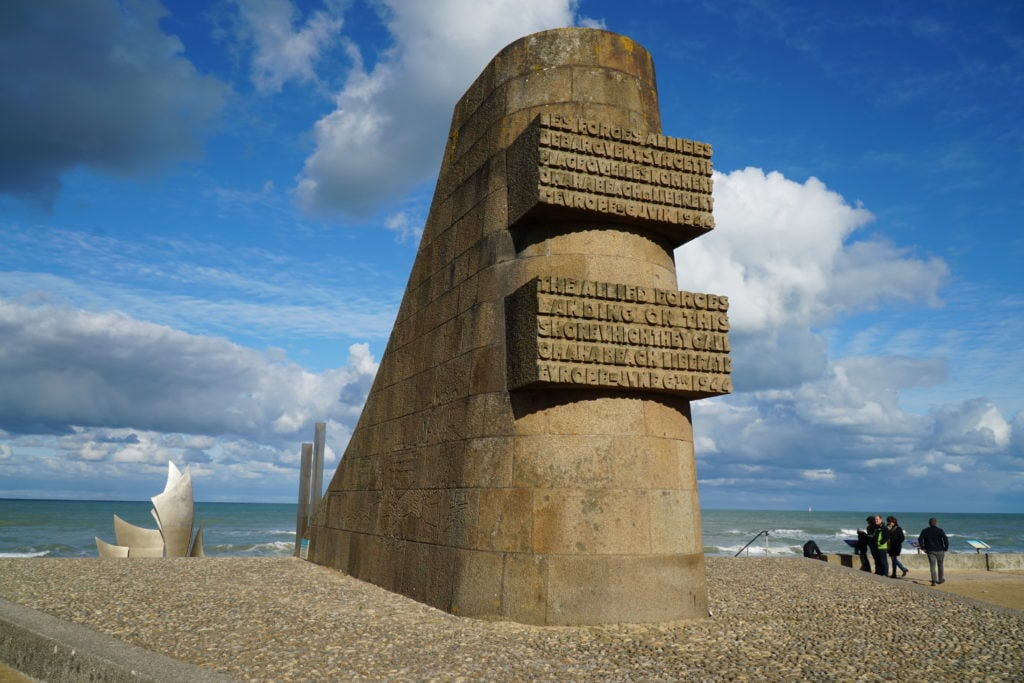
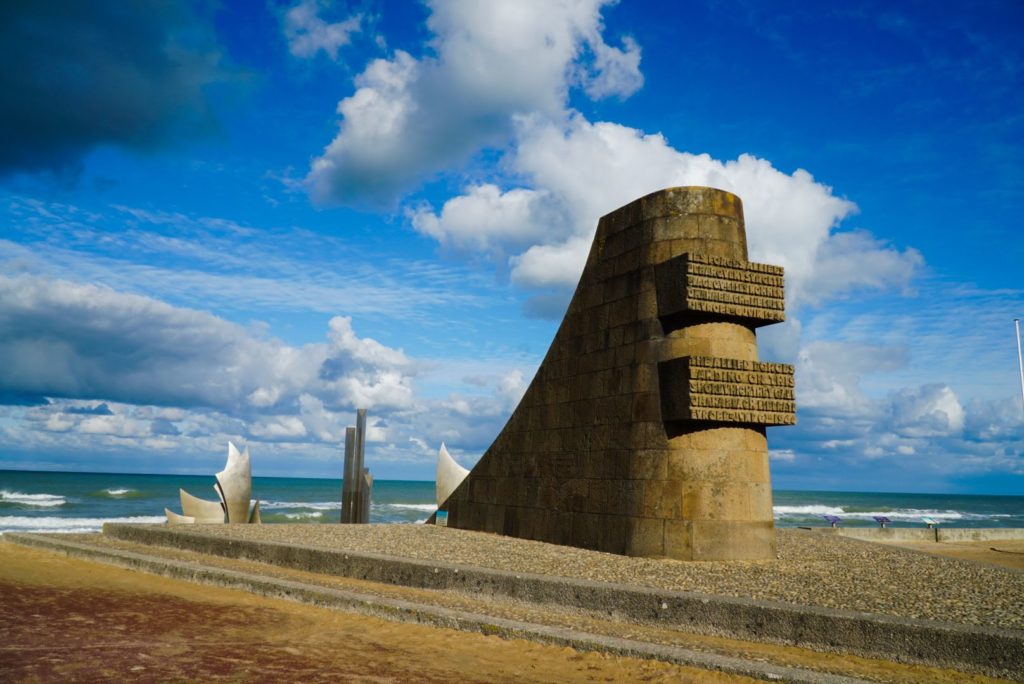
    A stone memorial at Omaha beach commemorating D-Day.
    A stone memorial at Omaha beach commemorating D-Day.

    Next to the parking lot, there is a large stone marker, which is a memorial to the Allied forces landing here on Omaha Beach on June 6, 1944.  On one side of the stone memorial is the inscription: —No mission too difficult —No sacrifice too great. Duty First. Forced Omaha Beach at dawn 6 June. The other is etched with the images of soldiers and reads: Erected in memory of those —The 116th RCT 29th Infantry Division AUS landed here June 6, 1944.

    Les Braves

    Just behind it is a beautiful metal sculpture rising out of the sand just off the shore. The sculpture created by French sculptor Anilore Banon is titled “Les Braves.” According to Banon, the sculpture consists of the following three elements:

    The Wings of Hope – So that the spirit which carried these men on June 6, 1944, continues to inspire us, reminding us that together it is always possible to change the future. 

    Rise Freedom! – So that the example of those who rose against barbarity, helps us remain standing strong against all forms of inhumanity. 

    Wings of Fraternity – So that this surge of brotherhood always reminds us of our responsibility towards others as well as ourselves. On June 6th, 1944, these men were more than soldiers, they were our brothers.
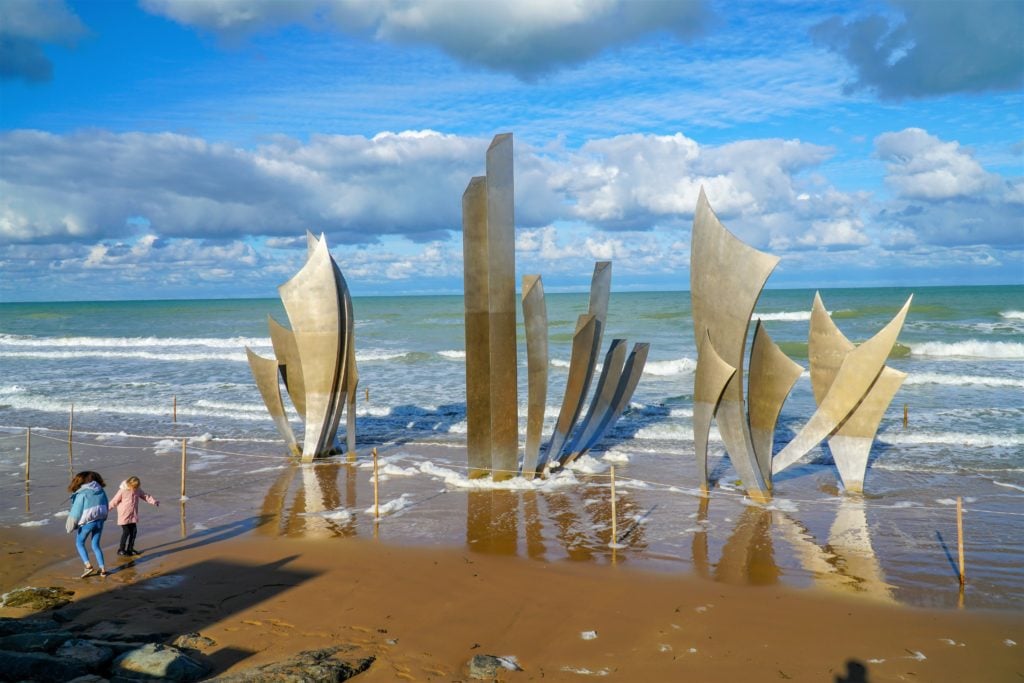
    Les Braves D-Day Sculpture
    “Les Braves” sculpture on Omaha Beach.

    The people of Normandy are still very grateful to the American and Allied forces for freeing them from the Germans.

    If you have extra time and want to stop, there is the Omaha Beach Museum about a 5-minute walk from the Omaha Beach Memorial.

    Time Spent Here: (~ 1 hour)
    Location: Omaha Beach Memorial, Avenue de la Libération, 14710 Saint-Laurent-sur-Mer, France
    Commute Time to Next Site: ~ 15 minute drive

    Lunch Break

    We ate lunch at the D-Day restaurant across from the Omaha Beach Memorial parking lot. It was a choice of convenience. However, it was warm and cozy inside the restaurant. My lunch consisted of some toast topped with ham and cheese. It was a warm break from the chilly weather outside.

    I recommend packing snacks and water in your car, and possibly a picnic lunch if you’re able to. I didn’t see too many dining choices along this route.  However, that may be due in part to the time of year when we visited. In the summer, you might find more options available.

    Location: D-Day House, 1 Rue Désiré Lemière, 14710 Saint-Laurent-sur-Mer, France
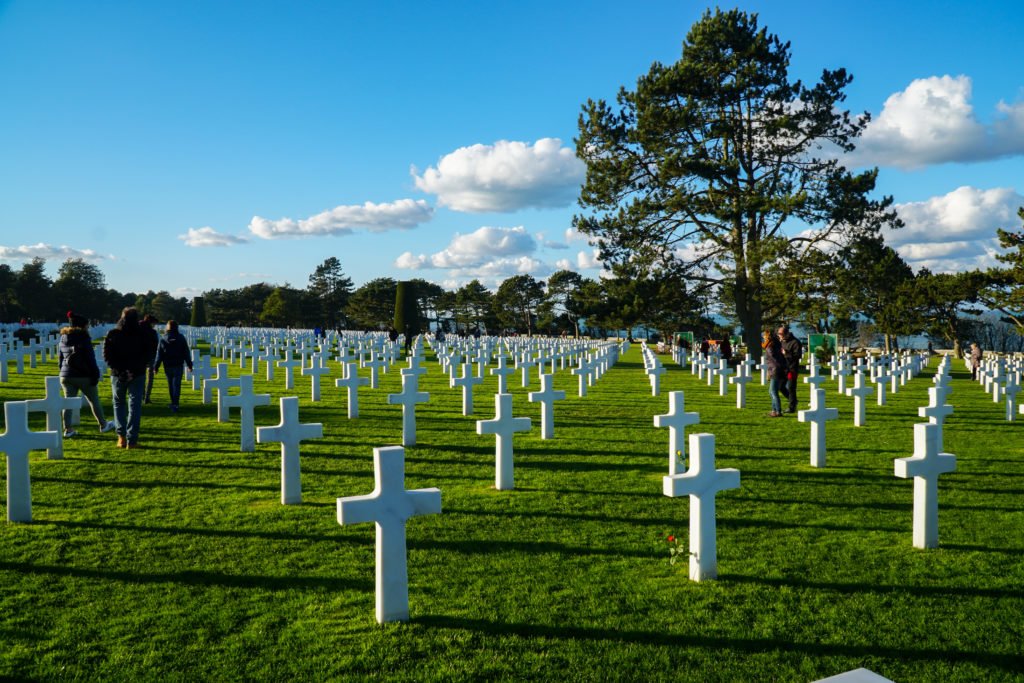
    Normandy American Cemetery for WWII
    This beautiful cemetery dotted with white crosses is a serene resting place for the heroes buried here.

    Site 7: Normandy American Cemetery & Memorial

    Next, we drove to the Normandy American Cemetery and Memorial in Colleville-sur-Mer. Due to the delay at the Airborne Museum, we only had about an hour to spend at the cemetery before it closed at 5:00. So we quickly parked and headed down the long path.  We bypassed the visitor’s center, knowing what little time we had and instead continued to follow the path towards the ocean, along the infinity pool, and then curving around to the cemetery.
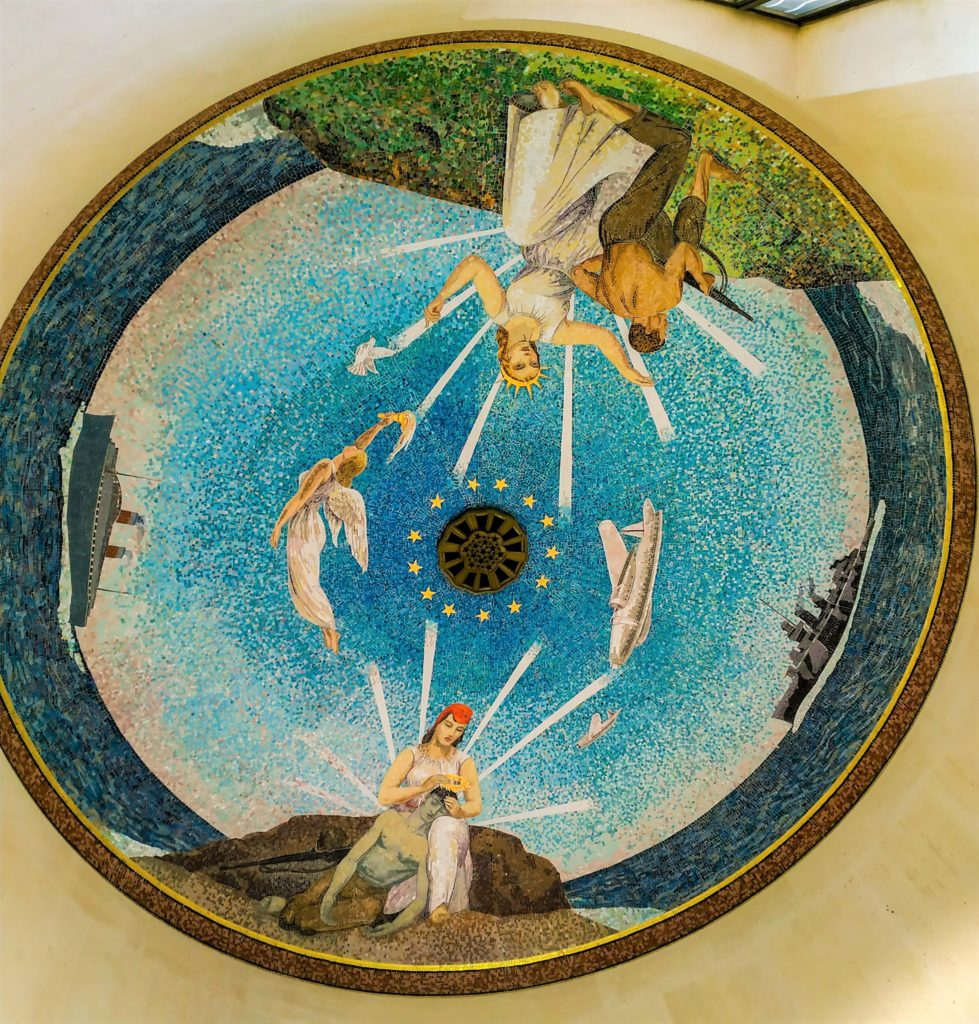
    mosaic at Normandy American Cemetery
    The beautiful mosaic on the chapel ceiling.

    The rows and rows of white crosses stretched out almost endlessly in front of us.  People were milling about through the rows of crosses, searching perhaps for the grave of a loved one.  As you walk throughout the Normandy American cemetery, you feel almost as though you are in a park and not a cemetery. The setting is so lush and green. It is very peaceful.

    Sculptures & Artistic Tributes to the Fallen

    Make sure to stop in the cemetery’s chapel.  It is the rotund building at the center of the cemetery. Step inside the small chapel and admire the beauty and thoughtfulness put into the gorgeous mosaic on the chapel’s ceiling. American painter Leon Kroll created this beautiful portrait symbolizing American on one side, sending out her son to battle and France on the other side, taking our fallen soldier in her arms.  It is such a beautiful image. 

    After you finish your walk around the cemetery, make your way to the large reflection pool where you’ll see a tall bronze statue rising above from the far end.  This beautiful sculpture created by Donald Harcourt De Lueis titled “Spirit of American Youth Rising from the Waves.” It bears an inscription at the bottom that reads “Mine eyes have seen the glory of the coming of the Lord.” On the walls close to it, you’ll find huge maps displaying all of the various forces along the shore and their routes.  It is awe-inspiring!
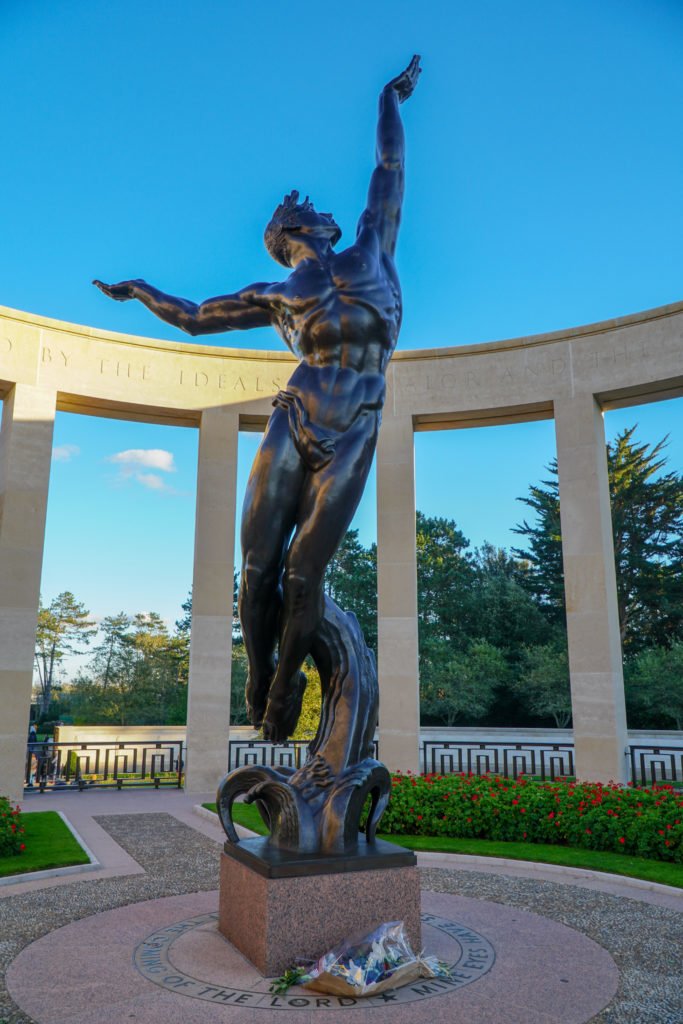
    Bronze sculpture at D-Day cemetery in Normandy France
    “The Spirit of American Youth Rising.”

    If you have time, walk along the shores of Omaha Beach below the cemetery. Make sure to stop in at the visitor’s center for more helpful information regarding those buried here and to view the beautiful infinity pool.  They have volunteers on staff who can also help you locate any loved ones who are buried here.  

    Normandy American Cemetery in Colleville-sur-Mer is a beautiful park-like setting, very peaceful.  A wonderful resting place and memorial to these soldiers.

    Time Spent Here: (~ 1 hour)
    Location: Normandy American Cemetery, 14710 Colleville-sur-Mer, France
    Commute Time to Next Site: This was the final stop, and it was about a 45-minute drive back to Caen.
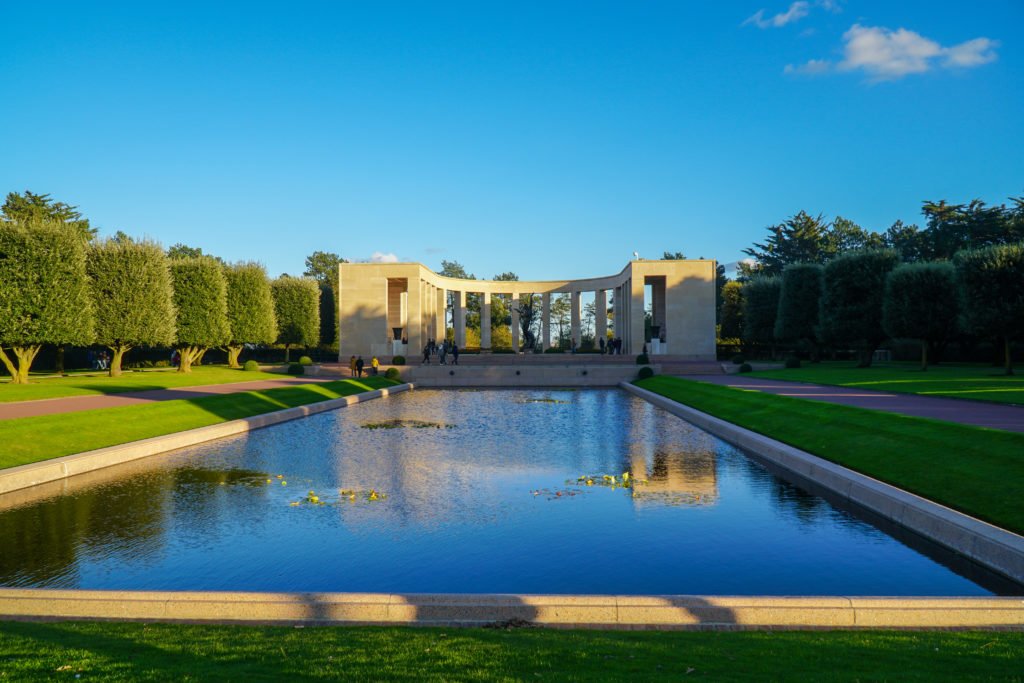
    The reflection pool at Normandy American Cemetery.
    The reflection pool at Normandy American Cemetery.

    Tips & Recommendations for a Self-Guided Tour of D-Day Sites

    Planning Tips

    • Always check the hours for each museum directly on the museum’s website. Google is not always up to date on its listing for hours and operations.
    • Pack snacks and drinks in the car to keep your energy up in between stops.
    • Make sure you can drive a manual transmission before renting a car in Europe.
    • Organize your day, so you have the most time at the sites you want to see. Then if you can’t make it to all the stops on the list, you will at least have seen the ones most important to you first.
    • Wear layers and sturdy walking shoes.

    How Much Time To Spend Here

    There is so much to see that you could spend days or possibly weeks here, depending on your interests.  However, with only one day, you’ll need to pick the top sights you want to see and save the rest for your next trip. One site I would have liked to have fit into our day was Utah Beach. I guess I’ll save that for my next trip!

    Getting Here:

    You can take a direct train from Paris’ Saint-Lazare station to Caen. This takes approximately 2 hours, 15 minutes. You can also take a train from Caen to Bayeux if you prefer to stay there.  In Bayeux, bus #70 takes you to many of the D-Day sites if you prefer not to drive.  You can also, of course, book a tour of the sites. Caen also has an airport so if you’re coming from somewhere other than Paris, you might check to see if they have flights that go through it.

    Recommended Apps to Download Before Your Trip

    Google Maps: This invaluable tool will help you get to each destination along your journey. If you plan to do a self-guided driving itinerary, then you will want to install Google Maps on your phone ahead of time and also download it for offline use.

    Normandy D-Day 1944 (by Spot on Locations Ltd): This Normandy D-Day app provides the names and locations for all the various D-Day sites in Normandy. It gives historical details associated with each area and includes over 500 photos and 100 locations. If you like learning more about the history, then consider downloading this app before your trip and looking through the areas you’ll visit and read up on the history associated with each.

    Rick Steves Audio Europe: Consider downloading this app before any trip you take to Europe.  If you enjoy self-guided tours, then you will appreciate this app. Just put your earbuds in, and Rick Steves will guide you on your walking tour to whichever destination you’ve chosen on the app. 

     So say you choose France, you will then see a list of all the audio guides the app has for France.  Look for the one titled “Normandy: D-Day Sites” and listen to this before your trip to D-Day to get an idea about what there is to see and learn more about the history of the region. The app has not only audio walking guides, but also interviews with local experts on a variety of subjects relating to each location.
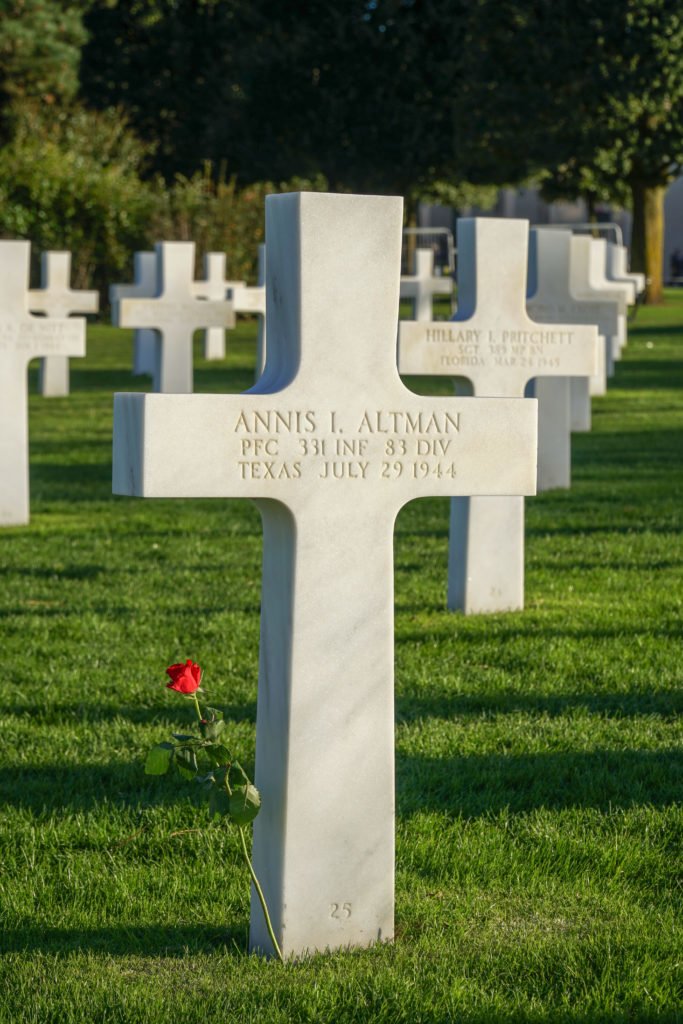
    crosses at American Cemetery in Normandy.
    Roses and flowers left by crosses. Reminders that they are not forgotten.

    Closing Thoughts on D-Day

    Visiting the D-Day sites in Normandy was like walking through the history books. It is one thing to read about this incredible date in history, but it is something else to see the area firsthand. To see the graves of the thousands of soldiers who lost their lives here, and to read about their individual stories is an incredible and moving way to spend the day.  

    Visiting sites like D-Day or even Auschwitz remind me of the beauty of the human spirit. Yes, there is an ugly side to humanity. However, there is also resilience and a determination to overcome even the worst odds for the good of mankind.

    I hope you plan a trip to visit Normandy, France, and the historic D-Day sites. However, if you can’t do that right now, why not visit a local Veteran’s Cemetery or museum near you, dedicated to those who gave so we could have freedom.  Say thank you the next time you see a veteran, and let’s use our freedom to show compassion and grace to everyone we meet.

    Thank You to All Who Served and Continue to Serve

  • Spend an Unforgettable Day At Mont-Saint-Michel

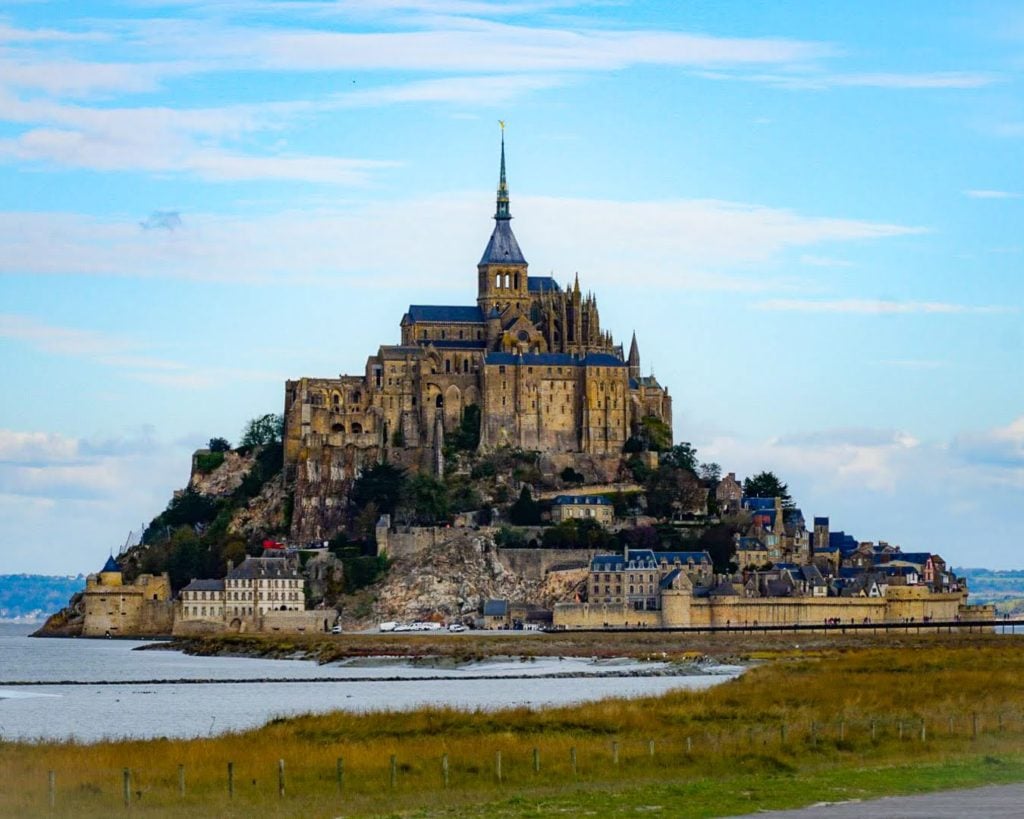
    On the border of Normandy and Brittany, Mont-Saint-Michel rises above the bay like a bastion. This medieval fortress is chiseled into the granite that formed this small island. One look at it and you can understand its allure. There is something so unique about this little island. Mont-Saint-Michel is just one of the many historical treasures found in Normandy. It may take a little extra work getting here, but the historical significance and beauty of this region are well worth your time and effort!

    Discover for yourself why over 2 million people visit this island every year. This article includes everything you need to plan your visit to Mont-Saint-Michel, whether you’re visiting from Paris or another area of France.  Don’t be put off by the extra effort to visit this remarkable destination. It’s easier than you think!

    What You’ll Find in this Article

    About Mont-Saint-Michel

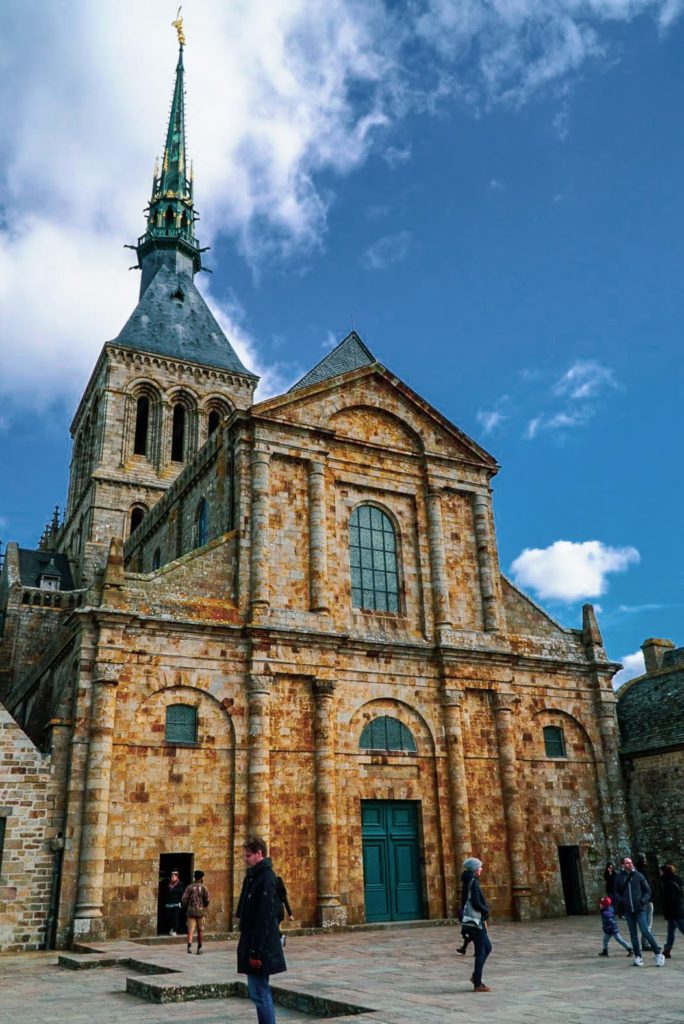
    Mont-Saint-Michel is a UNESCO Heritage Site. It reportedly dates back to 708. The story is that the Bishop of Avranches had a vision from the Archangel Michael telling him to build a sanctuary here. So one of the first things you might notice when looking up at Mont-Saint-Michel is the golden spire with the Archangel Michael rising high above everything else.

    Benedictines settled in the abbey in the 10th century, where the town began to grow outward on the rocky island, and by the 14th century, it reached the foot of the rock.  It was used as a stronghold during the Hundred Years War and became a symbol of national identity. The Germans also occupied Mont-Saint-Michel during World War II, bringing with them thousands of German tourists seeking to visit this incredible place. So, as you can see, this small island is rich with history!

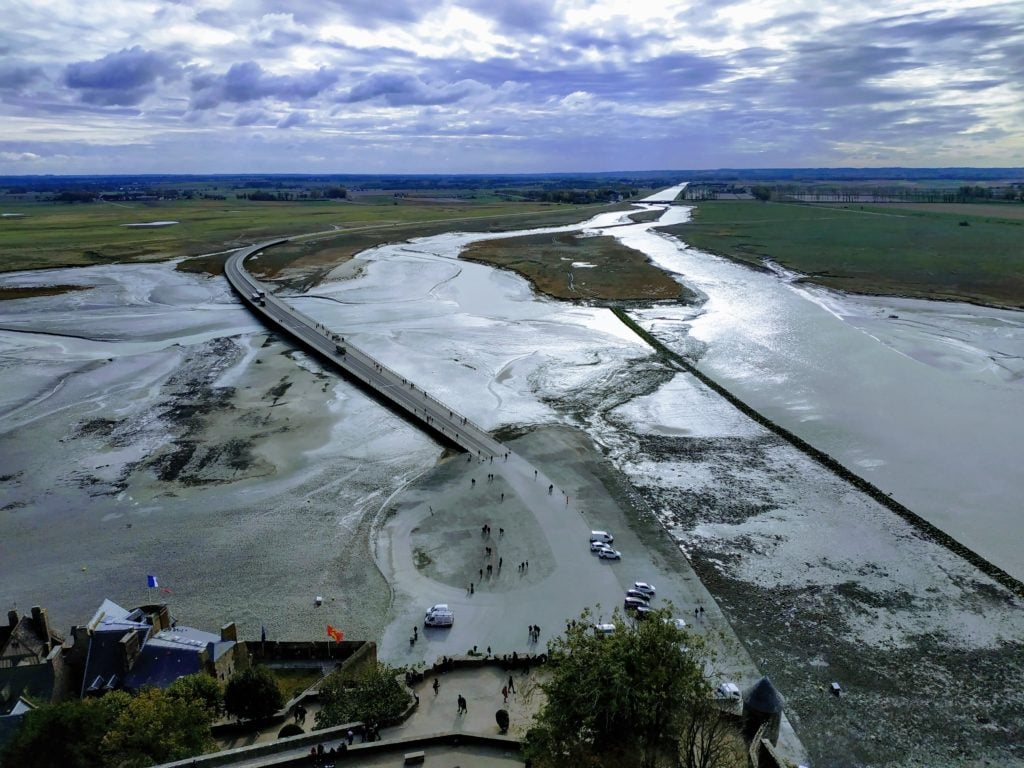
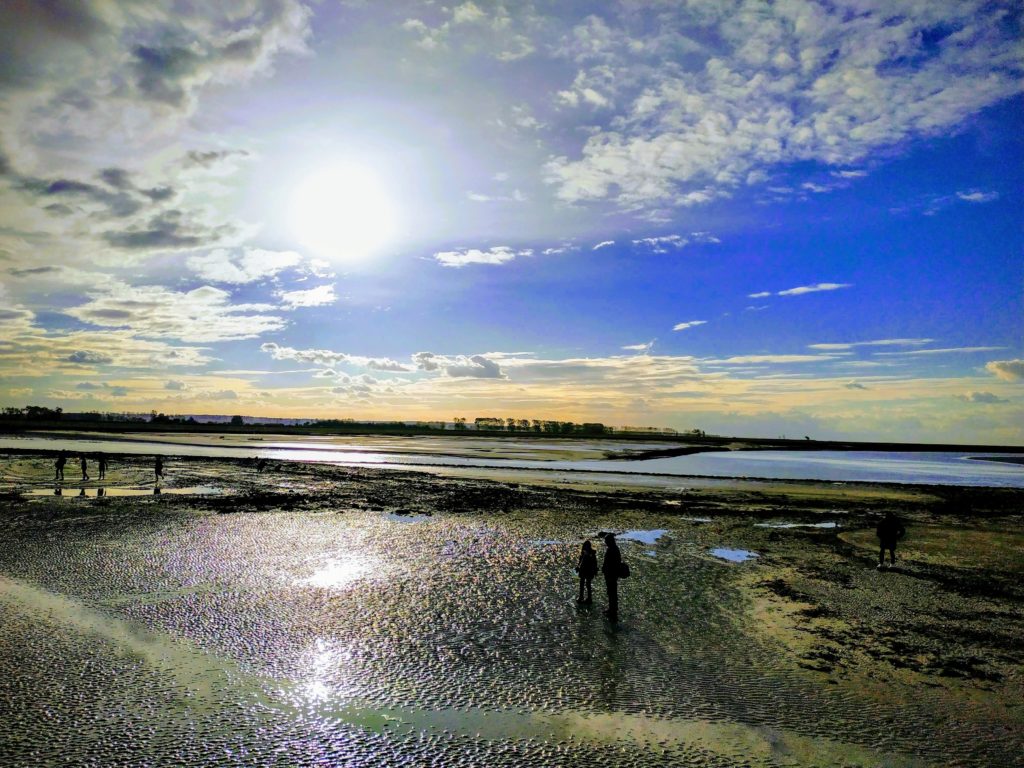
    mont-saint-michel bay at low tide
    Explore the area around Mont-Saint-Michel at low tide.


    As you explore the village of Mont-Saint-Michel, you will discover what a feat of engineering it is.   The walls are built into the granite rock that makes up the island. This was certainly not the most natural choice of terrain for construction, and that is what makes it so extraordinary!

    The tides at Mont-Saint-Michel are another aspect that makes this island fortress so remarkable. The highest tides in all of Continental Europe are observed here!  Access to the island is restricted during “spring tides.” This is when the tide is the highest. You can view the tide charts for the whole year and also check Mont-Saint-Michel’s website for dates when they are closed

    Arriving at Mont-Saint-Michel

    Whether you arrive via bus or car, you will still need to either walk the remaining 1.5 miles across the causeway to the island from the car park or take the complimentary shuttle.

    Mont-Saint-Michel at low tide
    This is the most water we saw surrounding Mont-Saint-Michel during our low-tide visit.

    Parking at Mont Saint Michel: It costs around 9€ to 15€ to park for 24 hours at Mont-Saint-Michel. Prices vary depending on what time of year you visit. 

    Walking to Mont-Saint-Michel: It is approximately a 40-minute walk (~1.5 miles) from the parking lot at Mont-Saint-Michel to the main entrance into the walled city. There are signs posted along the trail telling you how long from “this” point the walk will be.

    Complimentary Shuttle: You can walk over to the complimentary shuttle area following the signs from the parking lot or bus stop (if arriving via bus) and wait for the next free shuttle to transport you across the causeway. 

    My Recommendation: 

    If the weather is nice and you’re able to do it, I recommend walking. You have beautiful views all along the way to Mont Saint Michel. It gives you time to soak in the size and location of this walled island and the abbey rising from the top. You can always choose to ride the shuttle back at the end of your visit.

    My friend Angela and I chose to walk the 1.5 miles, and although it was a cold day, the walk was beautiful. It helps that it is a flat, easy walk.  There were lots of people out walking with us too.  Oh, and of course, we chose to walk it before realizing that it would be a 40-minute walk in the cold.  However, in the end, I’m glad we didn’t know how long it was, otherwise we would have missed out on admiring and photographing the views as we walked. So skip the shuttle and walk to the island, then take it back when you’re ready to leave. 

    Things to Do at Mont-Saint-Michel

    La Grande Rue

     
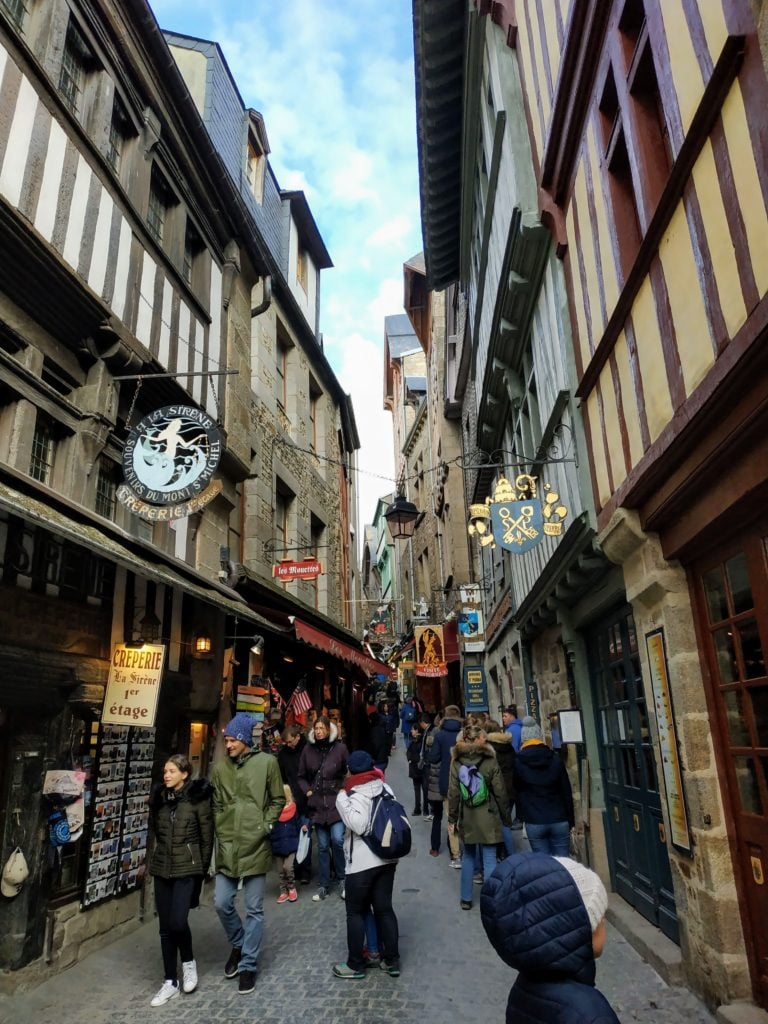
    La Grand Rue Mont Saint Michel
    Enjoy exploring the narrow streets of Mont-Saint-Michel.

    Upon arriving at Mont-Saint-Michel, you’ll pass by public restrooms and enter the archway on to La Grand Rue. This narrow street is the main street in the village.  This is where you’ll find souvenir shops, hotels, cafes, and restaurants.  Continue up this street to visit the abbey. I recommend you do that first, then take your time stopping at the shops and sites along La Grand Rue on your way back down.

    Mont-Saint-Michel Abbey

    This is the one attraction you must see while visiting Mont-Saint-Michel.  If you only pay for one, make this it. The historic Mont-Saint-Michel Abbey crowns the top of this rocky fortress. The Benedictine abbey was built around the 10th century and was used as an abbey until the French Revolution when it later became a prison; this lasted until 1863. Then in 1874, it became a historical monument. It took over 1300 years to build the abbey!

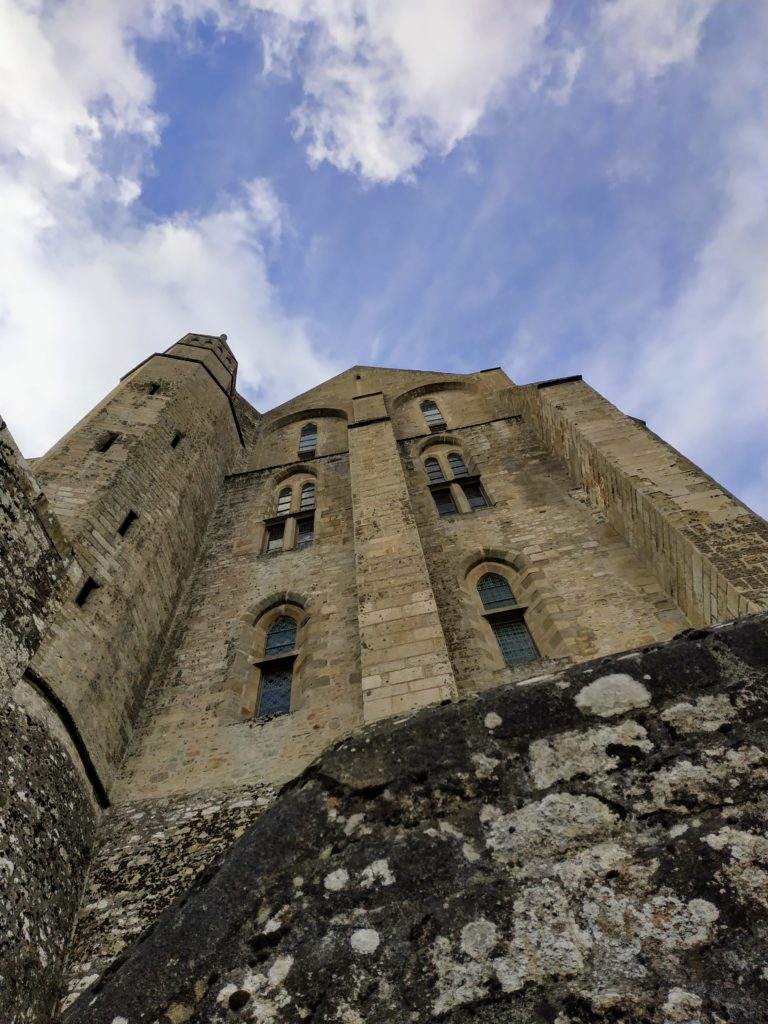
    The climb up to the abbey is a steep one. However, it is fascinating to look up at this magnificent medieval structure rising and towering over everything surrounding it.  It also makes your neck hurt!

    looking up at the abbey towering above
    Looking up at the Abbey can be a real pain in the neck!


    Hours & Ticket Information:
     Mont-Saint-Michel Abbey Ticket Prices and Opening Hours

    The price of your ticket includes a guided tour (during certain hours). You can also purchase an audio guide for an additional 3€ and take a self-guided tour. There are a lot of stairs to climb as you make your way to see the abbey. However, the view from the top is worth it.

    Skip the ticket line at the abbey and purchase your abbey tickets in advance

    Mont-Saint-Michel Abbey Church
    The Mont-Saint-Michel Abbey Church as seen from the terrace.

    Terrasse de l’Ouest

    Don’t miss this stop on your visit to the abbey.  The terrace is located outside the abbey church and has incredible views! You can walk down the backside of the abbey from the terrace to return to the main town. I highly recommend you do this! There are also restrooms at the terrace.  Soak in the views before exploring more of this unique island.

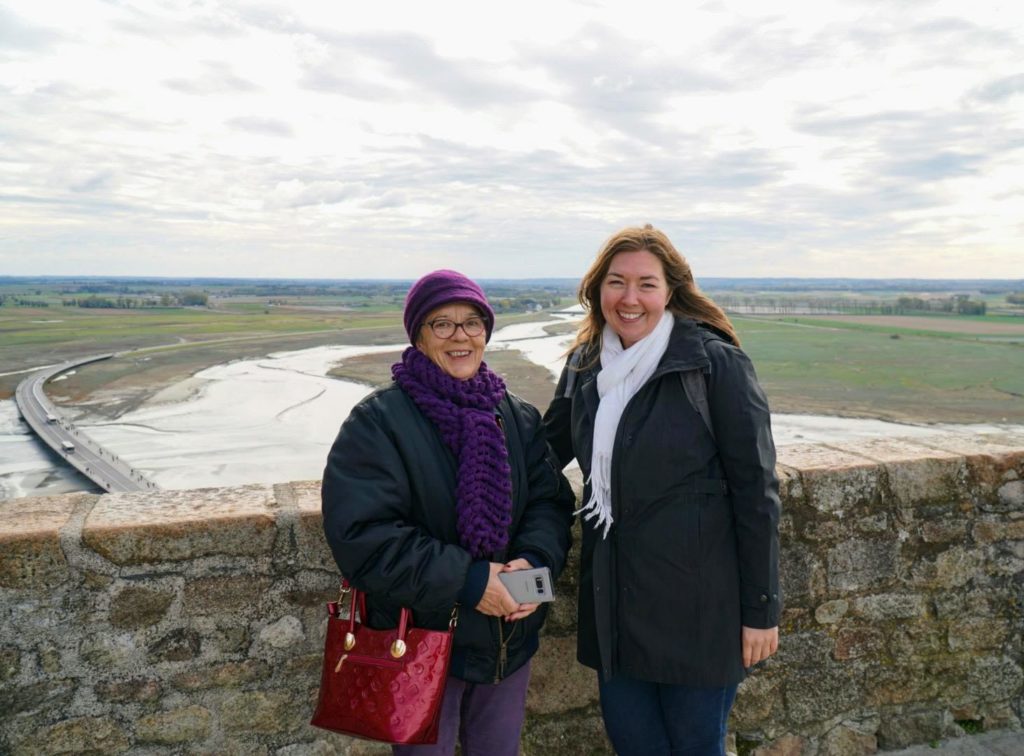
    My friend, Angela, met the woman she was studying French with online before our trip, at Mont-Saint-Michel and we toured it together.  It was fun to meet a local and get a chance to learn more about French culture.  The French people I know are warm and funny, and yes, they love food! I love getting to learn about a country from the locals. 

    Travel, and be prepared to have your preconceived ideas forever transformed in the light of reality.

    My friend Angela and her French friend Bernadette
    One of the gifts of travel is friendships made around the world!

    Église Saint-Pierre

    Step inside this small chapel just off the La Grand Rue and enjoy a quiet break.  Make sure to also stop at the cemetery just up from the church.  It is a unique setting with views of the bay below.  This local parishioner’s church provides a more simplistic and less touristy space in which to have a quiet moment. Admire the beautiful stained glass windows as well as an impressive statue of the Archangel Michael slaying a dragon.  You are welcome to join them in mass during its observed hours.

    La Chapelle-Saint-Aubert

    This small chapel was built towards the foot of Mont-Saint-Michel, you can access it via a path near the front entrance to La Grand Rue.  It is best seen during low tide, though, due to its low position. Although you may not be able to go inside, you can look around the outside and take a peek in the windows.

    Explore the Sandy Bay at Low Tide

    Check with the Tourist Information Center to see whether or not there are any guided tours of the mudflats surrounding the island. Also, make sure to check the tide charts and ask the tourist information center about when it is safest to explore.  Even if you can’t take a tour, you will have fun walking around the outside perimeter of the island, examining it from the ground level.

    Views of Mont-Saint-Michel Bay at low tide
    A view of the bay at low tide and the causeway leading up to Mont-Saint-Michel.

    Getting to Mont-Saint-Michel

    You have a lot of options when traveling to Mont-Saint-Michel. I will focus on the two most common options.

    Fastest Route to Mont-Saint-Michel from Paris by Train:

    If you’re coming from Paris to Mont-Saint-Michel on the train, the quickest route will take you about 3.5 hours to get to Mont-Saint-Michel.  Take the train from Paris’ Montparnasse Station to Rennes and then a shuttle bus from Rennes to Mont-Saint-Michel. You can book the entire trip ahead of time online. Prices start around 50€ to travel from Paris to Mont-Saint-Michel (one-way). 

    In addition to passing through Rennes, there is also an option that takes you to Dol de Bretagne. Then it’s just a 20-minute shuttle from there to Mont-Saint-Michel. The travel times are similar for both options leaving Montparnasse Station. Visit SNCF’s website to view a timetable for the day you wish to travel. 

    You don’t have to book your shuttle bus from Rennes Station to Mont-Saint-Michel ahead of time either. You can always purchase your ticket at the Rennes train station.  They schedule shuttle buses in conjunction with the arriving trains from Paris. Upon arrival at the station, you can purchase your ticket for the next departing shuttle (or purchase ahead of time online at SNCF). The ticket price from Rennes station to Mont-Saint-Michel is 30€ for a round trip ticket.

    Here are some additional train options, as well as shuttle bus information if you’re arriving from Pontorson.

    Car Rental Option from Caen:

    Another option when traveling from Paris to Mont-Saint-Michel is to take a train from Saint-Lazare Station to Caen. If you plan to visit other sites in the Normandy region of France, such as historic D-Day sites, then Caen makes an excellent starting destination for your trip to Mont-Saint-Michel.

    This is the option I chose for my trip.  My friend Angela and I planned to see D-Day sites the following day, and we also had a flight scheduled from Caen to Toulouse, so it made the most sense for our trip. Our car rental experience turned out to be far more of an adventure than we had planned! However, renting a car in France is pretty much the same process as renting one in the States. 

    They drive on the right side of the road, so there’s no learning curve for American drivers.  You do, however, need to know that when you rent a car in Europe, you will get a car with a standard transmission, unless you specifically request an automatic (subject to availability). So if you don’t know how to drive a clutch, learn before you go, or plan for another option.

    With Google Maps, it is easy to navigate from Caen to Mont-Saint-Michel via their freeway systems.  We had no issues getting lost, and there are lots of signs along the freeway for the major tourist sites too. We used our rental car to drive to all the D-Day sites, and the flexibility it provided is worth any extra hassle, in my opinion.

    Side Note: If driving from Paris, make sure to choose the “avoid tolls” option with Google Maps, so you aren’t surprised by any huge toll fees. I’ve read they can be surprisingly high.

    Thoughts on Driving vs. Public Transportation:

    It depends where you are driving from, but for the Normandy region of France, unless you’re booking through a tour company, I think renting a car makes the most sense.  A car gives you the most flexibility, and it is an easy area to navigate using Google Maps.  

    It will depend on your trip plans.  If you’re going to be in the area for 2-3 days at a minimum, then renting a car probably makes the most sense, however, if you are planning this for a day trip only, then you may want to take the train and shuttle option or book through a tour company. If you’re traveling solo, this will most likely save you money. However, if you’re in a group, then a car rental might save you some money.

    Approximate Travel Times: 

    • Train from Paris to Rennes leaving from Montparnasse Station: Approximately 2 hours
    • A shuttle from Rennes to Mont-Saint-Michel: Approximately 1 hour 10 minutes
    • Train from Paris to Caen leaving from Saint-Lazare Station: Approximately 2 hours and 15 minutes
    • Drive time from Caen to Mont-Saint-Michel: Approximately 1 hour 40 minutes
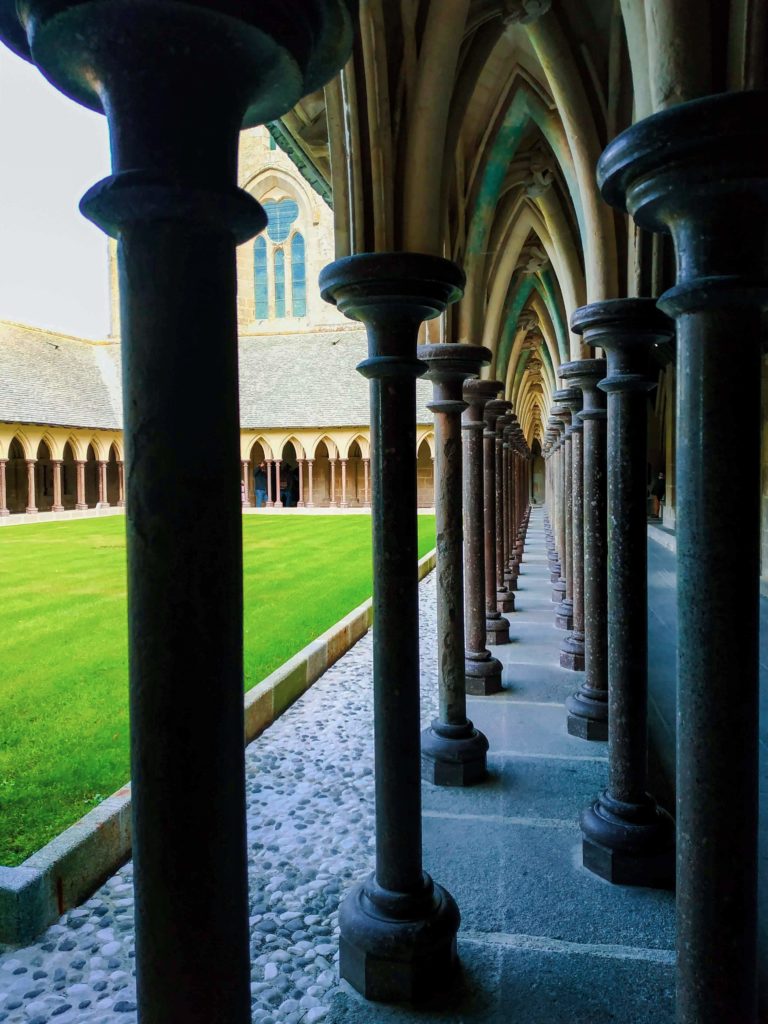
    The cloister at Mont-Saint-Michel Abbey
    The cloister at Mont-Saint-Michel Abbey.

    Tips for Your Visit to Mont-Saint-Michel

    Best Times to Avoid the Crowds:

    Spring to Fall is the busiest time to visit Mont-Saint-Michel, with summer being the absolute peak.  If you can visit in the off-season (mid-October to February), you will be rewarded with fewer crowds.  However, as I discovered during my visit there at the end of October, it can be frigid, so plan ahead and wear layers. Pack a scarf and gloves if you plan to visit during the colder months of the year.

    Plan to arrive between 9 a.m. and 10 a.m. to avoid the crowds brought in on the tour buses.  This is especially important during the peak season.  When I visited in October, I didn’t arrive until around noon, and although crowded, it wasn’t unbearable.

    Weather is typically the best April thru September. If you plan to explore outside and photography is one of your primary reasons for visiting, then I’d research weather patterns ahead of time to give yourself the best chance of good weather.

    Where to Eat:

    If you don’t plan ahead and pack a lunch or don’t plan to wait until you are off the island to eat, here are a couple of options for dining while at Mont-Saint-Michel. Just know that the prices and quality at most establishments here reflect the tourist-generated economy. In plain English: Prices are high, and food quality tends to be lower.

    Au Pelerin: This is one of the more reasonably priced options off the Grand Rue at Mont-Saint-Michele.  They serve baguettes and pizza and are a casual family-friendly establishment.

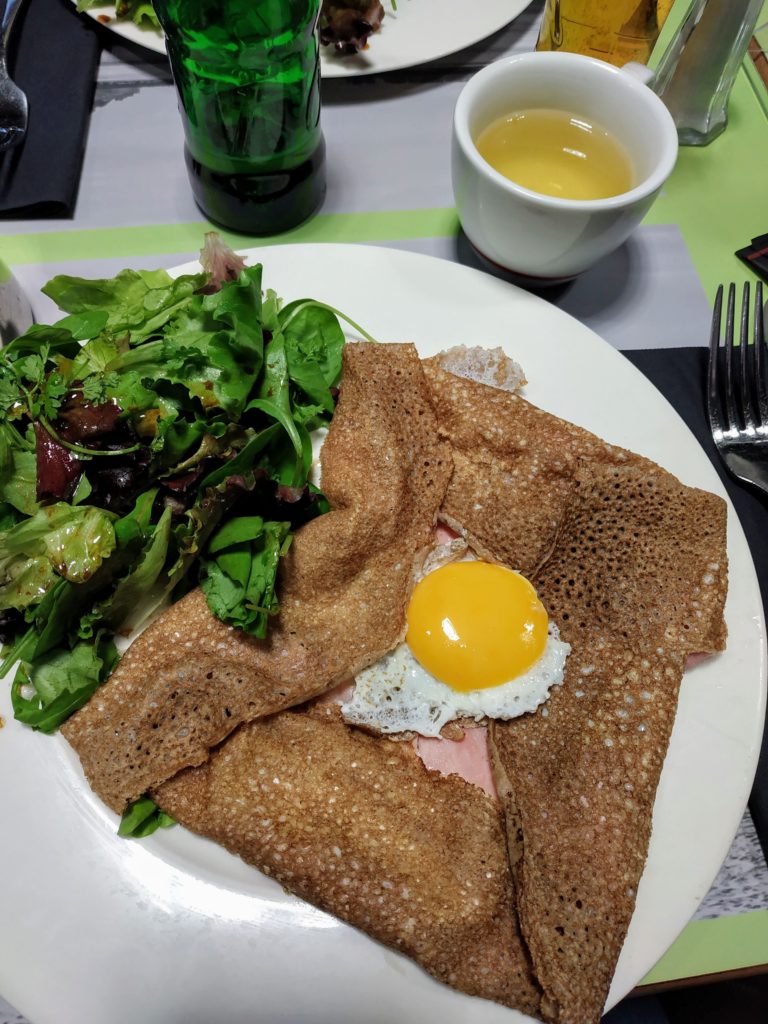
    La Sirene: If you wish to try the local dish of galette bretonne (which I recommend you do while in the area), then this is a good choice. The galette bretonne is a savory style crepe filled with ham and served with an egg. It is a simple but delicious meal!

    a galette bretonne
    Make sure to eat a galette bretonne while in the area.

    What to Wear:

    Wear comfortable walking shoes as the climb up to the abbey is a steep one with lots of stairs.  Additionally, if you plan to explore the area surrounding the island during low tide, you’ll want shoes that you’re okay with getting a little muddy.  

    If coming during the spring or fall, you’ll want to pack a light jacket, at least, plus a scarf.  Even in summer, I’d pack a rain jacket.  In the late fall and winter, you’ll want to dress in layers and wrap a scarf and gloves and perhaps a hat too.

    How Much Time Should You Plan to Spend Here:

    Plan to spend around 4 hours here.  That allows you time to explore the village, tour the Abbey, and grab a bite to eat if you wish.  You can also take time to explore the mudflats if the tide is out.  However, make sure to check with the tourist office and tide charts first!

    Consider spending the night if you want to see the tide at different levels and experience what it would be like to live on a small fortified island.  You will also get a chance to explore the village at night and early in the morning without the crowds.

    Mont-Saint-Michel at Night:

    You may want to consider visiting here in the late afternoon and then plan to stay for the sunset and views of Mont-Saint-Michel lit up at night. Seeing the island’s lights reflecting off the surrounding sand and water makes for beautiful photographs and treasured memories.

    Final Thoughts and Tips

    This small island is built out of a large mound of granite. This means that they only had one way to go–up!  This is the way you will go too. The streets are narrow because once again, this is a small town built on a small island chiseled from rock.  So expect it to get crowded and to take things slow. 

    Your climb up to the Abbey is a rather steep one, especially towards the top, but take it slow and stop for breaks as you need to.

    The goal is not to speed through this medieval village, but instead to take it all in, slowly meandering through the streets, stopping at whatever strikes your interest.  Mont-Saint-Michel is a unique destination. I have not visited any other place like it. So give it some time and try to imagine what it was like 500 years ago.

    If you’d like to read about Angela and my surprising discovery in the parking lot at Mont-Saint-Michel, then read Misadventures in Normandy France. If you have any questions about the trip that aren’t covered here, please don’t hesitate to ask!

    Bon Voyage!

  • Misadventures in Normandy France: There’s no going back.

    My friend Angela and I took a two and a half month backpacking trip through Europe, and although the majority of our travel was via trains and planes, we did rent a car during our visit to the Normandy region of France.  It wouldn’t have been a complete trip if I couldn’t say we used “trains, planes, and automobiles.”  

    Little did I know at the time, but this decision would go down in my travel journals as yet another travel misadventure. For those of you, who have read some of my previous misadventure stories, you know that I recommend you try to keep a positive attitude and have fun even when things don’t go the way you planned.  Our misadventure in Normandy was no different!

    The Misadventure Begins!

    The Normandy region of France is known for its rich history and beautiful coastal towns. In addition to the historic D-Day sites, there is also the unique island fortress of Mont Saint-Michel, seaside towns like Honfleur, the historic city of Rouen, the home of Claude Monet in Giverny and much more in Normandy. This region deserves so much more time than we had to give it.

    We took a train from Paris to Caen, where we had a hotel just outside the city. This is an excellent base for a quick trip to see the D-Day sites. It also has an airport, which made it convenient for us to get to our next destination.  Upon arriving at Caen, we took an Uber to our hotel, where we spent the night.

    The next morning we took a taxi to the car rental agency. However, we arrived before our rental time of 9:00 a.m., and the woman at the desk said that she couldn’t give us the car before 9:00. Since we still had around 20 minutes to wait, we decided to find an ATM and get some cash for our trip to Mont Saint-Michel.

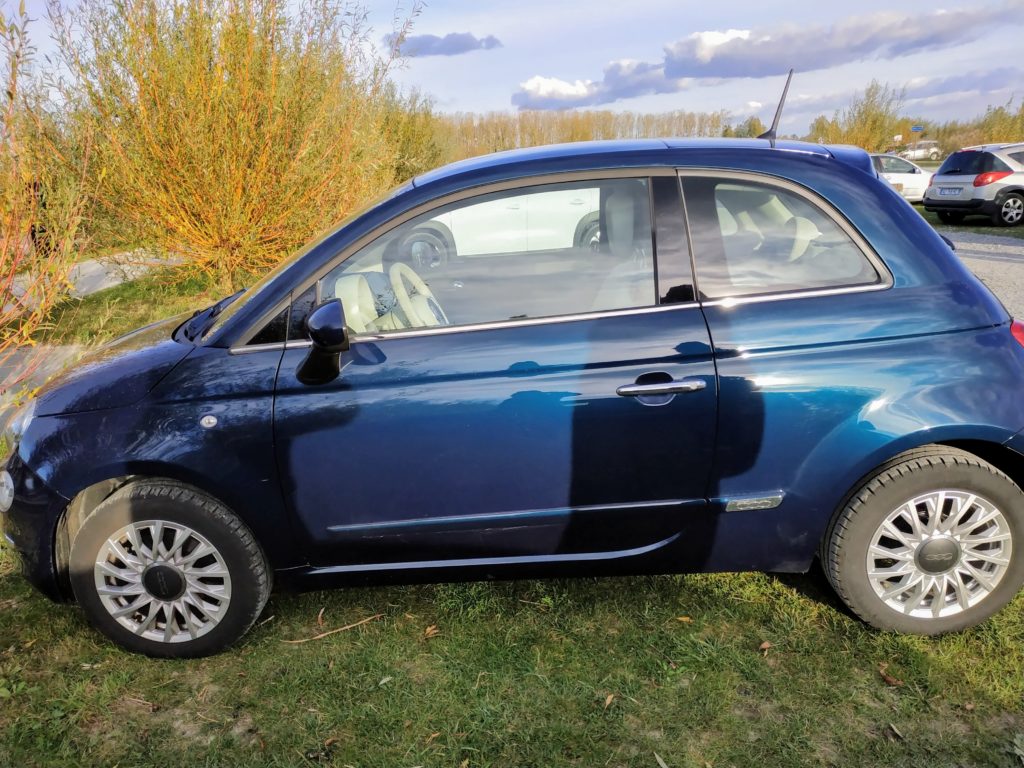
    We get our money and return to the car rental agency.  When we arrive back at the agency, there is now a line.  We wait and wait and wait. By the time they finally get around to helping us and giving us the keys to our car, it is almost 10:00 a.m.!  Our car, a Fiat 500, is positioned at the exit to the garage, so we quickly look over it and then get in and drive away.

    Blue Fiat 500 rented in Normandy.
    Our rental car while in Normandy, France.

    Driving to Mont Saint-Michel

    We are meeting a friend of Angela’s in Mont Saint-Michel, and we still have a 2-hour drive to get there.  Since the car rental process took longer than expected, we are running a little behind schedule.  This is a common occurrence when traveling.  Often timetables, trains, planes, and so on run behind schedule, and you must be flexible enough to adapt your itinerary accordingly.

    So Angela, with the help of Google, navigates us out of the city and onto the freeway.  We talk about the road signs that are different than our own back home, but mostly this could have been any freeway in rural America.  Fields and farmhouses dot the landscape. It is not so different from many highways in the U.S.

    We arrive at the parking lot for Mont Saint-Michel and quickly locate a parking spot.  Angela gets a text from her friend, who has also just arrived. We follow the signs from the parking lot to the shuttle area. However, since there is a long line for the shuttle, we decide we’ll walk to the island. 

    It is cold today. The low is around 32 degrees Fahrenheit, and the high is in the low 40’s, but with the wind chill, it feels much colder. However, we’re committed and figure it will give us excellent opportunities for photos along the way. It turns out that it’s about a 40-minute walk, thus, the reason for the shuttle line.

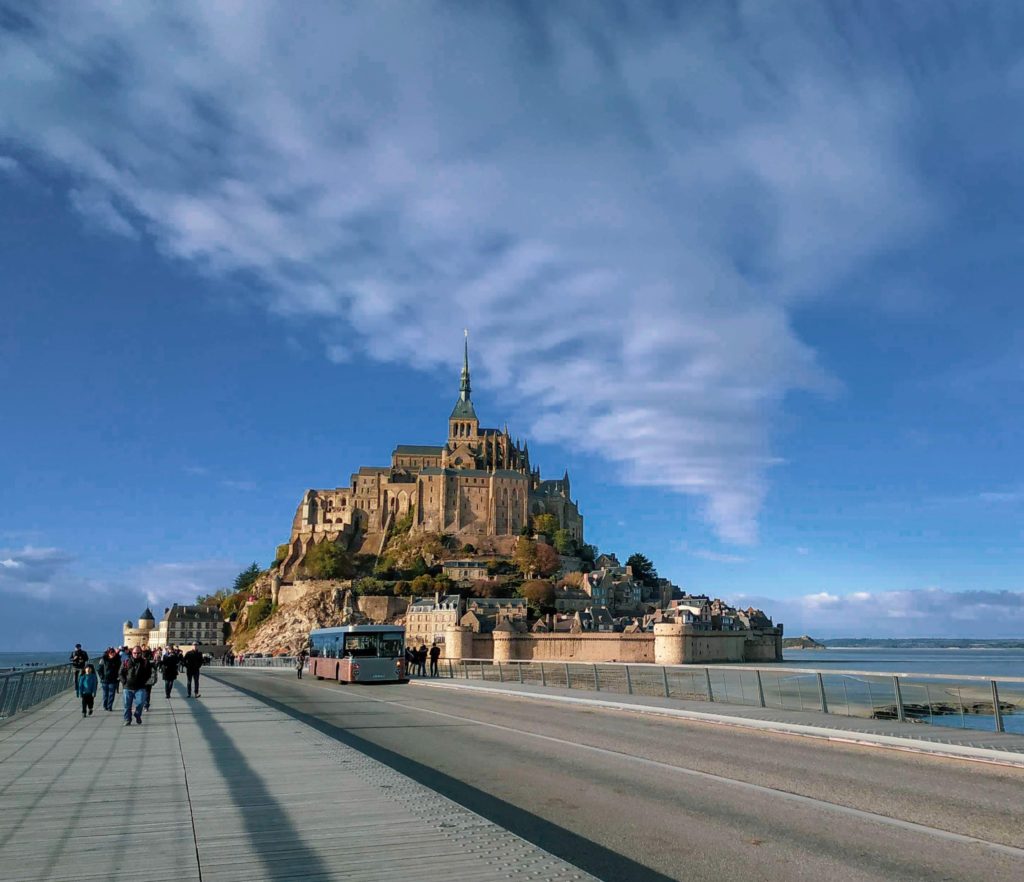
    Mont St-Michel in Normandy region of France.
    The view of Mont Saint-Michel as we walk up the causeway.


    We meet with Angela’s friend and have a wonderful time exploring the city of Mont Saint-Michel. I plan to write a post all about our visit.  It is such a unique destination, and I recommend you take a day to visit it if you’re ever in the area.

    As we leave the walled city area, we walk through an archway, and as we exit the arch, there is a man with his two kids who are throwing something – food, I assume.  Shortly after passing them, Angela says, “I think a bird just pooped on me,” but I say, “well, the kids were throwing stuff, so that was probably it.”

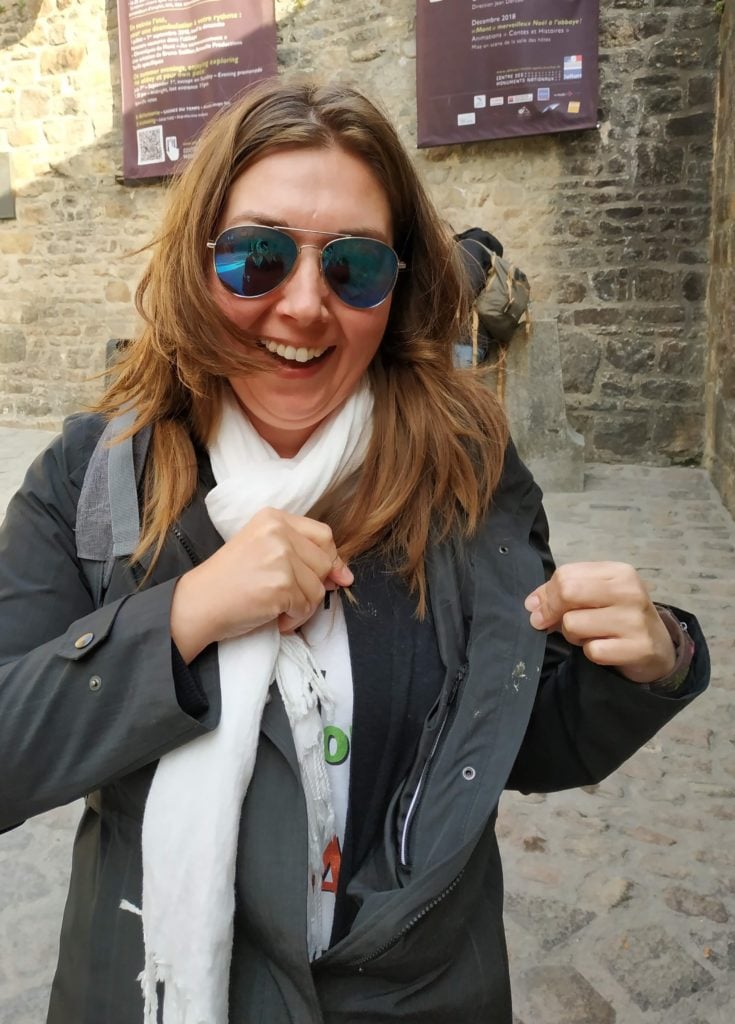
    She leaves to use the restroom before our two-hour drive back to the hotel. She returns and shows me that she did indeed get pooped on by a bird.  It is on the front of her jacket. Talk about misadventures! Yuck!

    woman with scarf and coat
    Angela shows me the evidence.

    The Parking Lot Discovery

    We return to our car and prepare to leave. I put the car in reverse, nothing happens. It doesn’t move. So I figure that I must not have the stick shift over in the correct position. Some cars can be a little finicky, no big deal. So I try to back up again. Nope. Nothing. I try everything I can think of and still NO REVERSE.  So then Angela and I start Googling what to do. We discover that this is a common issue with the Fiat 500.  

    Now to all of you out there who think I must not know how to drive a stick shift, I assure you, that is not the case.  I have driven and owned manual transmission cars off and on since receiving my driver’s license (and even before that). No, this car’s reverse was just not working.

    There were a few suggestions from people online for ways to possibly get reverse to work, like turn the car ignition off, put it in first, then turn on and try putting it in reverse.  I tried all of these suggestions and still nothing!

    So we realize, there’s only one thing to do–push the car backward ourselves!  So Angela, being the good sport she is, pushes the car back.  Thankfully it’s a small car. We both feel entirely ridiculous and are laughing so hard as she pushes the car backward.

    Angela is our personal reverse valet! Her superhero name is The Human Reverse Machine (coming to a parking lot near you)!

    Accepting the Situation and Moving Forward

    We laugh and discuss the absurdity of our situation as we begin our drive back.  We both agree that it seems hard to believe the car rental company would not have known about this issue. It was rather convenient that the car was already facing forward when we got into it. Otherwise, we would have discovered the problem at the rental agency, rather than almost 100 miles away!

    We talk about driving back to the rental company that night, but due to our late departure from Mont Saint-Michel, it would be a challenge to arrive before the rental agency closed. Plus, it was a hassle getting the car this morning, and we had a full day of driving to D-Day sites the following morning. So we agree to accept it as is, rather than miss out on our intended itinerary.

    There’s No Going Back

    Thus our misadventure in Normandy began.  The next morning, we get in the car to leave, and Angela has to push the car out so we can be on our way. Nothing quite like something not working to make you appreciate those simple things you take for granted! Just imagine for a moment if your car didn’t have a working reverse.  

    You’re at the grocery store, you go to the front of your car to push it backward, and someone walks by and asks: “Watchya doin’?”  You reply: “Oh, you know, just backing the car out.”

    Perhaps you’re leaving for work in the morning, and you holler “Hey honey, I’m leaving for work, can you help me back the car up?”

    You decide to stop in at the local Sonic drive-in, and the server brings your food out to your car, you thank them and then ask, “Could you help me back out now?”

    Okay, you get the point, reverse is a requirement in a car!  It’s also something I never thought I’d be missing, but then, travel is unpredictable!

    Omaha Beach Memorial Site
    Omaha Beach Memorial Site

    Angela: The Human Reverse Machine in Action

    We arrive at our first D-Day site, The Airborne Museum at Sainte-Mère-Église, and discover there are no pull-through parking spots.  Just our luck! Unfortunately, this is a recurring theme throughout our entire day! Park to see D-Day sites, Angela pushes us out, and we continue to the next location. 

    When we arrive at Pointe du Hoc, I turn into a disabled parking lot by mistake. It is a dead-end lot too. So now I need to–yep, you guessed it–back out! I do my best to swing as wide as possible, but it is too tight with parked cars on either side for me to complete a full U-turn.  So I am directly behind another vehicle that also happens to want to leave at this exact moment!

    The passenger is outside the vehicle attempting to help her driver back up. She looks at Angela, who is getting out of our car and motions as if to say, “no-no, move, we’re trying to leave.”  Angela, of course, nods her head, saying, “yes, I understand, so are we.” 

    I am inside the car, observing this hilarious game of charades.  Angela then pushes our car backward and gets in.  We drive off laughing hysterically at the absurdity of the situation and the look on that poor woman’s face! What she must have thought of us.

    At Omaha Beach, when we begin to leave, people are standing around watching as these two crazy girls push their car out of the parking spot. One of them even stopped to ask Angela if she needed help, “no, been doing this all day long!”  It is tough not to laugh as the situation is so odd and funny. 

    And so this is how our misadventures in Normandy went.  We were so happy to return the car that night. Note to self: never rent (or buy) a Fiat 500 again. Enjoy this video clip of the human reverse machine in action.

    Embrace Your Misadventure. Choose Laughter.

    Summary of our misadventures in Normandy: We get our car late, Angela gets pooped on by a bird, and we discover (after driving almost 100 miles away) that we have no reverse – not to mention it’s freezing outside!  Did this keep us from having an incredible visit to Normandy?  Not one bit.  I think it is even more memorable because of our misadventures!

    Had I let the car situation ruin our trip, I would have missed out on so much.  The D-Day sites in Normandy are full of world-changing history. They hold stories of honor and sacrifice, peace, and unity. I was humbled as an American to come and see first-hand these areas I had only read about in history books. I left inspired and grateful to all who sacrificed so I could have freedom, and just think, I could have let a little thing like working reverse stop me.  

    Things happen when you’re traveling, and you need to roll with the punches and have a good attitude.  We took what could have been a very frustrating situation and chose to see the endless humor in it, and we didn’t waste our only day to see D-Day sites because of it. We played the hand we were dealt with and created some unforgettable memories in the process.

    Thankfully, Angela was a good sport and isn’t a wimp. She backed our car up over and over again like a boss!

    So misadventures or not, have fun making memories!

    Choose Laughter!